Merthyr’s Ironmasters: Samuel Homfray

Following on from the previous article, here is a bit more about Samuel Homfray in the first instalment of another new (hopefully) regular feature.

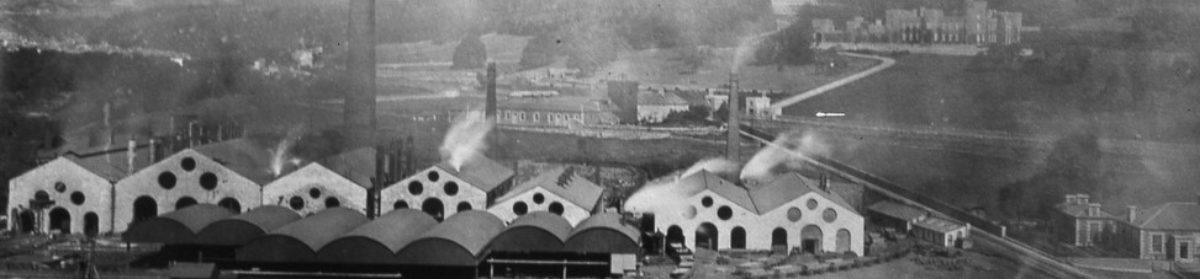
Samuel Homfray with Penydarren Ironworks in the background

Samuel Homfray was born in 1762, the fifth son of Francis Homfray and his second wife Jane. Francis Homfray (1725-1798) had been born into a successful industrial family, his father (also called Francis) had made his fortune in the iron industry at Coalbrookdale in Staffordshire. In 1749 Francis Homfray and Richard Jordan, also of Staffordshire, leased a water corn grist mill called Velin Griffith and a forge in the parish of Whitchurch, and in September 1782, he approached Anthony Bacon, owner of Cyfarthfa Ironworks, and leased the cannon foundry at the works to manufacture weapons and ammunitions.

In 1784 Homfray complained that he was not receiving sufficient metal and tapped Bacon’s furnace at Cyfarthfa. Francis Homfray worked the forge and mill until March 1786. However, after a disagreement with Bacon over the supply of iron, he gave up the lease of the Cyfarthfa property.

Francis encouraged two of his sons – Samuel and his older brother Jeremiah to lease land at Penydarren, next to the Morlais Brook and build an ironworks. After years of fierce competition with the Dowlais and Cyfarthfa Ironworks, they began to prosper. Samuel took over as proprietor of the Penydarren works, while Jeremiah moved to Ebbw Vale.

Penydarren Ironworks

Samuel was one of the chief promoters of the Glamorganshire Canal, which opened in 1795 and cost £103,000, of which he subscribed £40,000 and which enabled the transporting of heavy manufactured iron to Cardiff docks. In 1804 Samuel won a 1000 guineas wager with Richard Crawshay as to which of them could first build a steam locomotive for use in their works. Homfray employed Richard Trevithick for this purpose and his locomotive won the bet, hauling five wagons, carrying ten tons of iron and seventy men, at a speed of five miles an hour.

In 1800, Samuel married Jane Morgan, daughter of Sir Charles Gould Morgan, 1st Baronet of Tredegar House, and thus obtained a favorable lease of mineral land at Tredegar, where he established the Tredegar Ironworks.

In 1813 he left the Penydarren Iron Company to concentrate his resources on developing the Tredegar Ironworks. Handicapped at Penydarren by a shortage of coal on the property, he faced no such problems when he built his new works. By 1823 Tredegar had five furnaces in blast, producing over 16,000 tons of iron each year.

Homfray’s connection with Penydarren was re-established in 1817 when his daughter Amelia married one of the works’ new owners, William Thompson.

In 1813 he was appointed High Sheriff of Monmouthshire and, having unsuccessfully standing as a candidate for a seat in Parliament for Brecknock in 1806, he was elected as Member of Parliament for the Borough of Stafford in 1818.

He relinquished his seat two years later, and he died on 22 May 1822 in London and was buried at Bassaleg.

The Aeolus Waterwheel – Merthyr’s Great Wonder

When Rev Sir Thomas Cullum (8th Baronet Cullum) visited Merthyr Tydfil in 1811, one of the sights he was most taken with was the mighty Aeolus Waterwheel at the Cyfarthfa Ironworks, and he even called it ‘the wonder of the place’. Some contemporary accounts actually refer to it as ‘the Eighth Wonder of the World‘. I wonder how many people in Merthyr have actually heard of it nowadays?

‘Cyfarthfa Works and Waterwheel’ by William Pamplin. The Aeolus Waterwheel can clearly be seen at the centre of the illustration. Photo courtesy of Cyfarthfa Castle Museum & Art Gallery

When Richard Crawshay became sole owner of the Cyfarthfa Works in 1791, he began making plans to extend the works and come up with innovative ways to increase iron production. In 1792, he made the engineer Watkin George a partner in the firm, and the latter began making significant progress in maximising the potential of the works.

His major contribution was the construction between 1793 and 1797 of a huge overshot waterwheel to provide the air for the four blast furnaces.

According to volume 5 of Rees’s Manufacturing Industry (1819-20):

“…..the water-wheel is 50 feet in diameter and six feet wide: it is chiefly made of cast iron, and has 156 buckets. The axle is a hollow tube, and is strengthened by twenty-four pieces of timber applied around it. On each end of the axis is a cog-wheel of twenty-three feet diameter, which turns a pinion. On the axis of these are two cranks, and fly-wheel twenty-two feet diameter, and twelve tons weight; each of the cranks gives motion to a lever, like that of a large steam-engine, and works the piston of a blowing cylinder or air-pump 52½ inches in diameter, and five feet stroke, which blows air into the furnace, both when the piston goes up and down. The work on the other side being the same, it actuates in the whole four of these double cylinders; the wheel makes about two and a half turns per minute, and each cylinder makes ten strokes.”

At the time, it was the largest waterwheel of its kind in the world and was named Aeolus after a character in Greek Mythology. Aeolus, as mentioned in the Odyssey and the Aeneid,  was the keeper of the winds and king of the island of Aeolia, one of the abrupt rocky Lipara islands close to Sicily. Later classical writers regarded him as a god.

The wheel was operated by water fed from streams across the river and transported by a massive iron and wood double aqueduct mounted on stone piers between 60 and 70 feet high. This was the famous Gwynne Aqueduct. Sir Charles Manby (later Secretary of the Institution of Civil Engineers) visited Merthyr and commented that the aqueduct:

“…..maintained an apparent lightness of the whole that contrasted with the massy [sic] boundary of the river, has not only a singular, but also a very interesting and pleasing appearance.”

Gwynne Aqueduct from a painting by Penry Williams

This is the same aqueduct that was mentioned in the previous post about the Pont-y-cafnau (http://www.merthyr-history.com/?p=678)

The Aeolus Waterwheel continued to power the blast furnaces until the 1820’s when it was replaced by a steam powered engine, and was subsequently demolished.

The Puddler

Many thanks to prominent local historian Joe England for the following article:-

The Puddler

Who or what was the Puddler? He (always male) was a worker who in his day was central to the making of iron and a person of some importance in Merthyr and the other iron towns.

One writer reminisces: ‘One puddler I knew at Dowlais filled the chapel with his presence . . . a Cyfarthfa man stood in the Star parlour with his coat tails to the fire in the presence of Admiral Lord Nelson … another of the species used regularly every week to ride down to the seat of an influential county gentleman whose daughter he came very near marrying . . . it was by the merest accident in the world they found out, just in the nick of time, that the son-in-law elect was only a puddler.’

Puddling was a method of turning pig iron into much more malleable wrought iron. It was invented by Henry Cort but perfected by Richard Crawshay at Cyfarthfa in the 1790s. The puddler stirred the molten metal in a puddling furnace with an iron bar, working in conditions of tremendous heat and agitating the metal as it boiled and then gathering it at the end of a rod while the molten metal thickened.

This was arduous, strength-sapping work, but the puddler’s special skill was his judgement of when to bring out the congealing metal, a decision crucial to the quality of the finished product. He therefore held a key position in the manufacture of iron. They were usually young men in their twenties and thirties. By their forties they were physically burnt out.

In the early years of industrialisation their key position in the manufacture of iron made them workplace militants, although later they accepted the wage cuts imposed by the ironmasters. The reasons for that I have explained in my forthcoming book The Crucible of Modern Wales: Merthyr Tydfil 1760-1912. But the masters, nonetheless, were determined to find ways of getting rid of them. Puddlers were expensive and too powerful.

The opportunity came with the Bessemer process of making steel which would replace wrought iron in making rails. When the first steel rail was rolled at Dowlais in 1858 it broke while still hot ‘to the undisguised rejoicing of the assembled puddlers.’  But the writing was on the wall. Steel rails began to be successfully manufactured and by 1876 the iron rail was seen as a thing of the past. So was puddling. In 1885 the number of puddling forges at Dowlais was 19. There once had been 255.

Joe England