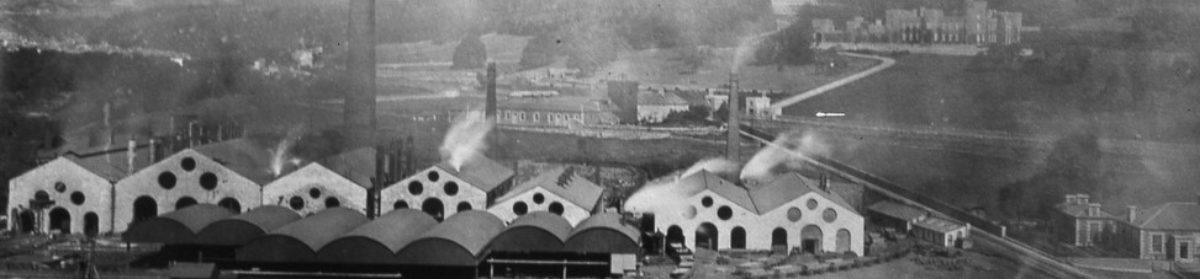
We continue our serialisation of the memories of Merthyr in the 1830’s by an un-named correspondent to the Merthyr Express, courtesy of Michael Donovan.
It was at the Dowlais Works the Bessemer process for the conversion of pig into malleable iron was tried, with the result, as told me by Sir Henry himself, “I was knocked down on my back, and for two years could not get up again”. The Bessemer process, as everyone knows, is to blow air through the molten metal and so burn the carbon out, but many years before that blowing steam through molten iron in the puddling was tried there. The furnace with the apparatus was seen in the upper forge – that is, between the Dowlais office and the fitting shop.

Sir John himself conceived the idea of running the iron direct from the blast furnace into the refinery, so as to avoid the remelting usually followed. It was used for a while at the Ivor Works at the furnace next to the engine-house on the Pant side, but the refinery process itself was soon superseded to a great extent.

It was at Dowlais the very first steam whistle was made, and although the tale has been previously told, the use of the whistle for railway purposes is so extensive that it will be again told in the words of the inventor himself as told to me personally by him.
For the better understanding of it allow my saying that a column of water about 27 inches high gives a pressure of a pound for every square inch of its area, and for the feeding of his boilers James Watt had designed an automatic arrangement, based upon the weight above mentioned. Even up to 10lbs, a standpipe 270m inches high would suffice, but when it comes to 50lbs the pipe would be excessive, and as some little looking after is needed, it would be rather inconvenient, so that the regulation of the feed became dependent on the care of the stoker, he being guided by the use of gauge cocks. Stokers are human, and therefore remiss; the feed goes too low, overheating of the plates follows. This reduces their strength, perhaps, too, the steam pressure increases, and disaster follows.

Something of this kind happened, and Sir John asked Adrian Stephens if it were possible to arrange something to indicate that the feed was getting low. The upshot of the conversation was that one of the pipes from the organ in the house was sent for Stephens’ consideration. In Watts’ arrangement a float was used for governing the feed, and Stephens very naturally followed the idea. The idea of an inside valve was evolved, and by the passing of steam through the organ pipe sound was produced. It then occurred to Stephens that if the emission aperture were made all around the pipe it would be better, and he made it so.
It did not bring him profit, nor was he ever honoured as he should have been. Some Manchester workmen were then down with tools for the fitting-shop, and they either communicated or took the idea back there, and not as a regulator for feed, but as a means of calling attention the whistle became used in locomotion.
To be continued at a later date…..
 George Thomas was born in London on 26 May 1809, the eldest son of George Clark (1777–1848), chaplain to the royal military asylum, Chelsea, and Clara, only surviving daughter of Thomas Dicey of Claybrook Hall, Leicestershire, and he was educated at the Charterhouse. Adopting engineering as a profession, he was entrusted by Brunel with the construction of two divisions of the Great Western Railway; the Paddington terminus and the bridges at Basildon and Moulsford being his principal works While thus engaged he compiled ‘A Guide-book to the Great Western Railway, containing some Account of the Construction of the Line, with Notices of the Objects best worth Attention upon its Course’ (London, 1839). This, the first guide to the line, was published officially without his name, and dedicated to Brunel. A more detailed account, which he subsequently wrote, of the geology and archæology of the country traversed by the railway, was published, with numerous illustrations, as ‘The History and Description of the Great Western Railway’ (London, 1846); but the only name attached to it was that of the artist, John C. Bourne.


