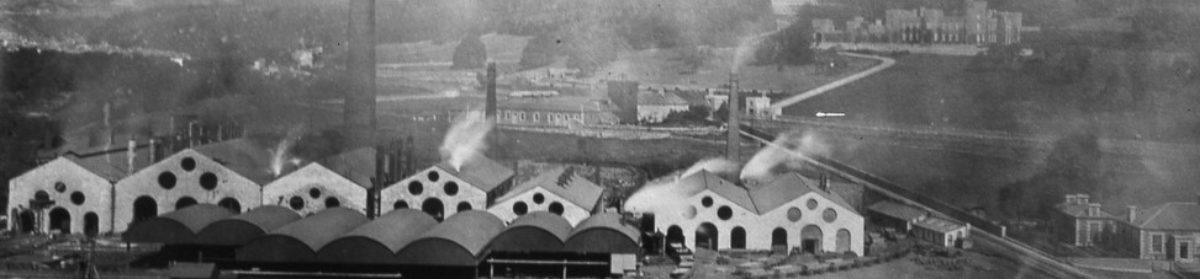
A visit to Cyfarthfa Iron works in 1850

Transcribed by Chris Parry

A visit to Cyfarthfa Iron works in 1850

By 1850, the scale and reputation of the iron metropolis of Merthyr Tydfil was know across the UK and even further. Journalists were coming to the town to write about the place, the people, the environment, the industry, every aspect of the most populated part of Wales at that time. The Morning Chronicle, between March and June 1850, published ten long articles exploring every aspect of life at Merthyr Tydfil, creating the most detailed exploration of the town published in the 19th century. The following is an extract from one of those articles that details a tour of Cyfarthfa Ironworks in 1850.

The next iron works I visited were those of Cyfarthfa – the model works of South Wales… There are at Cyfarthfa and Ynysfach (works adjacent to each other) 11 furnaces in blast, and four at Hirwaun – all being the sole property of Mr. William Crawshay. At these works there are employed under and above ground, 5,000 hands, of whom 190 are women. By the returns furnished me, I find the amount of wages paid at Cyfarthfa and Hirwaun alone is 16,000 a month (of four weeks). The make of pig iron is 72,000 tons per annum. The quantity of the bars, rails, and tin plates is 53,000 tons a year. There is used of Welsh iron, and hematite ores for the production of the above, 166,800 tons a year. The daily consumption of coal is 850 tons. As many as 400 horses are here employed. These extensive works are chiefly carried on by waterpower, the supply being procured from the river Taff at a considerable distance up the valley, but steam is used when in summer the water fails. The machinery is very large and ponderous. Those of the water wheels are 36 feet in diameter, and the fly wheels, which are 60 feet in circumference and of prodigious weight, make ordinarily 70 revolutions a minute. About three months ago the periphery of one of these wheels flew into pieces, the fragments demolishing the roof of the mill in which the accident occurred, and descending at a distance through the roof of another mill, crushing into pieces large portions of beautiful and costly machinery then in motion, but without further casualty to the numerous workmen than a fracture of the thighs of one of them. One of the steam engines is of 260 horsepower; it has six boilers, and is of nine feet stroke.

The above particulars will convey some idea of the magnitude of these works. I was accompanied over them by Mr. Robert Crawshay, whose familiarity with the philosophy of the various processes of smelting the iron is only equalled by his practical familiarity with its manufacture, and to who I am much indebted for the attention he paid me, and for the lucid and intelligible manner in which he explained everything which I did not at first clearly understand. These works are incomparably the best constructed, the most spacious, well-ventilated, comfortable, convenient, and methodical of all the works, not only in and around Merthyr, but throughout South Wales. Everything has been done on the most liberal scale, and with an evident aim at perfection and completeness. The extensive mills, with their massive walls pierced with large circular openings for light and lofty roofs, have an air of architectural grandeur that is quite imposing. The space within the roof of one mill is 82 feet. There is here so much room that the work is carried on without any appearance on hurry and bustle which I have remarked upon as belonging to other works. I was informed by Mr. David James, a disinterested party, that men who have once enjoyed the comfort, shelter, and convenience of these works would never leave them for others if could possibly avoid it. I have said shelter, because here the men and women employed at the furnace tops and at the hearths have roofs overhead, whereas at Dowlais I have complained that they are wholly unprotected, and such is the case elsewhere. The comfort of such a provision in the windy and rainy climate of these mountains can only be adequately valued by the workpeople who have tried both situations, the exposed and the sheltered. I think it the duty of those ironmasters who have neglected providing such a shelter, to lose no time in following the example of Cyfarthfa and the other works where such conveniences have been adopted. It will be an act of great kindness to the miserables who have now to endure all weathers, and the most violent alterations of heat and cold.

 Robert Thompson Crawshay. Courtesy of Cyfarthfa Museum & Art Gallery

At Cyfarthfa I saw men belonging to the furnaces, squeezers, rollers, and saws at their dinner. They had good beef or mutton, and potatoes; the boys had broth with a small piece of meat: they seemed pleased to show the contents of their tins, observing that the work was so hard and the heat so great that they could not stand it without animal food. This, it must be borne in mind, was in the mills; at Dowlais and in the other works, as I have stated, the workmen also get meat. They were rail-making in two of the mills I inspected. I saw three rails made by the direction of Mr. Crawshay. Timed by a watch, they were made in three minutes – that is, from the presentation of the white hot “bloom” to the rollers to its completion in them. The ends were cut off, filed, and the bars straightened in an additional minute and a quarter – so that altogether the making and finishing of three rails ready for laying down on the permanent way occupied just four minutes and a quarter. It was here I first saw that ingenious but simple invention, “the splitting mill” at work. It was making what is termed “nail rods”, which it did by lengthening and dividing a short iron bar into about a dozen rods, eight feet long by a quarter of an inch wide. This most important and useful invention was made in Sweden, and the consequences were most disastrous to the manufacturers of iron in this country, who, having to divide the rods by a long, tedious, and laborious process, could not compete with the new invention. The means by which this difficulty was overcome are highly interesting…….

The return made to me of the rate of wages paid at these works is as follows:-

Colliers, 15s. a week

Miners, 12s, 6d, a week

Founders, 22s. a week

Fillers, 21s. a week

Labourers, 10s. 6d. a week

Puddlers, 18s. a week

Rollers, 30s. a week; rail rollers, 31 to 41 a week.

Roughers, 18s. a week

Ballers, 24s. a week; girls, 5s. a week

The portion of boys employed under sixteen years of age is about one-sixth of the whole: at Dowlais these were returned as about one-fourth. At one of the mills in these works boys only are employed; it is a training school for them, preparing them for the heavier mill and forge work. I saw them making iron rods for rails, and light work; they seemed to work with great spirit and alacrity…[1]

[1] Morning Chronicle, March 21, 1850, London

Grade II* Listed buildings

Fifty years ago today a number of Merthyr’s buildings were given a Grade II* listing by CADW. Below is a list of all the Grade II* listed buildings in Merthyr.

Name

Location
Grid Ref.
Geo-coordinates
Date Listed

Notes

Cefn Railway Viaduct

Cyfarthfa
SO0304907597
51°45′31″N 3°24′22″W
7 Nov 1951 Viaduct A dual-listed (see below) structure built in 1866 to carry the Brecon and Merthyr Railway over the Taf Fawr. It was designed by Henry Conybeare and Alexander Sutherland at a cost of £25,000.  The fifteen arches of the 36.6 m (120 ft) high viaduct follow a gentle curve of 235 m (771 ft).
Cefn Railway Viaduct Vaynor
SO0304007795
51°45′38″N 3°24′23″W

7 Nov 1951

Viaduct A dual-listed (see above) structure built in 1866 to carry the Brecon and Merthyr Railway over the Taf Fawr. The viaduct has tall, slender limestone piers, a material originally intended to be used throughout, however, the arches were completed using a contrasting red brick due to a trade union strike by stonemasons.

Pont-y-Cafnau

Park
SO0376507138
51°45′17″N 3°23′44″W

22 August 1975

Bridge An ironwork bridge spanning the River Taff constructed in 1793. The name, meaning “bridge of troughs”, comes from its unusual three tier design of a tramroad between two watercourses, one beneath the bridge deck and the other on an upper wooden structure which is no longer present. Pont-y-Cafnau is also designated as a scheduled monument.

Town Hall

Town
SO0489306371
51°44′51″N 3°22′40″W

22 August 1975

Town hall A Large municipal building designed by Edwin Arthur Johnson in the early Renaissance style and built 1896–98 by Harry Gibbon. Built of red Cattybrook brick with orange terracotta dressings on a base of Pennant Sandstone. Following restoration work it became the Red House, an arts centre, in 2014.

Pontsarn Railway Viaduct

Pant
SO0454309921
51°46′47″N 3°23′06″W

22 August 1975

Viaduct A dual-listed (see below) structure built in 1866 to carry the Brecon and Merthyr Railway over the Taf Fechan. It was designed by Henry Conybeare and Alexander Sutherland. The viaduct is 28 m (92 ft) high and 128 m (420 ft) long.

Pontsarn Railway Viaduct

Vaynor
SO0453409918
51°46′47″N 3°23′07″W

22 August 1975

Viaduct A dual-listed (see above) structure built in 1866 to carry the Brecon and Merthyr Railway over the Taf Fechan. It is constructed of limestone and has tall, slender piers with segmental arches. The Cadw description has seven arches, Newman has eight.

Former Guest Memorial Library

Dowlais
SO0699107880
51°45′43″N 3°20′57″W

22 August 1975

Library A two-storey cruciform building of 1855–1863 built as a memorial to John Josiah Guest of the Dowlais Ironworks. The Dowlais workmen intended for the library and reading room to be funded by subscription, but rising costs led to the building being completed by the company at a total cost of £7,000.

Dowlais Works Blast Engine House

Dowlais
SO0690907739
51°45′38″N 3°21′01″W

22 August 1975

Engine house A 54 m (177 ft) long and 15 m (49 ft) high red brick industrial building constructed in 1905–07 to house three blowing engines as part of the Dowlais Ironworks. The works went into decline in the 1930s and in the late 20th century the building was being used by a chocolate company.

Quakers Yard Railway Viaduct

Treharris
ST0885396473
51°39′35″N 3°19′09″W

1 April 1988

Viaduct A tall stone-built viaduct with six arches that spans both the River Taff and the Merthyr Tramroad. It was constructed 1840–41 by Isambard Kingdom Brunel as part of the Taff Vale Railway and widened by 1861.

Ynysfach Engine House

Cyfarthfa
SO0452406096
51°44′44″N 3°23′04″W

5 Nov 1995

Engine house Built in 1836 as part of the Ynysfach Ironworks, it originally housed an engine made at the Neath Abbey Ironworks. This four-storey building of blue Pennant Sandstone with white ashlar dressings fell into disuse when the Ynysfach works closed in 1874. In the 1980s It was restored and became a museum until closed by the Leisure Trust.

Greenfield Bridge, Penydarren Tramroad

Treharris
ST0902496544
51°39′37″N 3°19′00″W

20 February 2003

Bridge A single arch Pennant Sandstone structure built to replace an earlier wooden bridge that collapsed in 1815 when a train was passing over it. The semi-circular arch has span of 19.2 m (63 ft) at a height of 8.4 m (28 ft) above the river. It is part of the Merthyr Tramroad scheduled monument.

Victoria Bridge, Penydarren Tramroad

Treharris
ST0942396281
51°39′29″N 3°18′39″W

20 February 2003

Bridge A single high-arch bridge over the River Taff similar in design to the nearby Greenfield bridge. Built in 1815 to replace a wooden bridge of 1800–02 it was originally as part of the Merthyr Tramway but is now a footbridge. It is part of the Merthyr Tramroad scheduled monument.

NOTE
The two viaducts constructed as part of the Brecon and Merthyr Railway both straddle the borders of neighbouring historic communities so have separate designations for each of these locations.

Memories of Old Merthyr

We conclude our serialisation of the memories of Merthyr in the 1830’s by an un-named correspondent to the Merthyr Express, courtesy of Michael Donovan.

© William Menelaus (1818-1882); Hagarty, Parker; Cardiff University; http://www.artuk.org/artworks/william-menelaus-18181882-15929

To some it is probable that to say much of Dowlais and leave the name of Mr Wm. Menelaus not prominently mentioned is like enacting the play “Hamlet” and leave out Hamlet himself. To such it is fair to say my knowledge of the place is antecedent to meeting with that gentleman prior to his going there. That he did much to keep up the prestige of the place is truthfully admitted. That he did not accomplish all his desires is also a fact; his intention and actual conversion of some portion of the works to another branch of manufacture can be doubtless recalled by many. Let me bear my humble tribute to his memory. Wishing Dowlais well, I will now part with it, and hope its future will be prosperous.

Instead of returning to Merthyr by the road, let us take a pleasanter way, and, mounting some steps by the roadside at Gellifaelog, cross by the footpath over a field or two, and then take the lane (or maybe paved road) back, passing by Gwaunfarren across the limestone tramroad there (there was also a limekiln close by), and we are close to the Penydarren Park again.

Before making my congé, let me recall some things that are now gone, most probably gone forever. One is the ‘Merched y Wern’ from Neath; they were well known, Their vocation in life some 60 or 70 years ago was to go to Swansea Pottery, and, getting a large crate or basket, in reality of ware, return to Neath upon the next morning loaded with the ware, walk to Merthyr to dispose of it. They were necessarily hardy and masculine. During their walks shoes or boots, as well as stockings, were taken off, only to be put on when entering a populous place. They were generally reputed to be well able to protect themselves. Generally there were two, three or four together, and evil betide any who raised their wrath. There is a tale of a man having said something being induced to accompany them for awhile, when at a suitable place he was denuded of clothing and bound a la Mazeppa – not to a horse but to a tree. Cwm-ynys Minton, not far from the Gelly Tarw junction, is the locus in quo of the episode.

Another class that has passed away are the old butter carriers, who, with their cart and horse, took weekly journeys from various parts of Carmarthenshire. They travelled 36 or even 48 hours at a stretch. Occasionally two or three would be in company; at night, some were thus able to sleep in their carts.

Then again there were the sand girls who earned a livelihood by gathering the stones from the river, calcining them and by ‘pounding’ reduce them to sand for use for domestic purposes. There are some stones far more suitable than others for this purpose – those of the silicious kind being more in request. However clear of them the river might be occasionally, a heavy flood brought down another stock, and so it went on. I am not aware if any such an employment now exists, but formerly the river from Caepantywyll to the bottom of Caedraw was the hunting ground of the sand girls.

The River Taff below Jackson’s Bridge, possibly showing some sand girls collecting stones. Reproduced by permission of The National Library of Wales Creative Archive Licence

The produce of the works, too, has undergone a strange metamorphosis. Not only are there no iron bars now made for tin works, but split rods have ceased to be so, and, while formerly large cargoes of ‘cable iron’ went to the Grecian Archipelago and other places in the Mediterranean, in vain should I look in all of South Wales for a bar bent to the shape of the camel’s back for conveyance across the desert. Advisedly, I say thousands of tons have gone from Merthyr for such a mode of conveyance.

‘Cable’ iron was also made, but if made now cannot be made from similar materials to what it used to be. I do not know of any South Wales works making cold blast all mine iron, but, if there is such it certainly not contiguous to Merthyr, where it was at one time made. Do not, however, suppose I consider Merthyr drawing to the close of its career:

“For I doubt not through the ages an increasing purpose runs,
And the thoughts of men are widened by the process of the suns”

Here for the present do I close but if “The sunset of life gives me mystified life” and coming events cast their shadows before my brain, I may endeavour to say a few words respecting “What of the future?”

Merthyr Historian Sale

The Merthyr Tydfil & District Historical Society is pleased to announce a very special offer price for back issues of Merthyr Historians.

All books are as new and are offered at £2.00 each or 3 for £5.00.

Postage is £3.50 per book, or books can be picked up from depositaries in Merthyr (on arrangement).

If you would like to buy any of these volumes, please contact merthyr.history@gmail.com

The volumes on offer are:-

VOLUME 15 (2003)  ISBN 0 9544201 1 X Ed. T.F. Holley
1.  Dr. Joseph Gross by Glanmor Williams
2. Attraction and Dispersal by John Wilkins
3. Mrs. Mary Ann Edmunds by Mary Patricia Jones
4. Bacon v Homfray by Eric Alexander
5. Cheshunt College, Hertfordshire by Barrie Jones
6. Striking Features: Robert Thompson Crawshay’s Large-Scale Portraits by Jane Fletcher
7. Margaret Stewart Taylor. A Notable Woman of Merthyr Tydfil by Carolyn Jacob
8. Iron Working in the Cynon Valley by Douglas Williams
9. Owain Glyn Dwr – After Six Hundred Years by Glanmor Williams
10. Merthyr Amateur Theatricals, 1860’s by H. W. Southey
11. Shon Llywelyn of Cwm Capel by Lyndon Harris
12. Hoover Transport, 1948-98 by Gwyn Harris M.M.
13. David Jones (1760-1842), Merthyr Clockmaker, Revisited by W. Linnard, D. Roy Sears & Chris Roberts
14. The English Bible by J. W. Bowen
15. He Came, He Saw, He Conquered Merthyr Commerce – Thomas Nibloe’s Story by T. F. Holley
16. Colour Supplement – Merthyr Buildings

VOLUME 17 (2004) ISBN 0 9544201 3 6 Ed. T.F. Holley 
1.  & Pastimes in the 18th & 19th Century, Merthyr Tydfil by Geoffrey Evans
2. Celtic Connections: Early Quoiting in Merthyr Tydfil by Innes MacLeod
3. The Will of the Revd. William Price Lewis, 1839 by T. F. Holley
4. The Dic Penderyn Society and the Popular Memory of Richard Lewis by Viv Pugh
5. The Welsh Religious Revival, 1904-5 by Robert Pope
6. Reporting Revival by Neville Granville
7. A French View of Merthyr Tydfil and the Evan Roberts Revival by William Linnard
8. Songs of Praises: Hymns and Tunes of the Welsh Revival, 1904-5 by Noel Gibbard
9. Revival, Cwm Rhondda, 1905 by William Linnard
10. Diwygiad 1904-5. A Select Reading List by Brynley Roberts
11. Rosina Davies, 1863-1949. A Welsh Evangelist by Eira M Smith
12. Evan Roberts, the Welsh Revivalist by J. Ann Lewis
13. Evan Roberts at Heolgerrig, Merthyr, January 1905 – Transcribed
14. Sir Thomas Marchant Williams & the Revival – Transcribed
15. Potpourri, a Medley by The Editor
16. What Wales Needs – Religiously, 1907 by Evan Roberts
17. Joseph Williams, Printer. TYST A’R DYDD. 1903 by T. F. Holley
18. Dr. Thomas Rees (1825-1908), of Cefncoedycymer by John Mallon
19. Everest & Charles Bruce (1866-1939): The Welsh Connection by Huw Rees
20. The Lusitania Catastrophe and the Welsh Male Voice Choir by Carl Llewellyn
21. Merthyr Amateur Theatricals, 1860’s. Part Two by H. W. Southey
22. Books, Old and New. Short Reviews by The Editor
23. Night Mrs. Evans by Ken J. Mumford
24. Some Early History of Park Baptist Church, The Walk, Merthyr – Transcribed
25. Letter re: Wool Factory, Merthyr Tydfil

VOLUME 22 (2011) ISBN 0 9544201 8  7  Ed. T.F. Holley
1. A Visit to Merthyr Tydfil in 1697 by Brynley F. Roberts
2. A Pedestrian Tour Through Scotland in 1801: New Lanark before Robert Owen by Innes Macleod
3. Note for Merthyr Historian by K. H. Edwards
4. Charles Richardson White, Merthyr Vale by T. F. Holley
5. Isaac John Williams, Curator by Scott Reid
6. The Merthyr Historian. Some Statistics by J. D. Holley
7. Thomas Evan Nicholas, 1879-1971 by Ivor Thomas Rees
8. Eira Margaret Smith: A Personal Tribute by Huw Williams
9. Saint Tydfil’s Hospital 1957. A House Physicians Recollections by Brian Loosmore
10. John Devonald, 1863-1936. Aberfan Musician and Remembrancer of Musicians by T. F. Holley
11. The Remarkable Berry Brothers by Joe England
12. Albert de Ritzen: Merthyr Tydfil’s Stipendiary Magistrate 1872-1876 by Huw Williams
13. A Scrap of Autobiography by Charles Wilkins, Annotated by His Great Grandson by John V. Wilkins, OBE
14. Industrial History of Colliers Row Site and Environs by Royston Holder (the late)
15. The Life of Maria Carini by Lisa Marie Powell
16. Lecture by J. C. Fowler, Esq., Stipendiary Magistrate, 1872 ‘Civilisation in South Wales – Transcribed
17. Gwyn Griffiths -‘The Author of our Anthem. Poems by Evan James’ – Book Review by Brian Davies
18. Enid Guest – ‘Daughter of an Ironmaster’ by Mary Owen – Book Review by Ceinwen Statter
19. Caepanttywyll – A Lost Community by Christopher Parry
20. James Colquhoun Campbell (in four parts) – T. F. Holley
(A) The Social Condition of Merthyr Tydfil, 1849
(B) The Venerable Archdeacon Campbell, 1859, Biography
(C) St. David’s Church, Merthyr Tydfil, Visited, 1860
(D) J. C. Campbell and the Census Record, Research 
by Mrs. C. Jacob
21. Interesting Book Plate

VOLUME 23 (2012) ISBN 0 9544201 9 5  Ed. T.F. Holley
1. Vince Harris, 1904-1987 by Margaret Lloyd
2. All Change for Plymouth: A Year in the Life of a Mining Engineer by Clive Thomas
3. Who Was The Real Lydia Fell? by Christine Trevett
4. Sewage Pollution of the Taff and the Merthyr Tydfil Local Board (1868-1871) by Leslie Rosenthal
5. Redmond Coleman, the Iron Man from Iron Lane by Carolyn Jacob
6. The Assimilation and Acculturation of the Descendants of Early 20th Century Spanish Industrial Immigrants to Merthyr by Stephen Murray
7. David Williams, High Constable, Merthyr Tydfil 1878-1880 by T. F. Holley
8. John Collins, V.C. by Malcolm Kenneth Payne
9. Marvellous Merthyr Boy – Transcribed
10. A Remarkable and Most Respected Enterprise, J. Howfield & Son, Merthyr Tydfil, 1872-2001 by Mary Owen
11. The Uncrowned Iron King (The First William Crawshay) by J. D. Evans
12. Watkin George 1759-1822, The Mechanical Genius of Cyfarthfa, The Pride of Pontypool by Wilf Owen
13. Opencast History (Illustrated) by Royston Holder
14. The Laundry Trade by T. F. Holley
15. Grand Concert at the Oddfellows Hall, Dowlais – Transcribed
16. Guidelines for Contributors – By courtesy of the Glamorgan History Society

VOLUME 24 (2012) Ed. T.F. Holley
1. Elphin, Literary Magistrate: Magisterial Commentator by Brynley Roberts
2. Picturing ‘The Member For Humanity’. J. M. Staniforth’s Cartoons of Keir Hardie, 1894-1914 by Chris Williams
3. William Morris, Yr Athraw and the ‘Blue Books’ by Huw Williams
4. Hugh Watkins by Carl Llewellyn and J. Ann Lewis
5. Gomer Thomas J.P. 1863-1935 by Wilf and Mary Owen
6. Oddfellows and Chartists by Lyndon Harris
7. John Roberts, Ieuan Gwyllt, Composer of Hymns by G. Parry Williams
8. Georgetown? How Was It? By Clive Thomas
9. Book Review: Bargoed and Gilfach – A Local History
10. A History of Ynysgau Chapel by Steven Brewer
11. ‘Mr Merthyr’ S.O. Davies 1886-1972 by Rev. Ivor Thomas Rees
12. Historical Farms of Merthyr Tydfil by John Griffiths Reviewed by Keith Lewis-Jones
13. National Service, Doctor With The Gurkhas by Brian Loosmoore
14. A Year of Anniversaries: Reflections on Local History 1972-2012 by Huw Williams
15. The Family of Dr. Thomas Rees, Revisited by John Mallon
16. Merthyr District Coffee Tavern Movement, 1880 by T. F. Holley
17. Henry Richard (1812-1888) – Apostle of Peace and Patriot by Gwyn Griffiths
18. Owen Morgan – Miners’ Reporter by Brian Davies
19. The Tredegar Riots of 1911 – Anti Liberalism ‘The Turbulent Years of 1910-1914’ by Lisa Marie Powell
20. Adulum Chapel by Carl Llewellyn
21. Cyfarthfa’s Curnow Vosper Archive by Gwyn Griffiths
22. Whithorn Gas, 1870 by Innes Macleod
23. A Journey from Merthyr to Sydney, A Talented Portrait Painter by Graham John Wilcox
24. The Merthyr Bus Rallies by Glyn Bowen

VOLUME 25 (2013)  Ed. T.F. Holley
1. The Merthyr Tydfil 1835 Election Revisited, Lady Charlotte Guest’s Account by E (Ted) Rowlands
2. John Josiah Guest at Auction by Huw Williams
3. Conway and Sons Dairies Ltd. – Some Notes by G. Conway
4. John Petherick; Merthyr’s Man of Africa by John Fletcher
5. Travels in the Valleys. Book Review by Glyn Bowen
6. Plaques by John D. Holley
7. William Thomas Lewis 1837-1914 by A Family Member
8. Boom Towns by Brian Loosmore
9. The Taff Valley Tornado 1913 by Stephen Brewer
10. Plaques by John D. Holley
11. From Mule Train to Diesel Lorries. The Dowlais Iron Company Connects the Coast by Wilf Owen
12. Review CD. Some of the History of Merthyr Tudful and District via Its Place Names by John & Gwilym Griffiths by Keith Lewis-Jones
13. Caedraw Primary School, 1875-1912 by Clive Thomas
14. Charles Butt Stanton, 1873-1946 by Revd. Ivor Thomas Rees
15. The Merthyr and Dowlais Steam Laundry Limited, 1891 by T. F. Holley
16. Dynamism, Diligence, Energy and Wealth. Trade and Commerce in Merthyr Tydfil 1800-1914 by Mary Owen
17. YMCA. Merthyr Tydfil Lecture 1861 by J. C. Fowler – Transcribed
18. John Nixon and the Welsh Coal Trade to France by Brian Davies
19. Tydfil School, Merthyr Tydfil, 1859-1873 by Evan Williams – Transcribed
20. Gossiping in Merthyr Tydfil by Carolyn Jacob
21. Penywern to Pontsarn. The Story of the Morlais Tunnel. The Writer’s Early Impressions by A. V. Phillips
22. Short History of the Thomas-Merthyr Colliery Company. Merthyr Tydfil, 1906-1946 by Ronald Llewellyn Thomas – Transcribed
23. Morien and Echos of Iolo Morgannwg by T. F. Holley
24. Merthyr Tydfil’s Stipendiary Magistracy and Walter Meyrick North (1886-1900): A Case Study by Huw Williams

VOLUME 26 (2014) ISBN 978 0 9929810 0 6 Ed. T.F. Holley
1. Three Generations of a Dowlais Medical Family 1860-1964 by Stuart Cresswell
2. Viscount Tredegar, Balaclava Veteran, 1913 by T. F. Holley
3. What Makes a Country Great? Lecture by Stipendiary Magistrate – J. C. Fowler – 1858
4. Billy ‘The Doll’ Williams by Malcolm K. Payne
5. Evan James, Dr. William Price and Iolo Morganwg’s Utopia by Brian Davies
6. John A. Owen (1936-1998), Dowlais Historian: An Appreciation by Huw Williams
7. Welsh Women and Liberation from Home: Feminist or Activist? By Lisa Marie Powell
8. Gwilym Harry (1792-1844), Unitarian – Farmer – Poet by Lyndon Harris
9. ‘Aunt’ Emma’s Ronnie by Clive Thomas
10. Morgan Williams: Merthyr’s Forgotten Leader by Joe England
11. Matthew Wayne (1780-1853) by Wilf Owen
12. The Contribution of Hunting to the 1914-18 War, 1914 by T. F. Holley
13. The Difficulties of M.T.C.B.C.’s Financial Management and Administration, 1926-1937: Maladministration, Political Ideology or Economic Reality? By Barrie Jones
14. The Rail Accident at Merthyr Station, 1874 by Stephen Brewer
15. Courtland House, 1851 by Mary Owen
16. Formation of the South Wales and Monmouthshire Brass Bands Association, 1891 by T. F. Holley
17. Moses Jones (1819-1901) by Annette Barr
18. Dr Richard Samuel Ryce, M.D. M.Ch.: An Irish Doctor by T. F. Holley
19. Cwmtaf – A Drowning of the Valley and its Consequences by Gwyneth Evans
20. A Professor Gwyn A. Williams Symposium
a. Recollections of Professor Gwyn Williams, University of York, 1967-70 by Frances Finnegan
b. Memories of Gwyn at York by Brian Davies
c. Professor Gwyn Alf Williams. A Personal Remembrance by Viv Pugh
21. Merthyr Tydfil at War, 1914 by Stephen Brewer
22. Photo Feature – Archaeology by T. F. Holley

Land Ownership in Merthyr Tydfil – part 2

by Brian Jones

Throughout the Medieval period the number of local farms increased and these Manorial farms improved their productivity whilst the population waxed and waned. The antiquarian, David Merch, studied the 1558 “Morganiae Archaiographia” and identified 14 freehold farms. Manorial Rent Lists became important historical sources and John Griffiths used these records in his detailed work “Historical Farms of Merthyr Tudful” (2012) he identified 120 farms (see map below) twenty five of which were “Charter Land Farms” which were freehold in 1630 suggesting that the aristocracy divested a proportion of their freehold land in order to accrue capital or to curry favour with landed gentry. The freeholders of noble birth had been established for hundreds of year however these were not continuous blood lines. For example, the Earldom of Plymouth title has been established three times, firstly in 1675 by Charles II and by 1765 there had been another different family line as the original title holders did not have children or near relatives required in order to inherit.                                     

Five centuries after Gilbert de Clare claimed freehold ownership of all of the Merthyr land by force, a number of entrepreneurs came into the valley to begin the manufacture of iron. Business people such as Anthony Bacon, William Brownrigg, Isaac Wilkinson, John Guest, Richard Crawshay and the three Homfray brothers jostled to gain leases to build the ironworks: Dowlais (1759), Plymouth (1763), Cyfarthfa (1765) and Penydarren (1784). These works were financed by wealthy individuals and distant investors aware that resources were available to include coal, ironstone, limestone, clay, timber and particularly important, supplies of water.

The rich absentee freeholders owned tracts of local farmland and were anxious to lease their holdings in the knowledge they could increase their income by leasing land for the extraction of minerals to the newcomers rather than from their existing tenant farmer. Two of the largest freeholders were the Earl of Plymouth and Earl Talbot whose forebears had concentrated on rural economies but now they changed their attitude to manufacturing and this opened a new chapter on the ownership of land in their possession. There was a rapid decline in the number of farms and an attendant change from a rural to an urban economy; houses were required for the influx of people to man the ironworks, quarry the limestone and mine the iron ore and coal. People left the land for the minor village which now began to increase in size.

450 years after Gilbert de Clare,7th Earl of Gloucester took possession of the land, later known as Merthyr parish, it is remarkable that three dynasties owned the majority of the freehold of the parish. At the beginning there were no maps to record existing land holdings and therefore landscape features assumed particular importance and the River Taff served as a boundary. Much of the land to the west of the river was owned by Lord Talbot whilst that to the east of the river was owned by the Earl of Plymouth with a portion around the parish church owned by the successors of the Lewis family. The leases for all four ironworks are set out in an authoritative work completed by John Lloyd in his 1906 book “The Early History of the Old South Wales Ironworks 1760 -1840”. This work draws on the extensive collection of leases drawn up by a Brecon firm of solicitors, Messrs Walter and John Powell. The first Cyfarthfa lease of 7th October 1765 with Anthony Bacon and William Brownrigg was for 4000 acres of land below the junction of the Taff Fawr and Taff Fechan, southwards down the valley, to the centre line of Aberdare mountain. The ancestry of William Talbot can be traced back to a Norman family in France, then to Sir Gilbert Talbot (1276-1346) Lord Chamberlain to King Edward III who married into the Welsh line of Prince Rhys Mechyll. William Talbot was created Earl Talbot of Hensol in 1761 and his legacy had spanned centuries intertwining noble ancestry, legal expertise and political service. His estates were extensive and he had links to Llancaiach Fawr in Nelson and Dynevor (Dinefwr) in Carmarthenshire. The family name is still linked to the premier noble seat of the Earl of Shrewsbury where the present Earl is also titled as Baron Talbot of Hensol.

The Cyfarthfa lease of 29 August 1765 with William Talbot was also joined with Michael Richards of Cardiff. There is some uncertainty as to this latter freeholder although there appears to be a connection with the Llancaiach estate and Rhyd-y-Car farm. It is likely that some time between 1685 and 1729, Jane, one of the two daughters of Colonel Edward Pritchard, sold her half share of the Merthyr estate to a Michael Richards who in a later lease is identified as the freeholder of Rhyd-y-Car farm. The other daughter, Mary, married David Jenkins of Hensol and their daughter married Charles Talbot in 1713. It is likely that the Talbots and Richards were closely connected by the date of the Cyfarthfa lease of 1765 and by then Michael Richards was of some social standing and wealth, living in Cardiff.

The lease for the land to the east of the river was held by the other major freehold interest with the 4th Earl of Plymouth of the 2nd Creation, Other Lewis Windsor Hickman, styled as Lord Windsor, made the Lord Lieutenant of Glamorgan in 1754. This family had combined a few years earlier with a wealthy landed Glamorgan family with firm links to the history of Merthyr Tydfil (Tudful). In 1589 the Lewis family had occupied the Courthouse (Cwrt) at the site of the present Labour Club in the centre of the town, then the location of the small parish village with the church of “The Martyr”. “The Cwrt” was possibly the court of the Welsh prince, Ifor Bach and then passed through his descendants to the Lewis family who left Merthyr and moved to Caerphilly at the time of Elizabeth I where they built a manor house with extensive parkland at the Van. Lewis of the Van became the Sheriff of Glamorgan in 1548 and in time the Glamorgan estates were gifted to the last survivor of the family line, Elizabeth, who married into the Earl of Plymouth line with the 3rd Earl of Plymouth in 1730 and hence the combined wealth of both families came into play.

In summary the ownership of land in Merthyr Tydfil (Tudful) changed from a sole landowner in 1267 with a small number of tenanted farms to increase to  about 120 in 1630. Three quarters of the farms were rented and perhaps 14 to 25 freehold. Most of the freeholds were of relatively small acreage with substantial acreages in the hands of the few families who were descended from  Norman lines. The Llancaiach estates and those of the Earles Plymouth and Talbot, and Richards, figure large in the leases for mineral rights agreed with the 4 local ironwork companies. Then the number of farms reduced and 100 years later the coal era building boom ensued to meet the needs of the new colliery villages. By that time the village became the growing town of Merthyr Tydfil, churches and chapels increased in number and the older churches reinforced their medieval rights as Glebe lands. As the 19th turned into the 20th century the vast majority of properties were leasehold however the Leasehold Reform Act of 1967 enabled leaseholders to acquire freehold interests and that ownership is now the norm.

Land Ownership in Merthyr Tydfil – part 1

by Brian Jones

Land, ground or earth is almost entirely covered by a layer of rocks and soil and local limestone, coals and ironstone form the bedrock of the land in the Merthyr Tydfil area. Here thin soils mask the land and support pasture, trees and recreational spaces however the dominant human feature is the urban environment with roads, houses, commercial and agency properties. All buildings stand on land which is either leasehold or freehold whilst the former ownership is of temporary duration, usually for 99 years, whereas the freeholder owns land in perpetuity. Only the freeholder can consent to a lease for which he/she is paid rent.

The population within the Merthyr Tydfil Borough Council area is approximately 59,000 in settlements spread over 43 sq. miles with over 30,000 private, commercial and retail properties. The records of ownership of all of the land and property in England and Wales is maintained by HM Land Registry which was created in 1862.There was no central record keeping prior to that date although legal documents that prove an individual’s ownership of land have been prepared for centuries and documentation can include Wills, Leases, Mortgages, Conveyances and Contracts for sale. It is an immense task to describe the ownership of all of the properties and land and, in any event, ownership is constantly changing as numerous pieces are bought and sold. In order to simplify the description of land ownership it is easier to refer back to a period  when the population was smaller and ownership was concentrated in few hands. This article concentrates on the freehold ownership of land between two local historical events: the construction of Morlais Castle at the end of the 13th century and the building of Cyfarthfa Ironworks 450 years later. The intervening Medieval period was a time of significant changes in farming and towards the end of this interim period land ownership was changed by mining and quarrying. Then came the business men seeking their fortunes in the iron industry.

In the 13th century north of Abercynon, the River Taff with its two headwater tributaries was a wooded area with few people, a small number of farms and a minor village located around a church dedicated to a venerated person named Tudful. “Liber Landavensis” c1130 (National Library of Wales) makes reference to this church. Another ancient ecclesiastical document “The Valuation of Norwich” (1254) includes reference to the church at Merthyr Tudful. That century saw large scale political change and military conflicts throughout Wales. Major changes were taking place in the ownership of land claimed by the Welsh population and challenged by the Anglo-Norman Plantagenet forces of the English King Edward I. The first Plantagenet King, Henry II, and his immediate successors refrained from annexing the land in Wales from the numerous Welsh Princes. Later English monarchs took the least line of military resistance which was in South Wales and in 1267 Richard de Clare, 6th Earl of Gloucester began to wrest control of the ancient Merthyr parish of Uwch-Senghenyyd, from the local Welsh ruler, Gruffydd ap Rhys.

The acquisition of land by way of force was recognised as a lawful means of gaining sovereignty and the rights of freehold over newly annexed land were claimed. The subjugation of Wales was completed by King Edward I in his second foray into Wales in 1282-83 and he continued to support the powerful and wealthy English Lords of Glamorgan, known as Marcher Lordships with a seat at Cardiff Castle. On the death of the 6th Earl, Gilbert de Clare became the 7th Earl in 1262 and he ruled his lands and was able to declare war, raise taxes, establish courts, markets and build castles, without reference to the King. To possess land by force of arms needed to translate into the creation of a border and this brought the Earl into conflict with his neighbour to the north, another Marcher Lord, Humphrey de Bohun, the Earl of Hereford and Lord of Brecon. The 7th Earl, began the construction of Morlais Castle in 1288 on a limestone ridge at 1,250 feet in order to mark the boundary of the land which he now claimed by right of conquest. This was to be the border between Morgannwg and Brecheiniog although it is doubtful that the castle was ever completed.

Plan of Morlais Castle

Humphrey de Bohun protested to the King claiming the castle was built within his border and thus claimed ownership of the land. Edward I forbade the private war between the two Earls however Gilbert ignored this proclamation and conducted a series of raids into the lands of Brecon. The dispute was heard in 1291 and resolved a year later and Gilbert died in 1295. The Merthyr freehold passed to his heirs however the political situation continued to be fraught and there began a period of monarchical turbulence with freehold interest in the land changing. Subsequent monarchs gifted portions of the Merthyr freehold to other favourites and eventually the wealthy Earls of Plymouth and descendents of the Norman Talbot families featured in large part of the story of the leasing of land for the mineral and water rights required for the building of the four Merthyr Ironworks.

To be continued…..

Merthyr Tydfil: Two chapels, two prophets

by Alan Davies

In the twentieth century two chapels were built in Merthyr Tydfil by the Church of Jesus Christ of Latter Day Saints. They have a unique connection: they were both dedicated by a prophet.

After experiencing great success in Merthyr Tydfil in the nineteenth century missionary work for the LDS church practically ceased after many members emigrated. The local branch of the church was officially closed in 1912. However, in the 1930s missionaries were again assigned to the area so a branch could again be organised. After months of effort baptisms took place in January 1932. Having no purpose-built chapel, the new converts were baptised in the River Taff, and during this time weekly meetings were held in members’ homes, with local halls hired for conferences.

By 1936 the local members felt it appropriate to build their own chapel. After purchasing the materials, they built their new wooden chapel in Penyard. This was done under the direction of the 74-year-old branch president Elder Evan Arthur, who was a missionary serving his third mission back in his homeland of Wales. The first recorded Sunday meeting in the new chapel was held on 20th December 1936 with President Arthur being the principal speaker.

The old LDS chapel in Penyard.

In February 1937 it was announced that President Heber J. Grant would visit Great Britain during the summer. President Grant was the head of the LDS church worldwide, and thus considered by the church membership to be a prophet, like Moses or Elijah. His plan was to observe the hundredth anniversary of the LDS missionaries coming to Britain on 23rd July 1837. Accordingly, on Monday, 26th July 1937 President Grant visited Merthyr Tydfil and dedicated the recently completed chapel. His dedicatory prayer included a blessing on the chapel that it would stand for as long as the members needed it.

Heber J. Grant, worldwide LDS church president (centre) with his counsellors. On the right is David O. McKay, who would later also become worldwide president of the LDS church.


In the 1950’s the growth of the church warranted a new larger chapel in Merthyr Tydfil. A two-and-a-half acre site was purchased in Georgetown, approximately half a mile from the previous chapel. Ground breaking took place in March 1961. The local leadership now included men who had been present as young boys at the earlier chapel dedication in 1937 where they had met President Grant.

As the church had recently instigated a building programme across the UK, a building supervisor and building missionaries (who served a type of apprenticeship under the direction of the supervisor) were assigned to Merthyr. Together with the help of local members the new building was completed by 1963.

The dedication was performed by President David O. McKay in August 1963 just a month before his 90th birthday. President McKay was then the current worldwide leader of the church and therefore also considered a prophet. His mother Jeanette (nee Evans) had been born in Merthyr and joined the church along with her family before emigrating in the previous century. With that family background President McKay had a keen interest in the progress of the building work and made the effort to be present for the dedication despite poor health.

As a footnote it should be recorded that in 1936 two huts were built in Penyard, both with the same materials and design – the one by the Church of Jesus Christ of Latter Day Saints, the other would be used by a youth club and scout group. A year later the non-church hut collapsed. Several months after the LDS church vacated their Penyard building it also collapsed – after more than 25 years of use. The members who had been present at the dedication in 1937 were not surprised and would refer to what President Grant, the prophet, had said during his dedicatory prayer.

Baptisms in the River Taff

by Alan Davies

So ran the headline in the Merthyr Express, a local newspaper published on 23rd January 1932. The article continued by referring to it as an “unusual scene “when new members of the Church of Jesus Christ of Latter-Day Saints were baptised” by immersion”. The scene was witnessed by a crowd of onlookers despite the rain storm on the day. The article concludes “It is understood that more of these baptisms are to take place.” Were they right to say that?

The Millennial Star[i] reported the following during 1932:

Millennial Star 11th February:

“Five persons were baptised by Elders Evan Arthur and Leon Whiting at a baptismal service held near Merthyr Tydfil Sunday January 10th. They were confirmed[ii] members of the church the same day by Elder Edward Rowe, Clarence Taylor, Evan Arthur, Marion Olsen and Elman Woodfield.”

Millennial Star 31st March:

“Onlookers numbering over two hundred and fifty were deeply impressed by a baptismal service held in the waters of the River Taff. Nine baptisms were performed ….and immediately after the new members were confirmed.”

Church records show the baptisms took place on 10th March 1932.

Millennial Star 14th July:

“Elder Frank Miller baptised two converts in the River Taff at Cefn Coed, near Merthyr Tydfil 18th June.”

Millennial Star 18th August:

“Elders Olsen and Butcher baptised three candidates 23rd July at Cefn Coed, near Merthyr Tydfil.”

Millennial Star 13th October:

“An impressive baptismal ceremony was held 17th September, near Merthyr Tydfil, in the River Taff, under the shadow of the huge railroad viaduct at Cefn Coed. Four candidates fulfilled the ordinance. Confirmation took place immediately afterwards during a service conducted in an adjoining cottage.”

The following year the Millennial Star issued on 9th February 1933 reported there had been 23 convert baptisms in the Welsh District in 1932. All are included in the separate reports above.

Not only was the original article correct to say “more of these baptisms are to take place,” it also reported that the baptismal scenes were witnessed by crowds of onlookers. A recently discovered photograph taken by the missionary Elder Donald K. Ipson[iii] impressively captures the baptismal scene on 17th September 1932 when the last four candidates were baptised.

In the mid-1800s missionaries for the Church of Jesus Christ of Latter Day Saints experienced considerable success in gaining news converts, but so many emigrated to join the main body of the Church in America, local congregations had disappeared by 1900. But after a quiet start for the church in Merthyr Tydfil at the beginning of the twentieth century, 1932 proved to be a turning point.
[i] UK publication of The Church of Jesus Christ of Latter Day Saints from 1840 to 1970

[ii] After baptism, membership in the church is ‘confirmed’ by hands being laid on the head of the newly baptised person and a blessing being pronounced on them.

[iii]Donald K. Ipson mission collection, 1876-1934, available online at: https://catalog.churchofjesuschrist.org

Merthyr Tydfil in 1803 – part 1

From: The Scenery, Antiquities and Biography of South Wales, from material collected during two excursions in the year 1803. Volume 1, by Benjamin Heath Malkin (1807)

Pages 251-253:

After descending the mountain, my road lay to the left in the vale near Gelligaer, where the memorable battle was fought after Fitzhamon’s conquest which proved to the Normans, at their cost, how dearly the natives loved their Liberty and how deeply they resented its loss. The next deviation was up a steep ascent, winding round suddenly on a height that overlooks the Quakers Yard with all its romantic scenery. This is, on the whole, perhaps the most singular spot in the Vale of Taff. The Quakers Yard is now a burial ground belonging to that sect. It is a spot of ground enclosed by a wall, but without any kind of house or other shelter. This was for a long time the place where the original Catabaptists performed their worship; and even to this day, or till very lately, there are or have been, occasional meetings for divine service here among the Quakers. It is about 6 miles lower in the Vale and Merthyr Tydfil. Directly beyond it, on the curiously-contrived Turnpike road from Merthyr Tydfil to Cardiff, is a bridge over the Bargoed Taff River, just at its junction with the Taff; the banks of which have here acquired there woody character, while the valley on each side is choked up by mountains.

The road carried over a precipice, exhibits the eccentricities of nature in all their extent and variety. I have been informed that the direct journey from the Quakers Yard till within a mile or two of Merthyr Tydfil was over a continued range of mountainous and unrelieved barrenness. I determined therefore to take a circuitous route; and for that purpose, bent my steps, near the feeder to the canal, towards New Bridge, by which direction, at different times, I completely explored the richer part of this delicious vale. At the aqueduct, where the canal is carried over the river, an iron railroad for the present ends; and from the wharf at this place the canal is the only conveyance for heavy goods to Cardiff. The length of it, as far as it has already been completed, is about 10 miles but it was designed to have extended from Merthyr Tydfil to Cardiff; and it is said that one horse would have been able to draw 40 tons of iron the whole distance of 26 miles in one day. I understand, however, that it is not likely to be finished; and indeed it is much more necessary where it is now made, from the occasional want of water, than lower down, where the confluence of many and copious dreams affords and more certain supply to the canal.

The wonders of art in this neighbourhood almost rival those of nature. There are just here 18 locks on the canal in the space of one mile, 11 of which follow each other in such immediate succession, as to occupy only one quarter of that mile. After pursuing this interesting part of the road nearly as far as New Bridge, I returned over the aqueduct into the vale of Cynon or Aberdare.

To be continued……..