From the Cardiff & Merthyr Guardian 180 years ago today….

The Melting Pot – Merthyr Tydfil's History and Culture
In Association with the Merthyr Tydfil & District Historical Society
From the Cardiff & Merthyr Guardian 180 years ago today….
Fifty years ago today a number of Merthyr’s buildings were given a Grade II* listing by CADW. Below is a list of all the Grade II* listed buildings in Merthyr.
|
Name |
Location Grid Ref. Geo-coordinates |
Date Listed |
Notes |
|
Cefn Railway Viaduct |
Cyfarthfa SO0304907597 51°45′31″N 3°24′22″W |
7 Nov 1951 | Viaduct A dual-listed (see below) structure built in 1866 to carry the Brecon and Merthyr Railway over the Taf Fawr. It was designed by Henry Conybeare and Alexander Sutherland at a cost of £25,000. The fifteen arches of the 36.6 m (120 ft) high viaduct follow a gentle curve of 235 m (771 ft). |
| Cefn Railway Viaduct | Vaynor SO0304007795 51°45′38″N 3°24′23″W |
7 Nov 1951 |
Viaduct A dual-listed (see above) structure built in 1866 to carry the Brecon and Merthyr Railway over the Taf Fawr. The viaduct has tall, slender limestone piers, a material originally intended to be used throughout, however, the arches were completed using a contrasting red brick due to a trade union strike by stonemasons. |
|
Pont-y-Cafnau |
Park SO0376507138 51°45′17″N 3°23′44″W |
22 August 1975 |
Bridge An ironwork bridge spanning the River Taff constructed in 1793. The name, meaning “bridge of troughs”, comes from its unusual three tier design of a tramroad between two watercourses, one beneath the bridge deck and the other on an upper wooden structure which is no longer present. Pont-y-Cafnau is also designated as a scheduled monument. |
|
Town Hall |
Town SO0489306371 51°44′51″N 3°22′40″W |
22 August 1975 |
Town hall A Large municipal building designed by Edwin Arthur Johnson in the early Renaissance style and built 1896–98 by Harry Gibbon. Built of red Cattybrook brick with orange terracotta dressings on a base of Pennant Sandstone. Following restoration work it became the Red House, an arts centre, in 2014. |
|
Pontsarn Railway Viaduct |
Pant SO0454309921 51°46′47″N 3°23′06″W |
22 August 1975 |
Viaduct A dual-listed (see below) structure built in 1866 to carry the Brecon and Merthyr Railway over the Taf Fechan. It was designed by Henry Conybeare and Alexander Sutherland. The viaduct is 28 m (92 ft) high and 128 m (420 ft) long. |
|
Pontsarn Railway Viaduct |
Vaynor SO0453409918 51°46′47″N 3°23′07″W |
22 August 1975 |
Viaduct A dual-listed (see above) structure built in 1866 to carry the Brecon and Merthyr Railway over the Taf Fechan. It is constructed of limestone and has tall, slender piers with segmental arches. The Cadw description has seven arches, Newman has eight. |
|
Former Guest Memorial Library |
Dowlais SO0699107880 51°45′43″N 3°20′57″W |
22 August 1975 |
Library A two-storey cruciform building of 1855–1863 built as a memorial to John Josiah Guest of the Dowlais Ironworks. The Dowlais workmen intended for the library and reading room to be funded by subscription, but rising costs led to the building being completed by the company at a total cost of £7,000. |
|
Dowlais Works Blast Engine House |
Dowlais SO0690907739 51°45′38″N 3°21′01″W |
22 August 1975 |
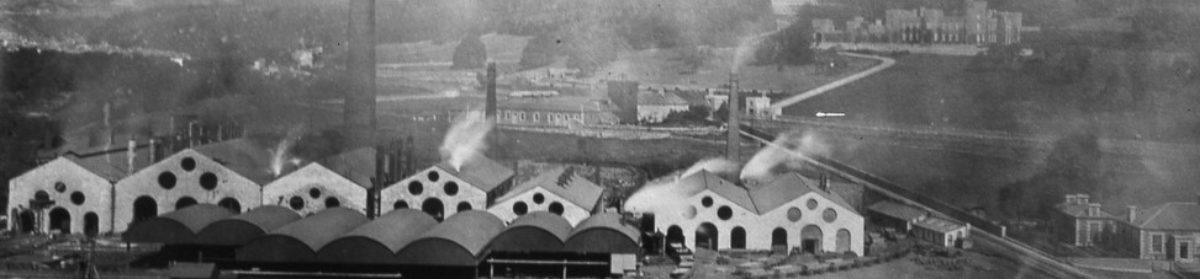
Engine house A 54 m (177 ft) long and 15 m (49 ft) high red brick industrial building constructed in 1905–07 to house three blowing engines as part of the Dowlais Ironworks. The works went into decline in the 1930s and in the late 20th century the building was being used by a chocolate company. |
|
Quakers Yard Railway Viaduct |
Treharris ST0885396473 51°39′35″N 3°19′09″W |
1 April 1988 |
Viaduct A tall stone-built viaduct with six arches that spans both the River Taff and the Merthyr Tramroad. It was constructed 1840–41 by Isambard Kingdom Brunel as part of the Taff Vale Railway and widened by 1861. |
|
Ynysfach Engine House |
Cyfarthfa SO0452406096 51°44′44″N 3°23′04″W |
5 Nov 1995 |
Engine house Built in 1836 as part of the Ynysfach Ironworks, it originally housed an engine made at the Neath Abbey Ironworks. This four-storey building of blue Pennant Sandstone with white ashlar dressings fell into disuse when the Ynysfach works closed in 1874. In the 1980s It was restored and became a museum until closed by the Leisure Trust. |
|
Greenfield Bridge, Penydarren Tramroad |
Treharris ST0902496544 51°39′37″N 3°19′00″W |
20 February 2003 |
Bridge A single arch Pennant Sandstone structure built to replace an earlier wooden bridge that collapsed in 1815 when a train was passing over it. The semi-circular arch has span of 19.2 m (63 ft) at a height of 8.4 m (28 ft) above the river. It is part of the Merthyr Tramroad scheduled monument. |
|
Victoria Bridge, Penydarren Tramroad |
Treharris ST0942396281 51°39′29″N 3°18′39″W |
20 February 2003 |
Bridge A single high-arch bridge over the River Taff similar in design to the nearby Greenfield bridge. Built in 1815 to replace a wooden bridge of 1800–02 it was originally as part of the Merthyr Tramway but is now a footbridge. It is part of the Merthyr Tramroad scheduled monument. |
NOTE
The two viaducts constructed as part of the Brecon and Merthyr Railway both straddle the borders of neighbouring historic communities so have separate designations for each of these locations.
by Carolyn Jacob

At one time most immigrants to Merthyr Tydfil simply walked unless they got a lift on a farm cart, but the few roads were poor. The early Iron-master, Anthony Bacon, built the first direct road between Merthyr Tydfil and Cardiff. The transportation of bulky iron products to the sea ports led to the building of the Glamorganshire Canal. The locomotives and trains of no less than six railway companies ran into the Merthyr station which had the title of ‘High Street’ rather than the more common ‘Central’.
The Taff Vale Railway had been first to arrive in Merthyr with a line from Cardiff and Pontypridd to their Plymouth Street station in 1841, followed by the Vale of Neath in 1853, soon to be taken over by the Great Western. These were followed by the Brecon & Merthyr whose operations stretched down to Newport and the London & North Western with their line from Abergavenny. The final arrivals were the Rhymney Railway with access provided from Quakers Yard by their joint line with the GWR, while the Cambrian Railway had running powers through to Merthyr. In 1922 all were absorbed by the GWR.

Isambard Kingdom Brunel was involved in railway projects here. ‘The railway sets you down in Merthyr at precisely the quaintest centre of the old town. There is an ancient atmosphere pervading‘, wrote Wirt Sikes, an American, in 1880. In 1856 Prince Louis Bonaparte arrived at the High Street station. On 1 April 1944, the King and Queen and Princess Elizabeth took the Royal train from the High Street station. Thousands of rails were manufactured here and the Dowlais Works sold rails to Russia, America and India. However, a hundred years ago the local Sunday trip or holiday was only to Pontsarn or the Brecon Beacons. During the Second World War many evacuees arrived by train. One evacuee wrote in a letter home; ‘we watch the trains arriving into Merthyr Tydfil railway station from the top of the slag heaps’.
In its heyday, the striking timbered roof, five operational platforms and more than 80 members of staff, ensured Merthyr High Street Station was in a class of its own. It had excellent facilities. There were refreshment rooms where first-class passengers could buy breakfast for 1s 6d. In 1945 the ticket boxes were open continuously except for 1.45pm to 2.45pm on Sundays and 12.30am to 4am on Mondays. There were toilets and brightly coloured advertisements for products such as Bovril and Venos’ Cough Cure. The waiting rooms were a pleasure to sit in, with large coal fires and plenty of seats. The station was kept litter-free and clean. High Street station cleaner Margaret Pritchard was so conscientious keeping the Merthyr Station spick and span that she accidentally polished over important finger prints after a robbery.

In the 1960s young fighters trained by former boxer Eddie Thomas would weigh on the scales in the goods depot at the station, the most accurate scales in town. The station a centre for local sporting life, filled with the sound of cooing racing pigeons and the raucous barking of whippet dogs. In 1953, after 98 years, the roof designed by Brunel was removed and in 1987 the fire-ravaged goods shed at the station was demolished.
In the 1960s Merthyr lost nearly all its passenger services except the Taff Vale route to Cardiff. In 1971 and new station building was erected but it was a shadow of its former self. The official opening of the present new Merthyr Railway Station was February 1996 by Councillor Ray Thomas. The new station which cost £500,000 to build was funded by the sale of the old station just 120 metres away.
From the Evening Express 110 years ago today….

The following article is transcribed from the Dictionary of National Biography, 1927 supplement. It is out of copyright and is now in the public domain.
 William Thomas Lewis, first Baron Merthyr, of Senghenydd (1837–1914), engineer and coal-owner, the eldest son of Thomas William Lewis, engineer, of Abercanaid House, Merthyr Tydfil, by his wife, Mary Anne, daughter of John Watkin, was born at Merthyr Tydfil 5 August 1837. He received his early training under his father, and in 1855 became assistant engineer to William Southern Clark, mining agent for the Marquess of Bute’s estate in South Wales—in Cardiff and its neighbourhood.
He succeeded Clark in 1864 at an important period in the history of the coal industry and, as consulting engineer, was connected with various colliery and railway schemes in South Wales. In 1881 Lewis was given entire control of the Marquess of Bute’s Welsh estates, and, by reducing the costs of working at the Cardiff docks (constructed by the Bute family), he made possible the expansion necessary for the rapidly increasing trade in steam coal. By 1887 he had constructed the Roath dock and by 1907 the Queen Alexandra dock. He also introduced new appliances, including the Lewis-Hunter crane, of which he was part inventor. When the Bute Dock Company was formed in 1887, he became managing director, and some years later helped to secure direct access to the South Wales coal-field by opening up the Cardiff Railway. Undoubtedly, the growth of Cardiff and the prosperity of the coal-field are bound up with Lewis’s career.
Lewis’s work for the Bute estates, however, represents but one phase of his activities. His marriage in 1864 to Anne (died 1902), daughter of William Rees, colliery-owner, of Lletyshenkin, Aberdare, brought him into close contact with the steam-coal trade, of which his wife’s family were pioneers. His main colliery interests ultimately lay in the lower Rhondda valley and in the Senghenydd district. He possessed a remarkable knowledge of the South Wales coal-field and of coal-working in general, and was appointed to serve on the royal commissions on the action of coal dust in mines, on mining royalties, on coal supplies, and on accidents in mines (1878–1886). For his valuable services on the last-named commission he was knighted in 1885. From coal Lewis was drawn into iron-working, and he helped to revive the industry by applying the new Bessemer process for the production of steel. In 1908 he was elected president of the Iron and Steel Institute.
Probably some of Lewis’s greatest work was done in the cause of industrial peace. Little effort had been made to organize the coal industry until after the strike of 1871, when he succeeded in persuading coal-owners and iron-masters of South Wales to form the Monmouthshire and South Wales Coal-Owners’ Association. During the great strike of 1873 he counselled arbitration and urged the adoption of a sliding scale as the basis of the new wage agreement. The acceptance of this principle in 1875 brought peace and stability to the industry for many years; and, as chairman for eighteen years of the sliding-scale committee, Lewis was largely responsible for the efficient working of the scheme. The principle led to a distinct improvement in the relations between capital and labour, and later came to be adopted in other coal-fields.
Lewis had won for himself a high reputation as an industrial expert and as a conciliator. In 1881 he was president of the Mining Association of Great Britain, and he served on the royal commissions on labour (1891–1894), on trades’ disputes (1903–1906), and on shipping combinations (1906–1907). He was successful in effecting a settlement of the Taff Vale Railway strike in 1900, and his proposal for the institution of permanent boards of arbitration became the basis of settlement of the general railway strike of 1907.
Lewis, who had been created a baronet in 1896 and had received the K.C.V.O. in 1907, was raised to the peerage in 1911 as Baron Merthyr, of Senghenydd, Glamorganshire. In 1912 he received the G.C.V.O. He took a keen interest in education and in the social welfare of the coal-field, and was a generous supporter of hospitals and other institutions. He had played a prominent part in the founding, in 1881, of the Monmouthshire and South Wales permanent provident fund for the relief of colliery workers in case of sickness or accident—a scheme which anticipated by many years some of the advantages of old age pensions, compensation for accident, and insurance against sickness or unemployment.
Lord Merthyr died at Newbury 27 August 1914. He had two sons and six daughters, and he was succeeded as second baron by his elder son, Herbert Clark Lewis (born 1866).

From the Western Mail 140 years ago today….

We continue our serialisation of the memories of Merthyr in the 1830’s by an un-named correspondent to the Merthyr Express, courtesy of Michael Donovan.
We have now entered Dowlais – yes, to some extent, truly called dismal and dirty. No doubt it has redeeming traits, but from personal recollections I do not consider it had even the amenities that existed in Merthyr. It was, or seemed to be, more brusque, more aggrandising, but if Merthyr was truly a village in the early thirties, Dowlais was somewhat less. “Nothing extenuate, nor set down aught in malice” shall be my guide.
Up the brook a short way there was a brewery, erected by a Mr Powell of Abergavenny, whose father was a church dignitary there. The hill before us is steep, and the first road is one that doubles back in front of the Dowlais Inn, and then turns up to the right to the Dowlais Church, stables and on to the Ivor Works. This was kept by a James Henry, who went thence to keep another public house in Rhymney.

Keeping the coach road, another public house on the other side was the Vulcan. There were steps alongside down to the tramroad, and the lowest entrance gates into the works stood just there. Some short distance further there was another public house, whose name has slipped. It was, however, some four steps (nearly three feet) lower than the road. Mr David Williams and his aunt, Miss Teague, kept it awhile after leaving the Angel in Merthyr, but it was taken as the station of the railway from the Taff Vale, and used as such at the time.
Following this on the same side was a row of workmen’s cottages having their back to, but the ground floor much lower than the road. About six of what were then the best shops in the place being passed, the main entrance into the works and office was come to.
The shop nearest the entrance gates was, or had been, the old Company shop. It had, however, ceased to be carried on upon the truck system as far as can be recalled. A Mr Parnell was the manager, but there is some hazy idea of Mr Williams, the father of Mr Joshua Williams, of Aberdylais (sic), being connected with it. Mr Jenkins, the druggist, had a branch shop in the row; also a Mr D Lewis kept another druggist’s shop, and Mr Lewis, draper, of the London Warehouse, also had a branch. Immediately opposite to the entrance gates was the Bush Hotel, kept by Mr Richard Henry who had been a contractor in the works some years before.

At the passing of the Reform Bill in 1832, Merthyr was made a borough, and privileged to send one member to Parliament. Sir John (then Mrs) Guest was returned, but he had previously been member for Honiton, and upon one occasion ordered a large number of pairs of boots and shoes there. They were dispatched to Dowlais to the company’s shop there, but Mr Parnell decline having anything to do with them. “He had not ordered them”, and knew nothing whatever about them.
Richard Henry was sent for to the office, he being then a contractor and having a great number of persons under him. “Dick I want you to sell a lot of boots and shoes for me” was said by Mr Guest. “Well, but master, I don’t want them, and how am I to pay for them?” was replied. “Oh that shall not trouble: you can pay when you sell the last pair”, was the rejoinder, and ‘Dick’ took them all but never sold the last pair. It is not possible to vouch for the strict accuracy of it, but I can vouch for having the narrative from Mr Richard Henry’s own lips.
To be continued….
by Gwilym and John Griffiths
In October 1858, Rees Jones was interviewed by the Mining Journal. He assisted Richard Trevithick in the making of his locomotive. It worked very well but frequently its weight broke the tram-plates. On the third (see below) journey it broke a great many of the tram-plates. It was brought back to Pen y Darren by horses. The steam-engine was never used as a locomotive after this.
‘The Pen y Darren Locomotive’ added, without stating the source, that: Over the next few weeks the locomotive made numerous journeys over the tramroad and was later used as a stationary engine for pumping water, winding coal and driving a forging hammer.
The newspaper, Cambrian, reported the trial briefly: ‘Yesterday’, the long-awaited trial of Mr Trevithick’s newly-invented steam engine, for which he obtained His Majesty’s letters patent, to draw and work carriages of all descriptions on various kinds of roads, as well as for a number of other purposes to which its power may be usefully employed, took place near this town, and was found to perform to admiration all that was expected from its warmest advocates.
In the present instance, the novel application of steam by means of this truly valuable machine was made use of to convey along the tramroad ten tons, long weight, of bar iron from Pen y Darren Works to the place where it joins the Glamorgan Canal, upwards of nine miles distant; and it is necessary to observe that the weight of the load was soon increased from ten to fifteen tons by about seventy persons riding on the trams, who, drawn thither, as well as many others, by invincible curiosity, were eager to ride at the expense of the first display of the patentee’s abilities in this country.
To those who are not acquainted with the exact principle of this new engine, it may not be improper to observe that it differs from all others yet brought before the public, by disclaiming the use of condensed water, and discharges it into the open air, or applies it to the heating of fluids, as convenience may require. The expense of making engines on this principle does not exceed one half of many on the most approved plan made use of before this appeared. It takes much less coal to work it, and it is only necessary to supply a small quantity of water for the purpose of creating steam, which is the most essential matter. It performed the journey without feeding or using any water, and will travel with ease at the rate of five miles an hour. It is not doubted but that the number of horses in the kingdom will be very considerably reduced, and the machine, in the hands of the present proprietors, will be made use of in a hundred instances never yet though of for an instant’.
The Parliamentary Gazetteer of England and Wales, circa 1840, added extra bits of information: The first locomotive, though with toothed wheels, is said to have been started on the old Merthyr-Tydvil railroad in 1804, having been patented by Messrs Vivian and Co, in 1802; it was then stated to have drawn ten tons of bar iron at the rate of five miles an hour; but it did not come into anything like general use for the carriage of goods till ten years afterwards. The present (1840) noble species of locomotives, however, and railways, are of still more recent origin. There was clearly some conflict over the patent?
It seems likely that the authors must have made a mistake over ‘toothed wheels’: perhaps they were thinking of the cog-wheels on the engine itself?
We find it hard to believe that there was any need or purpose to construct the smaller tunnel near Plymouth Works in 1802, though this is the date so stated by Leo Davies in ‘Bridges of Merthyr Tydfil’, page 155, and the tunnel certainly existed by the time of John Woods’ 1836 Street Map of Merthyr Tudful. Richard Trevithick did not mention it in his letter describing the journey (but see below) yet, at only 8ft 4in high, it must have proved a problem for his steam locomotive with a stack of almost similar height? The second tunnel was apparently built around 1860 or 1862, per Leo Davies. Why was it needed? Why was it so much higher at 13ft 0in? The lower tunnel would have limited the height of any transport through it, a quarter of a century after the arrival of the Taff Vale Railway.
A Trystan Edwards, in ‘Merthyr, Rhondda and The Valleys’, page 163, apparently knew (from frustratingly unnamed sources but see above quote) that Richard Trevithick was assisted in the construction of the engine by Rees Jones of Dowlais and that the engine-driver’s name was Watkin Richards. He wrote that a collision with a bridge brought down both bridge and stack (though Trevithick himself made no reference to this accident in his account). Trystan Edwards recorded that the engine failed to return, a fact totally incorrect according to Trevithick’s own account written at the time.
According to Joseph Gross, ‘The Merthyr Tramroad’, in Merthyr Historian, volume 1, Anthony Bacon refused to make the award of the bet because Richard Trevithick had moved some sleepers in the tunnel near Plymouth Works to the middle to allow the funnel to pass. This was supposed to have changed the existing track, violating one of the conditions of the wager. The return journey of the locomotive was not completed because it was said the gradient was too steep. This, too, contradicts other sources.
By Laura Bray
We all know the story – a wager between Samuel Homfray of the Penydarren Ironworks, and Richard Crawshay of Cyfarthfa that Trevithick’s steam locomotive could haul ten tens of iron from Penydarren to Abercynon, and we all know that Homfray won his bet, and Merthyr became known across the world as the home of the first railway.
But have you ever wondered why the bet was made? Perhaps it just a whim between two very rich two men with money to burn. After all the bet was sizeable 500 guineas or something like £40,000 in today’s money. Perhaps it was because Homfray, who had used Trevithick’s engines to drive a hammer in the ironworks, was a pioneer. Or was it because of the Glamorganshire Canal…..?

By the late 18th century, Merthyr was probably the most important manufacturing town in Britain, with a population 8 times larger than that of Cardiff, which was the nearest port. However, the river wharfs in Cardiff were rapidly reaching capacity and could not keep up with the maritime demands made by Merthyr’s four ironworks. In addition, it was prohibitively expensive to get the goods from Merthyr to Cardiff, costing the ironmasters something like £14,000 p.a. – a sum equivalent to around £1m today.

It was within this context that Richard Crawshay took the lead in lobbying for a Parliamentary Bill in order to get the powers to build a canal from Merthyr to Cardiff, and in 1790 the Glamorganshire Canal Act was passed. The Act provided that a company be formed of The Company of Proprietors of the Glamorganshire Canal Navigation with power to purchase land for making the canal and to carry out the necessary works. The Act also laid down the route that was to be followed, authorised the raising of £90,000 to meet the cost of completing the canal, and laid down the maximum charges for carrying various classes of goods, up to 5d. per ton per mile for carrying stone, iron, timber, etc. and up to 2d. per ton per mile for carrying iron stone, iron ore, coal, lime-stone, etc. It also stated that the distribution of Company profits was not to exceed £8% per annum upon the capital sum actually laid out in making the canal.
The Canal Company appointed a Committee from amongst its shareholders to be responsible for the management of the Company’s affairs, and the first Committee meeting was held on 19 July 1790 at the Cardiff Arms Inn, when it was decided to enter into a contract with Thomas Dadford senior, Thomas Dadford junior and Thomas Sheasby to construct the canal at a cost of £48,228, exclusive of the cost of land. This is about 3 times the annual cost of sending goods to Cardiff, so it was estimated that all costs would be recouped in as little as three years.
Construction work started in August 1790 and it was a massive undertaking – over its length of 25 miles, the land drops by 543 feet, so it was necessary to build 51 locks, some double, and one in Nantgarw, a triple lock; some locks were 10 feet high and the one in Aberfan topped 14’6″. In addition. there was the necessity for an aqueduct to be built at Abercynon, a tunnel under Queen St in Cardiff, several feeders to be created and, as the canal came closer to Merthyr, it had to be cut through sheer mountain rock. By 1794, however, there was a functioning and effective new transport link between Merthyr and Cardiff at a final cost of £103,600.

But even before the canal was completed it had become clear that it needed to be extended beyond Cardiff so as to give access directly to the sea. Another £20,000 was raised by subscription and a deal was struck with the Marquis of Bute, who owned the land, to build a sea lock and canal basin, which enabled ships of 200 tons to dock. The Sea Lock itself was 103 feet long with gates 27 feet wide.
The canal made transport to Cardiff very cheap, but generated very high revenues. It was designed to take canal boats of up to 25 tons, each drawn by a horse, with a man and a boy. By 1836 there were about 200 boats on the canal, each doing 3 round trips every fortnight. That’s a lot of tonnage at an average of 3d a ton.
But all was not well in the Committee. From the start, it was dominated by Richard Crawshay, who tended to regard the canal as his and his attempts to squeeze the profits of the other ironmasters was bitterly resented. As early as 1794 Richard Hill Of the Plymouth Works complained that the Canal Company was using water from the river that was legally his. Guest, in Dowlais, was also vocal about how we could access the canal from his works. A branch canal seemed impractical so a tramroad was proposed to which the canal company contributed £1000. This was competed in 1791 – before the canal. The Crawshays built a second tramroad between the Gurnos Quarry and their works in Cyfarthfa and a third was built in 1799 by the Hills, linking the Morlais Quarry with the Dowlais to Merthyr Tramroad at Penydarren.

But by 1798, tensions in the committee were so great that they blew. As a consequence, the other ironmasters were dropped for the canal committee, leaving only Crawshay, and it was another 26 years before they rejoined. But discussions took place between them about how to break the Crawshay stranglehold of the canal, and the answer seemed to be the construction of a tramroad from Merthyr, to meet the canal at Abercynon. This tramroad, which opened in 1802 and was built without an Act of Parliament, linking the two existing tramroads from Dowlais to Merthyr and from Morlais to Penydarren. From the point of view of Guest, Homfray and Hill, although the trams using it were horse drawn, this new tramroad avoided the delays caused by the locks between Merthyr and Abercynon.
This is the background to the bet that was made between Homfray and Crawshay. Could the new stream locomotive pull a load of iron? Could it supersede canal power?
We all know that it did, but broke the rails on the way down, so could not come back. But progress had been made. The Taff Vale Railway Company opened as far as Abercynon only 40 years later, and to Merthyr a year later and the canal’s decline was inexorable and it had all but ceased by 1900.
Looking back, it is reasonable to ask, if there had been no canal, where would the home of the steam locomotive be? Not Merthyr, that’s for sure.
We continue our serialisation of the memories of Merthyr in the 1830’s by an un-named correspondent to the Merthyr Express, courtesy of Michael Donovan.
But there is another matter that contributed to that end both for them and other ironmasters too. With the dawn of the railways the public were diffident of investing, and the issue of bonds was a neccessity for the ready obtaining of rails. These were generally issued at discount, say as an example, a bond for £100 for ten tons of rails at £8 per ton. The cost of the rails would be, perhaps. £6, so that the iron master, if in a position to do so, would receive say £100 for £60 worth of his product. Bankers would advance upon the deposit of such bonds, and, in consequence, enough money would be obtained to carry on the same cycle of operations.
It must not be thought that the railway company, on the one hand, or the ironmaster on the other, were dealing in hundreds only. One deal may be for ten thousand tons of rails, and if not able to make and deliver the full amount within the specified time, he contracted with other and, perhaps, smaller makers for some portion. The ironmaster, taking the original contract, would thus become an iron merchant, and pay cash or some other mode of payment as may be arranged. Wages were paid in cash, and it may be that a part was arranged by acceptance.
 In order to show the difficulty in obtaining money for the making of railroads, let me remind you readers that the £100 Taff Vale share was for sale at £30 at one time, and it was only some five or six persons who made the Aberdare branch from Navigation to Aberdare – the public declined to take shares, Mr C H James told me – but those who ventured have one of the best railway investments, for it was leased to the Taff Vale Railway Company at an increasing rate, 10 percent being obtained in three years, and so to continue in perpetuity.
To be continued at a later date.