Jem Mace in Merthyr

by Peter Rogers

James ‘Jem’ Mace (8 April 1831 – 30 November 1910) was an English boxing champion, primarily during the bare-knuckle era.

He was born at Beeston, Norfolk, and although he was nicknamed ‘The Gypsy’, he denied Romany ethnicity in his autobiography. Fighting in England, at the height of his career between 1860 and 1866, he won the English Welterweight, Heavyweight and Middleweight championships, and was considered one of the most scientific boxers of his era.

Most impressively he held the World Heavyweight Championship from 1870 to 1871 while fighting in the United States.

The following article is transcribed from the Merthyr Telegraph of 11 June 1864.

JEM MACE’S VISIT

LOSS OF A VALUABLE HORSE

The members of the prize ring – if they happen to be at all distinguished – can certainly make no complaint that their peculiar merits are overlooked, even in quarters by no means vulgar or uninfluential. We had an instance of this last week, when Jem Mace and some others of the bruising fraternity, paid us a flying visit, and delighted the roughs by an exhibition of fistic prowess. Jem, however, bad higher patrons than the boisterous admirers who crowded to see himself and “The Wolf” set-to at the circus, and one gentleman carried his enthusiasm for the champion so far as to invite him to his residence*, order his band out for his entertainment, and we need not add, treated him there with the fullest hospitality. It is with regret that we have to relate that his appreciation of the manly qualities of Jem, should have cost the gentleman in question rather dearly, as he lost in consequence a fine carriage horse, worth some 70 or 80 guineas.

After having entertained his guest, and given honour where he deemed honour to be due – when the hour of Jem’s departure arrived Mr Crawshay, with great consideration, ordered his coachman to drive the pugilistic hero to the circus, where he was to perform. The well appointed vehicle was accordingly got ready, one of the horses harnessed in, and off they went at a truly slapping pace. In due time the champion was brought to his destination, and after a decent interval, the coachman set out to return.

There are malicious stories abroad that he must have offered sacrifice to one of the divinities, as he picked up a ‘navvy’ or labourer on the road, to whom he transferred the reins – and on whose knees – evidently in playful mood, he rather nonchalantly took his seat. The new Jehu was however not very skilful at driving, and soon got off the road upon a tramway, where the wheels of the trap somehow became entangled in the rails, causing the spirited animal suddenly to plunge and grow restive.

The first result of this was to fling the coachman from his perch headlong on the road, but by the good fortune which often attends somnambulists he suffered no serious injury. Not so with the poor horse however -he at once started forth at full speed, but came in contact with a wall, against which he broke the trap, and in the collision received such injuries that to be killed on the spot.

*Cyfarthfa Castle

A visit to Cyfarthfa Iron works in 1850

Transcribed by Chris Parry

A visit to Cyfarthfa Iron works in 1850

By 1850, the scale and reputation of the iron metropolis of Merthyr Tydfil was know across the UK and even further. Journalists were coming to the town to write about the place, the people, the environment, the industry, every aspect of the most populated part of Wales at that time. The Morning Chronicle, between March and June 1850, published ten long articles exploring every aspect of life at Merthyr Tydfil, creating the most detailed exploration of the town published in the 19th century. The following is an extract from one of those articles that details a tour of Cyfarthfa Ironworks in 1850.

The next iron works I visited were those of Cyfarthfa – the model works of South Wales… There are at Cyfarthfa and Ynysfach (works adjacent to each other) 11 furnaces in blast, and four at Hirwaun – all being the sole property of Mr. William Crawshay. At these works there are employed under and above ground, 5,000 hands, of whom 190 are women. By the returns furnished me, I find the amount of wages paid at Cyfarthfa and Hirwaun alone is 16,000 a month (of four weeks). The make of pig iron is 72,000 tons per annum. The quantity of the bars, rails, and tin plates is 53,000 tons a year. There is used of Welsh iron, and hematite ores for the production of the above, 166,800 tons a year. The daily consumption of coal is 850 tons. As many as 400 horses are here employed. These extensive works are chiefly carried on by waterpower, the supply being procured from the river Taff at a considerable distance up the valley, but steam is used when in summer the water fails. The machinery is very large and ponderous. Those of the water wheels are 36 feet in diameter, and the fly wheels, which are 60 feet in circumference and of prodigious weight, make ordinarily 70 revolutions a minute. About three months ago the periphery of one of these wheels flew into pieces, the fragments demolishing the roof of the mill in which the accident occurred, and descending at a distance through the roof of another mill, crushing into pieces large portions of beautiful and costly machinery then in motion, but without further casualty to the numerous workmen than a fracture of the thighs of one of them. One of the steam engines is of 260 horsepower; it has six boilers, and is of nine feet stroke.

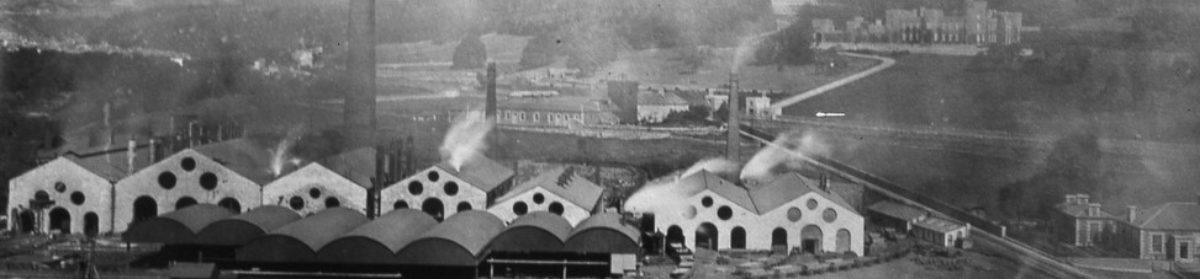
The above particulars will convey some idea of the magnitude of these works. I was accompanied over them by Mr. Robert Crawshay, whose familiarity with the philosophy of the various processes of smelting the iron is only equalled by his practical familiarity with its manufacture, and to who I am much indebted for the attention he paid me, and for the lucid and intelligible manner in which he explained everything which I did not at first clearly understand. These works are incomparably the best constructed, the most spacious, well-ventilated, comfortable, convenient, and methodical of all the works, not only in and around Merthyr, but throughout South Wales. Everything has been done on the most liberal scale, and with an evident aim at perfection and completeness. The extensive mills, with their massive walls pierced with large circular openings for light and lofty roofs, have an air of architectural grandeur that is quite imposing. The space within the roof of one mill is 82 feet. There is here so much room that the work is carried on without any appearance on hurry and bustle which I have remarked upon as belonging to other works. I was informed by Mr. David James, a disinterested party, that men who have once enjoyed the comfort, shelter, and convenience of these works would never leave them for others if could possibly avoid it. I have said shelter, because here the men and women employed at the furnace tops and at the hearths have roofs overhead, whereas at Dowlais I have complained that they are wholly unprotected, and such is the case elsewhere. The comfort of such a provision in the windy and rainy climate of these mountains can only be adequately valued by the workpeople who have tried both situations, the exposed and the sheltered. I think it the duty of those ironmasters who have neglected providing such a shelter, to lose no time in following the example of Cyfarthfa and the other works where such conveniences have been adopted. It will be an act of great kindness to the miserables who have now to endure all weathers, and the most violent alterations of heat and cold.

 Robert Thompson Crawshay. Courtesy of Cyfarthfa Museum & Art Gallery

At Cyfarthfa I saw men belonging to the furnaces, squeezers, rollers, and saws at their dinner. They had good beef or mutton, and potatoes; the boys had broth with a small piece of meat: they seemed pleased to show the contents of their tins, observing that the work was so hard and the heat so great that they could not stand it without animal food. This, it must be borne in mind, was in the mills; at Dowlais and in the other works, as I have stated, the workmen also get meat. They were rail-making in two of the mills I inspected. I saw three rails made by the direction of Mr. Crawshay. Timed by a watch, they were made in three minutes – that is, from the presentation of the white hot “bloom” to the rollers to its completion in them. The ends were cut off, filed, and the bars straightened in an additional minute and a quarter – so that altogether the making and finishing of three rails ready for laying down on the permanent way occupied just four minutes and a quarter. It was here I first saw that ingenious but simple invention, “the splitting mill” at work. It was making what is termed “nail rods”, which it did by lengthening and dividing a short iron bar into about a dozen rods, eight feet long by a quarter of an inch wide. This most important and useful invention was made in Sweden, and the consequences were most disastrous to the manufacturers of iron in this country, who, having to divide the rods by a long, tedious, and laborious process, could not compete with the new invention. The means by which this difficulty was overcome are highly interesting…….

The return made to me of the rate of wages paid at these works is as follows:-

Colliers, 15s. a week

Miners, 12s, 6d, a week

Founders, 22s. a week

Fillers, 21s. a week

Labourers, 10s. 6d. a week

Puddlers, 18s. a week

Rollers, 30s. a week; rail rollers, 31 to 41 a week.

Roughers, 18s. a week

Ballers, 24s. a week; girls, 5s. a week

The portion of boys employed under sixteen years of age is about one-sixth of the whole: at Dowlais these were returned as about one-fourth. At one of the mills in these works boys only are employed; it is a training school for them, preparing them for the heavier mill and forge work. I saw them making iron rods for rails, and light work; they seemed to work with great spirit and alacrity…[1]

[1] Morning Chronicle, March 21, 1850, London

The South Wales Lock Out

The article transcribed below appeared in the Illustrated London News 150 years ago today.

Several fresh illustrations are given this week, from sketches by our own artists, of the deplorable stoppage of labour in the vast collieries and ironworks of South Wales. The amount of interests involved in this unfortunate rupture between capital and labour is estimated by the correspondent of a daily paper:—

“In Monmouthshire and Glamorgan there are, all told, 450 collieries, of which about 150 are the property of ironmasters. In times when business is at full swing, the amount of coal ‘won’ from these numerous pits reaches 350,000 tons weekly. The manufacture of iron in the district demands 100,000 tons this weekly output, the remainder being spread abroad—some for shipping purposes, but the greater part for household and factory consumption. To raise 350,000 tons of coal in six days would require the operation of 70,000 hands—that is to say, practical ‘pitmen’, with labourers and lads. It is reckoned that the united earnings of this great body of workmen average £100,000 a week—about 27s. a head per week ‘all round’;  or take the labourers and lads at 10s. to £1 a week, and the miners at 34s.

In the immediate vicinity of these collieries are the establishments of at least a score of leading ironmasters, giving employment to some 30,000 men. Taking an ironworker’s wages at the low average of 27s. a week, nearly £40,000 would be required to satisfy the number above indicated. Then there are those who are engaged in the ironstone mines, a body of men reckoned by thousands, and whose earnings are said to be at least £10,000 weekly. One way and another it may be fairly reckoned that the South Wales coal-fields are not worked at a less weekly average cost in the shape of wages than £150,000, and when nothing is amiss this is the sum, barring the small savings of the pitman, which between Saturday and Saturday finds its way into the tills of the butcher, the baker, the grocer, the publican, and other worthy tradesfolk of Merthyr, Aberdare, Dowlais, and the surrounding districts. It is hard to say who feel most acutely the pinch of the lock-out—the shopkeeper, or those who in flourishing times are his profitable customers. In by far the majority of instances, the tradesmen in question depend mainly for support on those who are employed in the pits and at the ironworks, and when these are rendered wageless the shopkeeper may as well put up his shutters.”

Merthyr Tydvil, a place of 70,000 inhabitants, including the Dowlais, Cyfarthfa, Pen-y-darren, and other works, in the neighbourhood of the town, is situated in the north of Glamorganshire. It takes its name from an ancient Celtic princess, named Tydvil, who was Christian virgin martyr, slaughtered by the Pagan Saxons about King Arthur’s time. The Vale of Merthyr varies in width from a mile to half a mile, with hills on each side that nowhere reach an altitude of 2000 feet. It has all the characteristics of those valleys of South Wales where the days are darkened by furnaces vomiting smoke and the nights are illumined by hundreds of furnace fires. Such, at least, is its normal condition. The Vale of Merthyr is not the least valuable of the wealth-producing districts where gigantic fortunes have been accumulated. Right and left shafts rise out of the hill-side, and from side to side engines reply to each other. Small streams bear away the water that constantly springs in the underground workings. The entire vale is intersected with tramways, by which coal is conveyed, from the pit to the metal-works.

“But these days,” writes newspaper correspondent, “the Vale of Merthyr has begun to put on an appearance of desolation. The Plymouth Iron and Coal Works, which extend for nearly a couple of miles, and present a succession of valuable workings, are strangely silent. The steam-engines at the pit mouth, noisily and showily pumping, throw significant aspect of inactivity upon acres of unworked machinery; and there is long line of black, funnels, tall chimneys, gaunt beams and cranks, and gaping machinery in cold repose. Not a gleam will to-night enlighten the landscape where for years the valley has been notorious for its unearthly glare. An old man, gazing upon the dismal desertion of these magnificent works, says there are people starving in the valley, and that half the distress which exists, and will exist here, will be never known.”

In the midst of so much gloom, there is one gleam of satisfaction in the fact that the ironstone-miners are working. They will not be stopped. They have been associated with the ironworkers in past reductions, and, as they are dependent upon neither collieries nor ironworkers, work has been secured to them at Cyfarthfa. These men attempted a resistance to the first reduction, and were out about two months. They then applied for work, but the difference with the ironmasters having obliged Mr. Crawshay to blow out his blast-furnaces, he told them ironstone was not required. If, however, they chose to work upon the wages of 1871—that was, 30 per cent below the highest point which had been reached, and the level to which the present reduction of 10 per cent brings colliers’ labour—they might go on. They accepted the offer, and have been working with regularity ever since.

Although the ironworks have been at a standstill all the time, and the colliers are now reduced to a similar condition, they will be kept going, no matter how long this struggle may last. It is stated that Mr. Crawshay would have kept his ironworkers similarly employed, had they met him in the same spirit; he would have stocked iron to the extent of 100,000 tons rather than they should have been thrown out of employment. Further, he made more than one effort to come to an arrangement with the association for the employment of his ironworks colliers alone, but the union question cropped up and became an insurmountable obstacle. Cyfarthfa, therefore, with the exception of the ironstone works, is in the same position as all the rest of the ironworks, with one furnace only in blast.

There has been no event of importance during the week, lord Aberdare (who was Mr. Bruce, late Home Secretary) has declined to interfere on behalf of the men, and advises them give way. The Merthyr poor-law guardians impose stone-breaking tasks as a condition of outdoor relief.

Illustrated London News – 20 February 1875

Merthyr Historian Sale

The Merthyr Tydfil & District Historical Society is pleased to announce a very special offer price for back issues of Merthyr Historians.

All books are as new and are offered at £2.00 each or 3 for £5.00.

Postage is £3.50 per book, or books can be picked up from depositaries in Merthyr (on arrangement).

If you would like to buy any of these volumes, please contact merthyr.history@gmail.com

The volumes on offer are:-

VOLUME 15 (2003)  ISBN 0 9544201 1 X Ed. T.F. Holley
1.  Dr. Joseph Gross by Glanmor Williams
2. Attraction and Dispersal by John Wilkins
3. Mrs. Mary Ann Edmunds by Mary Patricia Jones
4. Bacon v Homfray by Eric Alexander
5. Cheshunt College, Hertfordshire by Barrie Jones
6. Striking Features: Robert Thompson Crawshay’s Large-Scale Portraits by Jane Fletcher
7. Margaret Stewart Taylor. A Notable Woman of Merthyr Tydfil by Carolyn Jacob
8. Iron Working in the Cynon Valley by Douglas Williams
9. Owain Glyn Dwr – After Six Hundred Years by Glanmor Williams
10. Merthyr Amateur Theatricals, 1860’s by H. W. Southey
11. Shon Llywelyn of Cwm Capel by Lyndon Harris
12. Hoover Transport, 1948-98 by Gwyn Harris M.M.
13. David Jones (1760-1842), Merthyr Clockmaker, Revisited by W. Linnard, D. Roy Sears & Chris Roberts
14. The English Bible by J. W. Bowen
15. He Came, He Saw, He Conquered Merthyr Commerce – Thomas Nibloe’s Story by T. F. Holley
16. Colour Supplement – Merthyr Buildings

VOLUME 17 (2004) ISBN 0 9544201 3 6 Ed. T.F. Holley 
1.  & Pastimes in the 18th & 19th Century, Merthyr Tydfil by Geoffrey Evans
2. Celtic Connections: Early Quoiting in Merthyr Tydfil by Innes MacLeod
3. The Will of the Revd. William Price Lewis, 1839 by T. F. Holley
4. The Dic Penderyn Society and the Popular Memory of Richard Lewis by Viv Pugh
5. The Welsh Religious Revival, 1904-5 by Robert Pope
6. Reporting Revival by Neville Granville
7. A French View of Merthyr Tydfil and the Evan Roberts Revival by William Linnard
8. Songs of Praises: Hymns and Tunes of the Welsh Revival, 1904-5 by Noel Gibbard
9. Revival, Cwm Rhondda, 1905 by William Linnard
10. Diwygiad 1904-5. A Select Reading List by Brynley Roberts
11. Rosina Davies, 1863-1949. A Welsh Evangelist by Eira M Smith
12. Evan Roberts, the Welsh Revivalist by J. Ann Lewis
13. Evan Roberts at Heolgerrig, Merthyr, January 1905 – Transcribed
14. Sir Thomas Marchant Williams & the Revival – Transcribed
15. Potpourri, a Medley by The Editor
16. What Wales Needs – Religiously, 1907 by Evan Roberts
17. Joseph Williams, Printer. TYST A’R DYDD. 1903 by T. F. Holley
18. Dr. Thomas Rees (1825-1908), of Cefncoedycymer by John Mallon
19. Everest & Charles Bruce (1866-1939): The Welsh Connection by Huw Rees
20. The Lusitania Catastrophe and the Welsh Male Voice Choir by Carl Llewellyn
21. Merthyr Amateur Theatricals, 1860’s. Part Two by H. W. Southey
22. Books, Old and New. Short Reviews by The Editor
23. Night Mrs. Evans by Ken J. Mumford
24. Some Early History of Park Baptist Church, The Walk, Merthyr – Transcribed
25. Letter re: Wool Factory, Merthyr Tydfil

VOLUME 22 (2011) ISBN 0 9544201 8  7  Ed. T.F. Holley
1. A Visit to Merthyr Tydfil in 1697 by Brynley F. Roberts
2. A Pedestrian Tour Through Scotland in 1801: New Lanark before Robert Owen by Innes Macleod
3. Note for Merthyr Historian by K. H. Edwards
4. Charles Richardson White, Merthyr Vale by T. F. Holley
5. Isaac John Williams, Curator by Scott Reid
6. The Merthyr Historian. Some Statistics by J. D. Holley
7. Thomas Evan Nicholas, 1879-1971 by Ivor Thomas Rees
8. Eira Margaret Smith: A Personal Tribute by Huw Williams
9. Saint Tydfil’s Hospital 1957. A House Physicians Recollections by Brian Loosmore
10. John Devonald, 1863-1936. Aberfan Musician and Remembrancer of Musicians by T. F. Holley
11. The Remarkable Berry Brothers by Joe England
12. Albert de Ritzen: Merthyr Tydfil’s Stipendiary Magistrate 1872-1876 by Huw Williams
13. A Scrap of Autobiography by Charles Wilkins, Annotated by His Great Grandson by John V. Wilkins, OBE
14. Industrial History of Colliers Row Site and Environs by Royston Holder (the late)
15. The Life of Maria Carini by Lisa Marie Powell
16. Lecture by J. C. Fowler, Esq., Stipendiary Magistrate, 1872 ‘Civilisation in South Wales – Transcribed
17. Gwyn Griffiths -‘The Author of our Anthem. Poems by Evan James’ – Book Review by Brian Davies
18. Enid Guest – ‘Daughter of an Ironmaster’ by Mary Owen – Book Review by Ceinwen Statter
19. Caepanttywyll – A Lost Community by Christopher Parry
20. James Colquhoun Campbell (in four parts) – T. F. Holley
(A) The Social Condition of Merthyr Tydfil, 1849
(B) The Venerable Archdeacon Campbell, 1859, Biography
(C) St. David’s Church, Merthyr Tydfil, Visited, 1860
(D) J. C. Campbell and the Census Record, Research 
by Mrs. C. Jacob
21. Interesting Book Plate

VOLUME 23 (2012) ISBN 0 9544201 9 5  Ed. T.F. Holley
1. Vince Harris, 1904-1987 by Margaret Lloyd
2. All Change for Plymouth: A Year in the Life of a Mining Engineer by Clive Thomas
3. Who Was The Real Lydia Fell? by Christine Trevett
4. Sewage Pollution of the Taff and the Merthyr Tydfil Local Board (1868-1871) by Leslie Rosenthal
5. Redmond Coleman, the Iron Man from Iron Lane by Carolyn Jacob
6. The Assimilation and Acculturation of the Descendants of Early 20th Century Spanish Industrial Immigrants to Merthyr by Stephen Murray
7. David Williams, High Constable, Merthyr Tydfil 1878-1880 by T. F. Holley
8. John Collins, V.C. by Malcolm Kenneth Payne
9. Marvellous Merthyr Boy – Transcribed
10. A Remarkable and Most Respected Enterprise, J. Howfield & Son, Merthyr Tydfil, 1872-2001 by Mary Owen
11. The Uncrowned Iron King (The First William Crawshay) by J. D. Evans
12. Watkin George 1759-1822, The Mechanical Genius of Cyfarthfa, The Pride of Pontypool by Wilf Owen
13. Opencast History (Illustrated) by Royston Holder
14. The Laundry Trade by T. F. Holley
15. Grand Concert at the Oddfellows Hall, Dowlais – Transcribed
16. Guidelines for Contributors – By courtesy of the Glamorgan History Society

VOLUME 24 (2012) Ed. T.F. Holley
1. Elphin, Literary Magistrate: Magisterial Commentator by Brynley Roberts
2. Picturing ‘The Member For Humanity’. J. M. Staniforth’s Cartoons of Keir Hardie, 1894-1914 by Chris Williams
3. William Morris, Yr Athraw and the ‘Blue Books’ by Huw Williams
4. Hugh Watkins by Carl Llewellyn and J. Ann Lewis
5. Gomer Thomas J.P. 1863-1935 by Wilf and Mary Owen
6. Oddfellows and Chartists by Lyndon Harris
7. John Roberts, Ieuan Gwyllt, Composer of Hymns by G. Parry Williams
8. Georgetown? How Was It? By Clive Thomas
9. Book Review: Bargoed and Gilfach – A Local History
10. A History of Ynysgau Chapel by Steven Brewer
11. ‘Mr Merthyr’ S.O. Davies 1886-1972 by Rev. Ivor Thomas Rees
12. Historical Farms of Merthyr Tydfil by John Griffiths Reviewed by Keith Lewis-Jones
13. National Service, Doctor With The Gurkhas by Brian Loosmoore
14. A Year of Anniversaries: Reflections on Local History 1972-2012 by Huw Williams
15. The Family of Dr. Thomas Rees, Revisited by John Mallon
16. Merthyr District Coffee Tavern Movement, 1880 by T. F. Holley
17. Henry Richard (1812-1888) – Apostle of Peace and Patriot by Gwyn Griffiths
18. Owen Morgan – Miners’ Reporter by Brian Davies
19. The Tredegar Riots of 1911 – Anti Liberalism ‘The Turbulent Years of 1910-1914’ by Lisa Marie Powell
20. Adulum Chapel by Carl Llewellyn
21. Cyfarthfa’s Curnow Vosper Archive by Gwyn Griffiths
22. Whithorn Gas, 1870 by Innes Macleod
23. A Journey from Merthyr to Sydney, A Talented Portrait Painter by Graham John Wilcox
24. The Merthyr Bus Rallies by Glyn Bowen

VOLUME 25 (2013)  Ed. T.F. Holley
1. The Merthyr Tydfil 1835 Election Revisited, Lady Charlotte Guest’s Account by E (Ted) Rowlands
2. John Josiah Guest at Auction by Huw Williams
3. Conway and Sons Dairies Ltd. – Some Notes by G. Conway
4. John Petherick; Merthyr’s Man of Africa by John Fletcher
5. Travels in the Valleys. Book Review by Glyn Bowen
6. Plaques by John D. Holley
7. William Thomas Lewis 1837-1914 by A Family Member
8. Boom Towns by Brian Loosmore
9. The Taff Valley Tornado 1913 by Stephen Brewer
10. Plaques by John D. Holley
11. From Mule Train to Diesel Lorries. The Dowlais Iron Company Connects the Coast by Wilf Owen
12. Review CD. Some of the History of Merthyr Tudful and District via Its Place Names by John & Gwilym Griffiths by Keith Lewis-Jones
13. Caedraw Primary School, 1875-1912 by Clive Thomas
14. Charles Butt Stanton, 1873-1946 by Revd. Ivor Thomas Rees
15. The Merthyr and Dowlais Steam Laundry Limited, 1891 by T. F. Holley
16. Dynamism, Diligence, Energy and Wealth. Trade and Commerce in Merthyr Tydfil 1800-1914 by Mary Owen
17. YMCA. Merthyr Tydfil Lecture 1861 by J. C. Fowler – Transcribed
18. John Nixon and the Welsh Coal Trade to France by Brian Davies
19. Tydfil School, Merthyr Tydfil, 1859-1873 by Evan Williams – Transcribed
20. Gossiping in Merthyr Tydfil by Carolyn Jacob
21. Penywern to Pontsarn. The Story of the Morlais Tunnel. The Writer’s Early Impressions by A. V. Phillips
22. Short History of the Thomas-Merthyr Colliery Company. Merthyr Tydfil, 1906-1946 by Ronald Llewellyn Thomas – Transcribed
23. Morien and Echos of Iolo Morgannwg by T. F. Holley
24. Merthyr Tydfil’s Stipendiary Magistracy and Walter Meyrick North (1886-1900): A Case Study by Huw Williams

VOLUME 26 (2014) ISBN 978 0 9929810 0 6 Ed. T.F. Holley
1. Three Generations of a Dowlais Medical Family 1860-1964 by Stuart Cresswell
2. Viscount Tredegar, Balaclava Veteran, 1913 by T. F. Holley
3. What Makes a Country Great? Lecture by Stipendiary Magistrate – J. C. Fowler – 1858
4. Billy ‘The Doll’ Williams by Malcolm K. Payne
5. Evan James, Dr. William Price and Iolo Morganwg’s Utopia by Brian Davies
6. John A. Owen (1936-1998), Dowlais Historian: An Appreciation by Huw Williams
7. Welsh Women and Liberation from Home: Feminist or Activist? By Lisa Marie Powell
8. Gwilym Harry (1792-1844), Unitarian – Farmer – Poet by Lyndon Harris
9. ‘Aunt’ Emma’s Ronnie by Clive Thomas
10. Morgan Williams: Merthyr’s Forgotten Leader by Joe England
11. Matthew Wayne (1780-1853) by Wilf Owen
12. The Contribution of Hunting to the 1914-18 War, 1914 by T. F. Holley
13. The Difficulties of M.T.C.B.C.’s Financial Management and Administration, 1926-1937: Maladministration, Political Ideology or Economic Reality? By Barrie Jones
14. The Rail Accident at Merthyr Station, 1874 by Stephen Brewer
15. Courtland House, 1851 by Mary Owen
16. Formation of the South Wales and Monmouthshire Brass Bands Association, 1891 by T. F. Holley
17. Moses Jones (1819-1901) by Annette Barr
18. Dr Richard Samuel Ryce, M.D. M.Ch.: An Irish Doctor by T. F. Holley
19. Cwmtaf – A Drowning of the Valley and its Consequences by Gwyneth Evans
20. A Professor Gwyn A. Williams Symposium
a. Recollections of Professor Gwyn Williams, University of York, 1967-70 by Frances Finnegan
b. Memories of Gwyn at York by Brian Davies
c. Professor Gwyn Alf Williams. A Personal Remembrance by Viv Pugh
21. Merthyr Tydfil at War, 1914 by Stephen Brewer
22. Photo Feature – Archaeology by T. F. Holley
Merthyr’s Chapels: Gellideg Chapel

Gellideg Welsh Independent Chapel

The cause at Gellideg was started when a number of members of Bethesda Chapel, amongst them John Roger, Thomas Watkins, Edward Hughes, Rees Price, Thomas Morris, and David Jones started holding Sunday Schools and prayer meetings in local houses.

It soon became apparent that they needed somewhere more practical, so they approached Robert T Crawshay who gave them the land free of charge, and also provided the building materials at low price. He also contributed £5 towards the cost of building a schoolroom.

The Trustees of Bethesda Chapel took responsibility for the schoolroom at Gellideg after its completion in May 1861. The function of the schoolroom was to cater for the religious education of the district. Once the building was erected it could now be used for other activities relating to religious involvement such as Sunday School, mid week Prayer meetings; thus the numbers of people attending the schoolroom increased.

As the congregation grew, the elders at Bethesda Chapel decided that the members that attended Bethesda could now hold their own Sunday services at Gellideg with the help of the officers of the mother church.

Rev R Gwesyn Jones, minister of Bethesda Chapel, ministered to the congregation at Gellideg until he emigrated to America in 1867. When Rev R Gwesyn Jones left, the congregation at Gellideg approached Rev James Evans, minister at Zion, Craig y Fargoed to be their minister. He accepted and was inducted in May 1867. He continued as minister until 1878 when he was forced to retire due to ill health. Since then Gellideg has had no permanent minister.

Following its closure as an Independent Chapel in 1995, Gellideg Chapel was used for a time by the Nation Changers Church, but as of 2012 is once again empty.

Memories of Old Merthyr

We continue our serialisation of the memories of Merthyr in the 1830’s by an un-named correspondent to the Merthyr Express, courtesy of Michael Donovan.

Mr William Davies was the forge and mill manager at Cyfarthfa, and Mr John Jones, the furnace manager at Ynysfach. Mr Wiltshire was the vet or farrier (for the Veterinary College had not so many members then), but others also occur to me in other spheres of labour.

John Pritchard was the weigher on the top of the yard (approaching Gellideg). He was the father of the Dr Pritchard many of your readers may recall, living in High Street, opposite Glebeland Street. There was also a weigher at Ynysfach yard some few years later whose name I wish to mention; it was John Morgan, and his contributions to the mathematical part of the Gentleman’s Magazine of that time is ample evidence of his knowledge.

Possibly some of the descendents of those mentioned yet exist, and may read this – some can be recalled. Mr Davies, the mill manager had two daughters, one became Mrs John James (draper). Mr James married a Miss Kirkhouse, Llwyncelyn, an elder sister (half sister really) of the Rev Howell Kirkhouse. I do not think they had a family; nor can I recall either of Mr Jones’ brothers – William, who went to North Wales; or Charles, who went to London – having any; perhaps he (Charles) made up for it by becoming the secretary of the Welsh Girls’ School at Ashford.

William Crawshay II by an unknown artist. Courtesy of Cyfarthfa Castle Museum & Art Gallery

At the present time, when ‘combines’ for trade purposes are rife, and ever and anon a paragraph appears respecting what Mr Robert Thompson Crawshay said he would have done of the workmen had fallen in with his views, perhaps it may be appropriately state what Mr Wm. Crawshay did do in order to meet the varying conditions of demand for produce.

No matter what the marketable produce may have to be – whether bars, rails, sheets or slit rods – all were made from puddled bars rolled to 3 and 3½ inches wide and one-half to five-eighths thick; these were all cut when hot to suit the length of the ‘pile’, as a rule these may be about 18 inches only. After being cut to the length they were taken to an open place – there was one in front of what was afterwards erected and called the Pandy Mill – where they were packed up in the form of a shed, with the roof on, say 16 feet or 18 feet long, 12 feet wide, and 10 feet to the commencement of the slope forming the roof. The weight of one of these ‘houses’ would be about 500 tons. In very bad times, many of these would be built; I think as many as twenty have been seen at one time at the spot indicated, besides others elsewhere, so that there was a stack of 20,000 tons ready for working off when the demand required.

The value of a ton of puddled bars varied from £3 up, so that if 20s were added to the value, there was a virtual profit of about 30 percent on the full amount. Tin-plate manufacturers work for stock occasionally, and the pig-iron manufacturers can deposit their produce and obtain an advance thereon, but rail makers, or bar-iron makers cannot do so to a great extent. In the one case, because of the section, on on the other, the difficulty of avoiding the oxidation. Is it any wonder that the Crawshays are wealthy?

“Cyfarthfa Ironworks at Night” (1825) by Penry Williams. Courtesy of Cyfarthfa Castle Museum and Art Gallery

To be continued at a later date.

Merthyr Tydfil Historical Society

The Merthyr Tydfil Historical Society is pleased to announce its lecture programme for the first half of 2022 – the Society’s 50th year!!!

Annual membership is £12, but you are welcome to come to any lecture – whether you are a member or not – guests pay £2 per lecture, the lectures a free to members. Everyone is welcome!!!!