Beer, Brewing and Public Houses in the Merthyr Tydfil Locality – part 1

by Brian Jones

People living in the Merthyr Tydfil locality shrugged off the trauma of World War II and looked to an ever brighter future. Gone were the hardships of hot physical work associated with the iron works and the burden faced by coal miners, was eased, with mechanisation of that recently nationalised industry. Employment now centred on the new ‘lighter’ industries adapted from wartime production. The new Hoover factory was at the centre of the increasing prosperity and this was reflected in the increase in footfall in the High streets as a consumer society began to emerge. The retail sector thrived and weekend shoppers flooded the centres of the town and nearby villages, although supermarkets and shopping malls were a long way in the future.

Aside from food, furniture and clothing shops the town centres, and villages, were littered with public houses and ‘drinking culture’ became more respectable.  Unsanitary pubs were demolished and money invested  to brighten their appeal as suitable, and sober, places for both men and women. Sales people strove to market the tied pubs owned by the breweries and their signs were prominently displayed. The dominant sign was that used by Rhymney Brewery, with that of the William Hancock Brewery a poor second.

Courtesy of the Alan George Archive

Today this sign hangs outside the Royal Oak, Nelson, which is still trading, whilst a faded painted image can be seen on the gable end of a private house in Quakers Yard, previously named as the Victoria Inn.

Malting is the germination of grains such as barley, wheat or oats which are soaked in warm water to allow germination and that germinating grain is heated in a kiln in order to to increase the alcohol content. In areas where soil was less fertile barley was used and that drink was referred to as ale. The more water in the mixture the weaker the ale and the lighter the colour, the less water the stronger, darker and richer the ale. In rural areas farms and taverns made their own ale which was sold in malthouses. In Medieval times ale/beer was an important source of nutrition mainly served as small beer, table beer or mild beer. It contained just enough alcohol to act as a preservative without causing intoxication and could be drunk by children. In broad terms beer has an alcoholic strength between 0.5 % to 4% alcohol by volume (ABV) although some craft beers can exceed this.

Change came with the entry of business men who opened numerous iron works along the northern edge of the South Wales valleys. Labour flowed into the area and they acquired new skills in hot blast furnaces, puddling the pig iron and this  proved to be thirsty work. The workers could not trust the quality of either drinking water, nor barley water, so they sought refreshment firstly in ale, but later more increasingly in beer which is malted from hops. Beer was readily available and its importance for hydration was recognised by the Ironmasters some of whom took to investing in a more economic way of providing a consistent and safe liquid refreshment. A number of breweries were opened in the locality and these provided extra employment and a number of these were:-

  • Rhymney Brewery, Rhymney
  • Taff Vale Brewery, Georgetown, Merthyr
  • Taff Vale Brewery, Dan Y Parc, Merthyr
  • Six Bells (Heolgerrig), Merthyr
  • Pontycapel Brewery, Cefn Coed
  • Merthyr Brewery, Brecon Road, Merthyr

From the mid 18th century there was a race to build new iron works and  four were established in Merthyr with others at Hirwaun, Tredegar, Rhymney and Blaenavon. Many  of the men and women worked in the open air, mining ironstone, limestone, clay and coal in adits and comparatively small drift mines. In the summer this proved to be thirsty work. Those in the iron works faced hot conditions all year round and sought drink in the many pubs  and publicans began to brew alcohol for their customers. The Brewers Arms and the Clarence Hotel in Dowlais were small scale brewers, however some iron companies saw the potential to make safe and consistent quality beers in substantial quantities. A classic example was the Rhymney Iron Company which morphed from the Union Iron Company in Rhymney Bridge, and the Bute Ironworks. In 1838 it was decided to build a brewery for its workers and a year later a Scotsman, Andrew Buchan, became the brewery manager. For some decades the beers were sold as Buchan’s beers brewed and bottled at the brewery in the centre of Rhymney.

Andrew Buchan died in 1870 however, the brewery continued to use his name until 1930 when they acquired the Western Valleys Company in Crumlin, owned by D.F. Pritchard Ltd. In that purchase they also acquired the Pritchard logo and they decided to use the Hobby Horse with “The Man on a Barrel”. This clearly distinguished Rhymney Beers and the Rhymney Company from its competitors. The brewery at Rhymney was to become the largest in South Wales. Their beers dominated the market in Merthyr and their tied pubs became a common sight from Treharris to Cefn Coed and Dowlais. The company was taken over by Whitbread in 1966 and production ceased in Rhymney in 1978. The company name “Rhymney Brewery” and logo were resurrected in 2005 in Dowlais before production  moved  to its current brewery in Blaenavon. One of its many beers is the historic “Rhymney Hobby Horse”.

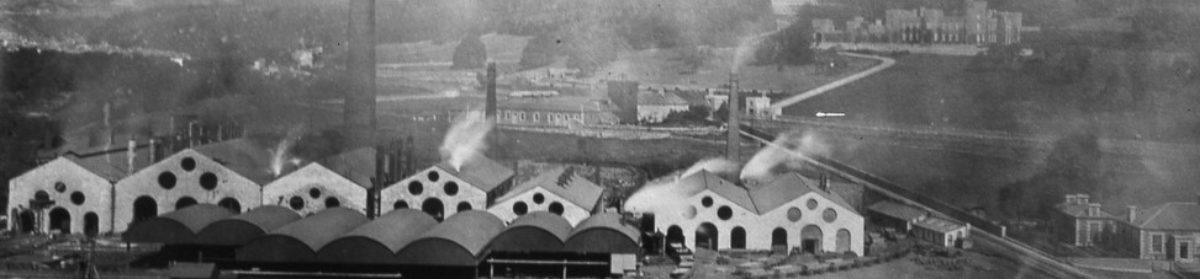
Taff Vale Brewery at Dan-y-Parc. Courtesy of the Alan George Archive

The largest of the local Merthyr breweries was the Taff Vale first located adjacent to the canal near the Old Iron Bridge close to where Merthyr college is today. It opened in in the 1840s and in 1904 moved to a new building in Dan Y Parc, to the south of Thomastown Park. The company was acquired by the Rhymney Brewery in 1936 and brewing ceased at that site. The Rhymney Brewery grew in importance as the dominant brewer and owner of public houses in the locality and in this same year(1936) it bought out a large Pritchard brewery in Crumlin and the last of the Merthyr brewing companies ceased production. In parallel with these 1936 acquisitions the William Hancock brewery in Cardiff purchased the Merthyr Brewery located on the Brecon Road and brewing also ceased there.

At the end of World War II the empty building at Dan Y Parc accommodated O.P. Chocolates and chocolate production continued there until 1963 when the company moved to a brand new factory in Dowlais which still operates today.

Six Bells Brewery. Photo Courtesy of the Alan George Archive

The Six Bells pub had served the people of Heolgerrig however many  may be surprised to learn that a large brewery once stood alongside the original pub. The Heolgerrig Brewery was founded in the 1840s by Thomas Evans until it was destroyed by fire in 1888. He then erected a new building which continued to brew beer until 1916 when it was Purchased by D.F. Pritchard Ltd. of Crumlin. The acquisition of breweries by larger companies became a trend where the new owners closed down local brewing in order to concentrate production at their own brewery. Some years later D.F. Pritchard Ltd. was bought out by the Rhymney Brewery who acquired the “Hobby Horse” trademark as part of that purchase.

Pontycapel Brewery. Photo Courtesy of the Alan George Archive

The Pontycapel Brewery was founded in the early 1800’s by Robert Millar and was later purchased by James Pearce when it became Pearce and Shapton in 1871.It was described as the most picturesque brewery in the country, sited in a wooded area it predated the construction of the Cefn Viaduct which was completed in 1866. Shortly thereafter the name changed to the Cefn Viaduct Brewery especially  known for Star Bright XXXX Pale Ale and production continued until 1921 when there was a post World War I economic downturn.

Photo Courtesy of the Alan George Archive

The Giles and Harrap’s Merthyr Brewery was located on the Brecon Road. An adjacent road was named Brewery Street in an area which was the centre of the Merthyr Irish community and St. Mary’s Catholic church was built a short distance away. In 1936 the brewery was taken over by the William Hancock Company based in Cardiff although the buildings continued to be used as a warehouse and distribution centre for beer and spirits until the Borough Council bought the site. The brewery was the oldest in the locality when it opened in 1830 and so predated the Taff Vale Brewery by about 30 years. Richard Harrap lived in Gwaunfarren House, which later became the Gwaunfarren Maternity Hospital. Both partners built up the business to rival the Rhymney Brewery although in time the Rhymney Brewing Company grew to be larger buying out other brewers. Both companies managed a large number of tied public houses in Merthyr and also sold beer in a large number of local freehold pubs. The Merthyr and Rhymney breweries were to dominate the beer market and their large number of pubs were to have a prominent visual impact in main and side streets spread throughout the locality.

To be continued…….

The Italians in Merthyr Tydfil

By Carolyn Jacob

The story of modern Italian immigration began with a tide of economic migrants in the 19th century. The majority coming from the mountain villages of the North, often as seasonal workers walking overland to French ports. Gradually more stayed and either saved enough to bring their families here or married local women and started families here. They encouraged other family members and friends from their villages to join them in a classic pattern of chain migration. The 20th century saw another wave of immigration, predominantly from the South of Italy and Sicily. A significant number passed through London and branched out to establish communities in South Wales.

Charlie Speroni wrote that leaving the family farm and vineyards in Italy was a major upheaval. As a child in 1927 he arrived in Wales unable to speak a word of English but he was made to feel very welcome. As well as attending school he was expected to work in the family business. During the depression the family rented a fish and chip shop in Penydarren and Charlie was in full time employment working on the chip carts in the winter and the ice cream carts in the summer months. He worked in London for a few years but always returned to Merthyr. Charlie never returned again to Italy and said that “The sky may not be so blue in Wales, but the friendliness of its people make it home.”

Tom Protheroe standing with Mr. Speroni’s Ice Cream cart. Photo courtesy of the Alan George Archive

The Galleozzie family are a Merthyr family! They have been living in Merthyr Tydfil for over 130 years, since Luigi moved here in the 1870s. Martyn Galleozzie, a former Welsh ABA featherweight champion in the 1970s was definitely Welsh.

Photo courtesy of the Alan George Archive

Dominico Basagelao arrived in South Wales in the early 1860s and finding himself in Pantywaun on a snowy winter’s evening he took lodgings with Mr and Mrs Thomas of the Royal Arms Public House. He found work in as a colliery in the South Tunnel Drift Mine. Although a poor Italian and a stranger, he married into the rich Jones (Ceffyl Gwyn) family who were Welsh speaking chapel people.  John Martin Basagelao born in 1868 became a wealthy man. He was the landlord of the Tredegar Arms and the former Red Lion public houses at Dowlais Top.

At the start of World War II Italian nationals were interned as enemy aliens, which many felt to be extremely harsh treatment as they themselves were fiercely  anti-Fascist. Just prior to the Second World War a number of Italian residents in the Borough decided that the time had come to make important decisions and a number made the big step of applying for and achieving British citizenship. Among their number was Giovanni  Bracchi from Troedyrhiw, Giovanni  and  Giuseppe Opel from Treharris and lastly Cesare  Cordani, Merthyr Tydfil  in April 1940.

From the 1880s the Berni family had a café in Pontmorlais, and then John Berni  had a temperance bar and high-class confectionery at 91 High Street.

The Berni Brothers’ Berni Inn at 13 Pontmorlais. Photo courtesy of the Alan George Archive

Mr Barsi  was at one time an electric tram driver but later he ran a fish and chip shop in Penydarren. He was thankfully not interned during the Second World War, having served his adopted country well during the First in the Welsh Regiment.

Mr Barsi in his fish and chip shop at Matthias Terrace, Penydarren. Photo courtesy of the Alan George Archive

The Provini’s came to Cefn Coed from Tredegar and kept the Corner Cafe for many years, there was the Provini fish-bar in Georgetown and they also kept the Wellington in Bethesda Street. Frank and Tony Viazzani  in the Station Café, John Street  were the ticket agents for all  local boxing tournaments and the  walls of the café are  still decorated  by many boxing photographs of Howard Winstone.

Merthyr’s Bridges: A New Bridge at Quakers’ Yard

The article transcribed below appeared in the Merthyr Express 100 years go today…

QUAKERS’ YARD BRIDGE.

A GREAT AND MUCH NEEDED IMPROVEMENT.

MAYOR OF MERTHYR PERFORMS THE OPENING CEREMONY.

In the presence of about 5.000 people, the Mayor of Merthyr (Councillor F. A. Phillips) on Thursday afternoon opened the splendid bridge of reinforced concrete. built by the Corporation at Quakers’ Yard, by cutting a silken ribbon with a pair of silver scissors presented to him by the contractor. Major Rugg of Westminster. Afterwards the Mayor and his party of Aldermen Councillors and friends, drove across the bridge and declared the same open for traffic, after which the children of Woodland School passed across in procession carrying flags.

At a meeting subsequently held the Mayor said:-

Ladies and Gentlemen.—The history of the reinforced concrete bridge which I am privileged to open today dates back as far as 1909, at which time the Town Clerk received a letter from the Road Board stating that advances were available from the Development and Road Improvement Fund in respect of works to highways.

In December, 1910. Councillor Edward Edwards moved a resolution that the attention of the Corporation should he called to the state of the Quakers’ Yard Bridge, and the Borough Engineer, Mr. Harvey, was instructed to report upon a scheme for widening the old structure. In January, 1911, plans were submitted showing the widening of the bridge to 28 feet between the parapets at an estimated cost of £250, and the Council gave instructions for detailed drawings to be prepared, but the matter deferred owing to the difficulties experienced in negotiating with the land owners.

There was now a lapse of ten years before the question was revived, as in January, 1921, two schemes were submitted for the Corporation’s consideration. Scheme No. 1 was for a proposed widening of the old bridge on both sides, destroying the existing arch and constructing in lieu thereof a concrete decking over the river. This proposal was intended to lower the level of the roadway and thus improve the dangerous inclination towards Mill-street. The estimated cost of this work was £1,350.

Scheme No. 2 proposed to entirely divert the main road filling in the Friends Burial-ground and adjoining meadow, culverting the Taff Bargoed for the width of the roadway, together with the necessary masonry wing walls. This proposal was specially recommended to the Council, and sub-committee who visited the site unanimously adopted the same, and abandoned all former proposals as inadequate. The estimated cost of this work was £4,200, the intention being to carry out the necessary filling by tipping house refuse obtained from Treharris and Quakers’ Yard.

When the committee’s resolution was brought before the Council an amendment to the scheme was proposed anti carried on the grounds that the interference with the burial ground was objectionable.

The improvement was again deferred until July, 1922. when the Ministry of Transport intimated to the Corporation that they were prepared to consider schemes of road improvement which would find useful employment for the unemployed during the autumn and winter of 1922-1923. In the same month the Borough Engineer submitted plans and estimates for various road improvements and diversions. one of which was the subject of our meeting to-day.

In view of the trend of former discussions a new line of diversion was chosen and plans prepared showing the non-interference with the Friends Burial-ground, but which involved the removal of the dwelling known as Hawthorn Cottage. The scheme was approved by the Ministry of Transport, and tenders were invited for carrying out the work. The width of roadway was intended to be 30 feet, being 24 feet of carriage-way and one six feet footpath.

When considering the tenders the committee after careful deliberations came to the conclusion that a wider structure would be advantageous, and eventually a 39-feet unit carriage -way with two 5-feet paths, was definitely decided upon.

Messrs. Lewis Rugg and Co., whose tender for the narrower scheme had been provisionally accepted, were asked to quote for the widened structure, and after examples of their work had been seen and approved of they were entrusted with the contract.

The bridge, which has a length of 360 feet, is comprised of 10 spans, each of 30 feet. and one span over the Taff Bargoed of 45 feet, together with a skew span at the lower extremity. The height of the spans vary between 12 feet and 24 feet above the ground level, whilst the river span is 26 feet shove the normal flow of the water. The carriageway on the bridge has a gradient of 1 in 36, and the kerb level of the outer side of the curve is super elevated to the extent of 7½ inches.

The work was commenced in January of this year, so it will he observed that no time has been lost in getting ever many difficulties which have presented themselves. The structure was tested in presence of a Ministry of Transport Official yesterday, when the following trains were passed over the bridge at a speed of six mike per hour: No. 1. a train composed of two 13-ton steam rollers, two 11-ton steam rollers, and two 4-ton lorries; No. 2. two trains composed of two 13-ton rollers side by side, two 11-ton rollers side by side, two 4-ton lorries side by side: No. 3.  trains as in test No. 2, passing in opposite directions. the 13-ton rollers passing each other at the centre of the bridge. The deflection as observed by instrument at three points – one at the centre of the 45-feet span and two at the centres of the 30 feet spans, was negligible, which is highly satisfactory.

The general scheme was designed and the specification and conditions of contract prepared by Mr. A. J. Marshall, Borough Engineer, whilst Messrs. Lewis Rugg and Co., Westminster. were responsible for the carrying out of the work. The cost of the bridge and appurtenant work is £8,650.

Merthyr Express 3 October 1925

Quakers’ Yard ‘New’ Bridge. Photo courtesy of the Alan George Archive

Grade II* Listed buildings

Fifty years ago today a number of Merthyr’s buildings were given a Grade II* listing by CADW. Below is a list of all the Grade II* listed buildings in Merthyr.

Name

Location
Grid Ref.
Geo-coordinates
Date Listed

Notes

Cefn Railway Viaduct

Cyfarthfa
SO0304907597
51°45′31″N 3°24′22″W
7 Nov 1951 Viaduct A dual-listed (see below) structure built in 1866 to carry the Brecon and Merthyr Railway over the Taf Fawr. It was designed by Henry Conybeare and Alexander Sutherland at a cost of £25,000.  The fifteen arches of the 36.6 m (120 ft) high viaduct follow a gentle curve of 235 m (771 ft).
Cefn Railway Viaduct Vaynor
SO0304007795
51°45′38″N 3°24′23″W

7 Nov 1951

Viaduct A dual-listed (see above) structure built in 1866 to carry the Brecon and Merthyr Railway over the Taf Fawr. The viaduct has tall, slender limestone piers, a material originally intended to be used throughout, however, the arches were completed using a contrasting red brick due to a trade union strike by stonemasons.

Pont-y-Cafnau

Park
SO0376507138
51°45′17″N 3°23′44″W

22 August 1975

Bridge An ironwork bridge spanning the River Taff constructed in 1793. The name, meaning “bridge of troughs”, comes from its unusual three tier design of a tramroad between two watercourses, one beneath the bridge deck and the other on an upper wooden structure which is no longer present. Pont-y-Cafnau is also designated as a scheduled monument.

Town Hall

Town
SO0489306371
51°44′51″N 3°22′40″W

22 August 1975

Town hall A Large municipal building designed by Edwin Arthur Johnson in the early Renaissance style and built 1896–98 by Harry Gibbon. Built of red Cattybrook brick with orange terracotta dressings on a base of Pennant Sandstone. Following restoration work it became the Red House, an arts centre, in 2014.

Pontsarn Railway Viaduct

Pant
SO0454309921
51°46′47″N 3°23′06″W

22 August 1975

Viaduct A dual-listed (see below) structure built in 1866 to carry the Brecon and Merthyr Railway over the Taf Fechan. It was designed by Henry Conybeare and Alexander Sutherland. The viaduct is 28 m (92 ft) high and 128 m (420 ft) long.

Pontsarn Railway Viaduct

Vaynor
SO0453409918
51°46′47″N 3°23′07″W

22 August 1975

Viaduct A dual-listed (see above) structure built in 1866 to carry the Brecon and Merthyr Railway over the Taf Fechan. It is constructed of limestone and has tall, slender piers with segmental arches. The Cadw description has seven arches, Newman has eight.

Former Guest Memorial Library

Dowlais
SO0699107880
51°45′43″N 3°20′57″W

22 August 1975

Library A two-storey cruciform building of 1855–1863 built as a memorial to John Josiah Guest of the Dowlais Ironworks. The Dowlais workmen intended for the library and reading room to be funded by subscription, but rising costs led to the building being completed by the company at a total cost of £7,000.

Dowlais Works Blast Engine House

Dowlais
SO0690907739
51°45′38″N 3°21′01″W

22 August 1975

Engine house A 54 m (177 ft) long and 15 m (49 ft) high red brick industrial building constructed in 1905–07 to house three blowing engines as part of the Dowlais Ironworks. The works went into decline in the 1930s and in the late 20th century the building was being used by a chocolate company.

Quakers Yard Railway Viaduct

Treharris
ST0885396473
51°39′35″N 3°19′09″W

1 April 1988

Viaduct A tall stone-built viaduct with six arches that spans both the River Taff and the Merthyr Tramroad. It was constructed 1840–41 by Isambard Kingdom Brunel as part of the Taff Vale Railway and widened by 1861.

Ynysfach Engine House

Cyfarthfa
SO0452406096
51°44′44″N 3°23′04″W

5 Nov 1995

Engine house Built in 1836 as part of the Ynysfach Ironworks, it originally housed an engine made at the Neath Abbey Ironworks. This four-storey building of blue Pennant Sandstone with white ashlar dressings fell into disuse when the Ynysfach works closed in 1874. In the 1980s It was restored and became a museum until closed by the Leisure Trust.

Greenfield Bridge, Penydarren Tramroad

Treharris
ST0902496544
51°39′37″N 3°19′00″W

20 February 2003

Bridge A single arch Pennant Sandstone structure built to replace an earlier wooden bridge that collapsed in 1815 when a train was passing over it. The semi-circular arch has span of 19.2 m (63 ft) at a height of 8.4 m (28 ft) above the river. It is part of the Merthyr Tramroad scheduled monument.

Victoria Bridge, Penydarren Tramroad

Treharris
ST0942396281
51°39′29″N 3°18′39″W

20 February 2003

Bridge A single high-arch bridge over the River Taff similar in design to the nearby Greenfield bridge. Built in 1815 to replace a wooden bridge of 1800–02 it was originally as part of the Merthyr Tramway but is now a footbridge. It is part of the Merthyr Tramroad scheduled monument.

NOTE
The two viaducts constructed as part of the Brecon and Merthyr Railway both straddle the borders of neighbouring historic communities so have separate designations for each of these locations.

A Great Storm at Merthyr

100 years ago today, the Merthyr Express published the following pictures showing the damage caused to the Salvation Army Citadel earlier in the month.

Merthyr Express – 24 January 1925

The New Year in 1925 was ushered in with terrific storms which lasted for several weeks.

The bad weather began over the Christmas period and affected most of Wales and Southern England. On New Year’s Eve the storm intensified with high winds, thunder and lightning, torrential rain and hail. Lightning struck the winding plant at No 1 Pit at Deep Navigation Colliery in Treharris, damaging the the electric motor and compressor. Luckily no-one was injured, but several miners were trapped underground, eventually escaping via No 2 pit where the winding gear was steam powered. The plant was again hit by lightning on Sunday 4 January, damaging the turbine engine which was being used to supply electricity to the plant whilst the machinery damaged on New Year’s Eve was being repaired.

That same weekend saw the full force of the storm affecting other parts of Merthyr. Dozens of houses had slates blown off their roofs, and a large portion of the roof at Cyfarthfa Stables was torn away.

The worst damage was done when the Morlais Brook overwhelmed the culvert that carried it underneath the road next to the Salvation Army Citadel. The culvert collapsed and severely damaged the foundations of the building.

As a result, the Citadel, which had formerly been Morlais Chapel had to be demolished, and a new building was erected in its place.

Merthyr’s Lost Landmarks: The Huts, Treharris

In the late 1860s, a mineral lease of over 3,000 acres of land, owned by three farms, Twyn-y-Garreg, Pantanas and Cefn Forest was exploited by a group of businessmen, headed by Frederick. W. Harris. There was no settlement here in those days just a beautiful green valley which was dissected by the small Taff Bargoed river.

Sinking commenced in 1873, and the colliery was to be named Harris’s Navigation Colliery (later Deep Navigation Colliery), the village which built up around it was subsequently names Harris’ town or Treharris.

In 1869, a row of small houses was built for the families and men who were to be employed to sink the pit. This small street was named the Twyn-y-Garreg Cottages, but have always been known locally as ‘The Huts’. There were 32 houses, and they mostly consisted of a kitchen and two bedrooms, although No.1 the Huts had four bedrooms, which the Minnett family of two adults and ten children occupied. These houses were made of wood and had hessian ceilings which were whitewashed, stone or brick chimney stacks and slate roofs. The rent was 7s. 8d.

‘The Huts’. Courtesy of the Alan George Archive

There was a commercial bakery at the Huts, and the first school lessons and religious services in the area were held there too.

Remarkably these huts survived until the 1950’s when they were finally demolished. A new street is built on the site now, and is called Navigation Close.

‘The Huts’ in 1936. Courtesy of the Alan George Archive

Merthyr Gliding School

by Laura Bray

During the Second World War an initiative was introduced in the form of Gliding Schools.  The schools came out of the Air Training Corps, itself a successor to the Air Defence Cadet Corps, which had been founded in 1938 with the aim of training boys aged between 14 and 18 in “all matters connected with aviation”.

The ADCC was a huge success – it organised itself into squadrons of 100 boys subdivided into 4 “flights” and within 5 months of its foundation, 41 squadrons had been formed. During 1939 more than 16,000 boys and 700 officers were members of the ADCC.

Indeed, by 1940, ADCC was making such a contribution to the recruitment for the RAF that it was decided by the War Cabinet to establish an organisation to provide pre-entry training for candidates for aircrew and technical duties for both the RAF and the Fleet Air Arm. Thus the Air Training Corps was born. It became one of the most important pre-service training organisations, providing the RAF with recruits who were “air-minded” when they enlisted.

Merthyr, it will not surprise you to learn, had an ATC, founded in the summer of 1941, and on 5th August 1944, a gliding school was opened, by Air Marshall Sir Robert Brook-Popham. The Gliding School was situated at the top of the Swansea Rd, and the opening was attended by the usual civic dignitaries. Before the presentation ceremony, the officers of the various squadrons in the area, the cadets and members of the Women’s Junior Air Corps were inspected by the Air Marshall. It was noted that Merthyr had sent several hundred boys into the RAF from the ATC and that they had benefited hugely from the training they had received there, training which would now include gliding. Indeed, so committed were the ATC to this that the boys had worked all winter to build a hanger for their glider, without any help from the Air Ministry or Council and squadrons from Aberdare, Treharris and the surrounding area would be using the base as part of their training.

It is clear from the Merthyr Express report of 5 August 1944 which covered the opening, that the ATC sent boys into the army as well as the RAF, as Air Marshall Brook-Popham was keen to stress that the skills learnt in the glider school were just as valuable to that branch of the armed services.

The Gliding School was disbanded in 1945 and is now largely forgotten – unless perhaps you were there…..

Merthyr Historian volume 33

The Merthyr Tydfil and District Historical Society is pleased to announce the publication of Volume 33 of the Merthyr Historian.

Contents:

  • A Local History Appreciated (‘The Story of Merthyr Tydfil …’ 1932) by Huw Williams
  • Merthyr Tydfil & District Historical Society: helping the historians of the future (The Welsh Heritage Schools Initiative Awards) by Clive Thomas
  • The history of Garthnewydd House by Lucy Richardson
  • Creating Merthyr Tydfil Educational Settlement (1930-1949): a view from behind the scenes by Christine Trevett
  • “Eisteddfod Merthyr Tydfil a’r Cylch”1958-1962 by John Fletcher
  • Japanese naval commander at Merthyr 1902 (transcription) by T. Fred Holley & John D. Holley
  • Mary Emmeline Horsfall, the lady of Gwernllwyn House: art, philanthropy and the workless in Dowlais by Christine Trevett
  • A Merthyr man’s wartime service in His Majesty’s Royal Navy by Brian, Peter & Barrie Jones
  • The dark side of convict life: an account of the career of Harry Williams (b. 1876), a Merthyr man by Barrie Jones
  • The White Horse, Twynyrodyn in the 19th century by Richard Clements
  • The first Aeronaut (balloonist) in Merthyr, 1847 (transcription)
  • Evacuees in the Borough’s Wards: ‘Merthyr welcomes evacuees…’ (transcription, 1940) by Stephen Brewer
  • Putting Merthyr Tydfil on the map by Clive Thomas
  • ‘Honouring a Dowlais Musician. Complimentary Concert …’ John Evans (Eos Myrddin) 1841-1905. A transcribed report from the Merthyr Times 1893 of ‘A Grand Performance’ by T. Fred Holley & John D. Holley
  • Gurnos Farm and the Cyfarthfa Estate by Alison Thomas Davies
  • Treharris pit-head baths and The Lancet 1908 (transcription)
  • The Lavernock tragedy 1888 and its Aberfan memorial by Stephen Brewer
  • The ‘earthly Eden’ which was dry and rustic Trelewis (newspaper items and editor’s commentary)
  • Chess in Merthyr by Martyn Griffiths
  • Lewys Glyn Cynon, Merthyr Vale poet by T. Fred Holley & John D. Holley
  • Calling local historians: banking and boxers by Stephen Brewer & Christine Trevett

This 324 page book is available to buy from the Merthyr Tydfil & District Historical Society for £13.

If you would like a copy, contact me at merthyr.history@gmail.com and all orders will be forwarded to the Society.

New Pithead Baths for Treharris

by Laura Bray

It was 90 years ago (1st November 1933) that the new pithead baths at the Ocean Colliery (Deep Navigation) in Treharris were opened, at a cost of £20,000 paid for by the Miners’ Welfare Committee. The baths replaced those first opened in 1916 – the first pithead baths in the country.

The original pithead baths. Photo courtesy of the Alan George Archive

It is hard at this remove to appreciate what a radical effect the pithead baths had on miners and their families. Imagine coming off a long shift underground, caked in coal-dust, mine-water and sweat and then getting yourself as clean as you can in a tin bath, which you wife had hauled in front of the fire and filled. See her steeping over and around children underfoot, carrying hot water in big, heavy jugs, water sloshing over the rim. Indeed, one South Wales coroner claimed that he conducted more inquests into the deaths of children who were scalded than he did into miners who were killed underground.

And then emptying the tin bath outside, carrying it through the house. Imagine the coal dust that wasn’t shaken off, settling around the house, like sand, getting into every nook and cranny. Imagine having to wash those clothes, by hand, and hanging them to dry over the fire. And this is your life day, after day. Miners themselves were prone to rheumatism, pneumonia and other respiratory conditions; the women, to back-breaking and heavy work, often leading to miscarriages or premature births.

Now move your mind forward to 1916: you, a miner in Treharris, are able to use the first pithead bath in Britain. Now you have proper changing and washing facilities; you go home clean. Your wife now longer has to cope with the dirt from the pit, no longer has to fill the bath. You are both heathier, your children less at risk of injury. Can you imagine the difference that made?

It took 30 years of campaigning to get pithead baths into every colliery but in 1926 the Mining Industry Act allowed for a “Royalties Welfare Levy” of 1 shilling in the pound, paid to the Miners’ Welfare Fund, which was instructed by the fact to make provision for the baths. From 1921 to 1952, over 400 baths were built across Britain. The Miners’ Welfare Committee’s own architects’ department established the most cost-effective way of constructing, equipping and operating baths buildings and by the 1930s, a ‘house style’ had developed, based on the ‘International Modern Movement’ of architectural design, which used flat roofs, clean lines and the plentiful glass, to give a natural light and airy feel.

The new pithead baths opening in Treharris in November 1933, are described as being 145 x 96 feet, built of red brick and able to accommodate 1824 men. Each man had 2 separate lockers, one for clean clothes and one for dirty, and a jet of hot air was passed through lockers to dry the clothes, wet towels etc. The baths boasted 112 cubicles, in white glazed brick, with adjustable-temperature showers, mirrors and electricity. The building also housed a first aid room, boot cleaning machine, drinking fountains and “lavatory accommodation”.

The new pithead baths. Photo courtesy of the Alan George Archive.

The opening was a prestigious event, attended by the great and good of the Borough, including the manager of the Deep Navigation Mine, the Director of the Ocean Coal Company, the Mayor, Aldermen and a crowd of 100s, of which about half were women. It is noted that they were the 18th baths to be built in South Wales, and the 121st nationwide, with another 35 in construction. The speeches acknowledged the difference the baths made to the community and particularly to the ladies, as the baths “stood for cleaner homes and a higher standard of life”. It is interesting that the speeches were directed at the women, who should use their influence to get their men to patronise the baths; and that the men, if they had any regard for their wives, would do so. As if to reinforce the message, the baths were opened to public viewing before they were put into use. So clearly, there was reluctance in some quarters still, to use them, despite baths having been available for 20 years.

The Miners’ Welfare Committee retained responsibility or the pithead baths until the nationalisation of the coal industry in 1947, when its remit passed to the National Coal Board.

The baths in Treharris are long gone now, but if you want to see a example of the pithead baths today, the one in Big Pit in Blaenavon is open, and is worth a visit, standing as a testimony to a revolution in colliers’ lives.