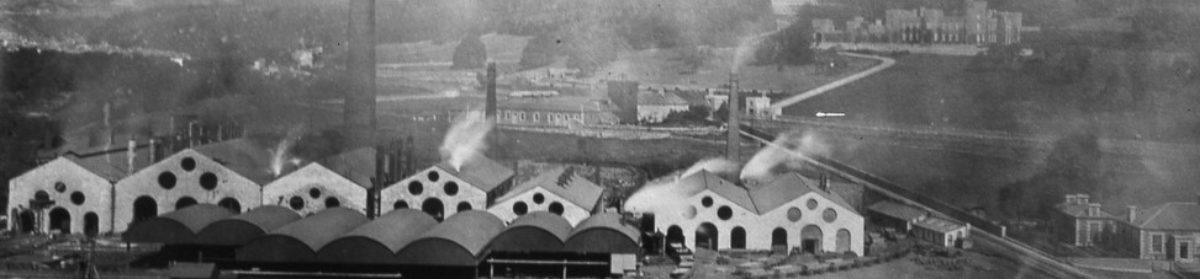
Dan y Castle Farm

by Alison Davies

With the proposed water treatment works at Dan y Castle Farm I have been inundated with messages asking for the history of the farm.

Dan y Castle , Llwyn Molgoch.

Dan y Castle Farm – or, to give it, its original name Llwyn Molgoch is a farmstead below Pontsarn Road, it nestles in the summer shadows, southwest of the Brynar and Morlais Castle hill.

With the building of a new road alongside the heads of the valleys, the land it is now visible from the roadside.

The site of the farm with Morlais Castle to the right

There has been a farmstead on this site since at least the 1500s, with earliest records naming it as Tir Llwyn Molgoch as part of the original Tir y Gyrnos Farm in 1640s with it eventually being sold in the early 1700s.

The original name Llwyn Molgoch was translated as ‘Bush of the red summit’, by Charles Wilkins, 1904.

Wilkins wrote, that, ‘tradition at the farm was, that Molgoch was a warrior, who, when escaping his enemies, sort shelter in a bush, where he was captured and killed’.

While, John Griffiths, writing about The Farms in the Merthyr Valley in 2011 gave two possible explanations, one, of Molgoch as, either, meaning’ Red Hill’ or secondly ‘the farm at ‘Molgoch Grove’ where he gives Molgoch as a name, or nickname. Griffiths further questioned, that, in some Welsh directories Moloch meant terror or dread.

There are a variety of spelling variations for Llwyn molgoch.

Lloyne moyle Goch – 1756 Gyrnos sale

Llwynmoelgoch – 1839 Merthyr Telegraph.

Glamol Yoch – 1850s Tithe map.

While, I am neither able to prove, or disprove its early origins, we will look at its significance and growth as one of the most important estate farm lands throughout the 1800s in Merthyr, and, how it became an integral piece of Merthyr’s history.

By the early 1800s Llwyn Molgoch had been separated from the original Gyrnos farm and was now part of the Penydarren Ironworks Estate land.

It was here at Llwyn Molgoch on May 13th 1813 that David Davies was born. He would grow up to be one of the most influential businessmen in 19th century South Wales.

While of interest is that his father, Thomas, rolled the first Iron rail at the Penydarren Ironworks and in South Wales.

David began work at Penydarren iron works firstly as a door boy at a young age, then training as a cutter man. Through his skill as a cutter, he was noted to have improved the manufacture of nail iron at Penydarren.

David left Penydarren works to take on the College Lock Ironworks in Llandaff, Cardiff.

By the early 1860s, he had then become the general manager at Gadlys Ironworks until 1863, when, he was drawn back to his native Merthyr. With his business partner, Thomas Williams he purchased the Penydarren estate and its works where he lived until 1884. From there, he became a partner, and later sole proprietor of the famous Beaufort Tinplate Company in Morriston, and Alderman, JP Swansea.

David Davis died September 1894 aged 81 years. The newspapers of the day ran extensive tributes to his achievements.

He is buried alongside his first wife in Cefn Cemetery.

By the 1830s Llwyn Molgoch was now in the ownership of the Crawshay family, and part the Cyfarthfa Estate. In the farmhouse where David Davies was born, now lived one of the first gamekeepers to the Crawshay family Thomas Havard who later moved to the newly built Gurnos Model Farm.

A succession of gamekeepers went on to live at Llwyn Molgoch. There was an ongoing problem with poaching on the Cyfarthfa Estate. From the front door, just two fields away, stood a folly, a stone tower known as the ‘keepers Tower’. It still stands today but is now surrounded by houses in New Gurnos, near to Pen y Dre School.

Keepers Tower

From this tower the gamekeepers would patiently wait for the poachers and their dogs, this elevated view allowed the gamekeepers to track the poachers across the land. Looking at Ariel photos today you can still see a well-trodden pathway leading from Llwyn Molgoch to the tower.

The land here is a pre industrial landscape undeveloped.

The history of the Cyfarthfa Estate is too important to be brushed aside, too important to be ignored, forgotten and built over. The act of preserving or preservation isn’t for the here and now . It’s for the future, a gift of preservation of our heritage for a generation or generations to come.

In 2025 , to mark the 200th year of Cyfarthfa Castle, Merthyr Historical Society and Cyfarthfa Castle produced a book called Cyfarthfa Castle and Park 1825 -2025. A people’s History. Here on page 41 is an article by Christine Trevett. This article, titled Class, clashes and Crawshay Land. The article formally acknowledges the history, and the importance of the Cyfarthfa estate and its lands. It was chosen, I’m sure by the author for its weight of significance.

In writing about it, she shows how very important this landscape is.

Now acknowledged in print, its history stands for the future. Its future should be preserved, therefore, now is the time, time for, Merthyr Historical Society, Cyfarthfa Castle, Cyfarthfa Foundation and Merthyr Tydfil County Borough Council to stand up for our history, and Heritage.

To see more of Alison’s fantastic research about Pontsarn and Vaynor, please follow this link: https://www.facebook.com/groups/747174317220437

Merthyr Historian volume 33

The Merthyr Tydfil and District Historical Society is pleased to announce the publication of Volume 33 of the Merthyr Historian.

Contents:

  • A Local History Appreciated (‘The Story of Merthyr Tydfil …’ 1932) by Huw Williams
  • Merthyr Tydfil & District Historical Society: helping the historians of the future (The Welsh Heritage Schools Initiative Awards) by Clive Thomas
  • The history of Garthnewydd House by Lucy Richardson
  • Creating Merthyr Tydfil Educational Settlement (1930-1949): a view from behind the scenes by Christine Trevett
  • “Eisteddfod Merthyr Tydfil a’r Cylch”1958-1962 by John Fletcher
  • Japanese naval commander at Merthyr 1902 (transcription) by T. Fred Holley & John D. Holley
  • Mary Emmeline Horsfall, the lady of Gwernllwyn House: art, philanthropy and the workless in Dowlais by Christine Trevett
  • A Merthyr man’s wartime service in His Majesty’s Royal Navy by Brian, Peter & Barrie Jones
  • The dark side of convict life: an account of the career of Harry Williams (b. 1876), a Merthyr man by Barrie Jones
  • The White Horse, Twynyrodyn in the 19th century by Richard Clements
  • The first Aeronaut (balloonist) in Merthyr, 1847 (transcription)
  • Evacuees in the Borough’s Wards: ‘Merthyr welcomes evacuees…’ (transcription, 1940) by Stephen Brewer
  • Putting Merthyr Tydfil on the map by Clive Thomas
  • ‘Honouring a Dowlais Musician. Complimentary Concert …’ John Evans (Eos Myrddin) 1841-1905. A transcribed report from the Merthyr Times 1893 of ‘A Grand Performance’ by T. Fred Holley & John D. Holley
  • Gurnos Farm and the Cyfarthfa Estate by Alison Thomas Davies
  • Treharris pit-head baths and The Lancet 1908 (transcription)
  • The Lavernock tragedy 1888 and its Aberfan memorial by Stephen Brewer
  • The ‘earthly Eden’ which was dry and rustic Trelewis (newspaper items and editor’s commentary)
  • Chess in Merthyr by Martyn Griffiths
  • Lewys Glyn Cynon, Merthyr Vale poet by T. Fred Holley & John D. Holley
  • Calling local historians: banking and boxers by Stephen Brewer & Christine Trevett

This 324 page book is available to buy from the Merthyr Tydfil & District Historical Society for £13.

If you would like a copy, contact me at merthyr.history@gmail.com and all orders will be forwarded to the Society.

Lord Buckland – 17 September 1877–23 May 1928 – part 2

BOWEN, BERRY, and BILBO BAGGINS

By Irene Janes

continued….

During the First World War, the government urged people to donate money to help build tanks. When it was Tank Week in Merthyr Tydfil, Seymour rose to the challenge and our town beat all other towns in raising one million pounds in today’s money. As a thank you, Merthyr was given the tank that had toured the country helping to raise funds.

The tank at Cyfrathfa Park. Photo courtesy of http://www.alangeorge.co.uk/index.htm

In 1919 Berry bought Gurnos Farm and its five hundred acres.

Berry admitted to being a gambler especially on the stock exchange. In hindsight, I think he won more than he lost and to our benefit.

He organised a Merthyr Tydfil Peace Memorial, £15,000 was raised which was distributed amongst the needy ex-servicemen and their dependents.

In 1920, with his brother, wife and David R. Llewellyn, Berry acquired John Lysaght and became its Chairman until it became part of Guest, Keen and Nettlefolds. Two years later he bought the Buckland estate in Bwlch, which included two thousand and six hundred acres and four miles of salmon fishing in the River Usk.

Buckland Hall

During this year the Conservative, Liberal and Constitutional Labour Parties all asked him to stand as a member of parliament for Merthyr Tydfil. He declined the offers.

In 1923 The Borough Council gave him the freedom of Merthyr Tydfil, and the following year he was invested as a Knight of Grace, Order of St John of Jerusalem. He held the office of High Sherriff of Brecknockshire. However, he still remembered his roots. An open-air baths had become derelict. Thanks to his interest and financial support the baths were renovated and had the added luxury of a roof, now fondly remembered as Gwaunfarren Baths.

Gwaunfarren Baths shortly after it opened. Photo courtesy of http://www.alangeorge.co.uk/index.htm

In 1926, in the Kings Birthday Honours List, he became Baron Buckland of Bwlch for his public, political and philanthropic service. Nevertheless, to Merthyr people he is best known as how he should be addressed, that of Lord Buckland, and the following year he again became a Chairman of G.K.N. (previously known as Guest, Keen and Nettlefolds).

His philanthropic work is well-known. He bought the Carlton Workingman’s Hotel (we now know it as the Merthyr Ex-Service Mens Club), and Edwardsville School, Merthyr Tydfil Football Club and Dowlais Choir are just a few of the organisations who benefited from his financial donations. £12,000 was given for a new wing for the town’s General Hospital.

He gave land and money for the building of Sandbrook Sanatorium at Pontsarn, which he named after his father-in-law. He was a Freemason and belonged to Loyal Cambrian Lodge No 100 in Merthyr Tydfil.

On Wednesday, 23 May 1928. Lord Buckland greets his favourite bay mare and the estates stud groom, Henry Weaver, outside Buckland House. They ride to the meadow for a fast morning gallop. He turns to speak to Weaver, riding a horse behind. A shout goes out “Mind the post my Lord”. His master tries to turn. Collision with the telegraph post is unavoidable. Berry’s head smashes into it and he is unseated. Weaver runs to the house to alert the butler who dashes to the scene of the accident. Estate workers unhinge a gate to use as a stretcher. He is driven to hospital by car. Berry is dead.

This was just days before he and Lady Buckland were due to attend the Cyfarthfa Park Carnival where they were to crown the May Queen.

On Friday 26 May, vast crowds gathered around the Congregational Chapel in Market Square, where Berry had been a lifelong member. With the funeral service over the cortège proceeded down the valley to Pontypridd Crematorium. Along the way crowds gathered to pay their last respects to the man who did so much to give Merthyr residents a better quality of life. Apparently his ashes were scattered to the four winds. Without a male heir, his title of Lord Buckland became extinct.

There is so much more I could add. It is with little wonder there is a statue to Lord Buckland outside the central library it is in recognition to the high ideal of citizenship displayed in his generous gifts for the alleviation of suffering in the town and for increasing the happiness and prosperity of his fellowmen.

5 June 1931 saw the official opening of the Lord Buckland Memorial Hospital. After his death a fund was set up and over 50,000 contributed. The largest of the amounts came from his widow and his two brothers, which by now were also Lords, but their stories are not for now.

Lord Buckland Memorial Hospital

Even in death, his philanthropy lives on.

He left shares to be put into trust. The income applied to help the poor of Merthyr Tydfil. 1,000 shares to provide annual prizes to the pupils of Abermorlais, Cyfarthfa and County Schools. Perhaps you have a book given to you on prize giving day with a black oval stamp on the first inside page saying it was donated by Lord Buckland).  1,000 shares to Market Square Church.

The trust aims have had to be amended as the Abermorlais and County Schools have long gone. The charity aims are for ‘The relief, or assistance of the necessitous and deserving poor persons over the age of 30 years born or resided in the borough for 10 years’. Someone told me his grandmother had ten shillings a week from the fund, I suspect it would be more than 50p now. It is still active today and the appropriate agencies who are in contact with those in need can apply to the trust on their behalf. The 5 April 2019 trust accounts shows this year they donated £68,329.

BAGGINS  – A connection

Bilbo Baggins is a name many are familiar with through a series of books by J.K. Tolkien.

In 1940 Tolkien had begun writing The Lord of The Rings. As a busy academic he chose Tal-y- Bont for a holiday and a chance to continue with his writing. A researcher from the Lord of The Rings Production Company is completely convinced the following places were the source of Tolkien’s inspiration. The Shire where the Buckleberries live, and child hood home of Frodo Baggins is based on the Buckland Estate with the curve of the river. Crick Hollow inspired by Crickhowell. Tredegar became Fredegar. The Merthyr Steel works possible Mordor. I wonder what Lord Buckland thinks about his old estate being the inspiration for the books and films. Yet another way the name Buckland continues to give.

I wonder what Tommy, Alfred, Marshall and my grandfather John Moses thought of their ex school teacher as he rose through society ranks and become rich beyond their dreams.

So back to where all this began, researching my family tree. I realised something, my grandfather was actually a child, and I thought he was born forty years old, with a balding head, collarless shirt with rolled up sleeves, black tatty waistcoat, black trousers with turn-ups and braces.

Statue of Lord Buckland outside Merthyr Central Library

Thanks to Irene for this fascinating article.

There will be more coming about the Berry brothers soon.

The Meaning of ‘Gurnos’

Gurnos
by Carl Llewellyn

Some time ago I read an article in an old edition of the Merthyr Express. It was written by a J.R. Evans of Aberdare who complained that many local Welsh place names were incorrectly spelt; he then gave his interpretation why places in our locality were so named. Many Welsh place names were bestowed centuries ago and were often descriptive of their pictorial detail. Perhaps because these place names were seldom written, and again because of the inability of the English to pronounce Welsh words, in some cases these words become so changed in form they become unrecognisable and unintelligible, with the original signification being entirely lost.

Examples of the mutilation of Welsh place names can be found in “Lechwedd” (meaning a slope) has become “Leckwith” near Cardiff, and “Rhaiadr” (water fall) becoming “Radyr”. When referring to the name Gurnos, it immediately brings to mind one of the UK’s largest Housing estates situated near Prince Charles Hospital to a majority of people but most of them are not aware of its origin and translation. We often find the name of parts of the body are used in place names. For instance we speak of head or top of a hill, for instance  Penydarren, (pen, head or top; y, of the; darren, a rocky hill) also Troedyrhiw (troed, foot; y, of the; rhiw slope). So the word “Cern” meaning “side of the head”, is applied similarity to the side of the hill, which perhaps has an even surface resembling earth moulds protruding on the side of the hill. There is a diminutive plural suffix “os”, when appended to “Cern” gives us “Cernos”, The placing of the letter “y” before the word modifies it into “Y Gernos”, meaning the lower side of the hill. In the opinion of J.R. Evans “Y Gernos” has been incorrectly spelt by some as the “Gurnos”.  I tend to agree with J.R. Evans over the centuries it’s possible the word has been corrupted either by incorrect spelling or pronunciation. On the site of Gurnos Housing Estate once stood the “Gurnos” farm whose name aptly describing its location.

Gurnos Farm by Penry Williams. Photo courtesy of http://www.alangeorge.co.uk/index.htm

Charles Wilkins in his History of Merthyr Tydfil calls the farm “Gyrnos” and gives it derivation as “Carn-nos” (carn, a heap of stones; nos, night), signifying “Night Watch Beacon” stating that it may have reference to the warfare day of the district. You the reader must make up your own mind on the explanations for the Welsh word “Gurnos”. I concur that Charles Wilkins reference is a romanticised version while J.R.Evans interpretation has more of a down to earth explanation.

These differing points of view reminded me of a television series, “The Dragon Has Two Tongues”, where Wynford Vaughan-Thomas, and Professor Gwyn Alf Williams gave their own passionate satire about Wales.