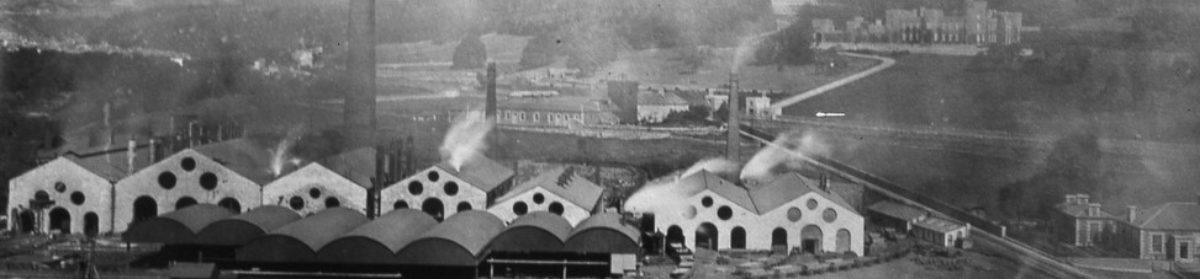
Dan y Castle Farm

by Alison Davies

With the proposed water treatment works at Dan y Castle Farm I have been inundated with messages asking for the history of the farm.

Dan y Castle , Llwyn Molgoch.

Dan y Castle Farm – or, to give it, its original name Llwyn Molgoch is a farmstead below Pontsarn Road, it nestles in the summer shadows, southwest of the Brynar and Morlais Castle hill.

With the building of a new road alongside the heads of the valleys, the land it is now visible from the roadside.

The site of the farm with Morlais Castle to the right

There has been a farmstead on this site since at least the 1500s, with earliest records naming it as Tir Llwyn Molgoch as part of the original Tir y Gyrnos Farm in 1640s with it eventually being sold in the early 1700s.

The original name Llwyn Molgoch was translated as ‘Bush of the red summit’, by Charles Wilkins, 1904.

Wilkins wrote, that, ‘tradition at the farm was, that Molgoch was a warrior, who, when escaping his enemies, sort shelter in a bush, where he was captured and killed’.

While, John Griffiths, writing about The Farms in the Merthyr Valley in 2011 gave two possible explanations, one, of Molgoch as, either, meaning’ Red Hill’ or secondly ‘the farm at ‘Molgoch Grove’ where he gives Molgoch as a name, or nickname. Griffiths further questioned, that, in some Welsh directories Moloch meant terror or dread.

There are a variety of spelling variations for Llwyn molgoch.

Lloyne moyle Goch – 1756 Gyrnos sale

Llwynmoelgoch – 1839 Merthyr Telegraph.

Glamol Yoch – 1850s Tithe map.

While, I am neither able to prove, or disprove its early origins, we will look at its significance and growth as one of the most important estate farm lands throughout the 1800s in Merthyr, and, how it became an integral piece of Merthyr’s history.

By the early 1800s Llwyn Molgoch had been separated from the original Gyrnos farm and was now part of the Penydarren Ironworks Estate land.

It was here at Llwyn Molgoch on May 13th 1813 that David Davies was born. He would grow up to be one of the most influential businessmen in 19th century South Wales.

While of interest is that his father, Thomas, rolled the first Iron rail at the Penydarren Ironworks and in South Wales.

David began work at Penydarren iron works firstly as a door boy at a young age, then training as a cutter man. Through his skill as a cutter, he was noted to have improved the manufacture of nail iron at Penydarren.

David left Penydarren works to take on the College Lock Ironworks in Llandaff, Cardiff.

By the early 1860s, he had then become the general manager at Gadlys Ironworks until 1863, when, he was drawn back to his native Merthyr. With his business partner, Thomas Williams he purchased the Penydarren estate and its works where he lived until 1884. From there, he became a partner, and later sole proprietor of the famous Beaufort Tinplate Company in Morriston, and Alderman, JP Swansea.

David Davis died September 1894 aged 81 years. The newspapers of the day ran extensive tributes to his achievements.

He is buried alongside his first wife in Cefn Cemetery.

By the 1830s Llwyn Molgoch was now in the ownership of the Crawshay family, and part the Cyfarthfa Estate. In the farmhouse where David Davies was born, now lived one of the first gamekeepers to the Crawshay family Thomas Havard who later moved to the newly built Gurnos Model Farm.

A succession of gamekeepers went on to live at Llwyn Molgoch. There was an ongoing problem with poaching on the Cyfarthfa Estate. From the front door, just two fields away, stood a folly, a stone tower known as the ‘keepers Tower’. It still stands today but is now surrounded by houses in New Gurnos, near to Pen y Dre School.

Keepers Tower

From this tower the gamekeepers would patiently wait for the poachers and their dogs, this elevated view allowed the gamekeepers to track the poachers across the land. Looking at Ariel photos today you can still see a well-trodden pathway leading from Llwyn Molgoch to the tower.

The land here is a pre industrial landscape undeveloped.

The history of the Cyfarthfa Estate is too important to be brushed aside, too important to be ignored, forgotten and built over. The act of preserving or preservation isn’t for the here and now . It’s for the future, a gift of preservation of our heritage for a generation or generations to come.

In 2025 , to mark the 200th year of Cyfarthfa Castle, Merthyr Historical Society and Cyfarthfa Castle produced a book called Cyfarthfa Castle and Park 1825 -2025. A people’s History. Here on page 41 is an article by Christine Trevett. This article, titled Class, clashes and Crawshay Land. The article formally acknowledges the history, and the importance of the Cyfarthfa estate and its lands. It was chosen, I’m sure by the author for its weight of significance.

In writing about it, she shows how very important this landscape is.

Now acknowledged in print, its history stands for the future. Its future should be preserved, therefore, now is the time, time for, Merthyr Historical Society, Cyfarthfa Castle, Cyfarthfa Foundation and Merthyr Tydfil County Borough Council to stand up for our history, and Heritage.

To see more of Alison’s fantastic research about Pontsarn and Vaynor, please follow this link: https://www.facebook.com/groups/747174317220437

Ffynnon Llysiog

by Richard Parfitt

It was back in 2005 when I was freelancing as a Mountain Leader, I was researching different walks for the ‘Discovering in the South Wales Countryside Course’ for the Summer School at the University of Glamorgan, is when the manager, Director, Clive Roberts of Outeractive (R), who I was working for, asked me if I wanted to borrow a book on the history of Vaynor. (One of the areas I decided to walk that year).  Clive had a vast wealth of knowledge and experience of the outdoors and many contacts, after being the manager of Dolygaer (Mid Glamorgan) Outdoor Centre. When I received the book from Clive. It was falling apart. With many loose pages. However, inside there were many interesting stories about Morlais Castle and the Battle of Maesvaynor with the two disputing Marcher Lords who were at war, due to boundary disputes and where King Edward the First had to intervene.

As I pondered over this little book, ‘Vaynor, its history and guide’, written by the Reverend J.E. Jenkins, Rector 1887, I came across the story of ‘Llysiog Well’.

Llysiog Well

This is a noted well. For the healing of Scrofula wounds, sores, ulcers and all skin diseases. It is situated in the upper part of the parish, on the side of the hill above Ynys Fawr Farm. The distance by the pathway over the hill from Pontsarn station. Is about four miles, and about 5 miles along the high Road from Coed Cymmer or Cefn station. Years ago, this well was better known than it is today. For ages it was the ‘Llanwrtyd’ of South Wales and Monmouthshire and will be so again, when the light railway. From Coedcymmer, via Cwm Taf Fawr, Devynog and Llandovery, will be constructed. Many and wonderful are the narratives told of cures effected by using this water. At present, the annual average number of people visiting well is about 300 (in 1897). A large quantity of the water is carried away to people who are unable to attend. The water is free like the mountain air. There are several love stories connected with it which I hope to give in a future page. A party starting from Pontsarn on after the arrival of the morning, trains on a fine day may be back in good time for luncheon and at one of the hotels or at any of the houses where visitors are received. It is now suggested that some arrangements should be made to have this noted* water for sale. Near Pontsarn during the summer months.

This is extracted from ‘Vaynor: Its History and Guide’ by Rev J.E. Jenkins Rector 1897

Even though I did not include a walk to the famous well of 1887 that year. I had talked about visiting it many times later, with Clive, but we just never seemed do the walk. Everything is for a reason! I often wondered if the water really did have healing powers or was it just a placebo of belief by our ancestors. Nevertheless, I had this nagging feeling that something might be in the water that really did do what the Rev Jenkins said it would, cure many locals in this way; and why would this man of the cloth, have had reason to include it in his book.

When researching I first looked at the geology of the location and realised that it was in the area between the ‘Old Red Sandstone’ that is found near Pen-y-Fan and the Carboniferous Limestone running down into Merthyr Tydfil in the south. In the area of Ffynnon Llysiog is a thin band of Grey Millstone Grit, it is also near to the Neath fault. I wondered if there were any traces of sulphur? When I was growing in my early teens, I remembered my mother giving me regular spoonfuls’ of flower of sulphur and honey to prevent me getting any spots or rashes that many teenagers have at that age. I must admit I went through my teenage years without acne or even a spot.

While trawling for any information I could find on Ffynnon Llysiog or the Rev J E Jenkins. I found information that the Rector of Vaynor was also a Welsh Bard whose bardic name was ‘Ceridiol’ and he had written a Welsh poem with the word ‘Llysi’ in one of the verses. The word Llysi or Llysiog means Herb/vegetable in English.

While tracing the area I found a page on the internet relating to a naturalist Mary Gillham MBE who authored many books on the areas of South Wales. She had been a lecturer in the University of Cardiff and was famous for a research career working on the vegetation of Sea birds and Islands around the world.

Mary’s page and photograph with the heading Nant Llysiog Water and Geologies, it further stated: above Llwyn On of the two branches of Nant Wern Ddu – November 1971 – and there in Black and white – “Iron Hydroxide” deposited when stream Ffynnon Llysiog enters, healing properties. This was only the second time there seemed evidence, that Mary recognised the water had healing properties, probably, due to the Iron Hydroxide. (I shouted “Bingo”). I was relieved that this place was special and come the spring to summer of 2024 I would be visiting it.

Further research around Mary Gillham highlighted a book co-written by her – The Historic Taf Valleys, Volume Two in the Brecon Beacons National Park by John Perkins, Jack Evans and Mary Gillham. This is what Jack Evans wrote about the Ffynnon Llysiog “The mention of Nant Llysiuog (Old spelling) introduces another custom which is now succumbed to modern medical treatment. Still marked on the Ordnance Survey Maps near the source of the Llysiuog are the words ‘Ffynnon Llysiuog (Ffynnon = Well). This denotes the present of a mineral spring, where many people from afar afield collected the water in jugs and urns and any suitable containers in the firm conviction that it cured most ailments, including constipation.

Particularly was good for removing impurities from the blood and liberal doses were taken during the spring season. Anyone walking to this site in an endeavour to discover the old well will quickly realise that to even get there, people must be extraordinarily fit.”

In October 2024 I did visit Ffynnon Llysiog I was able to follow the route as described by Mary and sure enough there was the confluence between the two waterfalls, where the reddish (Iron hydroxide).


On arrival at the pools, I could smell a strong smell. I turned to my son and asked him “can you smell that?” He said “Yes,” I replied, “I think its Sulphur.” Due to there being two pools above the confluence I was not sure which one was the Well. Therefore, I took it for granted the larger of the two would be the Well!

It was shortly after my visit to the location I contacted Alison Davies and asked if she knew of the Ffynnon Llysiog or if she had ever visited it? She said she had not visited it, but knew of it, from the Reverend J E Jenkins book. She also has sent me some cuttings from the Merthyr Express Saturday 02 November 1935, where a Youth Hostel Party had visited the river Llysiog as far as the Sulphur Wells (Plural). This answered two questions one was there were two pools and secondly confirming there was Sulphur.

I have since discovered another small reference to the Ffynnon Llysiog in Elwyn Bowen’s Book ‘Vaynor – A Study of the Welsh Countryside’ He states – “The constipated sought relief in the mineral spring of Ffynnon Lysiuog in Cwm Taf. The water was carried away in jugs and urns and so efficacious was it considered by the medical profession that the possibility of commercially exploiting it was seriously contemplated a century ago.”

There is no doubt this water has healing properties, Whether it be from the bacteria forming iron hydroxide or the peat bogs producing the sulphur, both which helps the body heal. I also have some modern theories that the area is linked to Negative Ions and even ‘Grounding a.k.a. Earthing’.

Considering the Ffynnon Llysiog not being related to a Saint, like many healing springs and wells throughout the principality and further afield, could indicate that this spring/well predates the medieval period combine this with Bronze age sites in the vicinity of Cilsanws mountain and Cwm Cadlan the Ffynnon Llysiog could very well have been visited by our ancient ancestors.

If you have any information about Ffynnon Llysiog I would be grateful to hear from you.

Merthyr Historian Volume 34

The Merthyr Tydfil & District Historical Society is pleased to announce the publication of Volume 34 of the Merthyr Historian.

The cost is £12, and volumes will initially be for sale at the Society’s next lecture at Canolfan Soar on Monday 4 November. They can also be ordered (for £12 plus p&p) via this blog at merthyr.history@gmail.com.

CONTENTS

VOLUME 33 (2024) ISBN 978-1-7391627-1-9

1. Remembering Brian Davies

2. The Welsh Heritage School’s Initiative. The winner of the 2024 prize  from our Historical Society

3. ‘Carlton Working Men’s Hotel. “A great boon to Merthyr”’ (1911). Transcription by Carl Llewellyn

4. DENIED! Welshman Cuthbert Taylor and the abolition of boxing’s colour bar by Bill Williams

5. A Railway walk from Pantysgallog (High Level) Halt to Torpantau station (1961) by Alistair V. Phillips

6. The History of Merthyr Newspapers (and some of their Printers and Publishers) by D. Rhys Davies and Carl Llewellyn

7. Harris Schwartz: family, furniture and Merthyr’s Jewish community recalled by Rita (Schwartz) Silverman

8. Apprenticing a chemist in Dowlais, 1880, and all those concerned by Christine Trevett

9. The Almanack and Year Book 1897 Merthyr Tydfil. A Victorian Townsman’s Pride in the Press and in his home-town, the Best Shopping Centre in North Glamorgan by Mary Owen

10. A history of the education movement in the parish of Merthyr Tydfil (to 1896) by H. W. Southey from The Almanack and Year Book transcribed by Caroline Owen

11. The Quakers’ Yard Truant School: some glimpses of its history by Stephen Brewer, Carolyn Jacob and Christine Trevett

12. A school from the ashes. The British Tip and some reflections on the final years of Abermorlais School by Clive Thomas

13. A Little Gay History of Merthyr by Daryl Leeworthy

14. From Troedyrhiw to California. Welsh Immigrants in the Mount Diabolo Coalfield by David Collier

15. A History of Nonconformity in Dowlais by Stephen Brewer

16. ‘The Mighty Morlais’: A study in the history of Morlais Castle and its significant figures by Benedict Bray

17. Out and About with Cerddwyson by T. Fred Holley and John D. Holley

18. Our Excursion to Swansea transcription by Stephen Brewer

BIOGRAPHIES OF CONTRIBUTORS

Land Ownership in Merthyr Tydfil – part 1

by Brian Jones

Land, ground or earth is almost entirely covered by a layer of rocks and soil and local limestone, coals and ironstone form the bedrock of the land in the Merthyr Tydfil area. Here thin soils mask the land and support pasture, trees and recreational spaces however the dominant human feature is the urban environment with roads, houses, commercial and agency properties. All buildings stand on land which is either leasehold or freehold whilst the former ownership is of temporary duration, usually for 99 years, whereas the freeholder owns land in perpetuity. Only the freeholder can consent to a lease for which he/she is paid rent.

The population within the Merthyr Tydfil Borough Council area is approximately 59,000 in settlements spread over 43 sq. miles with over 30,000 private, commercial and retail properties. The records of ownership of all of the land and property in England and Wales is maintained by HM Land Registry which was created in 1862.There was no central record keeping prior to that date although legal documents that prove an individual’s ownership of land have been prepared for centuries and documentation can include Wills, Leases, Mortgages, Conveyances and Contracts for sale. It is an immense task to describe the ownership of all of the properties and land and, in any event, ownership is constantly changing as numerous pieces are bought and sold. In order to simplify the description of land ownership it is easier to refer back to a period  when the population was smaller and ownership was concentrated in few hands. This article concentrates on the freehold ownership of land between two local historical events: the construction of Morlais Castle at the end of the 13th century and the building of Cyfarthfa Ironworks 450 years later. The intervening Medieval period was a time of significant changes in farming and towards the end of this interim period land ownership was changed by mining and quarrying. Then came the business men seeking their fortunes in the iron industry.

In the 13th century north of Abercynon, the River Taff with its two headwater tributaries was a wooded area with few people, a small number of farms and a minor village located around a church dedicated to a venerated person named Tudful. “Liber Landavensis” c1130 (National Library of Wales) makes reference to this church. Another ancient ecclesiastical document “The Valuation of Norwich” (1254) includes reference to the church at Merthyr Tudful. That century saw large scale political change and military conflicts throughout Wales. Major changes were taking place in the ownership of land claimed by the Welsh population and challenged by the Anglo-Norman Plantagenet forces of the English King Edward I. The first Plantagenet King, Henry II, and his immediate successors refrained from annexing the land in Wales from the numerous Welsh Princes. Later English monarchs took the least line of military resistance which was in South Wales and in 1267 Richard de Clare, 6th Earl of Gloucester began to wrest control of the ancient Merthyr parish of Uwch-Senghenyyd, from the local Welsh ruler, Gruffydd ap Rhys.

The acquisition of land by way of force was recognised as a lawful means of gaining sovereignty and the rights of freehold over newly annexed land were claimed. The subjugation of Wales was completed by King Edward I in his second foray into Wales in 1282-83 and he continued to support the powerful and wealthy English Lords of Glamorgan, known as Marcher Lordships with a seat at Cardiff Castle. On the death of the 6th Earl, Gilbert de Clare became the 7th Earl in 1262 and he ruled his lands and was able to declare war, raise taxes, establish courts, markets and build castles, without reference to the King. To possess land by force of arms needed to translate into the creation of a border and this brought the Earl into conflict with his neighbour to the north, another Marcher Lord, Humphrey de Bohun, the Earl of Hereford and Lord of Brecon. The 7th Earl, began the construction of Morlais Castle in 1288 on a limestone ridge at 1,250 feet in order to mark the boundary of the land which he now claimed by right of conquest. This was to be the border between Morgannwg and Brecheiniog although it is doubtful that the castle was ever completed.

Plan of Morlais Castle

Humphrey de Bohun protested to the King claiming the castle was built within his border and thus claimed ownership of the land. Edward I forbade the private war between the two Earls however Gilbert ignored this proclamation and conducted a series of raids into the lands of Brecon. The dispute was heard in 1291 and resolved a year later and Gilbert died in 1295. The Merthyr freehold passed to his heirs however the political situation continued to be fraught and there began a period of monarchical turbulence with freehold interest in the land changing. Subsequent monarchs gifted portions of the Merthyr freehold to other favourites and eventually the wealthy Earls of Plymouth and descendents of the Norman Talbot families featured in large part of the story of the leasing of land for the mineral and water rights required for the building of the four Merthyr Ironworks.

To be continued…..

200 years of history at Gwaunfarren – part 1

by Brian Jones

At the junction of Alexandra Road and Galon Uchaf Road is a triangular piece of land on which are sited ten houses named as Gwaunfarren Grove at postal code CF47 9BJ. Of extra significance is an additional older property named “Gwaunfarren Lodge” positioned at the entrance to the much newer residential development. The location comprises a modern housing development on land which has undergone considerable change in the last 200 years. A review of the history of this small portion of the Gwaunfarren locality reveals a sequence of events which mirror cultural and social changes in pre- and post-industrial Merthyr Tydfil. This article plots the timeline of the land use played out between the latter years of the eighteenth century and the present day.

The Medieval Hamlet of Garth comprised of land stretching from Morlais Castle to Caeracca, then south to Gellifaelog, Goytre, Gurnos, Galon Uchaf, Gwaunfarren, Gwaelodygarth and Abermorlais. Some of this land was occupied by both yeoman and tenant farmers with pasture for sheep and cattle. The freehold ownership of the land, with its few farms, passed from family to family and at the geographical centre of the Hamlet was a parcel of land then called Gwaun Faren. In 1789 Gwaun Faren was mapped by William Morrice who noted that both farms, Gwaun Faren and the adjacent Gwaelod Y Garth, had been purchased by Mr William Morgan of Grawen in 1785. That map was redrawn in 1998, and annotated, by Griffiths Bros and show in detail the fields comprising Gwaun Faren farm. This revised map conforms to the 1850 Tithe Map and particular attention is drawn to the field marked C annotated as Cae Bach (little field). This field now relates to post code CF47 9BJ which is the locus for Gwaunfarren Grove.

The 1850 Tithe Map shows field number 1901 as the homestead identified as “The Dairy” at the centre of a number of fields which made up the farm named as Gwaun Faren. The name has varied over time to include Gwaun Varen, Gwain Varen, Gwaun Faren, Gwaun Farren to the present-day spelling of Gwaunfarren. There is some debate as to the meaning of part of the name: “Gwaun=meadow” however there is some uncertainty as to the origin of “faren/Farren”. The Welsh-English Dictionary “Y Geiriadur Mawr” does not have a translation for this word and there is some speculation that it may have originated in the Irish word “Fearann” pronounced “Farran” meaning “pasture”. The book “Merthyr Tydfil – A Valley Community” (1981) published by The Merthyr Teachers Centre Group records the name as “Gwaun=meadow” and “Farren= warren” thus “Warren Meadow”.

In 1850 the freeholder of the farm was Mary Morgan the widow of William Morgan and the farmland was leased to the Penydarren Iron Company. That ironworks was less than half a mile away and the roads accessing the general locality conform in major part to the present-day road system. These were trackways and subsequently they became the present-day Alexandra Avenue and Galon Uchaf Road. There is no evidence of coal mining on the Gwaunfarren farmland however it is likely that iron stone and coal transited the adjacent trackways into the nearby iron works. The 1850 map identifies the farm homestead as “The Dairy” and it is probable that the farm produced milk, butter and cheese for the growing industrial population. The nearby Penydarren Ironworks opened in 1784 in the ownership of the Homfray family and George Forman. This was the smallest of the four local ironworks and in due course it made the cables of flat bar link for the Menai Straits Suspension Bridge. The works closed in 1857 followed shortly thereafter by the Plymouth Ironworks in 1859 whilst the two larger works at Cyfarthfa and Dowlais remained open.

Field number 1901 on the 1850 Tithe Map configures with the 2-acre piece of land that is now identified as post code CF47 9BJ. This land was leased in 1862 to William Simons for 25 years and he funded its redevelopment He was the first of two successful wealthy individuals and their families who lived there in succession until the 1920s. William was a barrister practising in Castle Street and he lived in the house with his wife and children from 1862 until 1888. He purchased the farmhouse and set about making substantial changes to that building, laid out a new garden, driveway and built a Lodge at the main entrance to the drive. His great grandson, Graham Simons later recounted a story detailed by one of Williams daughters, Phoebe, that some of the walls of the house were 4 feet thick and this perhaps indicates that some of the original farm building had been incorporated in the new house identified in the 1850 Tithe Map as “The Dairy”. A plan of the new house and garden is shown below. Note that the architect identified the house as “Gwain-faren” later named as “Gwaunfarren House”.

Parts of the old farmhouse were retained, the building substantially increased in size and an impressive new facade was built based on a Victorian style of architecture much in vogue at the time as demonstrated in an early photograph of the new house.

Photo courtesy of the Alan George Archive                                      

Margaret Stewart Taylor did not include the house in her essay titled “The Big Houses of Merthyr Tydfil” published in the inaugural edition of the “Merthyr Historian Volume I” in 1976. However this was indeed a large house necessary to accommodate the first large family to reside there. The 1871 census shows that in addition to William Simons and his wife, Clara, there were 8 children and 7 staff: a governess, nurse, nursemaid, cook, laundress and 2 housemaids. Ten years later the family had increased to 11 children making a compliment of 20 family plus staff. It is suggested that there were legal disputes between William Simons, the leaseholder, and the freeholder of the land which played a part in the move of the Simons family to Cardiff in 1888.

To be continued……. 

Merthyr Tydfil to Aber Cynon Tramroad – part 1

by Gwilym and John Griffiths

Some sources have recorded that this tramroad (then called a dram road) was started around 1800 by agreement between William Taitt of Dowlais, Samuel Homfray of Pen y Darren and Richard Hill of Plymouth. They added that the construction, under the supervision of George Overton, was allegedly started in 1799 and finished in 1802. Yet see under Leases 1800 for a few of the early leases in summary. It seems that Richard Fothergill was much involved in setting up these leases. In addition, the route was always described as being from Morlais Castle to Navigation House.  The route was from Pen y Darren to Aber Cynon, 9½ miles, a fall of 341 feet. Brief details were recorded in The Pen y Darren Locomotive by Stuart Owen-Jones.

The tramroad was used briefly (three times or numerous times, see below) with a trial of Trevithick’s steam engine on Tuesday 21 Feb 1804, returning to Pen y Darren the following day, but shortly thereafter the tramroad reverted to horse power for many further years. The weight of the steam-engine apparently damaged the rails. However, Charles Wilkins, ‘The History of Merthyr Tydfil’, page 252, thought that the engine, ‘after serving a long time on the tramway, was removed to a pit called Winch Fawr (in the hamlet of Heol Wermwd not the one in the hamlet of Gelli Deg), and finally taken to the top of the incline owned by the Pen y Darren Company at Cwm Bargod.’ We are not so sure. Richard Trevithick himself recorded the event from which the following summary is appropriate:

  1. On Saturday 11 Feb 1804, the fire was lit in the ‘Tram Waggon’ and Richard Trevithick worked it without the wheels to try the engine.
  2. On Monday 13 Feb 1804, they put the waggon on the ‘Tram Road’. It worked very well and ran up hill and down with great ease and was very manageable. There was plenty of power.
  3. Between 13 Feb and 20 Feb 1804 the ‘Tram Waggon’ had been worked several times. They had tried loads of up to ten tons, and it worked easily. He was sure it could cope with forty tons. Richard Trevithick intended making a smaller engine for the tram road as the first one had too much power, and would be used instead to work a hammer.
  4. On Tuesday 21 Feb 1804 they made the journey with the engine. They carried ten tons, presumably of iron, in five waggons, with seventy men riding on them for the whole of the journey. He recorded, very clearly, that it took four hours and five minutes to cover the nine miles because they had to cut down some trees and remove some large rocks out of the tram road. No mention of the stack being knocked down by a bridge or any problem with the ‘tunnel’ by Plymouth Works. They returned, but a broken bolt released the water, and the engine did not arrive back at Pen y Darren Works until the evening of Wednesday 22 Feb 1804. No mention of broken tramway plates or of having to be hauled back to Pen y Darren by horse.
  5. Later they tried the carriage with twenty-five tons of iron, and found the engine was more than a match for that weight. The steam was delivered into the chimney above the damper. It made the draught much stronger by going up the chimney. Trevithick’s locomotive was the first to employ this very important principle of turning the exhaust steam up the chimney, so producing a draft which drew the hot gases from the fire more powerfully through the boiler.

In May 1854, some forty years later, Thomas Ellis, an engineer from Tredegar, wrote a letter describing the first journey the Pen y Darren locomotive took in February, 1804. His father was at Pen y Darren when the engine was made and tried. Samuel Homfray, proprietor of the Pen y Darren Works, Merthyr Tydfil, made a bet of 1,000 guineas with Richard Crawshay, of the Cyfarthfa Works, that Trevithick’s steam-engine could convey a load of iron from his works to the Navigation House, nine miles distant.

To be continued……

Merthyr in the Tudor Period

In 1540, an English traveller, John Leland, spent some time travelling through Wales. Luckily, he kept an account of his journey, the relevant part about the Merthyr area is transcribed below.

“Merthyr Tydfil is in the commote of Senghenydd Uwch Caiach which is in the cantref of Eweinlwg. To go from east to west in the highest part of Glamorganshire towards the roots of the Black Mountains, is a sixteen mile of wild ground almost all.

Uwch Caiach stretcheth up to Taf by the east bank from Caiach to Morlays Castelle (sic), and two miles upward by north-north-east to Cae Drain, where the boundary is between Upper Monmouthshire, Breconshire and the Uwch Caiach part of Senghenydd.

Morlays Castelle standeth in a good valley of corn and grass and is on the right bank of the Morlays Brook*. This castle is a ruin and belongs to the King. Morlays Brook……comes out of the Breconshire hills, near Upper Monmouthshire and to Morlays Castelle, and about a mile lower in the parish called Merthyr it goeth into the east bank of the Taf.

There is a hill called Cefn Glas**, and stands between Cynon and Taf. This is the boundary between Miscin (sic) and Senghenydd. The ground between Cynon and Pennar is hilly and woody.

The water of the Taf cometh so down from woody hills and often bringeth down such log and trees, that the country would not be able to rebuild the bridges if they were stone, for they are so often broken.”

*  Actually the Taf Fechan River

**  Part of the Aberdare Mountain which overlooks Quakers Yard

Scheduled Monuments in Merthyr

I recently received an enquiry asking whether there were any Scheduled Monuments in Merthyr Tydfil. The following is transcribed from Wikipedia:-

Merthyr Tydfil County Borough has 43 scheduled monuments. The prehistoric scheduled sites include many burial cairns and several defensive enclosures. The Roman period is represented by a Roman Road. The medieval periods include two inscribed stones, several house platforms and two castle sites. Finally the modern period has 14 sites, mainly related to Merthyr’s industries, including coal mining, transportation and iron works. Almost all of Merthyr Tydfil was in the historic county of Glamorgan, with several of the northernmost sites having been in Brecknockshire.

Scheduled monuments have statutory protection. The compilation of the list is undertaken by Cadw Welsh Historic Monuments, which is an executive agency of the National Assembly of Wales. The list of scheduled monuments below is supplied by Cadw with additional material from RCAHMW (Royal Commission on the Ancient and Historical Monuments of Wales) and Glamorgan-Gwent Archaeological Trust.

Name Site type Community Details Historic County
Gelligaer Standing Stone Standing stone Bedlinog A 2 m (6.6 ft) high stone on open moorland. Probably Bronze Age and with the possible remains of a Bronze Age burial alongside. An inscription on the stone, now mostly illegible, is described as either post-Roman/Early Christian or Early Medieval. Glamorganshire
Coed Cae Round Cairns Round cairn Bedlinog Located in a cairnfield with at least 19 stony mounds, the scheduling consists of a group of eight Bronze Age burial cairns. Glamorganshire
Gelligaer Common Round Cairns Round cairn Bedlinog A group of eleven Bronze Age burial cairns. Glamorganshire
Carn Castell y Meibion ring cairn Ring cairn Cyfarthfa

Troed-y-rhiw

A ring cairn, possibly dating to the Bronze Age, with a 8 m (26 ft) diameter and surrounded by a 3 m (9.8 ft) wide stony ring bank. Glamorganshire
Brynbychan Round Cairn Round cairn Merthyr Vale, A Bronze Age circular cairn with a diameter of 18 m (59 ft). There is an OS triangulation pillar on the site. Glamorganshire
Cefn Merthyr Round Cairns Cairnfield Merthyr Vale Glamorganshire
Morlais Hill ring cairn Ring cairn Pant Glamorganshire
Tir Lan round barrow cemetery Round barrow Treharris The remains of six Bronze Age round barrows, three to the north-west and three to the south-east of Tir Lan farm. All six remain substantially intact despite being reduced by ploughing in the past. Glamorganshire
Garn Las Earthwork Round cairn Troed-y-rhiw The remains a circular burial cairn measuring 14 m (46 ft) in diameter, probably dating to the Bronze Age. Glamorganshire
Merthyr Common Round Cairns Round cairn Troed-y-rhiw A group of six Bronze Age burial cairns ranging from 5 to 19 m (16 to 62 ft) in diameter. Glamorganshire
Carn Ddu platform cairn Platform Cairn Vaynor Glamorganshire
Cefn Cil-Sanws ring cairn Ring cairn Vaynor Glamorganshire
Cefn Cil-Sanws, Cairn on SW side of Round Cairn Vaynor Brecknockshire
Coetgae’r Gwartheg barrow cemetery Round cairn Vaynor Glamorganshire
Garn Pontsticill ring cairn Ring cairn Vaynor Glamorganshire
Dyke 315m E of Tyla-Glas Ditch Bedlinog The remains of a later prehistoric/medieval dyke with a clearly defined bank and ditch running east-west across a ridge top. The 3 m (9.8 ft) wide ditch is 1.5 m (4.9 ft) deep at its east end. Glamorganshire
Cefn Cil-Sanws Defended Enclosure Enclosure – Defensive Vaynor Brecknockshire
Enclosure East of Nant Cwm Moel Enclosure – Defensive Vaynor Glamorganshire
Enclosure on Coedcae’r Ychain Enclosure – Defensive Vaynor Glamorganshire
Gelligaer Common Roman Road Road Bedlinog Glamorganshire
Nant Crew Inscribed Stone (now in St John’s Church, Cefn Coed ) Standing stone Vaynor A 1.5 m (5 ft) high square-sectioned pillar stone thought to date to the Bronze Age. A Latin inscription on the west face and cross incised on the north face are from the 6th and 7th-9th centuries. Holes in the stone indicate that it had been used as a gatepost. Brecknockshire
Platform Houses and Cairn Cemetery on Dinas Noddfa House platforms (& Cairnfield) Bedlinog Medieval house platforms, also prehistoric cairnfield Glamorganshire
Platform Houses on Coly Uchaf Platform house Bedlinog Glamorganshire
Morlais Castle Castle Pant The collapsed remains of a castle begun in 1288 by Gilbert de Clare, Lord of Glamorgan. The walls enclosed an area of approximately 130 by 60 m (430 by 200 ft). It was captured during the 1294-95 rebellion of Madog ap Llywelyn and may have been abandoned shortly afterwards. Glamorganshire
Cae Burdydd Castle Motte Vaynor A 3 m (9.8 ft) high motte and ditch dating to the medieval period. The diameter of 23 m (75 ft) narrows to 9 m (30 ft) at the top. Brecknockshire
Cefn Car settlement Building (Unclassified) Vaynor Glamorganshire
Gurnos Quarry Tramroad & Leat Industrial monument Gurnos Glamorganshire
Sarn Howell Pond and Watercourses Pond Town Glamorganshire
Abercanaid egg-ended boiler Egg-ended Boiler, re-purposed as garden shed Troed-y-rhiw Glamorganshire
Cyfarthfa Canal Level Canal Level Cyfarthfa Glamorganshire
Cyfarthfa Tramroad Section at Heolgerrig Tramroad Cyfarthfa Glamorganshire
Iron Ore Scours and Patch Workings at Winch Fawr, Merthyr Tydfil Iron mine Cyfarthfa Glamorganshire
Ynys Fach Iron Furnaces Industrial monument Cyfarthfa Glamorganshire
Penydarren Tram Road Trackway Merthyr Vale Glamorganshire
Iron Canal Bridge from Rhydycar Bridge Park Glamorganshire
Pont-y-Cafnau tramroad bridge Bridge Park An ironwork bridge spanning the River Taff constructed in 1793. The name, meaning “bridge of troughs”, comes from its unusual three tier design of a tramroad between two watercourses, one beneath the bridge deck and the other on an upper wooden structure which is no longer present. Pont-y-Cafnau is also Grade II* listed. Glamorganshire
Merthyr Tramroad: Morlais Castle section Tramroad Pant Glamorganshire
Merthyr Tramroad Tunnel (Trevithick’s Tunnel) Tramroad Troed-y-rhiw Glamorganshire
Cwmdu Air Shaft & Fan Air Shaft Cyfarthfa Glamorganshire
Remains of Blast Furnaces, Cyfarthfa Ironworks Blast Furnace Park Glamorganshire
Tai Mawr Leat for Cyfarthfa Iron Works Leat Park Glamorganshire
Deserted Iron Mining Village, Ffos-y-fran Industrial monument Troed-y-rhiw Glamorganshire

Please follow the link below to see the original:-

https://en.wikipedia.org/wiki/List_of_scheduled_monuments_in_Merthyr_Tydfil_County_Borough

Merthyr’s Coat of Arms and St Tydfil

by Carolyn Jacob

Upon becoming a Borough in 1905, the Corporation commissioned one of the top Welsh artists of the day, Sir Goscombe John, R. A. to design a suitable Coat of Arms. (Goscombe John was fond of using traditional mythical  heroic images and in 1906 he also designed the Fountain to the Pioneers  of the South Wales Steam Coal Trade to celebrate the efforts of Robert and Lucy Thomas in the steam coal trade).

It was decided that the central figure of the coat of arms should be St Tydfil, as the whole parish is named after her and the original pre – industrial small town grew up around the church dedicated to her. The name Merthyr Tydfil means THE BURIAL PLACE OF TYDFIL.

St Tydfil as depicted in a stained glass window at Llandaff Cathedral

Legend has it that Tydfil was the daughter of a 5th Century Chieftain, Brychan, King of Breconshire. While visiting their sister Tanglwst in Aberfan, Tydfil and her family were massacred by a band of marauding Picts, who came over to Wales from Ireland. It is generally believed that she died on the site of the Parish Church, which bears her name, having defied the pagans and refused to give up Christianity. Tydfil had many brothers and sisters who became saints, including Saint Cynon.  One of her brothers, Cadoc, became the Patron Saint of Brittany. Miracles happened around her grave and the shrine of St. Tydfil the Martyr soon became a place of Christian pilgrimage.

In the Middle Ages a village grew up around the church. There was once a wooden statue in the church representing Tydfil which was probably carried out in a procession on her Saints Day on the 23rd of August. The Royal Charter was in fact formally granted only 6 days before the official Saints Day of Tydfil. This changed with the Protestant Reformation and the statue was possibly destroyed in the seventeenth century when Cromwell’s troops were drinking in the inn near the church.

It is significant that, although Merthyr Tydfil became a major centre of nonconformity and had no Roman Catholics until the Irish came in 1815, the town never abandoned the Celtic Saint, Tydfil although very little is known about her. There are in fact very few British towns named after a female Saint and the association with Tydfil is very special.

The later Merthyr Tydfil First World War Memorial has in its centre the same mythological figure of St Tydfil together with the images of a working miner and a mother and child. All these figures are emblematic of  sacrifice, St Tydfil was sacrificed for her religious beliefs, too often coal miners are sacrificed to the coal mining industry and mothers’ always make sacrifices  for their children.

The Borough Coat of Arms (right) bears a likeness of St. Tydfil as the central  motif. The heraldic description of the Borough Arms (formally granted on the 17th August 1906), is as follows:-

‘Azure a figure representing Saint Tydvil the Martyr, in Chief Two Crosses patee fitchee all Or’.

Tydfil is represented as a hard working saint because in her hands she has a distaff, which is used for spinning.  The placing of the distaff as an important symbol  in the coat of arms  is chosen to signify industry and to represent the proud industrial history of the new Borough of Merthyr Tydfil. The daggers on either side of her head are meant to indicate the martyrdom and to remind us of how Tydfil met her death and that her life was a sacrifice to God.

The motto on the coat of arms- ‘Nid Cadarn ond Brodyrdde’ is taken from an Old Welsh manuscript, ‘The Sayings of the Wise’ and means ‘Not force but Fellowship’.  There is nothing so strong as the bonds of brotherhood. This reflects the strength of Trade Union feeling and the strong political traditions here.

The Borough’s Seal incorporates the Coat of Arms and has three circles, each with individual illustrations, Morlais Castle (the ancient links with Norman Lords), Trevithick’s engine (the innovations and inventions pioneered here) and a blast furnace (the industrial nature of Merthyr Tydfil).

The Borough Seal. © Amgueddfa Cymru – National Museum Wales

Merthyr Tydfil Historical Society

The Merthyr Tydfil Historical Society is pleased to announce that, after 18 months of disruption due to Covid, their lecture programme is due resume next month.

The first lecture will be at 2.00pm on Monday 6 September at Canolfan Soar, and the subject will be Morlais Castle.

Below is the full list of lectures for the rest of the year (fingers crossed). All members who paid their membership fee in 2020 will automatically have it carried forward to this year.

Everyone is welcome.