Beer, Brewing and Public Houses in the Merthyr Tydfil Locality – part 2

by Brian Jones

Prior to the early 19th century public houses, coaching inns, hotels and hostelries sold beer of variable quality in vessels of various sizes and without restrictions on opening times. Governments did not interfere in the trade however the “Gin Riots”  in England, particularly in London, of the early 18th century prompted legislation spread over many decades in order to standardise units of measures, pub opening times and the legal definition of beers, wines and spirits. Premises had to be licenced, pub landlords needed to apply for licences and it was necessary for them to keep their pubs in good order for fear of losing their licence. Licensed Victuallers, or pub landlords, became more professional and local licensed victualler Associations were formed. Some important Acts of Parliament were:-

  • 1824 British Weights and Measures Act which defined the imperial measurements for (amongst others) the pint and half pint.
  • 1830 Beerhouse Act which sought to encourage the establishment of pubs with more supervision plus the promotion of beer sales as a more wholesome beverage than gin and other spirits. This Act resulted in a significant increase in the number of public houses.
  • 1921 The Licensing Act made permanent the World War I restriction on alcohol sales, establishing standard opening hours for licensed premises.
  • 2003 Licensing Act aimed to pull a host of previous legislation together and covers the production, advertising, sale and taxation of products based on their alcohol by volume (ABV) Alcohol is now defined if it exceeds 1.2% ABV.

In 1835 ironworks were the major employer in the locality whilst the coal industry still remained relatively small scale. The population was less than 14,000 and “Pigot’s Directory” described Merthyr as a market town. His listing of the local businesses has the characteristics of a growing urban population with bakers, blacksmiths, booksellers, boot makers, hardware dealers, hairdressers, tanners etc. The directory also lists over 50 pubs and retailers of beer. Nearly all of the pubs no longer exist with a few exceptions such as The Crown and The Vulcan, both in the High Street, the Wyndham in Glebeland Street and the Glove and Shears (now a fast food outlet)  adjacent to the Labour Club. It is remarkable that these premises still exist after nearly 200 years!

Courtesy of the Alan George Archive

The local pubs in the era of the iron aside from selling beer, also served as centres of trade and mischief. Most of the ironworkers were not employed by the Ironmasters but by contractors, and their gangmasters would pay workers in the pubs, initially in tokens, and after the Truck Act of 1819 in coin of the realm. These men were captive customers and in the decades that followed drunkenness became a significant social problem. Local press was littered with stories of assaults, thefts and public indecency whilst under the influence of alcohol, and such was public concern that alcohol became political in nature. It transpired that the Beerhouse Act of 1830 had been too lax and a rift emerged between the political parties; the Conservative Party represented Brewers and Licensees and the Liberal Party represented those groups seeking to reduce the effects of “demon drink”. In Wales this came to a head in 1881 when pressure from Non-Conformists forced the prohibition of the sale of alcohol on Sundays. In time the national Liberal Party supported a 3 year Royal Commission into Liquor Licensing because of concerns about alcohol consumption, public order and social progress. In 1908 a Licensing Act sought to reduce pub licenses and opening hours and a later Act in 1921 reinforced changes in the laws.

Deep Coal mines were sunk in the 1880s and a surge in the transport of coal by the improved rail transport, coincided with immigration into the coalfield and a second rapid increase in population. Tom Hier produced a significant piece of work set out in the Alan George archives, He listed in alphabetical order more than 500 pubs in the Merthyr locality and these establishments became important economic and social centres The list starts with Aberfan Hotel and finishes with the Zebro in Mary Street, Dowlais and spans the economic history of the locality from farming to the Iron works era, through the railway age and then coal mining. Here are a few examples of the number of pubs with similar names:-

  • 12 Plough /Farmers Arms
  • 7 Rolling Mill/Puddlers Arms/Blast Furnace
  • 12 Railway/ Locomotive /Station
  • 12 Miners/Colliers Arms

There were also a small number of pubs with curious names which mirrored the makeup of the population. Greyhound racing had been a popular pastime and there were at least 10 pubs named the Greyhound. The Irish communities of both Merthyr and Dowlais had their own Shamrock pubs at Bethesda Street and Cross Street respectively whilst the leather tanners at “The Skinyard” near Jackson Bridge had the Tanyard pub in Bethesda Street.

The Tanyard Inn. Courtesy of the Alan George Archive

Throughout  the 19th and into the 20th century the beer trade expanded however most breweries confined their sales to premises within a relatively short distance because the mode of transport was a limiting factor. Beer wagons were drawn by sturdy horses who could manage heavy loads on the flat or slightly sloping ground but not the steep climbs from one valley to the next one. That was to change at the end of World War I with the manufacture of petrol driven lorries. Prior to 1914 The Rhymney Brewery company had bought out local breweries however they were now able to expand their transport fleet and this enabled them to further economise by closing the local brewers and concentrate production at their brewery in Rhymney. In addition their sales outlets increased with the acquisition of freehold premises and now they owned more than 70 pubs in the Merthyr locality and the “Hobby Horse” reigned supreme adorning pubs such as:-

Eagle Inn (right). Courtesy of the Alan George Archive
The Aberfan Hotel. Courtesy of the Alan George Archive
The Glamorgan Arms in Abercanaid. Photo courtesy of the Alan George Archive

To concentrate on the ownership of pubs as part of the real estate owned by the breweries can diminish their importance as part of the social fabric of 19th and 20th century communities. It was not all about beer sales and beer drinking! In the first 100 years after the opening of the four local ironworks pubs were the centres for trade, conversation, smoking and music. Welsh was the dominant language and the Welsh harp was the principal instrument played. The singing voice accompanied the 3 string harp in the men only pubs often described as “spit and sawdust” places. Clay pipes would be given to customers and sometimes these would bear the name of the pub.

In the next 100 years Government legislation and “good order” gained the upper hand. The increased efforts of local government, licensees and the police saw pubs change their character, more English was spoken, women were allowed to enter “The Snug” but not the bar! The pub no longer became the working man stronghold and respectability saw increased use by the middle and professional classes. By way of example Cyfarthfa Castle Grammar school teachers met in the Lamb Inn in Castle Street each Friday evening and the Football Referees Association held their meetings tin the Narrow Gauge, Glebeland Street. The laws of Association and Rugby football had been codified and clubs were formed in pubs especially after World War II. Some examples are a rugby team at the Lamb and a football team at the Iron Horse, Galon Uchaf. Pub darts was popular with darts leagues whilst table games included cribbage, dominoes and cards.

The Lamb Inn. Photo courtesy of the Alan George Archive

Selling alcohol, keeping good order and resolving disputes were the job of both landlords and landladies however they also raised families and a brief note is made of some of these. Thomas Stevens served in “B” Company at the battle of Rourke’s Drift (1879) and his family kept the Robin Hood pub in Dowlais. Aladdin Gibb  (1874-1939) followed his more famous father as an accomplished player of the Welsh harp and he was the landlord at the Rose and Crown in the Quar and later the Brecon House, Brecon Road. Some ex-professional footballers looked to retire to life behind the bar. Shenkin Powell (of the thunderous shot) played for Merthyr Tydfil after World War II and he was the landlord of the Brunswick in Church Street. The father of Lynn Mittell MBE kept the Royal Oak pub in old Caedraw, sited near to St. Tydfil’s Church, it was demolished in the 1960’s as part of the redevelopment of Caedraw.

Royal Oak Inn. Courtesy of the Alan George Archive

The pub trade of the 21stcentury bears no resemblance to that of the previous 200 years. Pubs are no longer the centres of public life, considerably fewer in number and now cater for the younger generation with less draught beer, more bottle and draught lager produced by a few national brewers. Supermarkets now sell a substantial volume of liquor for consumption in the home. Catering is a major part of the trade and gone are the days of pork scratchings, peanuts and pickled eggs. Those of us from the post 1945 generation remember the significant part that pubs played in the social and economic life of the youth, middle aged and older population,. All of that was played out beneath the sign of the man on a barrel sometimes identified as a jockey on a “Hobby Horse”.

Notes on Post War Developments on the Merthyr Tydfil High Street

by Carolyn Jacob

After World War II more street lights were powered by gas than electricity.  Electricity was then supplied by the Merthyr Electric Traction and Lighting Co. Ltd  and gas mainly by the Dowlais Gas Company and the Merthyr Tydfil Gas Company.

High Street Sewers

From the 1850s onwards the Board of Health continually argued as to how a High Street sewer was to be paid for and how to clean up certain problem areas such as Caedraw.

The drainage of the High Street was a problem as the town had no means of proper drainage. Mr. Hill said that sewers were made large for the purpose of admitting men and boys to clean them and that he would prefer draining the worst localities in the town first, especially those which had been afflicted with cholera like Caedraw.

Caedraw in the early 1900s. Photo courtesy of the Alan George Archive

Merthyr Tydfil had a 100 miles of sewers varying in diameters between 9 inches and 30 inches. In 1946  a new main sewer was built from Dowlais to Troedyrhiw, the trunk mains in the upper part of the Borough being defective and inadequate. It was proposed to broaden the whole of the old High Street.

In 1949  Trystan Edwards (left), father of the New Towns Movement and opposed to  tower blocks became the architect for Merthyr Council. His classic book on ‘Style and Design in Architecture’ by Mr Trystan Edwards’ of Merthyr Tydfil was published in 1950. Mr Trystan Edwards who had a high reputation as a town planner and architect made 3 objections in September 1952 to the new Merthyr Tydfil Development Plan. It seems that as early as 1905  a new Town Hall was on the cards and he objected to its proposed position and not a new building itself.

Caedraw Central Housing Development

In the 1960s came the new Caedraw flat scheme at a cost of £540,000. The new police station was officially opened in April 1965 by James Griffiths, the Secretary of State for Wales. He  said the development had transformed the area from an over-crowded slum to an ultra modern residential area ‘ bold and imaginative’ as he had a conducted tour of the estate.

Photo courtesy of the Alan George Archive

St Tydfil’s Shopping Centre

The bridge from the St Tydfil’s Shopping Centre to the car park constructed 1969 was the first of its kind  300 foot  cost £55,000  to build. Gareth Morgan a ten year old boy from Dowlais received a prize of £25 for naming the one and a half million new  shopping centre St Tydfil’s. All 80 suggested names were connected with the history of the town and variations of the name Winstone  were common. The centre developed by Chesterfield Properties Ltd  included 48 shopping units, 2 supermarkets, a market hall, one large departmental store, public house, entertainments centre, 25 maisonettes and office accommodation.

St Tydfil’s Shopping Centre in the 1970s. Photo courtesy of the Alan George Archive

The Market Square Chapel was demolished.

In July 1966 the Eagle Hotel was completely renovated and modernised throughout. The landlord and land lady were Mr and Mrs Parry.

Oldway House, Castle Street was begun in 1966 by Oldway Properties Ltd. as part of the new Merthyr  and took 13  months to complete. The building itself was a frame structure.

Oldway House during construction. Photo courtesy of the Alan George Archive

The new central Police Station cost £150,000 in Swan Street was completed 1968, it was only a 75 yard move from the old Merthyr Police Station at Graham Street.

Police Station in Swan Street. Courtesy of Mansell Richards

Victoria Street clearance 1966

In the 1970s it was decided that the High Street  was extremely congested and it was unsafe for pedestrians  and it was decided in the 1970s that there ought to be  a traffic-free shopping centre. The High Street became a haven of peace and quiet in  September 1976. The Welsh Office gave a grant of  £103,725  to take the traffic out of the High Street  This ring road was to get the traffic out of the High Street

In 1988 the shops and offices in the High Street in Pontmorlais were treated to a facelift under a commercial improvement scheme. A car park and flower beds were created at the junction with Bethesda Street.

‘A past, a tradition, an experience in space and time we seem hellbent on bulldozing away … A man who loses his memory is half a man … A man who destroys his won memory is a madman’.

From an address given by Professor Gwyn  Alf Williams to the first meeting of the Merthyr Tydfil Civic Society.

200 years of history at Gwaunfarren – part 1

by Brian Jones

At the junction of Alexandra Road and Galon Uchaf Road is a triangular piece of land on which are sited ten houses named as Gwaunfarren Grove at postal code CF47 9BJ. Of extra significance is an additional older property named “Gwaunfarren Lodge” positioned at the entrance to the much newer residential development. The location comprises a modern housing development on land which has undergone considerable change in the last 200 years. A review of the history of this small portion of the Gwaunfarren locality reveals a sequence of events which mirror cultural and social changes in pre- and post-industrial Merthyr Tydfil. This article plots the timeline of the land use played out between the latter years of the eighteenth century and the present day.

The Medieval Hamlet of Garth comprised of land stretching from Morlais Castle to Caeracca, then south to Gellifaelog, Goytre, Gurnos, Galon Uchaf, Gwaunfarren, Gwaelodygarth and Abermorlais. Some of this land was occupied by both yeoman and tenant farmers with pasture for sheep and cattle. The freehold ownership of the land, with its few farms, passed from family to family and at the geographical centre of the Hamlet was a parcel of land then called Gwaun Faren. In 1789 Gwaun Faren was mapped by William Morrice who noted that both farms, Gwaun Faren and the adjacent Gwaelod Y Garth, had been purchased by Mr William Morgan of Grawen in 1785. That map was redrawn in 1998, and annotated, by Griffiths Bros and show in detail the fields comprising Gwaun Faren farm. This revised map conforms to the 1850 Tithe Map and particular attention is drawn to the field marked C annotated as Cae Bach (little field). This field now relates to post code CF47 9BJ which is the locus for Gwaunfarren Grove.

The 1850 Tithe Map shows field number 1901 as the homestead identified as “The Dairy” at the centre of a number of fields which made up the farm named as Gwaun Faren. The name has varied over time to include Gwaun Varen, Gwain Varen, Gwaun Faren, Gwaun Farren to the present-day spelling of Gwaunfarren. There is some debate as to the meaning of part of the name: “Gwaun=meadow” however there is some uncertainty as to the origin of “faren/Farren”. The Welsh-English Dictionary “Y Geiriadur Mawr” does not have a translation for this word and there is some speculation that it may have originated in the Irish word “Fearann” pronounced “Farran” meaning “pasture”. The book “Merthyr Tydfil – A Valley Community” (1981) published by The Merthyr Teachers Centre Group records the name as “Gwaun=meadow” and “Farren= warren” thus “Warren Meadow”.

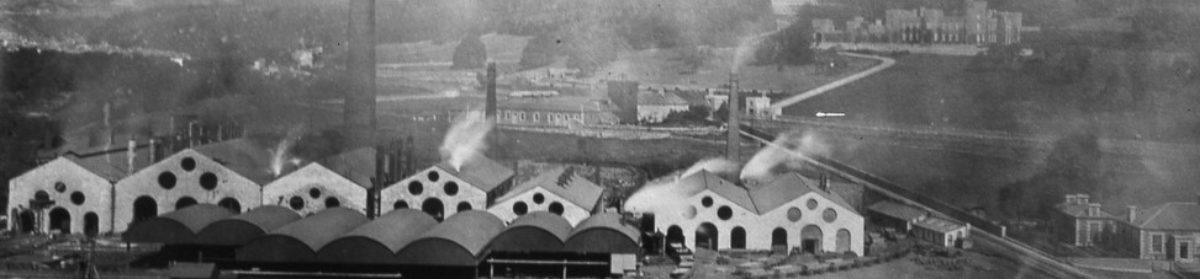
In 1850 the freeholder of the farm was Mary Morgan the widow of William Morgan and the farmland was leased to the Penydarren Iron Company. That ironworks was less than half a mile away and the roads accessing the general locality conform in major part to the present-day road system. These were trackways and subsequently they became the present-day Alexandra Avenue and Galon Uchaf Road. There is no evidence of coal mining on the Gwaunfarren farmland however it is likely that iron stone and coal transited the adjacent trackways into the nearby iron works. The 1850 map identifies the farm homestead as “The Dairy” and it is probable that the farm produced milk, butter and cheese for the growing industrial population. The nearby Penydarren Ironworks opened in 1784 in the ownership of the Homfray family and George Forman. This was the smallest of the four local ironworks and in due course it made the cables of flat bar link for the Menai Straits Suspension Bridge. The works closed in 1857 followed shortly thereafter by the Plymouth Ironworks in 1859 whilst the two larger works at Cyfarthfa and Dowlais remained open.

Field number 1901 on the 1850 Tithe Map configures with the 2-acre piece of land that is now identified as post code CF47 9BJ. This land was leased in 1862 to William Simons for 25 years and he funded its redevelopment He was the first of two successful wealthy individuals and their families who lived there in succession until the 1920s. William was a barrister practising in Castle Street and he lived in the house with his wife and children from 1862 until 1888. He purchased the farmhouse and set about making substantial changes to that building, laid out a new garden, driveway and built a Lodge at the main entrance to the drive. His great grandson, Graham Simons later recounted a story detailed by one of Williams daughters, Phoebe, that some of the walls of the house were 4 feet thick and this perhaps indicates that some of the original farm building had been incorporated in the new house identified in the 1850 Tithe Map as “The Dairy”. A plan of the new house and garden is shown below. Note that the architect identified the house as “Gwain-faren” later named as “Gwaunfarren House”.

Parts of the old farmhouse were retained, the building substantially increased in size and an impressive new facade was built based on a Victorian style of architecture much in vogue at the time as demonstrated in an early photograph of the new house.

Photo courtesy of the Alan George Archive                                      

Margaret Stewart Taylor did not include the house in her essay titled “The Big Houses of Merthyr Tydfil” published in the inaugural edition of the “Merthyr Historian Volume I” in 1976. However this was indeed a large house necessary to accommodate the first large family to reside there. The 1871 census shows that in addition to William Simons and his wife, Clara, there were 8 children and 7 staff: a governess, nurse, nursemaid, cook, laundress and 2 housemaids. Ten years later the family had increased to 11 children making a compliment of 20 family plus staff. It is suggested that there were legal disputes between William Simons, the leaseholder, and the freeholder of the land which played a part in the move of the Simons family to Cardiff in 1888.

To be continued……. 

Merthyr Memories: The Lamb Inn

by Alun Morgan

Fifty years ago today one of Merthyr’s most famous and iconic pubs, The Lamb Inn, closed its doors for the last time. To mark the anniversary Alun Morgan has shared some of his memories.

The Lamb Inn was located at the corner of Castle Street. Its distinctive black and white façade shared with the premises next door, the very popular B Harris Jones Children and Ladies clothes shop. Both fell, alongside other attractive and historic buildings, to the large-scale town centre redevelopment being undertaken by Merthyr Borough Council in the late 60s and early 70s. Another example of this was the Bee Hive, the cosy little pub opposite the Lamb, run by Mr and Mrs Mittel, Owen Money’s parents.

Photo courtesy of the Alan George Archive

The Lamb was one of Merthyr’s best known and popular pubs; it appealed to a very wide age and occupational range, as well as supporters of politics across the spectrum. There was no television nor juke box in the bar so conversation was almost compulsory. Despite the very varying opinions of customers this only very rarely became heated and personal. The Bar was ‘men only’ while women were able to use the cosy Snug and the side room, where there was a rather ancient television.  By the early 1970s the once handsome bar had been somewhat spoiled by removal of a semi-partition and paint that did not blend with the furniture.

‘John the Lamb’. Photo courtesy of the Alan George Archive

However, it still generated a vibrant atmosphere and thirsty customers well-served by the owner John Lewis (John the Lamb) , his son, Peter, Jimmy Ryan, Bert (can’t recall his surname) and Jenkin Powell. Jenkin is widely recognised as one of the greatest footballers to have played for Merthyr FC, he also ran the Brunswick pub. I think John had taken over the Lamb in the early sixties, from Mr Walsh, a very widely respected landlord.

The pub’s reputation extended far beyond Merthyr and a photograph of it formed the cover of an album, The Green Desert by the Hennessey’s; the album featured songs, poems and ballads by Harri Webb, one of Wales’ best known poets and one of the Lamb’s many regular customers. The pub also ran a very good Sunday rugby team, under the experienced guidance of ‘Captain’ Syd Hill. One of its final fixtures was, ironically on a Saturday, in the Gwendreath Valley, Carmarthenshire, accompanied by vociferous travelling support.

The Lamb Rugby Team. Photo courtesy of the Alan George Archive

The Lamb closed its doors for the last time on April 1, 1973; it was demolished shortly after. With its men-only bar perhaps it was already out of sync with the way society was developing. Nonetheless it was greatly missed by many. I vaguely recall the editorial in the Merthyr Express of the week after. I think it stated something along the lines of ‘Merthyr is not the same without The Lamb’. Few at the time would disagree.

Does anyone else have any memories that they would like to share? Any Merthyr-related memories will be most welcome. If so please get in touch at merthyr.history@gmail.com

Memories of Old Merthyr

We continue our serialisation of the memories of Merthyr in the 1830’s by an un-named correspondent to the Merthyr Express, courtesy of Michael Donovan.

Taliesin Williams by Joseph Edwards. ©Photo courtesy of Amgueddfa Cymru – National Museum Wales

The Rev J Carroll, the Catholic priest, resided on the Glebeland. He used to write a political letter to the Silurian weekly. Taliesin Williams’ residence was in Castle Street, but the schoolroom entrance for pupils was in Castle Field Lane. He had the most prominent school and the reputation for being somewhat too strict. My recollection of him, however, is quite clear, that he did not punish severely without great provocation. I can acknowledge that he gave me a slap once, and once only, but that it was also fully deserved must also be acknowledged.

As far as can now be recalled not one of his pupils can be named as alive now, except the writer. The late Mr Thomas Jenkins, of Pant, was supposed to be the last – but I am still left. The last of the family of that generation, Miss Elizabeth Williams, died about a year ago in the vicinity of London.

A Mr Shaw also had a school on the other side of the same lane. His son was an artist. John Thomas (Ieuan Ddu) can also be hazily recalled as keeping a school, but more vividly as a bass singer.

Mr John Millar, who, in conjunction with his brother Robert, carried on the brewery at Pontycapel, kept the Wheat Sheaf for many years, and afterwards moved to the Lamb. There was also a weaver, of the name of Wilkins, about the Glebeland, one of whose daughters married Mr W E Jones, the artist. The other daughter married and emigrated. The Merthyr Library and Reading Room started in the house at the corner of Castle Street and Glebeland.

Upon coming up to the Brecon Road from Caepantywyll, if we had gone on to Gwaelodygarth it would have led us past the entrance to the “Cottage” and Penydarren farm yard, past which the road leads to Penybryn and Pant, but keeping around by the Penydarren Park wall we came to the road to Dowlais close to the Penydarren turpike gate.

Mr Richard Forman, when manager of the Penydarren Works, resided at the “Cottage”. Mr William Davies, of the firm of Meyrick and Davies, lived there subsequently, and then Mr John Daniel Thomas, many years the high bailiff of the Merthyr County Court. Mr Grenfell, when the manager of Penydarren, resided at Gwaunfarren. Mr Benjamin Martin followed him (moving from the yard there) when becoming manager. Prior to this I always heard it called the Dairy. Occasionally one of the partners remained a short time at Penydarren House, but the gardener (named Price) used to sell the produce raised there.

Gwaelodygarth Fach a.k.a. “The Cottage”. Photo courtesy of the Alan George Archive

It was at Penydarren Ironworks that the first iron rails were rolled. They were known as the “fish-bellied” pattern. Tredgold, the authority upon the strength of iron, had a piece of iron supplied him with “Penydarren” upon it, by a firm of merchants in London, to whom he applied for a specimen of Welsh iron for experimental purposes. This fact is recorded in his treatise on the strength of iron.

To be continued at a later date…..

Memories of Old Merthyr

We continue our serialisation of the memories of Merthyr in the 1830’s by an un-named correspondent to the Merthyr Express, courtesy of Michael Donovan.

An extract from the 1851 Public Health Map showing a more detailed view of the area covered in this article.

What may be called Ynysfach rows were close by, but we cross the bridge over the canal, and on the right was the coalyard of Waunwyllt. Just fancy! The coal was sold out in ‘drafts’ by one of Mrs Thomas’ sons. Coal or colliery proprietors would think it infra dig to let their sons do so now, and yet it was done, and done properly then with results that satisfied them.

The small cottage and workshop in the garden adjoining was the residence of the father of Penry Williams, one of, if not the greatest painters Wales has produced. John (*see below) Williams, whom I knew, was a clever artist, but was unfortunately deaf and dumb. The father and son carried on the glazing business here while Penry was in the zenith of his fame in Rome. There was also a sister, Miss Sophia Williams, who carried on a school for many years.

Penry Williams’ painting of his father’s cottage. Photo courtesy of Cyfarthfa Castle Museum & Art Gallery

In the house just around the corner Mr Abraham Jones, the nailer, resided and a timber yard followed. Upon the other side, the corner house, opposite the coalyard, was a grocery establishment, opened by a Mr Rees. He was connected with the Waunwyllt family, and if I mistake not, an ancestor of the family of that name of Lletty Shenkin.

Several small cottages followed, and the last house bordering the river was the Heathcock Inn, at one time kept by Mrs Williams after her husband had, with John Frost and William Jones, been banished to Australia for their connection with the Chartist rising.

We re now at the Iron Bridge – I mean the old one, going straight across to Ynysgau-not the modern one erected by the old Local Board, and going to Victoria Street. I have crossed it on many occasions, have felt its vibrations when a heavy load passed over a rough place, and yet always thought it was a well-developed structure, reflecting credit on some whose names I have never learnt. Remembering the time and state of knowledge when it was put up, it was a wonderful example of daring skill.

The Old Iron Bridge

Crossing this, the locality to the left was analagous to China. The road direct in front, leaving the chapel to the right, would bring us to an archway or a narrow opening over which the upstairs room of one of the houses extended, and to the end of Castle Street; but we turn at the foot of the bridge, and keeping the chapel on our left instead go down Bridge Street.

*Penry Williams’ father was named William – as can be seen from the portrait. The original writer either made an error with his name or he was actually known as John as well. We will probably never know!!!

Right – A portrait by Penry Williams of his father William. Photo courtesy of Cyfarthfa Castle Museum & Art Gallery

To be continued at a later date…….


**Many thanks to Dr John Taylor for the following….

Isn’t the “John”, referred to above, the deaf and dumb brother of Penry Williams? Accordingly, this would not conflict with the father’s name, William.  The deaf and dumb brother is made reference to in the blog post for 17 July 2020 ‘Death of Penry Williams’.

I think that clears up a lot – the original author could easily have been mistaken.

Merthyr’s Bridges: Ynysgau Bridge

By the mid 1800s, the only bridge of any note across the Taff in central Merthyr was the Iron Bridge at the bottom of Castle Street, the only other bridge being Jackson’s Bridge further up the river. It soon became obvious that the Iron Bridge was not adequate for the amount of traffic needing to cross the river.

In June 1860, the Surveyor of the Local Board of Health submitted a plan for a new bridge to be situated downstream of the Iron Bridge to carry traffic from the town to Georgetown. His proposal stated:

“The proposed bridge to be erected….is the continuance of the line of Victoria Street and its terminus by Ynysgau Chapel, and crossing the river Taff on the skew at an angle of sixty-five degrees – thus forming a direct communication between Victoria Street and Penry Street, which will effect greater facility of traffic that the inconsistent turns at the present site”.

An excerpt from an 1860 map showing the planned new bridge just below the Iron Bridge.

The proposed new bridge would cross the river in one single 80 foot span, and would be built of wrought iron plate girders six feet deep. It would be 24 feet wide, five foot of which would be set aside for a pedestrian footpath on the north side. The cost of the new bridge was estimated at £1,700, and would take about four months to complete.

The Board of Health decided to hold over the report for a month to allow them time to consider the proposals. Ten years later, the bridge still hadn’t been built.

It was in 1879 that it became obvious that the situation at the Iron Bridge was critical and that a new bridge was needed straight away. The Board finally dusted off the old plans, and the new bridge was begun. The work was entrusted to Messrs Patton and Co of Crumlin Viaduct Works, and the bridge was finally completed on 17 March 1880.

Ynysgau Bridge. Photo courtesy of http://www.alangeorge.co.uk/index.htm

The bridge remained the primary road bridge in the centre of Merthyr until the 1960s, by which time everyone was becoming increasingly concerned by the way the bridge would move and spring alarmingly every time heavy vehicles passed over it. It was decided that a new bridge was required, and a new concrete bridge was built 50 yards upstream (the present bridge near the Fire Station).

The old bridge closed in November 1963 when the new bridge was opened, and the structure was dismantled in 1964.