Remembering Professor Gwyn A. Williams (1925-1995) on the centenary of his birth

by Mary Owen

Gwyn Alfred Williams was born on September 30th, 1925 in Lower Row, Penywern, Dowlais. His parents, Thomas John and Gwladys, were schoolteachers. The family attended Gwernllwyn Independent Chapel, where they worshipped in Welsh and where young Gwyn and his friends, the ‘Gwernllwyn Chapel Gang’, absorbed the scriptures and played a lively part in social activities. He was educated in Cyfarthfa Castle Grammar School, where he enjoyed school life and many successes, becoming Head Boy and winning a David Davies Open Scholarship to study History at the University College of Wales, Aberystwyth.

Sadly, he was unable to begin these studies immediately because, as Geraint H. Jenkins wrote in his 18-page tribute to Gwyn on behalf of the University of Wales Centre for Advanced Welsh and Celtic Studies 1996, ‘the demands of war took him instead to the battlefields of Europe where he learnt a great deal about human suffering. Indeed, the experience of wartime service stayed with him for the rest of his days. Having witnessed the liberation of Paris and stood amongst the ruins of Berlin, he was then persuaded that he should help to build a better world in Yugoslavia, where he joined gangs of labourers who built a road linking Zagreb and Belgrade.’

His belated studies began ‘at the feet of Francis Treharne, Professor of History since the 1930s and a fellow native of Merthyr’ who veered Gwyn to specialise in medievalism. He graduated with an ‘outstanding first-class honours in 1950 and ‘was showered with prizes.’ A master’s degree and a doctorate followed and in 1954 Gwyn was appointed to teach Welsh History at the College. Jenkins states, ‘It is entirely appropriate that we in Aberystwyth should pay tribute to Gwyn for it was here that he served his apprenticeship as a historian and made his reputation as a scintillating lecturer. His senior colleagues ‘were rather staid, undemonstrative and solemn lecturers… lacking improvisation and lightness of touch…It was all clearly too dull and complacent for the young ball of fire from Dowlais. In his classes Gwyn was erudite and entertaining and his penchant for irreverent statements meant that the classroom where he delivered lectures to first year students was always filled to the brim.’

The strong views and quick wit of Gwyn’s early lecturing days  had been evident in his 1940s school days and honed to perfection when  I once heard him recall, in a Prize-giving event in the 1970s at Cyfarthfa High School, when he told us of the day when Miss Davenport, Head of  the Girls’ Section, based upstairs, where the boys were not allowed to tread, asked him (then the Head Boy) to come to see her.

‘Mr Williams’, she said, ‘There are boys hanging about upstairs. I want you to do something about it.’ His reply to her complaint was:

‘Miss Davenport, what do you want me to do about it? Cut them down?’

His early research as a keen medieval historian widened and Jenkins relates, ‘he became obsessively interested in the French Revolution and in the Atlantic world. Nor was the early history of Merthyr Tydfil, the cradle of the Industrial Revolution in Wales, ever far from his mind. Indeed, the first articles of Welsh history -published in 1959-61 were devoted to the Merthyr Riots of 1831.’ All helped to make this historian ‘the people’s remembrancer’ he wished to be.

Gwyn’s fame spread and in 1963 he was invited to become Reader in History at the new University of York ‘a major turning-point in his career.’ Two years later he was awarded a Chair and for the next eleven years, the swinging sixties! the young professor enjoyed furthering his career with his own exhilarating, modern style of teaching, delighted by classes, again ‘filled to the brim’.

In 1974 he returned to Wales to become Professor of History at Cardiff University. It was a sea- change: his aim to liven up and modernise the study of Welsh History was met with indifference by senior colleagues, who did not share his left-wing values and enthusiasm for the need to focus on the evils of capitalism and the struggles of the exploited working-class of 19th and 20th century industrial South Wales. His new post brought friction and bitter disappointment to the ambitious 49-year- old Welshman. His health suffered and, after battling against the odds for five years, he was persuaded to retire.

Nevertheless, there was life after academia, and he was saved by his need to research, write and to impart his views and his knowledge via active political work and then through radio and television. In 1979 his book, The Merthyr Rising of 1831 was an outstanding success, displaying his scholarship and masterly command of language and written in his fast and furious style. It still has a place on many a bookshelf in Merthyr Tydfil and elsewhere. Revolutions, riots and risings in France, Italy and Spain became favoured topics of his writings. Gwyn, who had already relearnt his Welsh, was a gifted linguist, reading and translating from original documents, often studied in those foreign countries. He won great success as a broadcaster too. His passionate performance in the 1988 TV series, The Dragon has Two Tongues, (A History of the Welsh) proved that the ‘ball of fire from Dowlais’ was still blazing.

He died of cancer on November 16, 1995.

A General View of Pontsarn

by Alison Davies

I love collecting Vaynor memorabilia and postcards of the area, like many local collectors it’s a lifelong passion.

Then every so often a card comes along that is both historically important on the front and back, and please excuse the phrase but ‘it blows me away’ and below is one.

A General View of Pontsarn

This is a rare image taken from the fields overlooking Vaynor a little way below Pontsticill. It’s like peeping through a curtain back in time.

In the centre of the picture is the back of the Church Tavern pub with the two churches at Vaynor you can see the steeple on the new Church, the pathway leading from the old church and first few headstones in the new cemetery. The houses too: Dolcoed, Hy Brasail and Bragty Cottages are clearly visible along with the fields systems around.

The view then sweeps down the valley to the viaduct, Pontsarn Station and beyond its one of the most incredible postcards of Vaynor that I’ve seen.

The back of the card is equally important, it is an incredible piece of Merthyr’s history. Postmarked Merthyr Tydfil 27 Dec 1936 and sent from Gwernllwyn House Dowlais by M E Horsefall (Mary Emmeline Horsfall)

It reads:

Thank you for your card and good wishes.

I hope you and Mr Cobby are well

With good wishes M E Horsfall

Mary Horsfall was a philanthropist who came to Dowlais in 1934 to help at the Educational Settlement formed by John Dennithorne. She lived at Gwenllwyn House Dowlais and from there ran classes teaching unemployed men and women the arts.

Mary invited important artists including Heinz Koppel and Cedric Morris to teach art at Dowlais. Her address book must have read like a who’s who of the art world. Whilst in Dowlais Heinz Koppel painted Mary’s Portrait from his studio at Gwenllwyn House. Also in Dowlais between 1936-1939 Cedric Morris painted two of the most iconic and celebrated paintings in Welsh Art today, Dowlais Tips and Caeharris Post Office. Now in Cyfarthfa Castle Museum.

So who is the card written to ?

Mary Horsfall wrote the card to her friend Lucy Mary Cobby and her husband Anthony Cobby at little Bognor, Frittleworth Sussex.

Little Bognor is a tiny rural hamlet in Sussex re known for its artistic connections however I think Mary knew Lucy Cobby from earlier connections rather than artistic ones.

If you’re interested in the Dowlais Settlement and Mary Horsfall see Christine Trevett’s wonderful article Merthyr Historian Vol 33 p 123.

To see more of Alison’s fantastic research about Pontsarn and Vaynor, please follow this link: https://www.facebook.com/groups/747174317220437

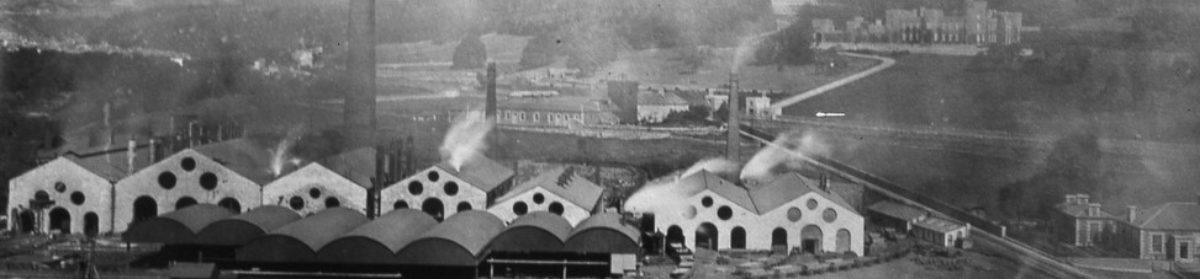
A visit to Cyfarthfa Iron works in 1850

Transcribed by Chris Parry

A visit to Cyfarthfa Iron works in 1850

By 1850, the scale and reputation of the iron metropolis of Merthyr Tydfil was know across the UK and even further. Journalists were coming to the town to write about the place, the people, the environment, the industry, every aspect of the most populated part of Wales at that time. The Morning Chronicle, between March and June 1850, published ten long articles exploring every aspect of life at Merthyr Tydfil, creating the most detailed exploration of the town published in the 19th century. The following is an extract from one of those articles that details a tour of Cyfarthfa Ironworks in 1850.

The next iron works I visited were those of Cyfarthfa – the model works of South Wales… There are at Cyfarthfa and Ynysfach (works adjacent to each other) 11 furnaces in blast, and four at Hirwaun – all being the sole property of Mr. William Crawshay. At these works there are employed under and above ground, 5,000 hands, of whom 190 are women. By the returns furnished me, I find the amount of wages paid at Cyfarthfa and Hirwaun alone is 16,000 a month (of four weeks). The make of pig iron is 72,000 tons per annum. The quantity of the bars, rails, and tin plates is 53,000 tons a year. There is used of Welsh iron, and hematite ores for the production of the above, 166,800 tons a year. The daily consumption of coal is 850 tons. As many as 400 horses are here employed. These extensive works are chiefly carried on by waterpower, the supply being procured from the river Taff at a considerable distance up the valley, but steam is used when in summer the water fails. The machinery is very large and ponderous. Those of the water wheels are 36 feet in diameter, and the fly wheels, which are 60 feet in circumference and of prodigious weight, make ordinarily 70 revolutions a minute. About three months ago the periphery of one of these wheels flew into pieces, the fragments demolishing the roof of the mill in which the accident occurred, and descending at a distance through the roof of another mill, crushing into pieces large portions of beautiful and costly machinery then in motion, but without further casualty to the numerous workmen than a fracture of the thighs of one of them. One of the steam engines is of 260 horsepower; it has six boilers, and is of nine feet stroke.

The above particulars will convey some idea of the magnitude of these works. I was accompanied over them by Mr. Robert Crawshay, whose familiarity with the philosophy of the various processes of smelting the iron is only equalled by his practical familiarity with its manufacture, and to who I am much indebted for the attention he paid me, and for the lucid and intelligible manner in which he explained everything which I did not at first clearly understand. These works are incomparably the best constructed, the most spacious, well-ventilated, comfortable, convenient, and methodical of all the works, not only in and around Merthyr, but throughout South Wales. Everything has been done on the most liberal scale, and with an evident aim at perfection and completeness. The extensive mills, with their massive walls pierced with large circular openings for light and lofty roofs, have an air of architectural grandeur that is quite imposing. The space within the roof of one mill is 82 feet. There is here so much room that the work is carried on without any appearance on hurry and bustle which I have remarked upon as belonging to other works. I was informed by Mr. David James, a disinterested party, that men who have once enjoyed the comfort, shelter, and convenience of these works would never leave them for others if could possibly avoid it. I have said shelter, because here the men and women employed at the furnace tops and at the hearths have roofs overhead, whereas at Dowlais I have complained that they are wholly unprotected, and such is the case elsewhere. The comfort of such a provision in the windy and rainy climate of these mountains can only be adequately valued by the workpeople who have tried both situations, the exposed and the sheltered. I think it the duty of those ironmasters who have neglected providing such a shelter, to lose no time in following the example of Cyfarthfa and the other works where such conveniences have been adopted. It will be an act of great kindness to the miserables who have now to endure all weathers, and the most violent alterations of heat and cold.

 Robert Thompson Crawshay. Courtesy of Cyfarthfa Museum & Art Gallery

At Cyfarthfa I saw men belonging to the furnaces, squeezers, rollers, and saws at their dinner. They had good beef or mutton, and potatoes; the boys had broth with a small piece of meat: they seemed pleased to show the contents of their tins, observing that the work was so hard and the heat so great that they could not stand it without animal food. This, it must be borne in mind, was in the mills; at Dowlais and in the other works, as I have stated, the workmen also get meat. They were rail-making in two of the mills I inspected. I saw three rails made by the direction of Mr. Crawshay. Timed by a watch, they were made in three minutes – that is, from the presentation of the white hot “bloom” to the rollers to its completion in them. The ends were cut off, filed, and the bars straightened in an additional minute and a quarter – so that altogether the making and finishing of three rails ready for laying down on the permanent way occupied just four minutes and a quarter. It was here I first saw that ingenious but simple invention, “the splitting mill” at work. It was making what is termed “nail rods”, which it did by lengthening and dividing a short iron bar into about a dozen rods, eight feet long by a quarter of an inch wide. This most important and useful invention was made in Sweden, and the consequences were most disastrous to the manufacturers of iron in this country, who, having to divide the rods by a long, tedious, and laborious process, could not compete with the new invention. The means by which this difficulty was overcome are highly interesting…….

The return made to me of the rate of wages paid at these works is as follows:-

Colliers, 15s. a week

Miners, 12s, 6d, a week

Founders, 22s. a week

Fillers, 21s. a week

Labourers, 10s. 6d. a week

Puddlers, 18s. a week

Rollers, 30s. a week; rail rollers, 31 to 41 a week.

Roughers, 18s. a week

Ballers, 24s. a week; girls, 5s. a week

The portion of boys employed under sixteen years of age is about one-sixth of the whole: at Dowlais these were returned as about one-fourth. At one of the mills in these works boys only are employed; it is a training school for them, preparing them for the heavier mill and forge work. I saw them making iron rods for rails, and light work; they seemed to work with great spirit and alacrity…[1]

[1] Morning Chronicle, March 21, 1850, London

A visit to Cyfarthfa Iron works in 1797

Transcribed by Chris Parry

In August 1797, the Duke of Rutland was travelling through south Wales documenting his travels for a book. By this time no journey to Wales was complete without seeing the spectacle of Merthyr Tydfil, which by that time was home to four large ironworks and had already attracted thousands of workers from across Wales to come and begin lives that were utterly different from the agricultural lives they left. His descriptions of Merthyr Tydfil, a visit to Cyfarthfa Ironworks and a meeting Richard Crawshay give a valuable early insight into the works, the town, the people and Richard Crawshay.

Richard Crawshay. Courtesy of Cyfarthfa Museum and Art Gallery

August 7, 1797

…We now at least were cheered with the sight of Merthyr, and the iron forges (of which there are three about the town) sending fourth large columns of smoke…Merthyr lies in the middle of these desolate hills, rich indeed in their productions of ore; it is a large place, chiefly occupied by the families of the workmen belonging to the forges. Travellers do not often go there but it is a place well worth notice, as any in Wales.

We dined heartily, and at dusk in the evening, the rain ceasing for half an hour, walked towards the forges. We wandered about for some time, and then went immediately to them, guided by the streams of fire which were bursting fourth from the chimneys. The distance of them from the town is about three-quarters of a mile; and the railroad along which we walked ran by the side of a canal; as we approached them, the effect was grand and sublime beyond all description. The fires from the furnaces were bursting fourth in the darkness of the night, and every moment we saw, as it appeared, a red-hot bar of iron walking towards us, we could see numbers of Vulcans dragging about pigs of iron just taken from the furnaces (the fires of which would dazzle the strongest eye) and pursuing their different operations, while their grimy figures, and gloomy visages, were visible by the light of the forges. We saw them running about in all directions through the doorways of the buildings, some of them hammering, others rolling the iron, while regular thumps of an immense hammer, which we heard far off, before we came near the works, and gradually increased to a thundering noise as we approached, completed the grandeur of the scene. I never saw anything that gave me more the idea of the infernal regions…

Wednesday August 8, 1797

This morning, we sent a note to Mr. Crawshay, the proprietor of the works, requesting his permission to see them. He returned a very polite answer, saying, he would be ready to attend us whenever we chose…

He (Richard Crawshay) was an elderly man, and seemed a singular character, fully convinced of the great of the great importance of the works he had accomplished; and talking in high style, which however was perfectly excusable in him…He told us, that when he originally came to the place, about 10 years ago, there was only one furnace, and that all the other extensive and magnificent works and improvements were wholly his own. He said he could not form any idea of the number of men that he employed, as he had captains under him, who had each agreed to furnish him with a certain number; however there could be no fewer than 1000 able-bodied men employed, and after adding the women, out-labourers, and etc. and etc. the total number of souls depended upon him, must amount to about 4000.

We first saw, and entered one or two of the workmen’s houses, which he had himself built for them at the rate of 30 guineas per house; they are extremely neat and clean. The works themselves consist of two divisions, one of them below, the other above a hill. He first took us to the summit, and explained to us the nature of the mines…

Very fortunately, iron ore, coal and limestone, are all found in the same hill, so that Mr. Crawshay has every requisite for his works close at home. He pointed out to us one shaft of coal, which would yield daily 200 tons. This is the quantity expected every day amongst the works…Before the end of the summer, he lays up a provision of 15,000 tons of iron ore for the consumption of winter, when the mine cannot be so easily worked.

…the ore (the puddled balls) becomes merely flattened pigs; in the second, these pigs are lengthened out into bars, three times their original length. It is astonishing to see the ease with which the workmen run about with the hot pigs of iron between large tongs, and with which they lift them without difficulty between the rollers. When thus lengthened into bars, they are taken to an immense hammer, which continually acts upon them, and gives the finishing to them, by straightening the bars. The same engine which works the hammer, moves an immense instrument like a pair of scissors, which cuts off the end of the bar, generally the worst part of it. While red hot under the hammer, a boy stamps the initials R.C. on the ends of the bar…

 When we were there, three furnaces were at work, but there are five, all of which this single wheel is sufficient to blow, iron tubes connecting the whole, and joining them…

Mr. C said at present he made more iron than probably any person in the world, that he had bent his whole mind on being a perfect ironmaster, and that should he live long enough, he had yet great plans in view…

In the meantime, while so much engaged in the iron trade, Mr. C is by no means negligent of other concerns. He has cultivated the country around him, which on his arrival at the place was as barren as the bare rock. When his works were at a stand a short time since, he employed all his men on half-pay to clear the country of stones, several thousand tons of which he threw into the river and then cultivated the ground thus cleared…

Transcribed from Economic History of the British Iron and Steel Industry by Alan Birch, Taylor and Frances, 2005 (Originally published 1967), pp 83-86

The Growth of Football in Merthyr Tydfil – part 5

Transcribed by Phil Sweet

These articles which appeared in three consecutive editions of the Merthyr Express in March 1921 are Harvey Boots’ own reminiscences of the development of three football codes in the town up to that date.  

ARTICLE 3 MERTHYR EXPRESS 19TH MARCH 1921

THE GROWTH OF FOOTBALL IN MERTHYR

(By Harvey Boots)

I concluded my last article by referring to the paucity of the gates at the new game. At this juncture, for some reason (of which I know not) the Northern Union Club gave up the College Field and procured a ground at the bottom end of the town, the field known as Rhydycar. This, in my opinion, was probably their undoing; it was inaccessible, and the view from the surrounding tips was equal to a seat in the grand stand. Whatever the cause was I am not in a position to state, but as it proved to be their last season nothing will be gained by what our Yankee cousins call “beating it” so I leave it at that. The fight had been a long and costly one. It was obvious from the beginning that there was not enough room for both codes, and it really resolved itself into a question of which would stay the longest.

We were left in possession, but we still had a deal of squaring up to do. Here I might mention that, being a private company, we couldn’t go to the public for money; we just had to shell out as far as possible as we went along. We had numerous pilgrimages to the bank – indeed the sanctum of the manager was quite familiar to us. I think Mr. H. C. Davies, whose business premises are right opposite the bank and who acted as our treasurer, must have felt like bombing the place off the earth. As for myself, I had got quite used to passing it by on tiptoe, in case the manager knew my footsteps. The horizon, was beginning to clear and the clouds to look a little less dark, so we took heart of grace and proceeded to try and make the new code as popular as the old. As it was still a case of going very warily; the public had not yet “cottoned” to the new game, but there were very evident signs that it was rapidly gaining in favour. While it was comparatively new to Merthyr, there were clubs in Aberdare, Treharris, Ton Pentre, Mardy and Barry, of very old standing, and I think the fixtures with those local teams and the very keen rivalry that is always manifest when such close neighbours meet, had as much to do with popularising the game as anything I can think of. We were beginning to take decent “gates”; Indeed, one match stands out very vividly in my memory, and that was Bristol Rovers, then like ourselves, in Division II of the Southern League. I believe we had 17 professionals signed on at this time and we played in the particular match to about £11 16s. I wonder how much wages could be paid out of that sum today? Of course, we had to visit Bristol on this magnificent response of our patrons, for the return fixture; and it is memorable for one point; if for no other, viz, they put on 11 or 13, I am not sure, goals against our side, which caused our goalkeeper to remark that it was the busiest afternoon he had ever spent in picking the ball out of the back of the net. I think his name was Daw, and he came from “Owdham”.

There is no doubt at this period we were gaining very valuable experience from our near, and shall I say “dear,” neighbours, but the mere fact that we were continually rubbing shoulders, to use a metaphor, was of the utmost advantage to us. Many were the very useful tips we received about this or that from that good sport Jack Lewis (then the indefatigable secretary of the Treharris Club and now one of the directors of the Town team); also A. (Tagg) Williams, then, I should imagine, one of the best centre-halves who has played for Wales. Then again, that guiding spirit of the Aberdare Club, Tommy Daniel Jones was always ready with a bit of wholesome advice, and so were a host of others. Of course, by this time Cardiff (they at this moment are making football history for Wales and, en passent, I wish them well), Newport, Swansea and Llanelly were members of the Southern League, too, but really, I opine that the greatest asset in those days was the old South Wales Cup. There are few among us who haven’t vivid recollections of those strenuous combats. Ye gods! What fights they were. Ton Pentre, Aberdare, Mardy, Treharris etc., etc. I am sure they are all tolerably remembered by the habitues of Penydarren Park today. Things were now becoming really ship-shape, and I think it was from this period that Soccer began to boom.

Laura Ashley

Laura Ashley was born in Dowlais 100 years ago today.

To mark the centenary, Cyfarthfa Castle Museum are holding a talk on 10 September.

For details of how to book tickets, please follow the link below.

https://cyfarthfa-museum.arttickets.org.uk/cyfarthfa-castle-museum-and-art-gallery/laura-ashley-with-huw-williams-68664ddc7b8e4

There will also be a Laura Ashley pop up exhibition in the wedding groom gallery between 10.00-14.00 today. This is in celebration and partnership with USW and Coleg Y Cymoed fashion students to showcase the Laura Ashley inspired garments they’ve created.

In addition, from the week commencing 25 September there will be a brand new Laura Ashley display area featuring a complete overhaul of the lobby display areas.

Articles

Hello everyone.

It has been brought to my attention that several articles from this blog have been used on Facebook.

This blog is intended to share Merthyr’s History and is free for everyone to enjoy, and I am more than happy for anyone to use articles from the blog, but it would be nice if you could:

a) acknowledge where the article came from

b) acknowledge the original author of the blog

A number of people have worked hard researching the article they have written, so it would be nice if they could be acknowledged.

Also, and more importantly, a number of articles on this blog have been transcribed from other sources – without fail I have sought permission from the the original authors to use their work. A few times, my request has been denied (and on one occasion I was threatened with legal action if I used the article in question), but 99% of the time, authors are happy to share their work. If you see an article that was from another source, therefore, please ask permission of the original author before copying it.

I don’t want to sound petty or anything, but a lot of the stuff I use is copyrighted, and I have had to seek permission to use it. Worse case scenario – the copyright holders may sue, and have this blog and the Facebook page where the article is copied taken down. None of us want that to happen.

All I’m asking is – please be careful, and please acknowledge sources.

Lecture over!!!

Thanks