Remembering Professor Gwyn A. Williams (1925-1995) on the centenary of his birth

by Mary Owen

Gwyn Alfred Williams was born on September 30th, 1925 in Lower Row, Penywern, Dowlais. His parents, Thomas John and Gwladys, were schoolteachers. The family attended Gwernllwyn Independent Chapel, where they worshipped in Welsh and where young Gwyn and his friends, the ‘Gwernllwyn Chapel Gang’, absorbed the scriptures and played a lively part in social activities. He was educated in Cyfarthfa Castle Grammar School, where he enjoyed school life and many successes, becoming Head Boy and winning a David Davies Open Scholarship to study History at the University College of Wales, Aberystwyth.

Sadly, he was unable to begin these studies immediately because, as Geraint H. Jenkins wrote in his 18-page tribute to Gwyn on behalf of the University of Wales Centre for Advanced Welsh and Celtic Studies 1996, ‘the demands of war took him instead to the battlefields of Europe where he learnt a great deal about human suffering. Indeed, the experience of wartime service stayed with him for the rest of his days. Having witnessed the liberation of Paris and stood amongst the ruins of Berlin, he was then persuaded that he should help to build a better world in Yugoslavia, where he joined gangs of labourers who built a road linking Zagreb and Belgrade.’

His belated studies began ‘at the feet of Francis Treharne, Professor of History since the 1930s and a fellow native of Merthyr’ who veered Gwyn to specialise in medievalism. He graduated with an ‘outstanding first-class honours in 1950 and ‘was showered with prizes.’ A master’s degree and a doctorate followed and in 1954 Gwyn was appointed to teach Welsh History at the College. Jenkins states, ‘It is entirely appropriate that we in Aberystwyth should pay tribute to Gwyn for it was here that he served his apprenticeship as a historian and made his reputation as a scintillating lecturer. His senior colleagues ‘were rather staid, undemonstrative and solemn lecturers… lacking improvisation and lightness of touch…It was all clearly too dull and complacent for the young ball of fire from Dowlais. In his classes Gwyn was erudite and entertaining and his penchant for irreverent statements meant that the classroom where he delivered lectures to first year students was always filled to the brim.’

The strong views and quick wit of Gwyn’s early lecturing days  had been evident in his 1940s school days and honed to perfection when  I once heard him recall, in a Prize-giving event in the 1970s at Cyfarthfa High School, when he told us of the day when Miss Davenport, Head of  the Girls’ Section, based upstairs, where the boys were not allowed to tread, asked him (then the Head Boy) to come to see her.

‘Mr Williams’, she said, ‘There are boys hanging about upstairs. I want you to do something about it.’ His reply to her complaint was:

‘Miss Davenport, what do you want me to do about it? Cut them down?’

His early research as a keen medieval historian widened and Jenkins relates, ‘he became obsessively interested in the French Revolution and in the Atlantic world. Nor was the early history of Merthyr Tydfil, the cradle of the Industrial Revolution in Wales, ever far from his mind. Indeed, the first articles of Welsh history -published in 1959-61 were devoted to the Merthyr Riots of 1831.’ All helped to make this historian ‘the people’s remembrancer’ he wished to be.

Gwyn’s fame spread and in 1963 he was invited to become Reader in History at the new University of York ‘a major turning-point in his career.’ Two years later he was awarded a Chair and for the next eleven years, the swinging sixties! the young professor enjoyed furthering his career with his own exhilarating, modern style of teaching, delighted by classes, again ‘filled to the brim’.

In 1974 he returned to Wales to become Professor of History at Cardiff University. It was a sea- change: his aim to liven up and modernise the study of Welsh History was met with indifference by senior colleagues, who did not share his left-wing values and enthusiasm for the need to focus on the evils of capitalism and the struggles of the exploited working-class of 19th and 20th century industrial South Wales. His new post brought friction and bitter disappointment to the ambitious 49-year- old Welshman. His health suffered and, after battling against the odds for five years, he was persuaded to retire.

Nevertheless, there was life after academia, and he was saved by his need to research, write and to impart his views and his knowledge via active political work and then through radio and television. In 1979 his book, The Merthyr Rising of 1831 was an outstanding success, displaying his scholarship and masterly command of language and written in his fast and furious style. It still has a place on many a bookshelf in Merthyr Tydfil and elsewhere. Revolutions, riots and risings in France, Italy and Spain became favoured topics of his writings. Gwyn, who had already relearnt his Welsh, was a gifted linguist, reading and translating from original documents, often studied in those foreign countries. He won great success as a broadcaster too. His passionate performance in the 1988 TV series, The Dragon has Two Tongues, (A History of the Welsh) proved that the ‘ball of fire from Dowlais’ was still blazing.

He died of cancer on November 16, 1995.

Merthyr’s Lost Landmarks: Lost Chapels of Dowlais

Carrying on with the requested look at Merthyr’s lost chapels, here is the second batch – the lost chapels of Dowlais.

Bryn Sion Welsh Independent Chapel

Brynsion Street, Dowlais

Built 1834. Rebuilt 1844. Demolished 1969

Photo courtesy of the Alan George Archive

Caersalem Welsh Baptist Chapel

Well Street, Dowlais

Built 1821. Rebuilt 1833. Demolished 1977

Photo courtesy of the Alan George Archive

Calfaria Welsh Calvinistic Methodist Chapel

High Street, Caeharris

Built 1879. Closed 1979

Photo courtesy of the Alan George Archive

Ebenezer Primitive Methodist Chapel

Wind Street, Dowlais

Built 1846. Burnt down 1927

Photo courtesy of the Alan George Archive

Elizabeth Street Presbyterian Chapel

Elizabeth Street, Dowlais

Built 1876. Demolished 1965/6

Photo courtesy of the Alan George Archive

Gwernllwyn Welsh Independent Chapel

Mary Street, Dowlais

Built 1850. Rebuilt 1874. Demolished 1965

Photo courtesy of the Alan George Archive

Hermon Welsh Calvinistic Methodist Chapel

Castle Street, Dowlais

Built 1827. Rebuilt 1841. Demolished 1960s

Libanus Welsh Calvinistic Methodist Chapel

Libanus Street, Dowlais

Built 1852. Rebuilt 1858, 1870. Demolished 1996

Moriah Welsh Baptist Chapel

Mount Pleasant Street, Dowlais

Built 1856. Demolished 1992

Photo courtesy of the Alan George Archive

Penywern Welsh Independent Chapel

Jones Street, Peneywern

Built 1857. Rebuilt 1877. Demolished ?

Shiloh Welsh Wesleyan Chapel

Castle Street, Dowlais

Built 1811. Rebuilt 1853. Demolished 1920s

Photo courtesy of the Alan George Archive

Tabernacle (Elim) English Baptist (Pentecostal) Chapel

Ivor Street, Dowlais

Built 1873. Rebuilt 1876. Demolished 1974

Photo courtesy of the Alan George Archive

Unitarian Chapel (later Salvation Army)

White Street, Dowlais

Built 1881. Demolished ?

Photo courtesy of the Alan George Archive

Wesleyan Chapel

Castle Street, Dowlais

Built 1843. Rebuilt 1850, 1832. Demolished 1967

Photo courtesy of the Alan George Archive

If anyone has photographs of any other chapels that are no longer with us, and there are a few I can’t find photos of, or if anyone can fill in any details, please get in touch.

Merthyr’s Chapels: Bethania Chapel, Dowlais

Bethania Welsh Independent Chapel, Dowlais

In the early part of the 19th Century, members of the Independent chapels in Merthyr who were living in Dowlais began holding meetings at various houses around the town.

When Josiah John Guest arrived in Dowlais and expanded the Dowlais Works, the population increased to an extent that the need arose for the Independent worshippers in Dowlais to have their own chapel. The old Bethel Chapel became vacant in 1822 so services could be held there on Sunday evenings. Rev Methusalem Jones of Bethesda Chapel in Merthyr was instrumental in starting the cause in Dowlais and he had oversight of the congregation for a time until he had a difference of opinion with some of the congregation and left them. Rev Samuel Evans of Zoar Chapel then took over the care of the congregation.

Within a year however, it was realised that the small Bethel Chapel was not adequate for the congregation, so land was found and a chapel was built in 1823 for the cost of £444 and called Bethania.

In 1826 Rev Thomas Jones, a student from Newtown, was invited to Bethania and was ordained as minister of the chapel on 23 March 1826. The congregation increased rapidly and the chapel was rebuilt in 1827. However, within a short time a serious disagreement occurred at the chapel which resulted in Rev Jones and several of the congregation leaving and starting their own cause; this eventually became Bryn Sion Chapel. Rev Samuel Evans once again took charge of the chapel and stayed here until his death.

Following Rev Samuel Evans’ death, Rev John Hughes was inducted as Bethania’s minister in December 1833. Under his leadership the congregation grew rapidly and in 1838 it was decided to build a new larger chapel and the chapel was rebuilt at a cost of £1000 by Mr Thomas Sandbrook, a member of the chapel.

The re-built Bethania Chapel

In 1849, a serious cholera epidemic broke out in Merthyr with 1,682 deaths in Merthyr and Dowlais alone. In the aftermath of this epidemic, a religious revival occurred and despite its huge size, Bethania Chapel could not accommodate the huge increase in the congregation. It was decided that it would be impractical to build an even larger chapel, so a new chapel was built nearby called Gwernllwyn.

In 1855 a schoolroom was built at Pwll-yr-hwyaid, and this was followed by schoolrooms at Gellifaelog and Caeharris.

Bethania Chapel Caeharris Schoolroom. Photo courtesy of the Alan George Archive.

In 1883 the interior of the chapel was renovated with a new pulpit and seating costing £1350; and a new organ installed costing £350. In 1886, the vestry was constructed behind the chapel. Major renovations were again carried out on the chapel in 1896 when the main entrance of the chapel was altered and a large porch built, and the chapel was we see it today took shape. These renovations cost £500.

The chapel closed in 1999, but in 2012 the building was renovated by the Victory Church who now hold their services there.

Merthyr’s Chapels: Gwernllwyn Chapel

Gwernllwyn Welsh Independent Chapel, Dowlais

By the end of the 1840’s, the congregation at Bethania Chapel was growing so rapidly due to the revival that occurred following the devastating cholera outbreak in 1849, that the chapel could no longer accommodate them. Indeed, 250 new members were accepted into the chapel on one Sunday alone. The elders of the chapel met on 16 May 1850, and decided that rather than try to enlarge the already huge chapel, it would make more sense to build a new chapel nearby that would act as a sister church to Bethania.

A number of the congregation voluntarily left Bethania to form a new church and so Gwernllwyn Chapel was built in 1850 to seat 800 people. The new chapel was designed by Rev Benjamin Owen, minister of Zoar Chapel, Merthyr, and built by the Gabe Brothers at a cost of £900. On Sunday 2 February 1851, a prayer meeting was held at Bethania Chapel at 9 o’clock in the morning, and at 11 o’clock, 250 people ceremonially left Bethania to officially open the new chapel.

Mr John Hughes, the minister at Bethania took the services at Gwernllwyn for the first two years of its existence until Mr Benjamin Williams (left) became Gwernllwyn’s full time minister in July 1852.

Under Benjamin Williams’ ministry, the congregation flourished, and during his nine years at Gwernllwyn he was instrumental in the setting up of Penywern Chapel and the English Cause at Ivor Chapel.

The congregation at Gwernllwyn continued to increase and it was necessary to build a new larger chapel. The new chapel with seating for almost 1000 people was completed in 1874 at a cost of £2,210. As well as the new chapel it was also decided to build two schoolrooms – one at Gellifaelog in 1876 and one at Cwmrhydybedd in 1877; the cost being £500.

In 1889 a magnificent pipe organ was installed by Vowles and Sons at a cost of £334, and was opened by Mr J Haydn Parry, son of Dr Joseph Parry.

During the 1940’s a beautiful memorial window was placed in the vestibule of the chapel by the family of Messrs Enoch Williams & Sons in memory of their father who had been a deacon in the chapel for many years.

Gwernllwyn still had a flourishing congregation when the chapel was forced to close, and was demolished in the late 1960’s due to the redevelopment of Dowlais.

New Ration Books

From the Merthyr Express 80 years ago today…..

Merthyr Express – 16 May 1942

Merthyr’s Chapels: Penywern Chapel

The next chapel we are going to look at in our continuing series is Penywern Welsh Independent Chapel.

The cause at Penywern began in 1856 when Mr David Evans of Llanwrda and Rev Benjamin Williams of Gwernllwyn Chapel began holding meetings in Mr Evans’ house in Penywern. With the blessing of the congregation at Gwernllwyn, they also opened a Sunday School.

As there was no other room available, the Sunday School was held in the long room of The Ifor Arms, Penywern. The room was let by Mrs Nancy Rogers, the licensee, at a rental of 12 shillings a month. One rule was laid down by the officials of the Sunday School however, that “no intoxicants were to be consumed in the long room while the Sunday School was being held”.

As the congregation grew it was decided to build a chapel in Penywern. Land was leased from the Dowlais Iron Company for 5s per annum, and the chapel, designed by Rev Benjamin Owen, Zoar, opened on the first Sunday in March 1858, with Rev Benjamin Williams taking responsibility for the chapel in a joint ministry with Gwernllwyn Chapel until he left in 1861.

As the numbers grew the chapel was rebuilt in 1876-7 at a cost of £1000, and the new chapel opened on 19 August 1877. Rev Benjamin Williams was invited back to the chapel to take the opening services for the new chapel.

In 1910, a few of the young men at the chapel, encouraged by the minister Rev J H Hughes decided to start a small choir and elected Mr Evan Thomas to be their conductor. The choir quickly grew and evolved into the Penywern Male Voice Choir, which became famous throughout Wales. The choir, under the leadership of Evan Thomas, sang for King George V and Queen Mary when they visited Dowlais in 1912. They went on to win many auspicious prizes, culminating in 1927 when the choir won three Eisteddfodau, and Evan Thomas won the three Eisteddfod chairs which he donated to the chapel. Due to the depression in the 1930’s and the closing of the iron works, the choir membership dwindled and eventually disbanded.

Penywern Male Choir

In 1921 a large school room was added to the front of the chapel. As this was a difficult time financially at the chapel, the stone for the new school room was given by Messrs Guest, Keen and Nettlefold through the courtesy of the general manager Mr Howell R Jones. The school room was built by voluntary labour with horses and carts being used to transport the stone from the nearby quarry. The school room was completed and opened in 1922.

Volunteers beginning work on the new schoolroom

Like so many other chapels in Merthyr, the congregation dwindled over the years, and the chapel closed and was subsequently demolished.

The Town that Died

Has anyone read R L Lee’s remarkable book ‘The Town that Died’? The town in question is Dowlais, and the book recounts his memories of growing up there.

Dowlais is not a bad place at all, but when you compare the town today to how it was – for a lot of people from cherished memories, for others, relying on photographs, you can see that the epithet is a just one.

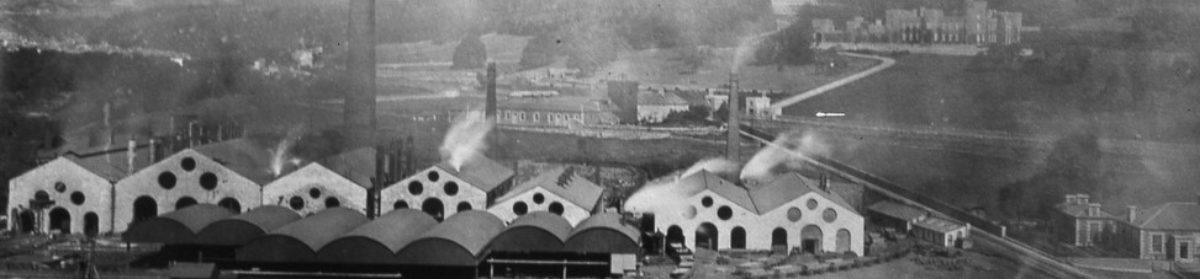
Below is an excellent photograph of Dowlais taken in 1920’s from the mountain behind the Ironworks (the present day Goat Mill Road). You can see what a large and bustling it place it was. A lot of the more prominent buildings are numbered and identified beneath the photo.

1.      Gwernllwyn Chapel
2.      Hermon Chapel
3.      Shiloh Chapel
4.      Elizabeth Street Chapel
5.      Bryn Sion Chapel
6.      Dowlais Works
7.      Temple Buildings
8.      Ivor Works
9.      Elim-Tabernacle Chapel
10.    Oddfellows Hall
11.     Bethania Chapel

Almost everything in the photograph has gone. Of the buildings numbered above, only Bethania Chapel still remains.

The Town that Died indeed.

Harry Evans – A Musical Giant

Harry Evans was born on 1 May 1873 in Russell Street, Dowlais, the son of John Evans (Eos Myrddin), a local choirmaster and his wife Sarah. Harry had no formal musical training, but was taught the Tonic Sol-fa system by his sister; such was his prodigious musical talent however, that he was appointed organist of Gwernllwyn Chapel in Dowlais when he was only 9 years old. The elders of the chapel encouraged the young Harry and arranged for him to receive music lessons from Edward Laurence, Merthyr Tydfil.

Harry Evans

In 1887 he was appointed organist of Bethania Chapel, Dowlais. He succeeded in passing all the local examinations of the Royal Academy and of the Royal College of Music, London, with honours. He was by that time anxious to devote himself entirely to music, but his father, who wished him to receive a more general education, obtained a post as pupil-teacher for him at the Abermorlais School; here he passed some South Kensington examinations in arithmetic, science, and art.

Although he passed the Queen’s Scholarship examination (for pupil-teachers), his health broke down and he was unable to proceed to a training college. In July 1893 he became A.R.C.O. (Associate of the Royal College of Organists), and from then on gave all his time to music.

An advert for Harry Evans’ services from an 1895 edition of The Merthyr Times

In 1898 Harry Evans formed a ladies’ choir at Merthyr Tydfil and a male choir at Dowlais. The male choir won the prize at the National Eisteddfod held at Liverpool in 1900; and when the National Eisteddfod came to Merthyr the following year, he conducted the Merthyr Tydfil Choir in a performance of Handel’s Israel in Egypt. Following a further success at the National Eisteddfod in Llanelli in 1903, Evans retired from competition and accepted an invitation to become conductor of the Liverpool Welsh Choral Union.

In 1913 he became musical director at Bangor University College and, in the same year, local conductor and registrar of the Liverpool Philharmonic Society. He also became, at this time, conductor of the North Staffordshire Choral Society. By this time many experts regarded him as the best choral conductor in the country, and he was invited to conduct Granville Bantock’s choral symphony, Vanity of Vanities, which the composer dedicated to him.

As well as his work as a conductor, Harry Evans was a one of the most well respected adjudicators at musical competitions, and he was much in demand in that capacity at musical festivals throughout the British Isles. Also a composer, his fullest compositions were Victory of St Garmon, produced at the Cardiff Festival in 1904, and also the cantata Dafydd ap Gwilym ; he also wrote several anthems and hymn-tunes, and arranged Welsh folk-songs and airs for choirs.

During 1914 Harry Evans’ health began to deteriorate, and his doctor advised complete rest, but it was soon discovered that he was suffering from a brain tumour. He underwent emergency surgery from which he never fully recovered, and on 23 July 1914 Harry Evans died and the tragically young age of 41. He was buried at the Toxteth Park Cemetery in Liverpool. After his death, a hymn-tune named In Memoriam was composed by Caradog Roberts in his memory and included in several Welsh hymnals.

Throughout his life Harry Evans’ main ambition was to establish a music college in Wales; had he lived he might have realized his ambition – the Royal Welsh College of Music and Drama was established in 1949 as Cardiff College of Music at Cardiff Castle.