The Italians in Merthyr Tydfil

By Carolyn Jacob

The story of modern Italian immigration began with a tide of economic migrants in the 19th century. The majority coming from the mountain villages of the North, often as seasonal workers walking overland to French ports. Gradually more stayed and either saved enough to bring their families here or married local women and started families here. They encouraged other family members and friends from their villages to join them in a classic pattern of chain migration. The 20th century saw another wave of immigration, predominantly from the South of Italy and Sicily. A significant number passed through London and branched out to establish communities in South Wales.

Charlie Speroni wrote that leaving the family farm and vineyards in Italy was a major upheaval. As a child in 1927 he arrived in Wales unable to speak a word of English but he was made to feel very welcome. As well as attending school he was expected to work in the family business. During the depression the family rented a fish and chip shop in Penydarren and Charlie was in full time employment working on the chip carts in the winter and the ice cream carts in the summer months. He worked in London for a few years but always returned to Merthyr. Charlie never returned again to Italy and said that “The sky may not be so blue in Wales, but the friendliness of its people make it home.”

Tom Protheroe standing with Mr. Speroni’s Ice Cream cart. Photo courtesy of the Alan George Archive

The Galleozzie family are a Merthyr family! They have been living in Merthyr Tydfil for over 130 years, since Luigi moved here in the 1870s. Martyn Galleozzie, a former Welsh ABA featherweight champion in the 1970s was definitely Welsh.

Photo courtesy of the Alan George Archive

Dominico Basagelao arrived in South Wales in the early 1860s and finding himself in Pantywaun on a snowy winter’s evening he took lodgings with Mr and Mrs Thomas of the Royal Arms Public House. He found work in as a colliery in the South Tunnel Drift Mine. Although a poor Italian and a stranger, he married into the rich Jones (Ceffyl Gwyn) family who were Welsh speaking chapel people.  John Martin Basagelao born in 1868 became a wealthy man. He was the landlord of the Tredegar Arms and the former Red Lion public houses at Dowlais Top.

At the start of World War II Italian nationals were interned as enemy aliens, which many felt to be extremely harsh treatment as they themselves were fiercely  anti-Fascist. Just prior to the Second World War a number of Italian residents in the Borough decided that the time had come to make important decisions and a number made the big step of applying for and achieving British citizenship. Among their number was Giovanni  Bracchi from Troedyrhiw, Giovanni  and  Giuseppe Opel from Treharris and lastly Cesare  Cordani, Merthyr Tydfil  in April 1940.

From the 1880s the Berni family had a café in Pontmorlais, and then John Berni  had a temperance bar and high-class confectionery at 91 High Street.

The Berni Brothers’ Berni Inn at 13 Pontmorlais. Photo courtesy of the Alan George Archive

Mr Barsi  was at one time an electric tram driver but later he ran a fish and chip shop in Penydarren. He was thankfully not interned during the Second World War, having served his adopted country well during the First in the Welsh Regiment.

Mr Barsi in his fish and chip shop at Matthias Terrace, Penydarren. Photo courtesy of the Alan George Archive

The Provini’s came to Cefn Coed from Tredegar and kept the Corner Cafe for many years, there was the Provini fish-bar in Georgetown and they also kept the Wellington in Bethesda Street. Frank and Tony Viazzani  in the Station Café, John Street  were the ticket agents for all  local boxing tournaments and the  walls of the café are  still decorated  by many boxing photographs of Howard Winstone.

Merthyr’s Lost Landmarks: Lost Chapels of Penydarren

Carrying on with the requested look at Merthyr’s lost chapels, here is the next batch – the lost chapels of Penydarren.

Elim Welsh Baptist Chapel

North Street, Penydarren

Built 1842. Rebuilt 1858. Demolished 1978

Photo courtesy of the Alan George Archive

Horeb Welsh Independent Chapel

Church Street, Penydarren

Built 1839. Rebuilt 1853, 1909. Demolished 1973

*A new chapel was built in 1974

Courtesy of the Alan George Archive

Mount Pleasant English Baptist Chapel

Lloyds Terrace Penydarren

Built 1902. Demolished ?

Noddfa Welsh Baptist Chapel

Garden Street, Penydarren

Built 1896. Demolished ?

Courtesy of the Alan George Archive

Radcliffe Hall Forward Movement English Presbyterian Chapel

High Street, Penydarren

Built 1905. Demolished 1976

Williams Memorial Congregational Chapel

Brynheulog Street, Penydarren

Built 1906. Demolished 2003

Memories of Old Merthyr

We continue our serialisation of the memories of Merthyr in the 1830’s by an un-named correspondent to the Merthyr Express, courtesy of Michael Donovan.

Here is fairly good evidence as to the time the Ivor Works were built. Why they were so may be difficult to determine, but the lease of the old works was drawing to an end, and the new, being on freehold land, was proof that the works might be carried on if terms for renewal could not be come to.

The Ivor Works from an 1875 map

There 14 blast furnaces at the old works with six blast engines for supplying them. The las of these, the No. 6, was on the yard at the top of the furnaces, as there was no room with the others on the lower yard. There was also the son, Ivor, to whom the translation of the Mabinogion had been dedicated, whose name could be used and possibly perpetuated thereby. Canford Manor was purchased about this time, but did anyone then think Ivor Bertie Guest would become Lord Wimborne?

The Ivor furnaces were amongst the first in South Wales that were erected so as to require the materials to be lifted to their top. This now used, but the recent ones are all built cupola fashion, that is (with the upper part at least) circular, but Ivor furnaces were truncated pyramid fashion.

Mr Thomas Wales, who afterwards became the Government Inspector of Mines, was the coal agent. He was succeeded by George Heppel, who afterwards went to Plymouth. Mr George Martin was also taken as the mine agent. His term of service was a long one. Some few years ago I was in Llangammarch Wells for a few hours, and having finished the purpose of my visit, turned into the churchyard, when to my surprise the resting-place of one who was known to me in 1838 was seen. Mr Samuel Truran was in charge of the blast engines and Mr Dan Williams the engineer of the forge etc.


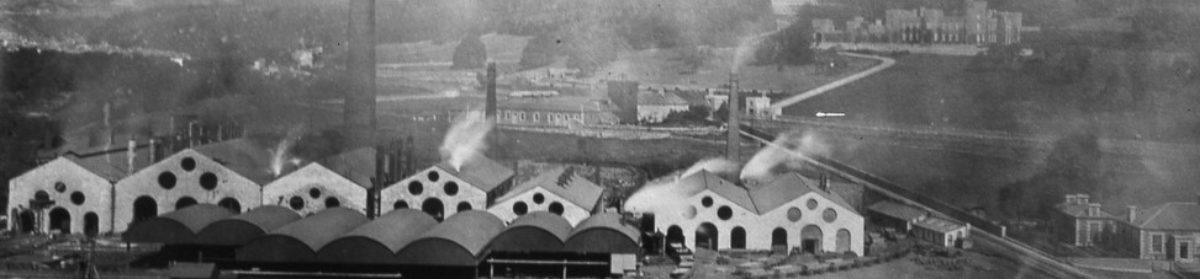
An aerial view of Dowlais from 1929. Dowlais Works are bottom right and Ivor Works are top middle. Photo courtesy of the Alan George Archive

There was an exodus of Dowlais men to Cwmavon. Frederick Evans; David Harris, forge carpenter; Lamphier, who has been mentioned, and others; but Dowlais has supplied other works also, Rhymney to wit, for Mr Josiah Richards was one, and by an accident, in fact a fall in the engine house, was killed. John P Roe went with him as draughtsman, and succeeded to his position after Mr Richards’ death.

It may not be generally known that William Thompson of Penydarren, was then a part proprietor of Rhymney Works, and being a Governor of the Blue Coat School in London, was the cause of Mr E Windsor Richards being educated there.

Maynard Colchester Harrison was the forge clerk, and Sydney Howard went first to Cardiff and then to London in the same service. Mr Lewis Lewis, who in later years retired to Treodyrhiw, was looking after the stables etc., and there was lodging with him John C Wolrige, who afterwards went to Plymouth, and Edward Jones (called Liverpool Jones), who became manager at Hemmetts at Bridgwater, and afterwards manager of the Patent Shaft and Axle Works, Wednesbury.

There were many others. One was Mr Wm. Jenkins, manager of Consett subsequently (his father was the storekeeper in the works and clerk in the church), and one Goodall, brother to the artist of that name. For a time after he came he used to dream so  much – cross-adding the colliers’ pay was no joke – that he was doing it in his sleep.

There had been one at Dowlais I never remember, It was he who put up what was then the foremost mill of the time. His name was William Gardner, and the big mill was put up by him, but from all I ever learnt, he it was who brought the false rider into good use. Simple as this is, it was exceedingly advantageous. To explain it, allow my saying it is placing of very cheap and simple casting to break and so save expensive damage to other parts.

To be continued at a later date…..

Memories of Old Merthyr

We continue our serialisation of the memories of Merthyr in the 1830’s by an un-named correspondent to the Merthyr Express, courtesy of Michael Donovan.

A little way down was the Owain Glyndwr Inn, of which a Mr Thomas Williams was host. He was a brother to the David Williams, Angel. He had a son whom some of your readers may remember as a druggist; his name was John Teague Williams.

There were several roads and streets leading off from this, the High Street, to the road from the Dowlais Inn up to the church; one was called Horse Street from the fact that horses always went up that way; the one on the upper side of the Bush was Church or Chapel Street, I forget which, and would have been a nearer way, but it was exceedingly steep. One of the six shops mentioned was used as a reading room.

An 1851 map showing some of the areas mentioned.

The caretaker or librarian was Mr Henry Murton, a remarkably clever man. To illustrate the character of the man let me give some anecdotes. He was engaged in the Works to carry the patterns to and from the moulders. He had a failing, and was told he had been appointed to a better position on condition that he give up the cup. Expressing his gratitude, of course, the promise to do so was made, but alas broken before the day passed. He was clever too. In Basil Hall’s voyages, reference is made to the earthquakes in South America. Murton designed and made a model of a house that would not be affected by them – this I well remember.

Merthyr Guardian – 2 February 1833

If I may interpolate a personal matter I would say it was in this reading room in the Athaneum the first account of sun pictures was read. It was Fox Talbot’s paper read on the subject before the British Association at the sitting just concluded.

Necessarily Murton’s occupation brought him into connection with master moulder, who, although a man of substance, peculiarly was not a man well informed, and interrogating Murton as to how vessels went across the Atlantic, obtained information as to the mariner’s compass. “Well” said the moulder, “I thought a big ship took boats, and then somehow the boat would guide the ship that way again”.

Passing the entrance to the Dowlais Works there were no cottages on the right hand. The small building with their back to the road were used for store houses for the necessaries of the works. The Police Station was not built, but there was a dwelling inside contiguous to the office. A David Phillips lived there, and two or three generally had lodgings there. George Cope Pearce was one, Edward Davies (we called him Ned) another; he was a brother of R P Davies, an old Dowlais man, but whose name can be seen on the base of the clock in the Circle at Tredegar. R P Davies was for a while the London agent of Messrs Guest, Lewis & Co.

Poor Ned! The last time I ever saw him was a chance meeting near the Tower of London. He had been down to one of the docks to see the ship in which he was going to California. There was no lack of substance in him for he was desirous of making a bet that he would go to any three persons that I pointed out, and persuade them he was known to them. Finding the cause for this, its necessity was avoided, and I parted from him as he went into the City Club to see his brother.

Two others sailed with him, one, Cox by name, and assistant doctor from Dowlais, and another, I think it was a Bramwell, from Penydarren, but they never reached their destination, the ship was wrecked.

To be continued at a later date…….

Memories of Old Merthyr

We continue our serialisation of the memories of Merthyr in the 1830’s by an un-named correspondent to the Merthyr Express, courtesy of Michael Donovan.

The Basin Tramroad continued between the turnpike road and the Morlais Brook, until it came close to Gellyfaelog, and then curved round to the right, the road taking a turn just beyond. There were several public houses on the way; one, the Talbot, was not far from Penydarren, and three chapels can be recalled.

The Talbot Inn, Penydarren. Photo courtesy of the Alan George Archive

The Morlais Brook was kept to its course by masonry, sometimes in the form of a semi-circular culvert, at other places by a wall. A rope maker by the name of Verge followed his business here, his walk being between the brook and the tramroad. About where the road now turns, for years there stood an ash tree, but it became dispoiled to a stump or trunk eventually; it was always understood to be a boundary of some property, the detail of which if ever known has now slipped into the land of forgetfulness. This road, however, is to me a new one, and was made after all the works traffic was conveyed by the railroad.

For some distance along here the continuity of the dwellings on the right side was broken. There were others further on, in one of which Thomas Gwythiwr, the roll turner of Dowlais lived, and a person by the name of Shaw, whose father kept a school in the Glebeland, Merthyr, stayed with him. Shaw was an artist, and painted likenesses in oil, as well as any scenes, real and fanciful that may have taken his fancy. Whilst writing this, it occurs to me that it is likely some of his work yet exists in the locality; indeed, I firmly believe, one place could be mentioned, but do not like to say so without permission. If anyone will enquire of me through you it could be mentioned without fear of offence.

At the end of the block of dwellings in one of which Gwythiwr lived, the tramroad and turnpike were not above forty feet apart, and level with each other. A pedestrian could, and generally did, come on to the tramroad to shorten the way, but all other traffic would go a little further on and then turn. This bridge is Gellifaelog, and the brook is the Morlais. There was was at one time a tramroad on the left side of the brook running around to the Ivor Works.

An extract of the 1851 Ordnance Survey Map showing the Gellifaelog Bridge

Crossing the bridge I fancy a turnpike gate can be remembered, but a public house, the Bridge End, can well be remembered. It was kept by one of the name of Evans. His daughter was married to Will Williams, who with others went to Russia on a rail matter; that may be again alluded to. There was a cheque presented at the Brecon Old Bank and paid, which turned out an imposition, and it was reputed to have been done by her in man’s clothing, but another was thought to have been the instigator. Whether the identity was correct or not, there was the on dit.

To be continued at a later date……

Memories of Old Merthyr

We continue our serialisation of the memories of Merthyr in the 1830’s by an un-named correspondent to the Merthyr Express, courtesy of Michael Donovan.

But stay! there was a round building that must not be forgotten. It is probable that many are unacquainted with its purpose, for they are not in vogue now. It was a structure for the rolls not in use, or being attended to for making or repairing. It was built round so that a crane fixed in the centre would sweep around, so as to deliver or take up all within its scope. I should add the rolls were stored on their ends, the floor plates having the necessary circular holes for taking in the neck or bearing, and so keep them in vertical position.

As regards the individuality of Penydarren, Mr Richard Forman was the one time manager, and resided at Gwaelodygarth Cottage. When Mr Grenfell was manager he resided at Gwaunfarren, and it was so occupied by Mr Benjamin Martin after he became manager, previous to which he resided on the “yard”, or rather the road leading to it and to Caemarydwn (sic).

Mr Martin had five brothers and one sister that can be remembered. Two of his brothers, Joseph and Thomas, were in the works; Edward who became the registrar at Penydarren; John was the doctor, living near the Bush, in the High Street of Merthyr, and George, who is always remembered in Dowlais. The sister married and went to America, whence she returned, and lived in a house between where the Pontmorlais turnpike gate stood and the bottom of Penydarren Works.

The first millwright that can be recalled was Mr Thomas Davies, who went thence to Nantyglo. He was succeeded by John Watt, from Dowlais, who afterwards removed to Govan. James Roe, a younger brother of John P Roe, was there also, and I think he died there. Bye-the-bye, he married either the daughter or other relative of the Waunwyllt family. Adrian Stephens (left), the inventor of the steam whistle, was also there.

It was in the Penydarren Forge one of Trevithick’s engines and boilers was seen, and another also of his make was used for winding coal at Winch Fawr. The upper end of the forge was built of limestone, and the purest specimen of Doric architecture ever seen in South Wales. The chimney or stack of the roll lathe, not many yards thence, was a copy of the Monument on Fish Street Hill, but one fifth the size.

Now to return to the crossing of the turnpike road on the limestone tramroad. I have an idea that Mr Morgan, who lived close by there, and already alluded to, married a sister of Mr Benj. Martin, but she has not been mentioned with that gentleman’s other brothers and sisters as I am not positive respecting it.

There were houses almost continually from her to Dowlais. On the opposite (the left) side of the road there was a shop kept by the name of Williams – it was a son of his, I believe, who erected a flour mill, and opened a grocery and and provision place on the right hand side of Victoria Street and named it the Hong Kong Shop.

I have omitted to say that one of those living in the houses near Penydarren Office was a Mr Gibson; he was the cashier, and married a Miss Farmer, whose father was a gunsmith etc. in Cardiff. His shop was, as near as I can remember, where or near there is one one present, between the Bute estate offices and the Angel Hotel. He built a row of cottages on the left, opposite to where the road now turns to Dowlais, and thus avoids Gellyfaelog, which is known to this day as Gibson’s Row.

Gibson’s Row in the 1940s. Photo courtesy of the Alan George Archive

A family named Waters also lived in the clump. John, the eldest son, became the furnace manager at Duffryn under Mr A Hill, in which position some years after he was succeeded by Mr John Place. Mr Evan Roberts, another of Mr Hill’s furnace managers, had charge at Plymouth after Mr Thos. Davies left.

To be continued at a later date…….

Memories of Old Merthyr Tydfil

We continue our serialisation of the memories of Merthyr in the 1830’s by an un-named correspondent to the Merthyr Express, courtesy of Michael Donovan.

Bidding goodbye to Plymouth, let us walk up to Penydarren, but to fall into line with what has been previously stated, now imagine ourselves at the old turnpike gate close to the Morlais Castle Inn. The road inclining to the right must now be followed.

After a short time the tramroad from the basin would be crossed, and only a few yards previously, the branch into the works would be seen. The gates, or rather the lower gates of the works are here, and passing through, the works would be virtually surrounding you, at least the rail shed, the brickyard, an the new mill, but persons other than hauliers with their horses etc. were not allowed in that way, so we must keep to the turnpike road for a short distance, having the tramway on the left, when another gate would be come to opposite the entrance to Penydarren Park.

A composite of parts of the 1851 Ordnance Survey Map showing Penydarren House and Gardens (left) and the Penydarren Ironworks (right)

Only a few yards further on the tramway again crosses the road, and over this very crossing the turnpike gate (the Penydarren gate) was hung. The gate house on the left was only recently removed by the District Council.

The clump of buildings on the right from the entrance gate to the works was agents or other employees residences, with the offices of the works in front of them. The tramroad kept to the right, and did not rise as fast as the turnpike road. There were no houses on the right-hand side of the road until the tramroad from the Morlais Limestone Quarries had been crossed.

The first come to was occupied by Mr Morgan, the blast furnace manager, but there were some cottages on the left before coming to the tramroad. There was a brick cistern near the crossing that was made for the use of the locomotives at work on the lower, or basin road, and upon one occasion, while being filled, the boiler exploded.

Before proceeding further, let us glance at the prospect on the right. Immediately in front were the blast furnaces, five in a row and one detached, a little to the right; but before reaching them the Morlais Brook, or dingle in which it ran, would be seen, then a long incline leading up on the left. This was used for the removal of cinders or other refuse, no doubt, after the tip on the riverside had become as large as could well be. On the other side of the incline were the blast furnaces, with a large spherical wrought-iron regulator for the blast between the engine houses.

To the left of the furnace yard are, or were, the hitting shops; to the right, after the blast furnaces, was the refinery, the the smiths shop, a self-acting incline to lower coal forge and mill use; then the rod lathe, the forge (or puddling forge) followed these mills where bars, sheets and slit rods were made. The rail mill was the lowest, and the sheds extended to the gates at the bottom of the works.

Penydarren Irnoworks

To be continued at a later date……

Merthyr’s Chapels: Williams Memorial Chapel, Penydarren

Williams Memorial Congregationalist Chapel, Penydarren

At the beginning of the 20th Century it was decided to build an English Independent Chapel for the rapidly growing population in Penydarren.

A committee of representatives of local Independent chapels was set up in 1901 and they agreed that the first task was to establish a Sunday School. This opened in Penydarren Boys School on 9 March 1902. More than a year was to pass before the first church service was held there on 12 April 1903, and on 25 May, the church was officially formed with 32 members, and a special service was held in Horeb Chapel.

The future of the church was discussed at a meeting presided over by Alderman Thomas Williams, J.P. (right), who owned much land in Penydarren. He was a staunch follower of the Independent movement and a supporter of the new church, and promised to make a gift to help build it. However, Alderman Williams died just two months later, but he had already arranged for a plot of land to be leased to the chapel in Brynheulog Street for 999 years at a rent of just one shilling a year. It was thus decided to name the chapel in honour of him.

On 19 November 1903, a meeting took place to discuss building the new chapel, and Messrs Owen Morris Roberts & Son, Porthmadoc were chosen to design the chapel. The committee decided that the cost of the building was not to exceed £1,800

The original plan submitted included a gallery and a schoolroom, but the committee decided that this plan was too ambitious and costly for their chapel, and also the members of the other Independent Churches recommended that the cost should be no more than £1,000, as there had been a very disappointing response to the original appeal for financial aid towards the building of the chapel.

After several further revisions of the plans, a tender was accepted for the work from Mr Samuel Evans of Dowlais, the cost being £1,258, and the stone laying took place on 19 July 1906.

The official opening of the chapel took place on 25 October 1906, and it was first used as a place of worship two days later. Due to an oversight however, the church wasn’t officially certified by the Registrar General as a place of worship until 2 July 1917.

The Chapel closed in 1996 and was subsequently demolished.