From The Pioneer 110 years ago today…..

The Melting Pot – Merthyr Tydfil's History and Culture
In Association with the Merthyr Tydfil & District Historical Society
From The Pioneer 110 years ago today…..
Transcribed by Chris Parry
A visit to Cyfarthfa Iron works in 1850
By 1850, the scale and reputation of the iron metropolis of Merthyr Tydfil was know across the UK and even further. Journalists were coming to the town to write about the place, the people, the environment, the industry, every aspect of the most populated part of Wales at that time. The Morning Chronicle, between March and June 1850, published ten long articles exploring every aspect of life at Merthyr Tydfil, creating the most detailed exploration of the town published in the 19th century. The following is an extract from one of those articles that details a tour of Cyfarthfa Ironworks in 1850.
The next iron works I visited were those of Cyfarthfa – the model works of South Wales… There are at Cyfarthfa and Ynysfach (works adjacent to each other) 11 furnaces in blast, and four at Hirwaun – all being the sole property of Mr. William Crawshay. At these works there are employed under and above ground, 5,000 hands, of whom 190 are women. By the returns furnished me, I find the amount of wages paid at Cyfarthfa and Hirwaun alone is 16,000 a month (of four weeks). The make of pig iron is 72,000 tons per annum. The quantity of the bars, rails, and tin plates is 53,000 tons a year. There is used of Welsh iron, and hematite ores for the production of the above, 166,800 tons a year. The daily consumption of coal is 850 tons. As many as 400 horses are here employed. These extensive works are chiefly carried on by waterpower, the supply being procured from the river Taff at a considerable distance up the valley, but steam is used when in summer the water fails. The machinery is very large and ponderous. Those of the water wheels are 36 feet in diameter, and the fly wheels, which are 60 feet in circumference and of prodigious weight, make ordinarily 70 revolutions a minute. About three months ago the periphery of one of these wheels flew into pieces, the fragments demolishing the roof of the mill in which the accident occurred, and descending at a distance through the roof of another mill, crushing into pieces large portions of beautiful and costly machinery then in motion, but without further casualty to the numerous workmen than a fracture of the thighs of one of them. One of the steam engines is of 260 horsepower; it has six boilers, and is of nine feet stroke.
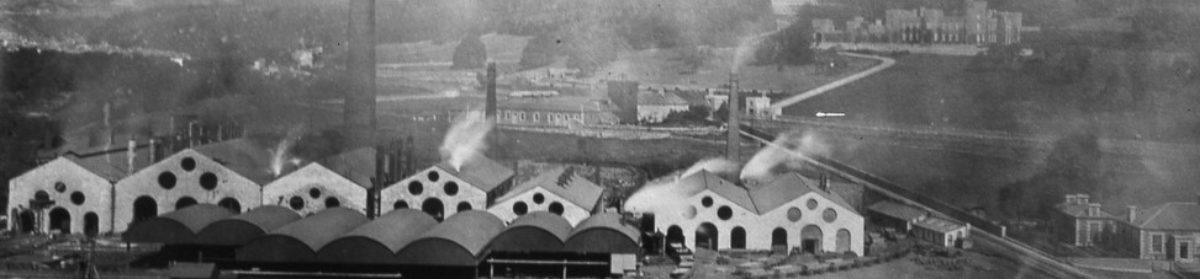
The above particulars will convey some idea of the magnitude of these works. I was accompanied over them by Mr. Robert Crawshay, whose familiarity with the philosophy of the various processes of smelting the iron is only equalled by his practical familiarity with its manufacture, and to who I am much indebted for the attention he paid me, and for the lucid and intelligible manner in which he explained everything which I did not at first clearly understand. These works are incomparably the best constructed, the most spacious, well-ventilated, comfortable, convenient, and methodical of all the works, not only in and around Merthyr, but throughout South Wales. Everything has been done on the most liberal scale, and with an evident aim at perfection and completeness. The extensive mills, with their massive walls pierced with large circular openings for light and lofty roofs, have an air of architectural grandeur that is quite imposing. The space within the roof of one mill is 82 feet. There is here so much room that the work is carried on without any appearance on hurry and bustle which I have remarked upon as belonging to other works. I was informed by Mr. David James, a disinterested party, that men who have once enjoyed the comfort, shelter, and convenience of these works would never leave them for others if could possibly avoid it. I have said shelter, because here the men and women employed at the furnace tops and at the hearths have roofs overhead, whereas at Dowlais I have complained that they are wholly unprotected, and such is the case elsewhere. The comfort of such a provision in the windy and rainy climate of these mountains can only be adequately valued by the workpeople who have tried both situations, the exposed and the sheltered. I think it the duty of those ironmasters who have neglected providing such a shelter, to lose no time in following the example of Cyfarthfa and the other works where such conveniences have been adopted. It will be an act of great kindness to the miserables who have now to endure all weathers, and the most violent alterations of heat and cold.

At Cyfarthfa I saw men belonging to the furnaces, squeezers, rollers, and saws at their dinner. They had good beef or mutton, and potatoes; the boys had broth with a small piece of meat: they seemed pleased to show the contents of their tins, observing that the work was so hard and the heat so great that they could not stand it without animal food. This, it must be borne in mind, was in the mills; at Dowlais and in the other works, as I have stated, the workmen also get meat. They were rail-making in two of the mills I inspected. I saw three rails made by the direction of Mr. Crawshay. Timed by a watch, they were made in three minutes – that is, from the presentation of the white hot “bloom” to the rollers to its completion in them. The ends were cut off, filed, and the bars straightened in an additional minute and a quarter – so that altogether the making and finishing of three rails ready for laying down on the permanent way occupied just four minutes and a quarter. It was here I first saw that ingenious but simple invention, “the splitting mill” at work. It was making what is termed “nail rods”, which it did by lengthening and dividing a short iron bar into about a dozen rods, eight feet long by a quarter of an inch wide. This most important and useful invention was made in Sweden, and the consequences were most disastrous to the manufacturers of iron in this country, who, having to divide the rods by a long, tedious, and laborious process, could not compete with the new invention. The means by which this difficulty was overcome are highly interesting…….
The return made to me of the rate of wages paid at these works is as follows:-
Colliers, 15s. a week
Miners, 12s, 6d, a week
Founders, 22s. a week
Fillers, 21s. a week
Labourers, 10s. 6d. a week
Puddlers, 18s. a week
Rollers, 30s. a week; rail rollers, 31 to 41 a week.
Roughers, 18s. a week
Ballers, 24s. a week; girls, 5s. a week
The portion of boys employed under sixteen years of age is about one-sixth of the whole: at Dowlais these were returned as about one-fourth. At one of the mills in these works boys only are employed; it is a training school for them, preparing them for the heavier mill and forge work. I saw them making iron rods for rails, and light work; they seemed to work with great spirit and alacrity…[1]
[1] Morning Chronicle, March 21, 1850, London
Transcribed by Chris Parry
In August 1797, the Duke of Rutland was travelling through south Wales documenting his travels for a book. By this time no journey to Wales was complete without seeing the spectacle of Merthyr Tydfil, which by that time was home to four large ironworks and had already attracted thousands of workers from across Wales to come and begin lives that were utterly different from the agricultural lives they left. His descriptions of Merthyr Tydfil, a visit to Cyfarthfa Ironworks and a meeting Richard Crawshay give a valuable early insight into the works, the town, the people and Richard Crawshay.

August 7, 1797
…We now at least were cheered with the sight of Merthyr, and the iron forges (of which there are three about the town) sending fourth large columns of smoke…Merthyr lies in the middle of these desolate hills, rich indeed in their productions of ore; it is a large place, chiefly occupied by the families of the workmen belonging to the forges. Travellers do not often go there but it is a place well worth notice, as any in Wales.
We dined heartily, and at dusk in the evening, the rain ceasing for half an hour, walked towards the forges. We wandered about for some time, and then went immediately to them, guided by the streams of fire which were bursting fourth from the chimneys. The distance of them from the town is about three-quarters of a mile; and the railroad along which we walked ran by the side of a canal; as we approached them, the effect was grand and sublime beyond all description. The fires from the furnaces were bursting fourth in the darkness of the night, and every moment we saw, as it appeared, a red-hot bar of iron walking towards us, we could see numbers of Vulcans dragging about pigs of iron just taken from the furnaces (the fires of which would dazzle the strongest eye) and pursuing their different operations, while their grimy figures, and gloomy visages, were visible by the light of the forges. We saw them running about in all directions through the doorways of the buildings, some of them hammering, others rolling the iron, while regular thumps of an immense hammer, which we heard far off, before we came near the works, and gradually increased to a thundering noise as we approached, completed the grandeur of the scene. I never saw anything that gave me more the idea of the infernal regions…
Wednesday August 8, 1797
This morning, we sent a note to Mr. Crawshay, the proprietor of the works, requesting his permission to see them. He returned a very polite answer, saying, he would be ready to attend us whenever we chose…
He (Richard Crawshay) was an elderly man, and seemed a singular character, fully convinced of the great of the great importance of the works he had accomplished; and talking in high style, which however was perfectly excusable in him…He told us, that when he originally came to the place, about 10 years ago, there was only one furnace, and that all the other extensive and magnificent works and improvements were wholly his own. He said he could not form any idea of the number of men that he employed, as he had captains under him, who had each agreed to furnish him with a certain number; however there could be no fewer than 1000 able-bodied men employed, and after adding the women, out-labourers, and etc. and etc. the total number of souls depended upon him, must amount to about 4000.
We first saw, and entered one or two of the workmen’s houses, which he had himself built for them at the rate of 30 guineas per house; they are extremely neat and clean. The works themselves consist of two divisions, one of them below, the other above a hill. He first took us to the summit, and explained to us the nature of the mines…
Very fortunately, iron ore, coal and limestone, are all found in the same hill, so that Mr. Crawshay has every requisite for his works close at home. He pointed out to us one shaft of coal, which would yield daily 200 tons. This is the quantity expected every day amongst the works…Before the end of the summer, he lays up a provision of 15,000 tons of iron ore for the consumption of winter, when the mine cannot be so easily worked.
…the ore (the puddled balls) becomes merely flattened pigs; in the second, these pigs are lengthened out into bars, three times their original length. It is astonishing to see the ease with which the workmen run about with the hot pigs of iron between large tongs, and with which they lift them without difficulty between the rollers. When thus lengthened into bars, they are taken to an immense hammer, which continually acts upon them, and gives the finishing to them, by straightening the bars. The same engine which works the hammer, moves an immense instrument like a pair of scissors, which cuts off the end of the bar, generally the worst part of it. While red hot under the hammer, a boy stamps the initials R.C. on the ends of the bar…
When we were there, three furnaces were at work, but there are five, all of which this single wheel is sufficient to blow, iron tubes connecting the whole, and joining them…
Mr. C said at present he made more iron than probably any person in the world, that he had bent his whole mind on being a perfect ironmaster, and that should he live long enough, he had yet great plans in view…
In the meantime, while so much engaged in the iron trade, Mr. C is by no means negligent of other concerns. He has cultivated the country around him, which on his arrival at the place was as barren as the bare rock. When his works were at a stand a short time since, he employed all his men on half-pay to clear the country of stones, several thousand tons of which he threw into the river and then cultivated the ground thus cleared…
Transcribed from Economic History of the British Iron and Steel Industry by Alan Birch, Taylor and Frances, 2005 (Originally published 1967), pp 83-86
From the South Wales Daily Post 130 years ago today….

by Victoria Owens
The following article is transcribed here with the permission of the Clifton Suspension Bridge & Museum official blog.

Since the Dowlais Iron Company made the iron that was used to forge the original chains, their importance to the Clifton Suspension Bridge was significant. The village of Dowlais itself is located on the fringes of Merthyr Tydfil and the Iron Company was established in 1759, when a group of nine gentlemen signed Articles of co-partnership in what they termed ‘Merthir Furnace’. By the 1840s, under the management of John – later Sir John – Guest, it was supplying iron rail to railway companies across the world. In time, Dowlais eclipsed the other Merthyr ironworks – Penydarren, Cyfarthfa and Plymouth – to become a vast concern; by 1853, when Guest’s widow Lady Charlotte headed the company, it had no few than eighteen furnaces in blast. The association with Clifton began a decade earlier in 1840 when Dowlais contracted to supply iron to the Copperhouse Foundry in the Cornish town of Hayle to be forged into eye-bar chains, that is, chains made up of bars with eye-plates at either end. A number of letters from John Poole on behalf of the Copperhouse Company, also known as Sandys, Carne and Vivian, to the Dowlais Iron Company – it also traded as Guest, Lewis & Co – survive which give some idea of the problems to which the contract gave rise.
On 15 August 1839, Poole wrote in confidence to Guest’s onsite manager, Thomas Evans. He wished to ascertain the prices ‘for Iron of the best quality’ that Dowlais could supply, and how soon Dowlais could provide it. Evidently Poole found the figures which Evans quoted acceptable, and fifteen months later, on 14 November 1840, he wrote again to Guest, Lewis & Co, demanding to know when they could make ’80 to 100 Tons of the Bars for the Clifton Bridge’ available at the Cardiff docks for shipping to Hayle. In bar form, the iron was not only convenient for transportation, but also ready to be worked into the finished product – in this instance, suspension chains.
At some point in the winter of 1840-41, Dowlais duly despatched a consignment of bar iron to Hayle where Brunel, always the perfectionist, sent one of his staff – a man named Charles Gainsford – to assess its quality. Having tested the iron, not only did Gainsford think it unfit for purpose, but also suspected Dowlais of having double-crossed Copperhouse. ‘We regret,’ John Pool informed the Dowlais management on 13 February 1841 ‘that [Gainsford] will allow us to use no part of the iron invoiced the 8th December last, which he says is not of best cable quality, & which he requested should not be forwarded to us when he visited the Dowlais Works. It is a great disappointment to us,’ he continues, that the Iron has not been made agreeably to the Order, and we fear the delay may subject us to a heavy loss. We hope the present shipment will be of the proper quality.’

It is a shocking indictment of procedures at Dowlais yet, surprising as it may seem, Poole’s aggrieved tone failed to bring about any improvement. Crucially, the iron bars from which the sections of chain were to be made up necessarily had to be straight. On 15 March 1841, Poole vented his growing impatience with Dowlais’s apparent failure to grasp this requirement in another letter of complaint. ‘Even a large portion of the Bars for the Clifton Bridge already received,’ he wrote, ‘must be heated all over to be made perfectly straight.’ He ordered them to send no more bars, other ‘than what may be inspected & approved by Mr Brunel’s representative at the works.’
By the end of March 1841, Poole’s forbearance was exhausted. Another consignment of faulty iron bars had reached him and, in considerable annoyance, he wrote at once to Thomas Evans. ‘We are exceedingly sorry,’ he protested, ‘that a large portion of the bars for the Clifton Bridge […] are so crooked as to entail upon us more labour to straighten them than ever upon welding on the eyes. […] Will you be good enough to inform us whether you are likely to have a further lot of bars shortly fit for use? It seems likely that, having received this missive, Evans read the Riot Act to the Dowlais workforce with the result that the quality of iron which they supplied to Copperhouse improved. Before long, Hayle was able to supply Clifton with satisfactory elements of the chains for the bridge ready for onsite assembly.
But by 1842, the Suspension Bridge trustees had run acutely short of money. Already £2,885 12s 1d was owing to Copperhouse and even by 1845 they had not been paid. Three years later, in 1848, so desperate for payment were the Hayle company that they were willing to accept £2780 12s 7d in return for quick settlement of their account. In the event, they were not paid until 1849, and only then after the despairing bridge trustees had taken out a loan for the purpose. In the town of Hayle, people evidently regarded this long-overdue settlement of the Clifton account as a significant landmark. The name of ‘Riviere Terrace’ which was a street of imposing houses built in 1840 changed to ‘Clifton Terrace’ by way of marking completion of the Cornish Copper Company’s contract. As for the chains themselves, when lack of funds halted work on the suspension bridge, the Cornwall Railway purchased them for incorporation within the Royal Albert Bridge at Saltash.
Yet although the lack of money brought work on the suspension bridge to a temporary halt before Hawkshaw and Barlow completed its construction to a much-revised version of Brunel’s design, the association with Dowlais did not entirely evaporate. The Dowlais Iron Company had provided the original iron used in the old Hungerford Bridge whose chains Hawkshaw and Barlow adopted for their bridge, supplemented by a large volume of new links purchased from the Lord Ward Round Oak works in Dudley. If the association between the Dowlais Iron Company, the Copperhouse Foundry of Hayle and the Trustees of the Clifton Suspension Bridge was less than harmonious, it is nevertheless intriguing to witness the frustrations and stalling that could bedevil even the most celebrated of Victorian construction projects.
Please follow the link below to see the original article. https://cliftonbridge.org.uk/clifton-suspension-bridge-and-dowlais-iron-company/
The article transcribed below appeared in the Illustrated London News 150 years ago today.
Several fresh illustrations are given this week, from sketches by our own artists, of the deplorable stoppage of labour in the vast collieries and ironworks of South Wales. The amount of interests involved in this unfortunate rupture between capital and labour is estimated by the correspondent of a daily paper:—
“In Monmouthshire and Glamorgan there are, all told, 450 collieries, of which about 150 are the property of ironmasters. In times when business is at full swing, the amount of coal ‘won’ from these numerous pits reaches 350,000 tons weekly. The manufacture of iron in the district demands 100,000 tons this weekly output, the remainder being spread abroad—some for shipping purposes, but the greater part for household and factory consumption. To raise 350,000 tons of coal in six days would require the operation of 70,000 hands—that is to say, practical ‘pitmen’, with labourers and lads. It is reckoned that the united earnings of this great body of workmen average £100,000 a week—about 27s. a head per week ‘all round’; or take the labourers and lads at 10s. to £1 a week, and the miners at 34s.
In the immediate vicinity of these collieries are the establishments of at least a score of leading ironmasters, giving employment to some 30,000 men. Taking an ironworker’s wages at the low average of 27s. a week, nearly £40,000 would be required to satisfy the number above indicated. Then there are those who are engaged in the ironstone mines, a body of men reckoned by thousands, and whose earnings are said to be at least £10,000 weekly. One way and another it may be fairly reckoned that the South Wales coal-fields are not worked at a less weekly average cost in the shape of wages than £150,000, and when nothing is amiss this is the sum, barring the small savings of the pitman, which between Saturday and Saturday finds its way into the tills of the butcher, the baker, the grocer, the publican, and other worthy tradesfolk of Merthyr, Aberdare, Dowlais, and the surrounding districts. It is hard to say who feel most acutely the pinch of the lock-out—the shopkeeper, or those who in flourishing times are his profitable customers. In by far the majority of instances, the tradesmen in question depend mainly for support on those who are employed in the pits and at the ironworks, and when these are rendered wageless the shopkeeper may as well put up his shutters.”
Merthyr Tydvil, a place of 70,000 inhabitants, including the Dowlais, Cyfarthfa, Pen-y-darren, and other works, in the neighbourhood of the town, is situated in the north of Glamorganshire. It takes its name from an ancient Celtic princess, named Tydvil, who was Christian virgin martyr, slaughtered by the Pagan Saxons about King Arthur’s time. The Vale of Merthyr varies in width from a mile to half a mile, with hills on each side that nowhere reach an altitude of 2000 feet. It has all the characteristics of those valleys of South Wales where the days are darkened by furnaces vomiting smoke and the nights are illumined by hundreds of furnace fires. Such, at least, is its normal condition. The Vale of Merthyr is not the least valuable of the wealth-producing districts where gigantic fortunes have been accumulated. Right and left shafts rise out of the hill-side, and from side to side engines reply to each other. Small streams bear away the water that constantly springs in the underground workings. The entire vale is intersected with tramways, by which coal is conveyed, from the pit to the metal-works.
“But these days,” writes newspaper correspondent, “the Vale of Merthyr has begun to put on an appearance of desolation. The Plymouth Iron and Coal Works, which extend for nearly a couple of miles, and present a succession of valuable workings, are strangely silent. The steam-engines at the pit mouth, noisily and showily pumping, throw significant aspect of inactivity upon acres of unworked machinery; and there is long line of black, funnels, tall chimneys, gaunt beams and cranks, and gaping machinery in cold repose. Not a gleam will to-night enlighten the landscape where for years the valley has been notorious for its unearthly glare. An old man, gazing upon the dismal desertion of these magnificent works, says there are people starving in the valley, and that half the distress which exists, and will exist here, will be never known.”
In the midst of so much gloom, there is one gleam of satisfaction in the fact that the ironstone-miners are working. They will not be stopped. They have been associated with the ironworkers in past reductions, and, as they are dependent upon neither collieries nor ironworkers, work has been secured to them at Cyfarthfa. These men attempted a resistance to the first reduction, and were out about two months. They then applied for work, but the difference with the ironmasters having obliged Mr. Crawshay to blow out his blast-furnaces, he told them ironstone was not required. If, however, they chose to work upon the wages of 1871—that was, 30 per cent below the highest point which had been reached, and the level to which the present reduction of 10 per cent brings colliers’ labour—they might go on. They accepted the offer, and have been working with regularity ever since.
Although the ironworks have been at a standstill all the time, and the colliers are now reduced to a similar condition, they will be kept going, no matter how long this struggle may last. It is stated that Mr. Crawshay would have kept his ironworkers similarly employed, had they met him in the same spirit; he would have stocked iron to the extent of 100,000 tons rather than they should have been thrown out of employment. Further, he made more than one effort to come to an arrangement with the association for the employment of his ironworks colliers alone, but the union question cropped up and became an insurmountable obstacle. Cyfarthfa, therefore, with the exception of the ironstone works, is in the same position as all the rest of the ironworks, with one furnace only in blast.
There has been no event of importance during the week, lord Aberdare (who was Mr. Bruce, late Home Secretary) has declined to interfere on behalf of the men, and advises them give way. The Merthyr poor-law guardians impose stone-breaking tasks as a condition of outdoor relief.

by Brian Jones
Throughout the Medieval period the number of local farms increased and these Manorial farms improved their productivity whilst the population waxed and waned. The antiquarian, David Merch, studied the 1558 “Morganiae Archaiographia” and identified 14 freehold farms. Manorial Rent Lists became important historical sources and John Griffiths used these records in his detailed work “Historical Farms of Merthyr Tudful” (2012) he identified 120 farms (see map below) twenty five of which were “Charter Land Farms” which were freehold in 1630 suggesting that the aristocracy divested a proportion of their freehold land in order to accrue capital or to curry favour with landed gentry. The freeholders of noble birth had been established for hundreds of year however these were not continuous blood lines. For example, the Earldom of Plymouth title has been established three times, firstly in 1675 by Charles II and by 1765 there had been another different family line as the original title holders did not have children or near relatives required in order to inherit. 
Five centuries after Gilbert de Clare claimed freehold ownership of all of the Merthyr land by force, a number of entrepreneurs came into the valley to begin the manufacture of iron. Business people such as Anthony Bacon, William Brownrigg, Isaac Wilkinson, John Guest, Richard Crawshay and the three Homfray brothers jostled to gain leases to build the ironworks: Dowlais (1759), Plymouth (1763), Cyfarthfa (1765) and Penydarren (1784). These works were financed by wealthy individuals and distant investors aware that resources were available to include coal, ironstone, limestone, clay, timber and particularly important, supplies of water.
The rich absentee freeholders owned tracts of local farmland and were anxious to lease their holdings in the knowledge they could increase their income by leasing land for the extraction of minerals to the newcomers rather than from their existing tenant farmer. Two of the largest freeholders were the Earl of Plymouth and Earl Talbot whose forebears had concentrated on rural economies but now they changed their attitude to manufacturing and this opened a new chapter on the ownership of land in their possession. There was a rapid decline in the number of farms and an attendant change from a rural to an urban economy; houses were required for the influx of people to man the ironworks, quarry the limestone and mine the iron ore and coal. People left the land for the minor village which now began to increase in size.
450 years after Gilbert de Clare,7th Earl of Gloucester took possession of the land, later known as Merthyr parish, it is remarkable that three dynasties owned the majority of the freehold of the parish. At the beginning there were no maps to record existing land holdings and therefore landscape features assumed particular importance and the River Taff served as a boundary. Much of the land to the west of the river was owned by Lord Talbot whilst that to the east of the river was owned by the Earl of Plymouth with a portion around the parish church owned by the successors of the Lewis family. The leases for all four ironworks are set out in an authoritative work completed by John Lloyd in his 1906 book “The Early History of the Old South Wales Ironworks 1760 -1840”. This work draws on the extensive collection of leases drawn up by a Brecon firm of solicitors, Messrs Walter and John Powell. The first Cyfarthfa lease of 7th October 1765 with Anthony Bacon and William Brownrigg was for 4000 acres of land below the junction of the Taff Fawr and Taff Fechan, southwards down the valley, to the centre line of Aberdare mountain. The ancestry of William Talbot can be traced back to a Norman family in France, then to Sir Gilbert Talbot (1276-1346) Lord Chamberlain to King Edward III who married into the Welsh line of Prince Rhys Mechyll. William Talbot was created Earl Talbot of Hensol in 1761 and his legacy had spanned centuries intertwining noble ancestry, legal expertise and political service. His estates were extensive and he had links to Llancaiach Fawr in Nelson and Dynevor (Dinefwr) in Carmarthenshire. The family name is still linked to the premier noble seat of the Earl of Shrewsbury where the present Earl is also titled as Baron Talbot of Hensol.
The Cyfarthfa lease of 29 August 1765 with William Talbot was also joined with Michael Richards of Cardiff. There is some uncertainty as to this latter freeholder although there appears to be a connection with the Llancaiach estate and Rhyd-y-Car farm. It is likely that some time between 1685 and 1729, Jane, one of the two daughters of Colonel Edward Pritchard, sold her half share of the Merthyr estate to a Michael Richards who in a later lease is identified as the freeholder of Rhyd-y-Car farm. The other daughter, Mary, married David Jenkins of Hensol and their daughter married Charles Talbot in 1713. It is likely that the Talbots and Richards were closely connected by the date of the Cyfarthfa lease of 1765 and by then Michael Richards was of some social standing and wealth, living in Cardiff.
The lease for the land to the east of the river was held by the other major freehold interest with the 4th Earl of Plymouth of the 2nd Creation, Other Lewis Windsor Hickman, styled as Lord Windsor, made the Lord Lieutenant of Glamorgan in 1754. This family had combined a few years earlier with a wealthy landed Glamorgan family with firm links to the history of Merthyr Tydfil (Tudful). In 1589 the Lewis family had occupied the Courthouse (Cwrt) at the site of the present Labour Club in the centre of the town, then the location of the small parish village with the church of “The Martyr”. “The Cwrt” was possibly the court of the Welsh prince, Ifor Bach and then passed through his descendants to the Lewis family who left Merthyr and moved to Caerphilly at the time of Elizabeth I where they built a manor house with extensive parkland at the Van. Lewis of the Van became the Sheriff of Glamorgan in 1548 and in time the Glamorgan estates were gifted to the last survivor of the family line, Elizabeth, who married into the Earl of Plymouth line with the 3rd Earl of Plymouth in 1730 and hence the combined wealth of both families came into play.
In summary the ownership of land in Merthyr Tydfil (Tudful) changed from a sole landowner in 1267 with a small number of tenanted farms to increase to about 120 in 1630. Three quarters of the farms were rented and perhaps 14 to 25 freehold. Most of the freeholds were of relatively small acreage with substantial acreages in the hands of the few families who were descended from Norman lines. The Llancaiach estates and those of the Earles Plymouth and Talbot, and Richards, figure large in the leases for mineral rights agreed with the 4 local ironwork companies. Then the number of farms reduced and 100 years later the coal era building boom ensued to meet the needs of the new colliery villages. By that time the village became the growing town of Merthyr Tydfil, churches and chapels increased in number and the older churches reinforced their medieval rights as Glebe lands. As the 19th turned into the 20th century the vast majority of properties were leasehold however the Leasehold Reform Act of 1967 enabled leaseholders to acquire freehold interests and that ownership is now the norm.
by Brian Jones
Land, ground or earth is almost entirely covered by a layer of rocks and soil and local limestone, coals and ironstone form the bedrock of the land in the Merthyr Tydfil area. Here thin soils mask the land and support pasture, trees and recreational spaces however the dominant human feature is the urban environment with roads, houses, commercial and agency properties. All buildings stand on land which is either leasehold or freehold whilst the former ownership is of temporary duration, usually for 99 years, whereas the freeholder owns land in perpetuity. Only the freeholder can consent to a lease for which he/she is paid rent.
The population within the Merthyr Tydfil Borough Council area is approximately 59,000 in settlements spread over 43 sq. miles with over 30,000 private, commercial and retail properties. The records of ownership of all of the land and property in England and Wales is maintained by HM Land Registry which was created in 1862.There was no central record keeping prior to that date although legal documents that prove an individual’s ownership of land have been prepared for centuries and documentation can include Wills, Leases, Mortgages, Conveyances and Contracts for sale. It is an immense task to describe the ownership of all of the properties and land and, in any event, ownership is constantly changing as numerous pieces are bought and sold. In order to simplify the description of land ownership it is easier to refer back to a period when the population was smaller and ownership was concentrated in few hands. This article concentrates on the freehold ownership of land between two local historical events: the construction of Morlais Castle at the end of the 13th century and the building of Cyfarthfa Ironworks 450 years later. The intervening Medieval period was a time of significant changes in farming and towards the end of this interim period land ownership was changed by mining and quarrying. Then came the business men seeking their fortunes in the iron industry.
In the 13th century north of Abercynon, the River Taff with its two headwater tributaries was a wooded area with few people, a small number of farms and a minor village located around a church dedicated to a venerated person named Tudful. “Liber Landavensis” c1130 (National Library of Wales) makes reference to this church. Another ancient ecclesiastical document “The Valuation of Norwich” (1254) includes reference to the church at Merthyr Tudful. That century saw large scale political change and military conflicts throughout Wales. Major changes were taking place in the ownership of land claimed by the Welsh population and challenged by the Anglo-Norman Plantagenet forces of the English King Edward I. The first Plantagenet King, Henry II, and his immediate successors refrained from annexing the land in Wales from the numerous Welsh Princes. Later English monarchs took the least line of military resistance which was in South Wales and in 1267 Richard de Clare, 6th Earl of Gloucester began to wrest control of the ancient Merthyr parish of Uwch-Senghenyyd, from the local Welsh ruler, Gruffydd ap Rhys.
The acquisition of land by way of force was recognised as a lawful means of gaining sovereignty and the rights of freehold over newly annexed land were claimed. The subjugation of Wales was completed by King Edward I in his second foray into Wales in 1282-83 and he continued to support the powerful and wealthy English Lords of Glamorgan, known as Marcher Lordships with a seat at Cardiff Castle. On the death of the 6th Earl, Gilbert de Clare became the 7th Earl in 1262 and he ruled his lands and was able to declare war, raise taxes, establish courts, markets and build castles, without reference to the King. To possess land by force of arms needed to translate into the creation of a border and this brought the Earl into conflict with his neighbour to the north, another Marcher Lord, Humphrey de Bohun, the Earl of Hereford and Lord of Brecon. The 7th Earl, began the construction of Morlais Castle in 1288 on a limestone ridge at 1,250 feet in order to mark the boundary of the land which he now claimed by right of conquest. This was to be the border between Morgannwg and Brecheiniog although it is doubtful that the castle was ever completed.

Humphrey de Bohun protested to the King claiming the castle was built within his border and thus claimed ownership of the land. Edward I forbade the private war between the two Earls however Gilbert ignored this proclamation and conducted a series of raids into the lands of Brecon. The dispute was heard in 1291 and resolved a year later and Gilbert died in 1295. The Merthyr freehold passed to his heirs however the political situation continued to be fraught and there began a period of monarchical turbulence with freehold interest in the land changing. Subsequent monarchs gifted portions of the Merthyr freehold to other favourites and eventually the wealthy Earls of Plymouth and descendents of the Norman Talbot families featured in large part of the story of the leasing of land for the mineral and water rights required for the building of the four Merthyr Ironworks.
To be continued…..
by Charlotte Barry
During May, the following talks will be held at Cyfarthfa Castle Museum and Art Gallery.
11 May – “Colonial Cyfarthfa: The Uncomfortable Truth Behind an Industrial Giant” – Chris Parry
14 May – “Women in Welsh Coal Mining: Tip Girls at Work in a Man’s World” – Norena Shopland
19 May – “Capturing the Crawshays” – Ben Price
Everyone is welcome. All talks start at 2.00 pm and tickets are available by following the link below.
by Andrew Green

The end of the eighteenth and the beginning of the nineteenth century saw the rise of local ‘literary and philosophical institutions’ throughout the British Isles. They aimed to bring together like-minded people to discuss issues of the day. The label ‘philosophy’ usually meant not logic or metaphysics, but an interest in the latest developments in science and technology, at a time when their study was in rapid flux as the industrial revolution gathered pace. Typically, members gathered to listen and respond to lectures by visiting speakers. Some societies also owned premises, issued publications, maintained libraries and museums, and even, as in the case of the Swansea Philosophical and Literary Institution (later the Royal Institution of South Wales), equipped and ran a scientific laboratory.
Most literary and philosophical societies were dominated by the upper and middle classes: members of the gentry and clergy, scientists, industrialists and engineers. And so, on the face of it, was the Cyfarthfa Philosophical Society, set up in Merthyr Tydfil in 1807. But all was not quite as it seemed.

At this time Merthyr was entering its heyday as one of the most dynamic and rapidly expanding towns in Britain, thanks to the numerous iron works set up in and around its centre. The ironworks – Cyfarthfa was one of the two largest – employed large numbers of skilled and semi-skilled workers, and the town also housed the works’ owners, engineers, managers and agents, and others like shopkeepers who serviced the residents. Early on in its explosive growth, despite its lack of physical infrastructure, like decent housing, sanitation and schools, Merthyr had a lively community culture, centred on its many chapels. From the start of the nineteenth century its people developed a tradition of industrial protest and political radicalism. In 1831 disaffection boiled over into what became known as the Merthyr Rising.
 Most of what’s known about the Cyfarthfa Philosophical Society comes from Charles Wilkins’s A History of Merthyr Tydfil, published much later in 1867. This is how Wilkins (left) describes how the Society began, apparently with a strong interest in astronomy:
On December 15th, 1807, sixty persons, living in Merthyr and its neighbourhood, met together, and subscribed a guinea each towards buying such apparatus as was deemed suitable; but that sum proving inadequate, it was augmented by a good many of them subscribing another half-guinea. The instruments were had, a code of rules drawn up, and a few books on astronomy purchased. It gives us a tolerable notion of the capacity of the members when we learn that the list of instruments was composed of a good reflecting telescope, a pair of globes, a microscope, a planetarium, an orrery, an equatorial, and other philosophical apparatus. (p.269)
Wilkins gives the names of the most prominent of the founding members:
J. Bailey, Esq., an M.P., and a large iron-master; the poet and stone-cutter, Rees Howell Rees; John Griffiths and William Williams, afterwards famous as engineers and mechanicians; William Aubrey, the mill contractor; Thomas Evans, the philosopher, astronomer, and mathematician, of Cyfarthfa ; Benjamin Saunders, the ingenious moulder; Henry Kirkhouse, the mineral agent; and several others more or less able in their respective callings.
Joseph Bailey was the nephew of Richard Crawshay, the founder of the Cyfarthfa Ironworks. He inherited a quarter share in the works, but sold it in 1813 and bought the Nant-y-Glo works. Later he added the Beaufort works. He converted much of his large profits into land, and lived at Glanusk Park. Possibly Bailey was chosen as the ‘respectable figurehead’ of the Society.

Most of the other men Wilkins mentioned were highly skilled technologists connected with the Cyfarthfa Ironworks. John Griffiths and William Williams were both engineers there. Griffiths built steam-engines. In 1829 Williams invented the first machine for testing the tensile strength of metals. In later life, it was said, he became so large that he had to be moved around the works in a specially built trolley. His son, Morgan Williams, became the leading Merthyr Chartist. William Aubrey of Tredegar helped design the extensive water systems at Cyfarthfa. ‘None of his contemporaries’, his obituary in Seren Gomer said, ‘was as skilful as he was in inventing and setting up all kinds of engines and machines worked by fire and water’. Benjamin Saunders, the ‘ingenious moulder’ at the Cyfarthfa works, later described as ‘an amalgam of an inventive brain and a deft hand’, built a planetarium, a quadrant, a thermometer, a water-gauge and a weather-glass. Henry Kirkhouse was the mineral agent at Cyfarthfa for more than half a century, and ‘retained the respect of all who came in contact with him – from Mr Crawshay to the humblest miner’.
To be continued……
Reproduced with the kind permission of Andrew Green. To see the original, please click https://gwallter.com/history/the-cyfarthfa-philosophical-society.html