Transcribed by Chris Parry
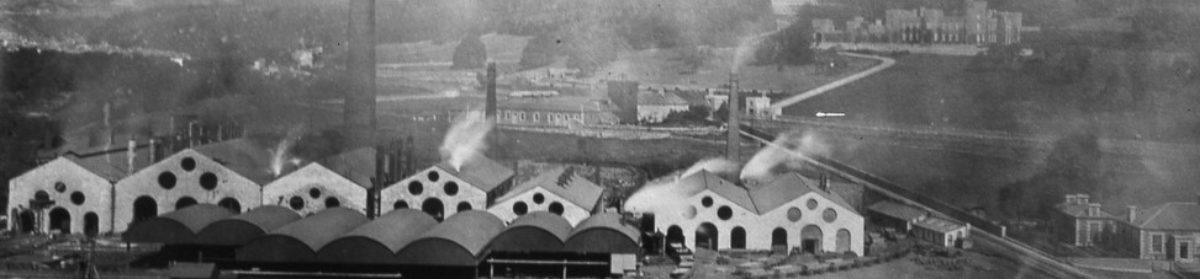
In August 1797, the Duke of Rutland was travelling through south Wales documenting his travels for a book. By this time no journey to Wales was complete without seeing the spectacle of Merthyr Tydfil, which by that time was home to four large ironworks and had already attracted thousands of workers from across Wales to come and begin lives that were utterly different from the agricultural lives they left. His descriptions of Merthyr Tydfil, a visit to Cyfarthfa Ironworks and a meeting Richard Crawshay give a valuable early insight into the works, the town, the people and Richard Crawshay.

August 7, 1797
…We now at least were cheered with the sight of Merthyr, and the iron forges (of which there are three about the town) sending fourth large columns of smoke…Merthyr lies in the middle of these desolate hills, rich indeed in their productions of ore; it is a large place, chiefly occupied by the families of the workmen belonging to the forges. Travellers do not often go there but it is a place well worth notice, as any in Wales.
We dined heartily, and at dusk in the evening, the rain ceasing for half an hour, walked towards the forges. We wandered about for some time, and then went immediately to them, guided by the streams of fire which were bursting fourth from the chimneys. The distance of them from the town is about three-quarters of a mile; and the railroad along which we walked ran by the side of a canal; as we approached them, the effect was grand and sublime beyond all description. The fires from the furnaces were bursting fourth in the darkness of the night, and every moment we saw, as it appeared, a red-hot bar of iron walking towards us, we could see numbers of Vulcans dragging about pigs of iron just taken from the furnaces (the fires of which would dazzle the strongest eye) and pursuing their different operations, while their grimy figures, and gloomy visages, were visible by the light of the forges. We saw them running about in all directions through the doorways of the buildings, some of them hammering, others rolling the iron, while regular thumps of an immense hammer, which we heard far off, before we came near the works, and gradually increased to a thundering noise as we approached, completed the grandeur of the scene. I never saw anything that gave me more the idea of the infernal regions…
Wednesday August 8, 1797
This morning, we sent a note to Mr. Crawshay, the proprietor of the works, requesting his permission to see them. He returned a very polite answer, saying, he would be ready to attend us whenever we chose…
He (Richard Crawshay) was an elderly man, and seemed a singular character, fully convinced of the great of the great importance of the works he had accomplished; and talking in high style, which however was perfectly excusable in him…He told us, that when he originally came to the place, about 10 years ago, there was only one furnace, and that all the other extensive and magnificent works and improvements were wholly his own. He said he could not form any idea of the number of men that he employed, as he had captains under him, who had each agreed to furnish him with a certain number; however there could be no fewer than 1000 able-bodied men employed, and after adding the women, out-labourers, and etc. and etc. the total number of souls depended upon him, must amount to about 4000.
We first saw, and entered one or two of the workmen’s houses, which he had himself built for them at the rate of 30 guineas per house; they are extremely neat and clean. The works themselves consist of two divisions, one of them below, the other above a hill. He first took us to the summit, and explained to us the nature of the mines…
Very fortunately, iron ore, coal and limestone, are all found in the same hill, so that Mr. Crawshay has every requisite for his works close at home. He pointed out to us one shaft of coal, which would yield daily 200 tons. This is the quantity expected every day amongst the works…Before the end of the summer, he lays up a provision of 15,000 tons of iron ore for the consumption of winter, when the mine cannot be so easily worked.
…the ore (the puddled balls) becomes merely flattened pigs; in the second, these pigs are lengthened out into bars, three times their original length. It is astonishing to see the ease with which the workmen run about with the hot pigs of iron between large tongs, and with which they lift them without difficulty between the rollers. When thus lengthened into bars, they are taken to an immense hammer, which continually acts upon them, and gives the finishing to them, by straightening the bars. The same engine which works the hammer, moves an immense instrument like a pair of scissors, which cuts off the end of the bar, generally the worst part of it. While red hot under the hammer, a boy stamps the initials R.C. on the ends of the bar…
When we were there, three furnaces were at work, but there are five, all of which this single wheel is sufficient to blow, iron tubes connecting the whole, and joining them…
Mr. C said at present he made more iron than probably any person in the world, that he had bent his whole mind on being a perfect ironmaster, and that should he live long enough, he had yet great plans in view…
In the meantime, while so much engaged in the iron trade, Mr. C is by no means negligent of other concerns. He has cultivated the country around him, which on his arrival at the place was as barren as the bare rock. When his works were at a stand a short time since, he employed all his men on half-pay to clear the country of stones, several thousand tons of which he threw into the river and then cultivated the ground thus cleared…
Transcribed from Economic History of the British Iron and Steel Industry by Alan Birch, Taylor and Frances, 2005 (Originally published 1967), pp 83-86