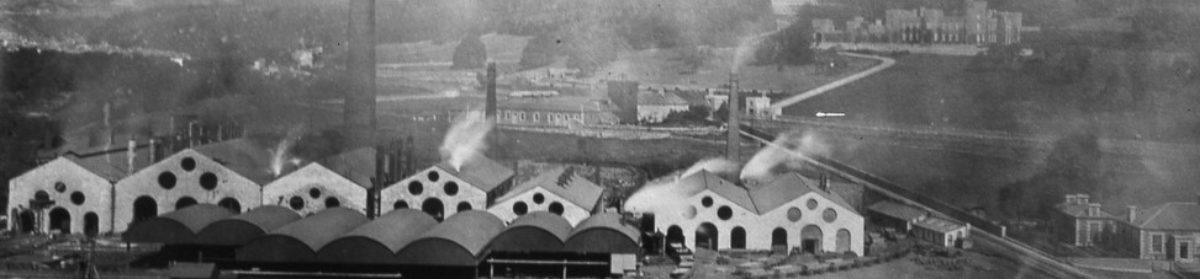
A General View of Pontsarn

by Alison Davies

I love collecting Vaynor memorabilia and postcards of the area, like many local collectors it’s a lifelong passion.

Then every so often a card comes along that is both historically important on the front and back, and please excuse the phrase but ‘it blows me away’ and below is one.

A General View of Pontsarn

This is a rare image taken from the fields overlooking Vaynor a little way below Pontsticill. It’s like peeping through a curtain back in time.

In the centre of the picture is the back of the Church Tavern pub with the two churches at Vaynor you can see the steeple on the new Church, the pathway leading from the old church and first few headstones in the new cemetery. The houses too: Dolcoed, Hy Brasail and Bragty Cottages are clearly visible along with the fields systems around.

The view then sweeps down the valley to the viaduct, Pontsarn Station and beyond its one of the most incredible postcards of Vaynor that I’ve seen.

The back of the card is equally important, it is an incredible piece of Merthyr’s history. Postmarked Merthyr Tydfil 27 Dec 1936 and sent from Gwernllwyn House Dowlais by M E Horsefall (Mary Emmeline Horsfall)

It reads:

Thank you for your card and good wishes.

I hope you and Mr Cobby are well

With good wishes M E Horsfall

Mary Horsfall was a philanthropist who came to Dowlais in 1934 to help at the Educational Settlement formed by John Dennithorne. She lived at Gwenllwyn House Dowlais and from there ran classes teaching unemployed men and women the arts.

Mary invited important artists including Heinz Koppel and Cedric Morris to teach art at Dowlais. Her address book must have read like a who’s who of the art world. Whilst in Dowlais Heinz Koppel painted Mary’s Portrait from his studio at Gwenllwyn House. Also in Dowlais between 1936-1939 Cedric Morris painted two of the most iconic and celebrated paintings in Welsh Art today, Dowlais Tips and Caeharris Post Office. Now in Cyfarthfa Castle Museum.

So who is the card written to ?

Mary Horsfall wrote the card to her friend Lucy Mary Cobby and her husband Anthony Cobby at little Bognor, Frittleworth Sussex.

Little Bognor is a tiny rural hamlet in Sussex re known for its artistic connections however I think Mary knew Lucy Cobby from earlier connections rather than artistic ones.

If you’re interested in the Dowlais Settlement and Mary Horsfall see Christine Trevett’s wonderful article Merthyr Historian Vol 33 p 123.

To see more of Alison’s fantastic research about Pontsarn and Vaynor, please follow this link: https://www.facebook.com/groups/747174317220437

A Strange House, a Welsh Lawyer and an Italian Contessa

by Graham Watkins

To the north of Merthyr Tydfil, near the railway viaduct at Pontsarn, stands a very peculiar house. The property has been known by a number of different names, over the years, including Hafod Cottage, Vaynor Cottage, The Old Spanish House and, more recently, Hy Brasail. At the time of writing, the house, a Grade II listed, stands empty, neglected and looking very sad. What makes the house unique is the style in which it was built.

Like its name, Hy Brasail, the house, is shrouded in mystery. Some commentators have suggested that the house was named after ‘Hy Brasail’ – also known as ‘Hy Brasil’ – a mythical island somewhere off the coast of Ireland.

According to legend, the island is hidden by an inpenetrable mist except for one day every seven years. In the old Irish tongue the name of the island suggests beauty, great worth and might. In 1674, a Captain Nisbet was on a voyage from France to Ireland when he chanced upon the mysterious island. According to the Captain’s reports, a colony of enormous black rabbits inhabited the island together with a magician who lived alone in a castle. It’s an unlikely tale and a strange place after which to name a house near Merthyr Tydfil.

As well as having a strange name, the house called Hy Brasail is a bewilderment of ideas. Part of the dwelling is conventional and looks like a Victorian middle class house but a strange extension has been added. Stone columns hold up an incongruous arch while, just beyond, Spanish archways support an upper floor containing stone mullioned windows, sheltering from the weather under a Welsh slate roof. Alongside the mullioned windows, an upstairs veranda sits, surrounded by carved stone balustrades. To add to the discord, two Venetian stone towers emerge, like campaniles, from the roof. Even the towers, with their pink stone columns, are mismatched; one is larger than the other.

There are several opinions regarding the origins of the strange dwelling. Although there is no evidence to support the idea, some say it was built by an owner in the style of his wife’s Tuscan childhood home. It is known that a solicitor named Mr. James, whose law practice was in Merthyr, lived in the house in 1912. At the time the house, rather smaller than it is now, was known as ‘Vaynor Cottage.’ Each morning, Mr. James walked to Pontsarn Station to catch an early train to Merthyr. Each night he returned to his empty house. That summer, he went to Italy for a holiday where he met an Italian Countessa and immediately fell in love.

Thinking the holiday liaison was something more serious than a brief romance, Mr. James returned home and added an Italian style extension to his house with the hope that the Contessa would join him in Wales. To make the house more homely, he furnished it with fine furniture, porcelain and paintings and in the courtyard, at the front of the house, he placed a large statue of an eagle sat on a plinth. Sadly, the Contessa never came to Wales and Mr. James’ dream of love remained unfulfilled. The disappointed solicitor resumed his daily train rides to work and remained a bachelor for the rest of his life.

In 1948, a butcher by the name of Bowen bought Vaynor Cottage. Bowen’s Irish wife, a teacher, wanted a name for the house that was more in keeping with its size and quirky character. It was Mrs Bowen who renamed the house ‘Hy Brasail’ after the mythical island from Irish folklore.

The eagle was either sold or stolen in the 1980s and the railway station at Pontsarn has long since closed. Today, the old rail bed is part of the Taff Trail and walkers who enjoy the path pass close to Hy Brasail, a structurally odd derelict building and one of the strangest looking houses in Wales.

Many thanks to Graham Watkins for sharing this with us.

To read more about some of the unusual buildings in Wales please check out his book ‘The Welsh Folly Book’ (which includes a chapter on Hy Brasail).

You can also visit his website where you can also see this article and order this (and other) books.

https://www.grahamwatkins.info/

https://www.grahamwatkins.info/the-welsh-folly-book