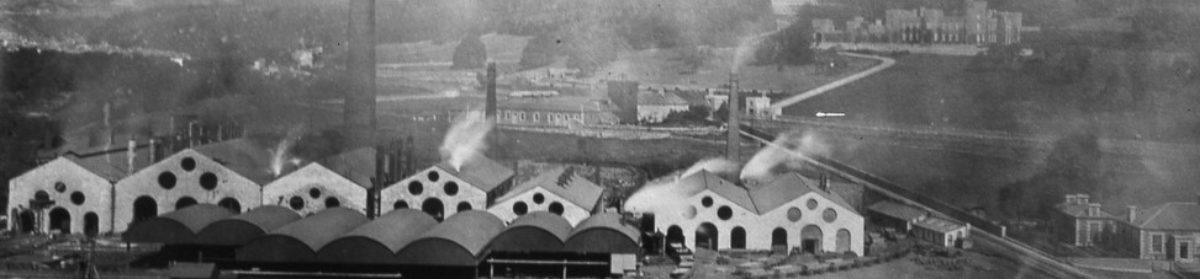
A General View of Pontsarn

by Alison Davies

I love collecting Vaynor memorabilia and postcards of the area, like many local collectors it’s a lifelong passion.

Then every so often a card comes along that is both historically important on the front and back, and please excuse the phrase but ‘it blows me away’ and below is one.

A General View of Pontsarn

This is a rare image taken from the fields overlooking Vaynor a little way below Pontsticill. It’s like peeping through a curtain back in time.

In the centre of the picture is the back of the Church Tavern pub with the two churches at Vaynor you can see the steeple on the new Church, the pathway leading from the old church and first few headstones in the new cemetery. The houses too: Dolcoed, Hy Brasail and Bragty Cottages are clearly visible along with the fields systems around.

The view then sweeps down the valley to the viaduct, Pontsarn Station and beyond its one of the most incredible postcards of Vaynor that I’ve seen.

The back of the card is equally important, it is an incredible piece of Merthyr’s history. Postmarked Merthyr Tydfil 27 Dec 1936 and sent from Gwernllwyn House Dowlais by M E Horsefall (Mary Emmeline Horsfall)

It reads:

Thank you for your card and good wishes.

I hope you and Mr Cobby are well

With good wishes M E Horsfall

Mary Horsfall was a philanthropist who came to Dowlais in 1934 to help at the Educational Settlement formed by John Dennithorne. She lived at Gwenllwyn House Dowlais and from there ran classes teaching unemployed men and women the arts.

Mary invited important artists including Heinz Koppel and Cedric Morris to teach art at Dowlais. Her address book must have read like a who’s who of the art world. Whilst in Dowlais Heinz Koppel painted Mary’s Portrait from his studio at Gwenllwyn House. Also in Dowlais between 1936-1939 Cedric Morris painted two of the most iconic and celebrated paintings in Welsh Art today, Dowlais Tips and Caeharris Post Office. Now in Cyfarthfa Castle Museum.

So who is the card written to ?

Mary Horsfall wrote the card to her friend Lucy Mary Cobby and her husband Anthony Cobby at little Bognor, Frittleworth Sussex.

Little Bognor is a tiny rural hamlet in Sussex re known for its artistic connections however I think Mary knew Lucy Cobby from earlier connections rather than artistic ones.

If you’re interested in the Dowlais Settlement and Mary Horsfall see Christine Trevett’s wonderful article Merthyr Historian Vol 33 p 123.

To see more of Alison’s fantastic research about Pontsarn and Vaynor, please follow this link: https://www.facebook.com/groups/747174317220437

Grade II* Listed buildings

Fifty years ago today a number of Merthyr’s buildings were given a Grade II* listing by CADW. Below is a list of all the Grade II* listed buildings in Merthyr.

Name

Location
Grid Ref.
Geo-coordinates
Date Listed

Notes

Cefn Railway Viaduct

Cyfarthfa
SO0304907597
51°45′31″N 3°24′22″W
7 Nov 1951 Viaduct A dual-listed (see below) structure built in 1866 to carry the Brecon and Merthyr Railway over the Taf Fawr. It was designed by Henry Conybeare and Alexander Sutherland at a cost of £25,000.  The fifteen arches of the 36.6 m (120 ft) high viaduct follow a gentle curve of 235 m (771 ft).
Cefn Railway Viaduct Vaynor
SO0304007795
51°45′38″N 3°24′23″W

7 Nov 1951

Viaduct A dual-listed (see above) structure built in 1866 to carry the Brecon and Merthyr Railway over the Taf Fawr. The viaduct has tall, slender limestone piers, a material originally intended to be used throughout, however, the arches were completed using a contrasting red brick due to a trade union strike by stonemasons.

Pont-y-Cafnau

Park
SO0376507138
51°45′17″N 3°23′44″W

22 August 1975

Bridge An ironwork bridge spanning the River Taff constructed in 1793. The name, meaning “bridge of troughs”, comes from its unusual three tier design of a tramroad between two watercourses, one beneath the bridge deck and the other on an upper wooden structure which is no longer present. Pont-y-Cafnau is also designated as a scheduled monument.

Town Hall

Town
SO0489306371
51°44′51″N 3°22′40″W

22 August 1975

Town hall A Large municipal building designed by Edwin Arthur Johnson in the early Renaissance style and built 1896–98 by Harry Gibbon. Built of red Cattybrook brick with orange terracotta dressings on a base of Pennant Sandstone. Following restoration work it became the Red House, an arts centre, in 2014.

Pontsarn Railway Viaduct

Pant
SO0454309921
51°46′47″N 3°23′06″W

22 August 1975

Viaduct A dual-listed (see below) structure built in 1866 to carry the Brecon and Merthyr Railway over the Taf Fechan. It was designed by Henry Conybeare and Alexander Sutherland. The viaduct is 28 m (92 ft) high and 128 m (420 ft) long.

Pontsarn Railway Viaduct

Vaynor
SO0453409918
51°46′47″N 3°23′07″W

22 August 1975

Viaduct A dual-listed (see above) structure built in 1866 to carry the Brecon and Merthyr Railway over the Taf Fechan. It is constructed of limestone and has tall, slender piers with segmental arches. The Cadw description has seven arches, Newman has eight.

Former Guest Memorial Library

Dowlais
SO0699107880
51°45′43″N 3°20′57″W

22 August 1975

Library A two-storey cruciform building of 1855–1863 built as a memorial to John Josiah Guest of the Dowlais Ironworks. The Dowlais workmen intended for the library and reading room to be funded by subscription, but rising costs led to the building being completed by the company at a total cost of £7,000.

Dowlais Works Blast Engine House

Dowlais
SO0690907739
51°45′38″N 3°21′01″W

22 August 1975

Engine house A 54 m (177 ft) long and 15 m (49 ft) high red brick industrial building constructed in 1905–07 to house three blowing engines as part of the Dowlais Ironworks. The works went into decline in the 1930s and in the late 20th century the building was being used by a chocolate company.

Quakers Yard Railway Viaduct

Treharris
ST0885396473
51°39′35″N 3°19′09″W

1 April 1988

Viaduct A tall stone-built viaduct with six arches that spans both the River Taff and the Merthyr Tramroad. It was constructed 1840–41 by Isambard Kingdom Brunel as part of the Taff Vale Railway and widened by 1861.

Ynysfach Engine House

Cyfarthfa
SO0452406096
51°44′44″N 3°23′04″W

5 Nov 1995

Engine house Built in 1836 as part of the Ynysfach Ironworks, it originally housed an engine made at the Neath Abbey Ironworks. This four-storey building of blue Pennant Sandstone with white ashlar dressings fell into disuse when the Ynysfach works closed in 1874. In the 1980s It was restored and became a museum until closed by the Leisure Trust.

Greenfield Bridge, Penydarren Tramroad

Treharris
ST0902496544
51°39′37″N 3°19′00″W

20 February 2003

Bridge A single arch Pennant Sandstone structure built to replace an earlier wooden bridge that collapsed in 1815 when a train was passing over it. The semi-circular arch has span of 19.2 m (63 ft) at a height of 8.4 m (28 ft) above the river. It is part of the Merthyr Tramroad scheduled monument.

Victoria Bridge, Penydarren Tramroad

Treharris
ST0942396281
51°39′29″N 3°18′39″W

20 February 2003

Bridge A single high-arch bridge over the River Taff similar in design to the nearby Greenfield bridge. Built in 1815 to replace a wooden bridge of 1800–02 it was originally as part of the Merthyr Tramway but is now a footbridge. It is part of the Merthyr Tramroad scheduled monument.

NOTE
The two viaducts constructed as part of the Brecon and Merthyr Railway both straddle the borders of neighbouring historic communities so have separate designations for each of these locations.

Merthyr: Then and Now

In the pre-war era, one of the high-points of the year for many people would be the annual Sunday School outing. More often than not this would be to Pontsarn – catching the train from your local station to Pontsarn Station, refreshments in the specially built refreshment room and then fun and games at the side of the Taf Fechan river under the ‘Seven Arches’ as Pontsarn Viaduct was more often called.

Below is a photo of a Sunday School outing to Pontsarn from Adulam Chapel in the late 1920s or early ’30s.

Below is a more recent photo of the same area – still a lovely place, but deserted more often than not these days.

Long gone are Sunday School outings to Pontsarn. Long gone are Pontsarn Railway Station and Refreshment Rooms. Such a shame.

Do you remember Sunday School outings? Let me know all about your memories.

A Strange House, a Welsh Lawyer and an Italian Contessa

by Graham Watkins

To the north of Merthyr Tydfil, near the railway viaduct at Pontsarn, stands a very peculiar house. The property has been known by a number of different names, over the years, including Hafod Cottage, Vaynor Cottage, The Old Spanish House and, more recently, Hy Brasail. At the time of writing, the house, a Grade II listed, stands empty, neglected and looking very sad. What makes the house unique is the style in which it was built.

Like its name, Hy Brasail, the house, is shrouded in mystery. Some commentators have suggested that the house was named after ‘Hy Brasail’ – also known as ‘Hy Brasil’ – a mythical island somewhere off the coast of Ireland.

According to legend, the island is hidden by an inpenetrable mist except for one day every seven years. In the old Irish tongue the name of the island suggests beauty, great worth and might. In 1674, a Captain Nisbet was on a voyage from France to Ireland when he chanced upon the mysterious island. According to the Captain’s reports, a colony of enormous black rabbits inhabited the island together with a magician who lived alone in a castle. It’s an unlikely tale and a strange place after which to name a house near Merthyr Tydfil.

As well as having a strange name, the house called Hy Brasail is a bewilderment of ideas. Part of the dwelling is conventional and looks like a Victorian middle class house but a strange extension has been added. Stone columns hold up an incongruous arch while, just beyond, Spanish archways support an upper floor containing stone mullioned windows, sheltering from the weather under a Welsh slate roof. Alongside the mullioned windows, an upstairs veranda sits, surrounded by carved stone balustrades. To add to the discord, two Venetian stone towers emerge, like campaniles, from the roof. Even the towers, with their pink stone columns, are mismatched; one is larger than the other.

There are several opinions regarding the origins of the strange dwelling. Although there is no evidence to support the idea, some say it was built by an owner in the style of his wife’s Tuscan childhood home. It is known that a solicitor named Mr. James, whose law practice was in Merthyr, lived in the house in 1912. At the time the house, rather smaller than it is now, was known as ‘Vaynor Cottage.’ Each morning, Mr. James walked to Pontsarn Station to catch an early train to Merthyr. Each night he returned to his empty house. That summer, he went to Italy for a holiday where he met an Italian Countessa and immediately fell in love.

Thinking the holiday liaison was something more serious than a brief romance, Mr. James returned home and added an Italian style extension to his house with the hope that the Contessa would join him in Wales. To make the house more homely, he furnished it with fine furniture, porcelain and paintings and in the courtyard, at the front of the house, he placed a large statue of an eagle sat on a plinth. Sadly, the Contessa never came to Wales and Mr. James’ dream of love remained unfulfilled. The disappointed solicitor resumed his daily train rides to work and remained a bachelor for the rest of his life.

In 1948, a butcher by the name of Bowen bought Vaynor Cottage. Bowen’s Irish wife, a teacher, wanted a name for the house that was more in keeping with its size and quirky character. It was Mrs Bowen who renamed the house ‘Hy Brasail’ after the mythical island from Irish folklore.

The eagle was either sold or stolen in the 1980s and the railway station at Pontsarn has long since closed. Today, the old rail bed is part of the Taff Trail and walkers who enjoy the path pass close to Hy Brasail, a structurally odd derelict building and one of the strangest looking houses in Wales.

Many thanks to Graham Watkins for sharing this with us.

To read more about some of the unusual buildings in Wales please check out his book ‘The Welsh Folly Book’ (which includes a chapter on Hy Brasail).

You can also visit his website where you can also see this article and order this (and other) books.

https://www.grahamwatkins.info/

https://www.grahamwatkins.info/the-welsh-folly-book

The Brecon and Merthyr Railway

By the second half of the 19th century, Merthyr was served by several railway companies, one of which was the Brecon and Merthyr Tydfil Junction Railway (B&M) which, as its name implies, ran from Brecon to Merthyr.

A 1905 map showing the Railways around Merthyr and Dowlais

As early as 1836, Sir John Josiah Guest, of the Dowlais Ironworks, had written of his proposal to construct a railway linking Dowlais to the valley of the River Usk, and possibly also running into Brecon. The line would have pretty nearly covered the same route as was eventually adopted by the B&M. A similar proposal suggested a line running up the Taf Fawr valley over the Brecon Beacons via Storey Arms and thence to Brecon.

The Brecon and Merthyr Railway Company was established by a Bill of 1859, financially supported by several prominent Brecon citizens, and the complete route from Brecon to Merthyr Tydfil was authorised the following year. The first section to open was a 6.75 miles (10.86 km) section between Brecon and Talybont-on-Usk in 1863, which reused a section of a horse-drawn tram line. The Beacons Tunnel at Torpantau opened in 1868. Officially named the Torpantau Tunnel, at 1313 feet above mean sea level, it is the highest railway tunnel in Britain.

The system eventually came to comprise two sections of lines:

  • The Southern section, effectively the consumed Rumney Railway, which linked Bassaleg (where there were connections with the GWR and the London and North Western Railway) and the ironworks town of Rhymney, near the head of the Rhymney Valley.
  • The Northern section linked Deri Junction by means of running powers over a section of the Rhymney Railway in the Bargoed Rhymney Valley to Pant, Pontsticill and Brecon via a tunnel through the Brecon Beacons. From the tunnel the line descended towards Talybont-on-Usk on a continuous 1-in-38 gradient known as the “Seven-Mile Bank”. For southbound trains this presented the steepest continuous ascent on the British railway network.
Pontsticill Station. Photo courtesy of http://www.alangeorge.co.uk/index.htm

Initially, the only connection to Merthyr Tydfil was by means of a horse-drawn bus from Pant, but by 1868, a connection with Merthyr at Rhydycar Junction had been established by sharing lines with Vale of Neath, London and North Western and Taff Vale railways. This involved the building of nearly seven miles of single line from Pontsticill to Merthyr, with an almost continuous descent of 1 in 45-50, two complete reversals of direction, and the construction of two viaducts to carry the line over the Taf Fechan at Pontsarn, and the Taf Fawr at Cefn Coed.

North of the Pontsarn viaduct, a connection was made with the LNWR’s Merthyr Extension line at Morlais Tunnel Junction from where the latter’s double track entered the 1034 yard Morlais Tunnel and beyond routed along the double line to Dowlais High Street and thence to Tredegar, Brynmawr and Abergavenny. The sections from Merthyr to Pontsticill and Bargoed through to Brecon were laid as single lines with passing loops and usually locomotive watering facilities at principal stations. For those single lines, tokens were issued to drivers from signal boxes at such locations and being essential for safe working over single lines.

A train leaving the Morlais Tunnel. Photo courtesy of http://www.alangeorge.co.uk/index.htm

The line was eventually amalgamated with the Great Western Railway in 1923, and by 1958, the line was running three services each way on weekdays, increasing to four on Saturdays, taking around 2½ hours to run from Brecon to Newport. Although surviving nationalisation, the service had run at a substantial loss for most of its lifetime, and was an obvious candidate for closure. Passenger services were closed from Pontsticill Junction to Merthyr Tydfil in November 1961, with the remainder of services stopping at the end of the 1962. The line was closed completely after the withdrawal of goods services in 1964.

Towards the end of the 1970s, a private company, the Brecon Mountain Railway, began to build a narrow-gauge steam-hauled tourist line on the existing 5.5-mile (8.9 km) trackbed from Pant through Pontsticill to Dol-y-gaer. The initial section of 1.75 miles (2.82 km) from Pant to Pontsticill first opened in June 1980. After more than 30 years of hard work and extra-funding, passenger services finally extended to Torpantau in April 2014, bringing the BMR to a total of approximately 5 miles in length.

For more about the Brecon Mountain Railway, please follow the link below:

https://www.bmr.wales/

Bridging the gap

One of the most striking structures in Merthyr if Cefn Viaduct. You can’t miss it, but how much do you know about it?

viaduct_2
Cefn Viaduct photo courtesy of Christopher Surridge

The viaduct was commissioned by the Brecon and Merthyr Railway company to span the Taf Fawr Valley in Cefn-Coed-y-Cymmer. Before work began, a special Act of Parliament had to be sought in 1862 to allow construction. The viaduct was designed by Alexander Sutherland and Henry Conybeare, and was built by Thomas Savin and John Ward. In early 1866, the project faced disaster when Savin and Ward suffered serious financial and legal difficulties. It was eventually completed with the assistance of Alexander Sutherland, and was completed on 29 October 1866 at a cost of £25,000.

cefnviaduct_beingbuilt_adj
Cefn Viaduct under construction courtesy of Old Merthyr Tydfil (http://www.alangeorge.co.uk/index.htm)

The viaduct is 770 ft long, and at its highest point stands 115 ft high; it has 15 arches, each one 39 ft 6 inches wide. It was planned to be constructed entirely of limestone , but a strike by stonemasons in February 1866 caused the company to buy 800,000 bricks and use bricklayers to complete the 15 arches. The most striking feature of the viaduct is its elegant curve. The viaduct was apparently designed this way to avoid encroaching on Robert Thompson Crawshay’s land.

Smaller, but no less impressive is Pontsarn Viaduct. This was also designed by Alexander Sutherland and built by Savin and Ward to bridge the Taf Fechan Valley. Opened in 1867, Pontsarn is 455 ft long and 92 ft high at its highest point and comprises seven arches. Unlike Cefn Viaduct, it is built entirely of limestone.

pontsarnviaduct
Pontsarn Viaduct courtesy of Old Merthyr Tydfil (http://www.alangeorge.co.uk/index.htm)

The Merthyr to Brecon Line stopped carrying passenger trains in 1961, but goods trains continued to use the viaducts, with the last train crossing them on 1 August 1966. Both viaducts are now Grade II* listed and form part of the Taff Trail.