Beer, Brewing and Public Houses in the Merthyr Tydfil Locality – part 1

by Brian Jones

People living in the Merthyr Tydfil locality shrugged off the trauma of World War II and looked to an ever brighter future. Gone were the hardships of hot physical work associated with the iron works and the burden faced by coal miners, was eased, with mechanisation of that recently nationalised industry. Employment now centred on the new ‘lighter’ industries adapted from wartime production. The new Hoover factory was at the centre of the increasing prosperity and this was reflected in the increase in footfall in the High streets as a consumer society began to emerge. The retail sector thrived and weekend shoppers flooded the centres of the town and nearby villages, although supermarkets and shopping malls were a long way in the future.

Aside from food, furniture and clothing shops the town centres, and villages, were littered with public houses and ‘drinking culture’ became more respectable.  Unsanitary pubs were demolished and money invested  to brighten their appeal as suitable, and sober, places for both men and women. Sales people strove to market the tied pubs owned by the breweries and their signs were prominently displayed. The dominant sign was that used by Rhymney Brewery, with that of the William Hancock Brewery a poor second.

Courtesy of the Alan George Archive

Today this sign hangs outside the Royal Oak, Nelson, which is still trading, whilst a faded painted image can be seen on the gable end of a private house in Quakers Yard, previously named as the Victoria Inn.

Malting is the germination of grains such as barley, wheat or oats which are soaked in warm water to allow germination and that germinating grain is heated in a kiln in order to to increase the alcohol content. In areas where soil was less fertile barley was used and that drink was referred to as ale. The more water in the mixture the weaker the ale and the lighter the colour, the less water the stronger, darker and richer the ale. In rural areas farms and taverns made their own ale which was sold in malthouses. In Medieval times ale/beer was an important source of nutrition mainly served as small beer, table beer or mild beer. It contained just enough alcohol to act as a preservative without causing intoxication and could be drunk by children. In broad terms beer has an alcoholic strength between 0.5 % to 4% alcohol by volume (ABV) although some craft beers can exceed this.

Change came with the entry of business men who opened numerous iron works along the northern edge of the South Wales valleys. Labour flowed into the area and they acquired new skills in hot blast furnaces, puddling the pig iron and this  proved to be thirsty work. The workers could not trust the quality of either drinking water, nor barley water, so they sought refreshment firstly in ale, but later more increasingly in beer which is malted from hops. Beer was readily available and its importance for hydration was recognised by the Ironmasters some of whom took to investing in a more economic way of providing a consistent and safe liquid refreshment. A number of breweries were opened in the locality and these provided extra employment and a number of these were:-

  • Rhymney Brewery, Rhymney
  • Taff Vale Brewery, Georgetown, Merthyr
  • Taff Vale Brewery, Dan Y Parc, Merthyr
  • Six Bells (Heolgerrig), Merthyr
  • Pontycapel Brewery, Cefn Coed
  • Merthyr Brewery, Brecon Road, Merthyr

From the mid 18th century there was a race to build new iron works and  four were established in Merthyr with others at Hirwaun, Tredegar, Rhymney and Blaenavon. Many  of the men and women worked in the open air, mining ironstone, limestone, clay and coal in adits and comparatively small drift mines. In the summer this proved to be thirsty work. Those in the iron works faced hot conditions all year round and sought drink in the many pubs  and publicans began to brew alcohol for their customers. The Brewers Arms and the Clarence Hotel in Dowlais were small scale brewers, however some iron companies saw the potential to make safe and consistent quality beers in substantial quantities. A classic example was the Rhymney Iron Company which morphed from the Union Iron Company in Rhymney Bridge, and the Bute Ironworks. In 1838 it was decided to build a brewery for its workers and a year later a Scotsman, Andrew Buchan, became the brewery manager. For some decades the beers were sold as Buchan’s beers brewed and bottled at the brewery in the centre of Rhymney.

Andrew Buchan died in 1870 however, the brewery continued to use his name until 1930 when they acquired the Western Valleys Company in Crumlin, owned by D.F. Pritchard Ltd. In that purchase they also acquired the Pritchard logo and they decided to use the Hobby Horse with “The Man on a Barrel”. This clearly distinguished Rhymney Beers and the Rhymney Company from its competitors. The brewery at Rhymney was to become the largest in South Wales. Their beers dominated the market in Merthyr and their tied pubs became a common sight from Treharris to Cefn Coed and Dowlais. The company was taken over by Whitbread in 1966 and production ceased in Rhymney in 1978. The company name “Rhymney Brewery” and logo were resurrected in 2005 in Dowlais before production  moved  to its current brewery in Blaenavon. One of its many beers is the historic “Rhymney Hobby Horse”.

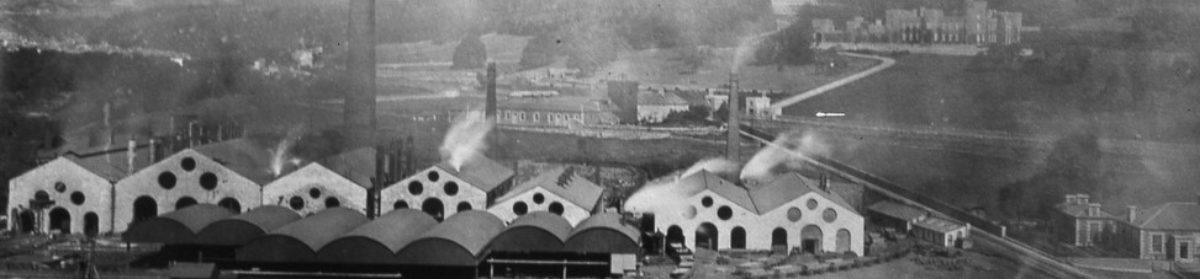
Taff Vale Brewery at Dan-y-Parc. Courtesy of the Alan George Archive

The largest of the local Merthyr breweries was the Taff Vale first located adjacent to the canal near the Old Iron Bridge close to where Merthyr college is today. It opened in in the 1840s and in 1904 moved to a new building in Dan Y Parc, to the south of Thomastown Park. The company was acquired by the Rhymney Brewery in 1936 and brewing ceased at that site. The Rhymney Brewery grew in importance as the dominant brewer and owner of public houses in the locality and in this same year(1936) it bought out a large Pritchard brewery in Crumlin and the last of the Merthyr brewing companies ceased production. In parallel with these 1936 acquisitions the William Hancock brewery in Cardiff purchased the Merthyr Brewery located on the Brecon Road and brewing also ceased there.

At the end of World War II the empty building at Dan Y Parc accommodated O.P. Chocolates and chocolate production continued there until 1963 when the company moved to a brand new factory in Dowlais which still operates today.

Six Bells Brewery. Photo Courtesy of the Alan George Archive

The Six Bells pub had served the people of Heolgerrig however many  may be surprised to learn that a large brewery once stood alongside the original pub. The Heolgerrig Brewery was founded in the 1840s by Thomas Evans until it was destroyed by fire in 1888. He then erected a new building which continued to brew beer until 1916 when it was Purchased by D.F. Pritchard Ltd. of Crumlin. The acquisition of breweries by larger companies became a trend where the new owners closed down local brewing in order to concentrate production at their own brewery. Some years later D.F. Pritchard Ltd. was bought out by the Rhymney Brewery who acquired the “Hobby Horse” trademark as part of that purchase.

Pontycapel Brewery. Photo Courtesy of the Alan George Archive

The Pontycapel Brewery was founded in the early 1800’s by Robert Millar and was later purchased by James Pearce when it became Pearce and Shapton in 1871.It was described as the most picturesque brewery in the country, sited in a wooded area it predated the construction of the Cefn Viaduct which was completed in 1866. Shortly thereafter the name changed to the Cefn Viaduct Brewery especially  known for Star Bright XXXX Pale Ale and production continued until 1921 when there was a post World War I economic downturn.

Photo Courtesy of the Alan George Archive

The Giles and Harrap’s Merthyr Brewery was located on the Brecon Road. An adjacent road was named Brewery Street in an area which was the centre of the Merthyr Irish community and St. Mary’s Catholic church was built a short distance away. In 1936 the brewery was taken over by the William Hancock Company based in Cardiff although the buildings continued to be used as a warehouse and distribution centre for beer and spirits until the Borough Council bought the site. The brewery was the oldest in the locality when it opened in 1830 and so predated the Taff Vale Brewery by about 30 years. Richard Harrap lived in Gwaunfarren House, which later became the Gwaunfarren Maternity Hospital. Both partners built up the business to rival the Rhymney Brewery although in time the Rhymney Brewing Company grew to be larger buying out other brewers. Both companies managed a large number of tied public houses in Merthyr and also sold beer in a large number of local freehold pubs. The Merthyr and Rhymney breweries were to dominate the beer market and their large number of pubs were to have a prominent visual impact in main and side streets spread throughout the locality.

To be continued…….

Grade II* Listed buildings

Fifty years ago today a number of Merthyr’s buildings were given a Grade II* listing by CADW. Below is a list of all the Grade II* listed buildings in Merthyr.

Name

Location
Grid Ref.
Geo-coordinates
Date Listed

Notes

Cefn Railway Viaduct

Cyfarthfa
SO0304907597
51°45′31″N 3°24′22″W
7 Nov 1951 Viaduct A dual-listed (see below) structure built in 1866 to carry the Brecon and Merthyr Railway over the Taf Fawr. It was designed by Henry Conybeare and Alexander Sutherland at a cost of £25,000.  The fifteen arches of the 36.6 m (120 ft) high viaduct follow a gentle curve of 235 m (771 ft).
Cefn Railway Viaduct Vaynor
SO0304007795
51°45′38″N 3°24′23″W

7 Nov 1951

Viaduct A dual-listed (see above) structure built in 1866 to carry the Brecon and Merthyr Railway over the Taf Fawr. The viaduct has tall, slender limestone piers, a material originally intended to be used throughout, however, the arches were completed using a contrasting red brick due to a trade union strike by stonemasons.

Pont-y-Cafnau

Park
SO0376507138
51°45′17″N 3°23′44″W

22 August 1975

Bridge An ironwork bridge spanning the River Taff constructed in 1793. The name, meaning “bridge of troughs”, comes from its unusual three tier design of a tramroad between two watercourses, one beneath the bridge deck and the other on an upper wooden structure which is no longer present. Pont-y-Cafnau is also designated as a scheduled monument.

Town Hall

Town
SO0489306371
51°44′51″N 3°22′40″W

22 August 1975

Town hall A Large municipal building designed by Edwin Arthur Johnson in the early Renaissance style and built 1896–98 by Harry Gibbon. Built of red Cattybrook brick with orange terracotta dressings on a base of Pennant Sandstone. Following restoration work it became the Red House, an arts centre, in 2014.

Pontsarn Railway Viaduct

Pant
SO0454309921
51°46′47″N 3°23′06″W

22 August 1975

Viaduct A dual-listed (see below) structure built in 1866 to carry the Brecon and Merthyr Railway over the Taf Fechan. It was designed by Henry Conybeare and Alexander Sutherland. The viaduct is 28 m (92 ft) high and 128 m (420 ft) long.

Pontsarn Railway Viaduct

Vaynor
SO0453409918
51°46′47″N 3°23′07″W

22 August 1975

Viaduct A dual-listed (see above) structure built in 1866 to carry the Brecon and Merthyr Railway over the Taf Fechan. It is constructed of limestone and has tall, slender piers with segmental arches. The Cadw description has seven arches, Newman has eight.

Former Guest Memorial Library

Dowlais
SO0699107880
51°45′43″N 3°20′57″W

22 August 1975

Library A two-storey cruciform building of 1855–1863 built as a memorial to John Josiah Guest of the Dowlais Ironworks. The Dowlais workmen intended for the library and reading room to be funded by subscription, but rising costs led to the building being completed by the company at a total cost of £7,000.

Dowlais Works Blast Engine House

Dowlais
SO0690907739
51°45′38″N 3°21′01″W

22 August 1975

Engine house A 54 m (177 ft) long and 15 m (49 ft) high red brick industrial building constructed in 1905–07 to house three blowing engines as part of the Dowlais Ironworks. The works went into decline in the 1930s and in the late 20th century the building was being used by a chocolate company.

Quakers Yard Railway Viaduct

Treharris
ST0885396473
51°39′35″N 3°19′09″W

1 April 1988

Viaduct A tall stone-built viaduct with six arches that spans both the River Taff and the Merthyr Tramroad. It was constructed 1840–41 by Isambard Kingdom Brunel as part of the Taff Vale Railway and widened by 1861.

Ynysfach Engine House

Cyfarthfa
SO0452406096
51°44′44″N 3°23′04″W

5 Nov 1995

Engine house Built in 1836 as part of the Ynysfach Ironworks, it originally housed an engine made at the Neath Abbey Ironworks. This four-storey building of blue Pennant Sandstone with white ashlar dressings fell into disuse when the Ynysfach works closed in 1874. In the 1980s It was restored and became a museum until closed by the Leisure Trust.

Greenfield Bridge, Penydarren Tramroad

Treharris
ST0902496544
51°39′37″N 3°19′00″W

20 February 2003

Bridge A single arch Pennant Sandstone structure built to replace an earlier wooden bridge that collapsed in 1815 when a train was passing over it. The semi-circular arch has span of 19.2 m (63 ft) at a height of 8.4 m (28 ft) above the river. It is part of the Merthyr Tramroad scheduled monument.

Victoria Bridge, Penydarren Tramroad

Treharris
ST0942396281
51°39′29″N 3°18′39″W

20 February 2003

Bridge A single high-arch bridge over the River Taff similar in design to the nearby Greenfield bridge. Built in 1815 to replace a wooden bridge of 1800–02 it was originally as part of the Merthyr Tramway but is now a footbridge. It is part of the Merthyr Tramroad scheduled monument.

NOTE
The two viaducts constructed as part of the Brecon and Merthyr Railway both straddle the borders of neighbouring historic communities so have separate designations for each of these locations.

Baptisms in the River Taff

by Alan Davies

So ran the headline in the Merthyr Express, a local newspaper published on 23rd January 1932. The article continued by referring to it as an “unusual scene “when new members of the Church of Jesus Christ of Latter-Day Saints were baptised” by immersion”. The scene was witnessed by a crowd of onlookers despite the rain storm on the day. The article concludes “It is understood that more of these baptisms are to take place.” Were they right to say that?

The Millennial Star[i] reported the following during 1932:

Millennial Star 11th February:

“Five persons were baptised by Elders Evan Arthur and Leon Whiting at a baptismal service held near Merthyr Tydfil Sunday January 10th. They were confirmed[ii] members of the church the same day by Elder Edward Rowe, Clarence Taylor, Evan Arthur, Marion Olsen and Elman Woodfield.”

Millennial Star 31st March:

“Onlookers numbering over two hundred and fifty were deeply impressed by a baptismal service held in the waters of the River Taff. Nine baptisms were performed ….and immediately after the new members were confirmed.”

Church records show the baptisms took place on 10th March 1932.

Millennial Star 14th July:

“Elder Frank Miller baptised two converts in the River Taff at Cefn Coed, near Merthyr Tydfil 18th June.”

Millennial Star 18th August:

“Elders Olsen and Butcher baptised three candidates 23rd July at Cefn Coed, near Merthyr Tydfil.”

Millennial Star 13th October:

“An impressive baptismal ceremony was held 17th September, near Merthyr Tydfil, in the River Taff, under the shadow of the huge railroad viaduct at Cefn Coed. Four candidates fulfilled the ordinance. Confirmation took place immediately afterwards during a service conducted in an adjoining cottage.”

The following year the Millennial Star issued on 9th February 1933 reported there had been 23 convert baptisms in the Welsh District in 1932. All are included in the separate reports above.

Not only was the original article correct to say “more of these baptisms are to take place,” it also reported that the baptismal scenes were witnessed by crowds of onlookers. A recently discovered photograph taken by the missionary Elder Donald K. Ipson[iii] impressively captures the baptismal scene on 17th September 1932 when the last four candidates were baptised.

In the mid-1800s missionaries for the Church of Jesus Christ of Latter Day Saints experienced considerable success in gaining news converts, but so many emigrated to join the main body of the Church in America, local congregations had disappeared by 1900. But after a quiet start for the church in Merthyr Tydfil at the beginning of the twentieth century, 1932 proved to be a turning point.
[i] UK publication of The Church of Jesus Christ of Latter Day Saints from 1840 to 1970

[ii] After baptism, membership in the church is ‘confirmed’ by hands being laid on the head of the newly baptised person and a blessing being pronounced on them.

[iii]Donald K. Ipson mission collection, 1876-1934, available online at: https://catalog.churchofjesuschrist.org

Demolishing Cefn Railway Bridge

submitted by Carl Llewellyn

While perusing the old Merthyr Expresses I came across an article written on 16 July 1970 entitled:-

Down Comes Link With Railways Pioneers

On 6 July, 1970, Cefn Railway Bridge, which spanned the Cefn Coed High Street was demolished after 104 years due to its unsafe condition. Demolition began at 08:00 a.m. and was completed with about four hours.

Cefn Railway being demolished

The bridge was a continuation of the Cefn Pontycapel Viaduct which completed in 1866 at a cost of £25,000 (equivalent to £2.1 million). The routing of the railway it served, may have been affected by the strong pressure from the powerful Crawshay iron masters.

Cefn Coed High Street showing the Railway Bridge in the early 20th Century

The viaduct was built by Thomas Savin and John Ward, his brother-in-law, to designs prepared by Alexander Sutherland. It had been described as a graceful and majestic structure, one of the finest viaducts in South Wales, being built on a graceful curve which added much to its beauty. With fifteen arches 40 feet each, it has a total length of 725 feet and a height of 115 feet.

Saviour

The Viaduct came into being after many trials and tribulations. At the beginning of 1866 a crisis occurred – Thomas Savin who with John had been managing the railway, and had been paying the shareholders their guaranteed five percent, was overwhelmed by his commitments and failed disastrously, nearly bringing down the finances of the Brecon and Merthyr Junction Railway with him. Other legal frays remained a prominent feature of their lives for the following four years. But despite all this the railway was completed.

The saviour of the venture was Alexander Sutherland who produced an alternative route into Merthyr, which avoided Cyfarthfa Castle by going down the West side of the valley and so won the support instead of the emnity of the Crawshay Family. This was achieved at great engineering expense.

It has been said that a bribe was accepted to divert the railway line around the Crawshay property instead of through it.

The six and three-quarter miles between Pontsticill and Merthyr involved a descent at 1 in 45-50 feet and between Morlais Junction and Merthyr and two complete reversals of direction.

At one stage in the construction of the Pontycapel Viaduct, the stone masons went on strike which meant that the bricklayers had to be called in. This is why one sees bricks lining the underneath of the arches while the remainder of the structure is stone.

The last brick was ceremonially laid by Mrs Sutherland in 1866, but there were further interruptions due to contracting difficulties and it was not until 1 August 1867 that the line was opened from Pontsticill to Cefn, which then replaced Pant as the terminus for the Merthyr horse bus.

The word Pontycapel means bridge to the chapel – it did in fact lead over to a chapel although it is believed that there was a Roman Catholic church at Tai-mawr.

Mr Elwyn Bowen, headmaster of Ysgol-y-Graig Junior School and local historian, said he was told by his Uncle, who would have reached the age of some 90 years, that when the footings were being dug for the viaduct a number skeletons were unearthed.

Cefn Viaduct during construction

The Brecon and Merthyr Railway

By the second half of the 19th century, Merthyr was served by several railway companies, one of which was the Brecon and Merthyr Tydfil Junction Railway (B&M) which, as its name implies, ran from Brecon to Merthyr.

A 1905 map showing the Railways around Merthyr and Dowlais

As early as 1836, Sir John Josiah Guest, of the Dowlais Ironworks, had written of his proposal to construct a railway linking Dowlais to the valley of the River Usk, and possibly also running into Brecon. The line would have pretty nearly covered the same route as was eventually adopted by the B&M. A similar proposal suggested a line running up the Taf Fawr valley over the Brecon Beacons via Storey Arms and thence to Brecon.

The Brecon and Merthyr Railway Company was established by a Bill of 1859, financially supported by several prominent Brecon citizens, and the complete route from Brecon to Merthyr Tydfil was authorised the following year. The first section to open was a 6.75 miles (10.86 km) section between Brecon and Talybont-on-Usk in 1863, which reused a section of a horse-drawn tram line. The Beacons Tunnel at Torpantau opened in 1868. Officially named the Torpantau Tunnel, at 1313 feet above mean sea level, it is the highest railway tunnel in Britain.

The system eventually came to comprise two sections of lines:

  • The Southern section, effectively the consumed Rumney Railway, which linked Bassaleg (where there were connections with the GWR and the London and North Western Railway) and the ironworks town of Rhymney, near the head of the Rhymney Valley.
  • The Northern section linked Deri Junction by means of running powers over a section of the Rhymney Railway in the Bargoed Rhymney Valley to Pant, Pontsticill and Brecon via a tunnel through the Brecon Beacons. From the tunnel the line descended towards Talybont-on-Usk on a continuous 1-in-38 gradient known as the “Seven-Mile Bank”. For southbound trains this presented the steepest continuous ascent on the British railway network.
Pontsticill Station. Photo courtesy of http://www.alangeorge.co.uk/index.htm

Initially, the only connection to Merthyr Tydfil was by means of a horse-drawn bus from Pant, but by 1868, a connection with Merthyr at Rhydycar Junction had been established by sharing lines with Vale of Neath, London and North Western and Taff Vale railways. This involved the building of nearly seven miles of single line from Pontsticill to Merthyr, with an almost continuous descent of 1 in 45-50, two complete reversals of direction, and the construction of two viaducts to carry the line over the Taf Fechan at Pontsarn, and the Taf Fawr at Cefn Coed.

North of the Pontsarn viaduct, a connection was made with the LNWR’s Merthyr Extension line at Morlais Tunnel Junction from where the latter’s double track entered the 1034 yard Morlais Tunnel and beyond routed along the double line to Dowlais High Street and thence to Tredegar, Brynmawr and Abergavenny. The sections from Merthyr to Pontsticill and Bargoed through to Brecon were laid as single lines with passing loops and usually locomotive watering facilities at principal stations. For those single lines, tokens were issued to drivers from signal boxes at such locations and being essential for safe working over single lines.

A train leaving the Morlais Tunnel. Photo courtesy of http://www.alangeorge.co.uk/index.htm

The line was eventually amalgamated with the Great Western Railway in 1923, and by 1958, the line was running three services each way on weekdays, increasing to four on Saturdays, taking around 2½ hours to run from Brecon to Newport. Although surviving nationalisation, the service had run at a substantial loss for most of its lifetime, and was an obvious candidate for closure. Passenger services were closed from Pontsticill Junction to Merthyr Tydfil in November 1961, with the remainder of services stopping at the end of the 1962. The line was closed completely after the withdrawal of goods services in 1964.

Towards the end of the 1970s, a private company, the Brecon Mountain Railway, began to build a narrow-gauge steam-hauled tourist line on the existing 5.5-mile (8.9 km) trackbed from Pant through Pontsticill to Dol-y-gaer. The initial section of 1.75 miles (2.82 km) from Pant to Pontsticill first opened in June 1980. After more than 30 years of hard work and extra-funding, passenger services finally extended to Torpantau in April 2014, bringing the BMR to a total of approximately 5 miles in length.

For more about the Brecon Mountain Railway, please follow the link below:

https://www.bmr.wales/

Bridging the gap

One of the most striking structures in Merthyr if Cefn Viaduct. You can’t miss it, but how much do you know about it?

viaduct_2
Cefn Viaduct photo courtesy of Christopher Surridge

The viaduct was commissioned by the Brecon and Merthyr Railway company to span the Taf Fawr Valley in Cefn-Coed-y-Cymmer. Before work began, a special Act of Parliament had to be sought in 1862 to allow construction. The viaduct was designed by Alexander Sutherland and Henry Conybeare, and was built by Thomas Savin and John Ward. In early 1866, the project faced disaster when Savin and Ward suffered serious financial and legal difficulties. It was eventually completed with the assistance of Alexander Sutherland, and was completed on 29 October 1866 at a cost of £25,000.

cefnviaduct_beingbuilt_adj
Cefn Viaduct under construction courtesy of Old Merthyr Tydfil (http://www.alangeorge.co.uk/index.htm)

The viaduct is 770 ft long, and at its highest point stands 115 ft high; it has 15 arches, each one 39 ft 6 inches wide. It was planned to be constructed entirely of limestone , but a strike by stonemasons in February 1866 caused the company to buy 800,000 bricks and use bricklayers to complete the 15 arches. The most striking feature of the viaduct is its elegant curve. The viaduct was apparently designed this way to avoid encroaching on Robert Thompson Crawshay’s land.

Smaller, but no less impressive is Pontsarn Viaduct. This was also designed by Alexander Sutherland and built by Savin and Ward to bridge the Taf Fechan Valley. Opened in 1867, Pontsarn is 455 ft long and 92 ft high at its highest point and comprises seven arches. Unlike Cefn Viaduct, it is built entirely of limestone.

pontsarnviaduct
Pontsarn Viaduct courtesy of Old Merthyr Tydfil (http://www.alangeorge.co.uk/index.htm)

The Merthyr to Brecon Line stopped carrying passenger trains in 1961, but goods trains continued to use the viaducts, with the last train crossing them on 1 August 1966. Both viaducts are now Grade II* listed and form part of the Taff Trail.