Opening of the Olympia Rink

110 years ago today, 29 March 1910, the Merthyr Express reported the opening of Merthyr’s latest great attraction, the Olympia Skating Rink, which had taken place on 19 March:

MERTHYR’S NEW SKATING RINK

OPENING CEREMONY BY THE MAYOR

ENTHUSIASTIC ASSEMBLAGE AT THE OLYMPIA

Roller-skating is attaining to great popularity in Merthyr. It was only in December last that the Central Rink, Wellington-street, was started. The proprietors found their enterprise successful, and also that the growing requirements of the public called for increased accommodation. Hence they embarked on a much larger undertaking, for which they took a site on Mr, Thomas’s land, Park-place, and entered into a contract with Messrs. Cross and Grose, Ltd., Walsall, for the erection thereon of a capacious rink — the Olympia — with approach opposite the Penydarren promenade, the spot being on the Merthyr and Dowlais electric tramway route, and easily accessible to visitors.

The new buildings, which has a length of 208ft., and an average width of about 70ft, rose as if by magic, the contractors being experts in such affairs, and having contracted rinks and floors at Dudley, Wolverhampton, Bath, Leamington, Walsall, Colchester, etc. The outside manager for the firm was Mr. J. James, a gentleman of twenty-three years’ experience, and who may be congratulated upon the admirable way in which he carried out his duties. The election of the new rink, with its extensive hard rock maple floor (so constructed as to reduce sound to a minimum), its accessories and fittings, offices, refreshment buffet and lounges, orchestral gallery, was completed in sixteen days — which constitutes a record for rapidity. — The concrete foundation had been previously prepared by Messrs. Warlow and Warlow, Merthyr.

Special attention has been given to the electric lighting, thirty pedants being distributed throughout the Rink by the Merthyr Electric Traction Company; and the decorative effects, which have been carried out by Mr. F. P. Dymond, Cardiff, are very pleasing. The Rink may, therefore, be regarded as not only one of the largest, but most attractive in Wales. The enterprising directors have catered lavishly in all respects for the entertainment and comfort of the public, and take every care to conduct the four sessions which are held daily, with the utmost regard for decorum and good order. The experienced attendants are civil and obliging, and the instructors are of the very best.

The Olympia Rink

RINK OPENED

The opening ceremony on Saturday afternoon was an encouraging success. It was known that the Mayor (Councillor F. T. James) would inaugurate the proceedings, and the crowd of people attending from Merthyr, Aberdare, and surrounding districts was very large. The Mayor, who was accompanied by the Mayoress (Mrs. F. T. James) and the Misses James, was received, upon entering the building, by the Chairman S. Phillips), and conducted to the dais, which had been erected for the occasion on the rink floor beneath the orchestral gallery. There was a very representative gathering. The first item in the programme was a well-played march by Mr. Cunningham’s military band.

The Chairman then rose to address the assemblage. He referred to the aims and accomplishments of the directors, and offered a hearty welcome to all present. He especially recognised the kindness of the Mayor and Mayoress in attending upon that interesting occasion, and mentioned that the new rink in which they had met possessed a skating capacity of £10,000 square feet, which was ten times greater than the floor space of their first venture, the Central Rink, and that the electric light equalled; 6,000 candle-power. He then invited the Mayor to perform the opening ceremony.

The Mayor, who was accorded a cordial reception, said that whatever might be said of rinking, one was bound to acknowledge that it was an exceedingly good exercise and a source of enjoyment to those who were young and active enough to engage in the healthful pastime. He had much pleasure in declaring Olympia Rink open for the purposes to which it was devoted (cheers).

The Band played the National Anthem, and at this point, Miss Peggy Lewis (daughter of Mrs. Henry Lewis) skated up gracefully to the dais, and in a pretty speech handed, as from the directors, a large and beautiful bouquet to the Mayoress, who bowed and briefly expressed her sense of the compliment.

A photograph of the opening ceremony was taken by Mr Charles Harris. Mr. John Plows referred to the interest which the Mayor had always taken in the affairs of the town and district, and to his public-spirited conduct on all occasions, and moved that a hearty vote of thanks be given him for the part that be had so ably taken in the proceedings.

Councillor F. S. Simons seconded the proposition, which was carried with enthusiasm. — This was acknowledged by His Worship, and Mr. Cunningham’s Band performed another attractive selection.

EXHIBITION OF EXPERT SKATING

An elaborate exhibition of expert skating, with musical accompaniments, was given by the instructor (Mr. Frank K. Deverall), Mr. Johns, and the instructress (Miss Wilkes). It may be mentioned that Mr. Deverall comes from the County Rink, Surbiton, and was previously associated for some years with Mr. J. F. Davidson, the champion skater of the world; and that Mr. Johns, whose capabilities are also of the highest order, is from Widnes, Lancashire. Miss Wilkes, whose style is very; elegant and graceful, comes from Folkestone. Hundreds of visitors put on skates, and there was high carnival during the afternoon. During the evening also, there was a very large attendance, and the proceedings were marked throughout with great success.

– Merthyr Express 26 March 1910

Notes on Post War Developments on the Merthyr Tydfil High Street

by Carolyn Jacob

After World War II more street lights were powered by gas than electricity.  Electricity was then supplied by the Merthyr Electric Traction and Lighting Co. Ltd  and gas mainly by the Dowlais Gas Company and the Merthyr Tydfil Gas Company.

High Street Sewers

From the 1850s onwards the Board of Health continually argued as to how a High Street sewer was to be paid for and how to clean up certain problem areas such as Caedraw.

The drainage of the High Street was a problem as the town had no means of proper drainage. Mr. Hill said that sewers were made large for the purpose of admitting men and boys to clean them and that he would prefer draining the worst localities in the town first, especially those which had been afflicted with cholera like Caedraw.

Caedraw in the early 1900s. Photo courtesy of the Alan George Archive

Merthyr Tydfil had a 100 miles of sewers varying in diameters between 9 inches and 30 inches. In 1946  a new main sewer was built from Dowlais to Troedyrhiw, the trunk mains in the upper part of the Borough being defective and inadequate. It was proposed to broaden the whole of the old High Street.

In 1949  Trystan Edwards (left), father of the New Towns Movement and opposed to  tower blocks became the architect for Merthyr Council. His classic book on ‘Style and Design in Architecture’ by Mr Trystan Edwards’ of Merthyr Tydfil was published in 1950. Mr Trystan Edwards who had a high reputation as a town planner and architect made 3 objections in September 1952 to the new Merthyr Tydfil Development Plan. It seems that as early as 1905  a new Town Hall was on the cards and he objected to its proposed position and not a new building itself.

Caedraw Central Housing Development

In the 1960s came the new Caedraw flat scheme at a cost of £540,000. The new police station was officially opened in April 1965 by James Griffiths, the Secretary of State for Wales. He  said the development had transformed the area from an over-crowded slum to an ultra modern residential area ‘ bold and imaginative’ as he had a conducted tour of the estate.

Photo courtesy of the Alan George Archive

St Tydfil’s Shopping Centre

The bridge from the St Tydfil’s Shopping Centre to the car park constructed 1969 was the first of its kind  300 foot  cost £55,000  to build. Gareth Morgan a ten year old boy from Dowlais received a prize of £25 for naming the one and a half million new  shopping centre St Tydfil’s. All 80 suggested names were connected with the history of the town and variations of the name Winstone  were common. The centre developed by Chesterfield Properties Ltd  included 48 shopping units, 2 supermarkets, a market hall, one large departmental store, public house, entertainments centre, 25 maisonettes and office accommodation.

St Tydfil’s Shopping Centre in the 1970s. Photo courtesy of the Alan George Archive

The Market Square Chapel was demolished.

In July 1966 the Eagle Hotel was completely renovated and modernised throughout. The landlord and land lady were Mr and Mrs Parry.

Oldway House, Castle Street was begun in 1966 by Oldway Properties Ltd. as part of the new Merthyr  and took 13  months to complete. The building itself was a frame structure.

Oldway House during construction. Photo courtesy of the Alan George Archive

The new central Police Station cost £150,000 in Swan Street was completed 1968, it was only a 75 yard move from the old Merthyr Police Station at Graham Street.

Police Station in Swan Street. Courtesy of Mansell Richards

Victoria Street clearance 1966

In the 1970s it was decided that the High Street  was extremely congested and it was unsafe for pedestrians  and it was decided in the 1970s that there ought to be  a traffic-free shopping centre. The High Street became a haven of peace and quiet in  September 1976. The Welsh Office gave a grant of  £103,725  to take the traffic out of the High Street  This ring road was to get the traffic out of the High Street

In 1988 the shops and offices in the High Street in Pontmorlais were treated to a facelift under a commercial improvement scheme. A car park and flower beds were created at the junction with Bethesda Street.

‘A past, a tradition, an experience in space and time we seem hellbent on bulldozing away … A man who loses his memory is half a man … A man who destroys his won memory is a madman’.

From an address given by Professor Gwyn  Alf Williams to the first meeting of the Merthyr Tydfil Civic Society.

A well-travelled ticket

A gentleman contacted me recently to tell me that he had found a Merthyr tram ticket whilst renovating his home……..IN ABERDEEN!!!!

Even though his daughter, Poppy, wanted to keep the ticket, he decided, with Poppy’s agreement, to send it to me. I will pass it on to the museum of course, but I have taken the opportunity to scan it and share it with everyone first.

Here is a photo of a tramcar at Cyfarthfa Park gates in the 1930s, on the route of the above journey.

Photo courtesy of the Alan George Archive

I wonder how it found its way to Aberdeen!!!

Many thanks to Phil Thompson, and especially to his daughter Poppy Reith-Thompson, for sending this to me and allowing me to share it with everyone.

An Electrical Mystery

I have received an e-mail from Alan Davies with a bit of mystery. Alan writes:

“I have seen two of these labels at properties in Penydarren, Merthyr
that I have worked in, at the fuse box location. I thought a photo may be of
small interest. I wondered if perhaps the customer was able to have three
lights installed for free, provided you paid the electric company for the
electric consumed!”

Can you shed any light (sorry!) on the mystery?

If anyone has any information on this, please get in touch.

Merthyr’s Trams

78 years ago today saw the last tram journey run in Merthyr. To mark the occasion, local historian Keith Lewis-Jones has provided the following fascinating article.

Trams at Pontmorlais Circus

The first thoughts of a tram system in the Merthyr area were in 1878, when a scheme was proposed by Messrs. Taylor, Forester and Sutherland, to construct a horse or steam tramway between Merthyr and Dowlais. In 1879, a public meeting was held at the Bush Hotel in Dowlais for the three promoters to explain their plans and to canvass support for the proposed system. The tramway failed to materialise for a variety of reasons, both financial and fear that the toll on the horses hauling trams up gradients, as steep as one in eleven, would make the tramway unprofitable to work.

By 1890, the population of Merthyr was 60,000, and the service of horse cars and brakes was wholly inadequate for the transport needs of such a large population. By this time a large section of the working population was employed at the Dowlais Works, with many living along the Brecon Road corridor and in Cefn Coed

It was therefore proposed to lease out, to a private company, the right to construct Light Railways between Cefn Coed and Dowlais, with a branch running to the centre of Merthyr at Graham Street. As is always the case with such progressive ideas, a great deal of vigorous and influential opposition was forthcoming from vested interests. It was decided to set up a commission to hear evidence and propose a way forward.

In May 1898 the Merthyr Tydfil Electric Traction and Lighting Co. Ltd., a wholly owned subsidiary of British Electric Traction (BET), made an application for a Light Railway Order under the Light Railways Act of 1896, and the order was granted on 16 May 1899.

The Light Railway Order authorised the construction of three railways.

Railway no. 1 was to be 3 miles 1 furlong 2.8 chains long and was to run from opposite the Morning Sun public house in Cefn High Street via Cefn Bridge, Brecon Road, Pontmorlais Road West, Penydarren Road, High Street Penydarren, New Road & High Street Dowlais to a terminus opposite the Bush Inn.

The section from the Morning Sun to the Merthyr side of Cefn Bridge was not to be constructed until Cefn Bridge had been re-constructed or replaced.

Railway no. 2, 3 furlongs 3.5 chains in length, was to run from the north side of the Owain Glyndwr on Pontmorlais Road West to Graham Street via High Street, terminating at the west end of Graham Street.

Railway no. 3 was 1.7 chains in length and formed the third side of the triangle at Pontmorlais, joining railway no. 1 with railway no. 2 on the east side of the Owain Glyndwr.

Trams at the terminus in Graham Street

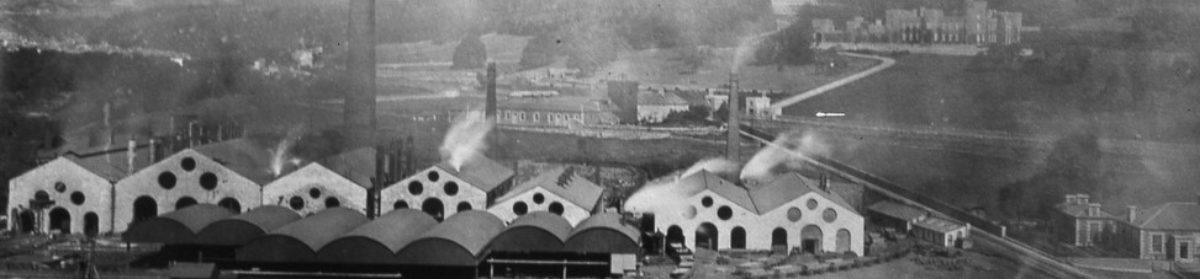
The Tram Depot, known as the Traction Yard, was constructed on the site of Penydarren Ironworks and was reached by way of a branch line which left the Dowlais route at the Trevethick (sic.) Street Junction. As well as providing facilities for tram maintenance, the site also housed the generating station for 550 volts direct current. As can be seen in the Company’s name, not only was it set up to operate trams but also to provide lighting within the area.

Traction Yard

For the opening of the system, thirteen single deck and three double deck trams were obtained. The single-deckers, nos. 1-13, were built by the Midland Railway Carriage & Wagon Co. Ltd., of Shrewsbury. They seated twenty-six passengers.

The open top, double deck trams came from the Electric Railway & Tramway Carriage Works Ltd. (ERTCW), of Preston – part of Dick, Kerr & Co. Ltd. They were numbered 14-16 and seated forty-eight passengers.

The first passengers were carried 6 April, 1901 with Dowlais route trams displaying a triangle and Cefn route vehicles a square on the front. The trams ran between 5.15 a.m. and 10.15 p.m. Passengers fares were one penny per mile or part thereof. Some examples being – Merthyr to Dowlais 2d and Cyfarthfa to Merthyr 1d. The fare for a journey from the Morning Sun in Cefn to the Bush Hotel in Dowlais would be 4d.

A tram outside the Bush Hotel in Dowlais

1903 saw the only serious accident to affect the tramway. On 22 January car number 10 left the rails while descending New Road, Dowlais causing no serious injuries, but the tram was badly damaged.

Passenger numbers had declined to 2,086,684 by 1936. The 1930’s had seen a decline in the number of passengers carried, partially due to the high rate of unemployment in the Borough – 41.7% in 1936.

The Corporation had been prevented from competing with the trams under the provisions of the Merthyr Tydfil Corporation Act of 1920 and so the tramway was eventually purchased by the Corporation for £13,500 in 1939, and abandoned on 23 August, leaving the Company to continue electricity generation until 1948.

Merthyr’s Last Tram

During its life, the tramway carried an estimated 85 million passengers and the tramcars covered a distance of around 8 million miles. Apart from the system in Cardiff, Merthyr’s tramway was the longest lasting in South Wales.

A fuller account of Merthyr’s Tram system by Keith Lewis-Jones can be found in Merthyr Historian volume 20.

All photos courtesy of http://www.alangeorge.co.uk/index.htm