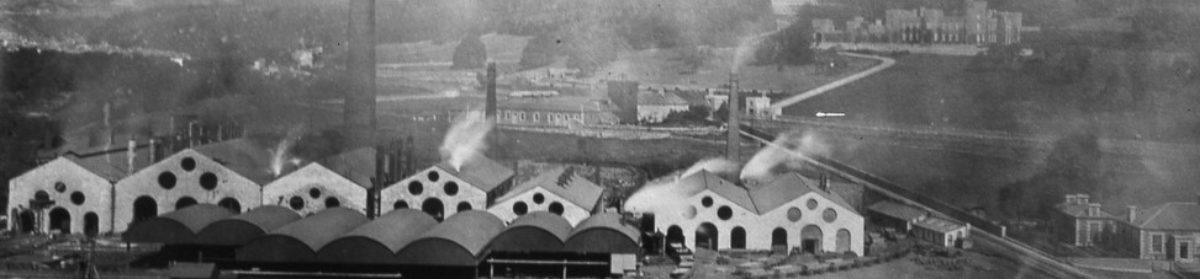
Merthyr’s Lost Landmarks: High Street Railway Station

by Carolyn Jacob

Photo courtesy of the Alan George Archive

At one time most immigrants to Merthyr Tydfil simply walked unless they got a lift on a farm cart, but the few roads were poor. The early Iron-master, Anthony Bacon, built the first direct road between Merthyr Tydfil and Cardiff. The transportation of bulky iron products to the sea ports led to the building of the Glamorganshire Canal. The locomotives and trains of no less than six railway companies ran into the Merthyr station which had the title of ‘High Street’ rather than the more common ‘Central’.

The Taff Vale Railway had been first to arrive in Merthyr with a line from Cardiff and Pontypridd to their Plymouth Street station in 1841, followed by the Vale of Neath in 1853, soon to be taken over by the Great Western. These were followed by the Brecon & Merthyr whose operations stretched down to Newport and the London & North Western with their line from Abergavenny. The final arrivals were the Rhymney Railway with access provided from Quakers Yard by their joint line with the GWR, while the Cambrian Railway had running powers through to Merthyr. In 1922 all were absorbed by the GWR.

Courtesy of the Alan George Archive

Isambard Kingdom Brunel was involved in railway projects here.  ‘The railway sets you down in Merthyr at precisely the quaintest centre of the old town. There is an ancient atmosphere pervading‘, wrote Wirt Sikes, an American, in 1880.  In 1856 Prince Louis Bonaparte arrived at the High Street station. On 1 April 1944, the King and Queen and Princess Elizabeth took the Royal train from the High Street station. Thousands of rails were manufactured here and the Dowlais Works sold rails to Russia, America and India. However, a hundred years ago the local Sunday trip or holiday was only to Pontsarn or the Brecon Beacons. During the Second World War many evacuees arrived by train. One evacuee wrote in a letter home; ‘we watch the trains arriving into Merthyr Tydfil railway station from the top of the slag heaps’.

In its heyday, the striking timbered roof, five operational platforms and more than 80 members of staff, ensured Merthyr High Street Station was in a class of its own. It had excellent facilities. There were refreshment rooms where first-class passengers could buy breakfast for 1s 6d. In 1945 the ticket boxes were open continuously except for 1.45pm to 2.45pm on Sundays and 12.30am to 4am on Mondays. There were toilets and brightly coloured advertisements for products such as Bovril and Venos’ Cough Cure. The waiting rooms were a pleasure to sit in, with large coal fires and plenty of seats. The station was kept litter-free and clean. High Street station cleaner Margaret Pritchard was so conscientious keeping the Merthyr Station spick and span that she accidentally polished over important finger prints after a robbery.

Photo courtesy of the Alan George Archive

In the 1960s young fighters trained by former boxer Eddie Thomas would weigh on the scales in the goods depot at the station, the most accurate scales in town. The station a centre for local sporting life, filled with the sound of cooing racing pigeons and the raucous barking of whippet dogs. In 1953, after 98 years, the roof designed by Brunel was removed and in 1987 the fire-ravaged goods shed at the station was demolished.

In the 1960s Merthyr lost nearly all its passenger services except the Taff Vale route to Cardiff. In 1971 and new station building was erected but it was a shadow of its former self. The official opening of the present new Merthyr Railway Station was February 1996 by Councillor Ray Thomas. The new station which cost £500,000 to build was funded by the sale of the old station just 120 metres away.

Family Firsts

by Barrie Jones

My paternal Grand-parents, Caradog and Margaret Jones, lived at number 12 Union Street, Thomastown, Merthyr Tydfil.  Occasionally, in  the early 1950’s when attending St Mary’s infant school in Morgantown, my grandmother would look after me in the late afternoon until my Mother  or Father were able to call in and collect me for home.  By then, my two older brothers were attending St Mary’s primary school in Court Street; presumably they were old enough to fend for themselves but not to look after me.  So, instead of getting off the school bus to the stop at Penuel Chapel, Twynyrodyn, a short walk away from my house on the Keir Hardie Estate, I would get off at the stop by the Brunswick public house in Church Street, which was just around the corner from my grandparents house.

My Grandfather, (Dad), was born in Troedyrhiw and was a coal miner for all his working life.  Firstly, for Hills Plymouth Collieries, and in the years close to his retirement in 1961 his last pit was Aberpergwm drift/slant mine, near Glyn-neath.  In those later days, Dad was a haulier, guiding his pit pony that pulled the dram full of anthracite coal from the coal face to the pit surface.  On one occasion when staying at Nan & Dad’s, I recall him being brought home by ambulance after having received a bump on the head from a minor roof fall at the mine.  He was sitting in his chair by the kitchen fire with his head bandaged and with a vacant look on his face, which I now know to have been a severe case of concussion.

My Grandmother, (Nan), supplemented the family income by ‘taking in’ travelling salesmen and theatrical artists, (see ‘A Full House’ http://www.merthyr-history.com/?p=3526http://www.merthyr-history.com/?p=3527), as well as helping to pay towards the purchase of the house, this extra income allowed my grandparents to buy some luxury goods.  Nan held accounts in several shops in the town.

One, in particular, was Goodall’s Ltd., which was located on the corner of Masonic Street and High Street, on the opposite corner to the Eagle Inn. In the 1940’s Goodall sold general merchandise but over the following decades concentrated more and more on electrical goods and lighting.  Nan’s account there, allowed her to buy items on extended purchase and a number of what may be called prestige electrical items were bought over the years.

Above and preceding photo – Goodall’s Ltd in 1947. Photos courtesy of the Alan George archive

The most memorable item Nan purchased was a television set, fitted in a fine wooden cabinet with a ten inch screen, which was placed pride of place in the front sitting room.  Staying at Nan’s meant that I could watch the BBC’s Watch With Mother fifteen minute programme for children, before being collected for home.  ‘Watch with Mother’ was initially broadcast from 3.45 pm and marked the start of BBC’s television’s broadcast for the day.  If I stayed later I would watch the older children’s programmes that were broadcast up to 6.00 pm.  Up until 1956 there was a programme free slot between 6.00 and 7.00 pm, known as the ‘Toddler’s Truce’, from that year onwards the ‘Television Ratings War’ with commercial television had well and truly begun.  Television was such a novelty then that even the ‘interludes’ would be watched avidly no matter how many times they were broadcast.  Memorable interludes were the ‘potter’s wheel’ and the ‘kitten’s playing with balls of wool’.  The first television in our house came much later in the 1950s, courtesy of Rediffusion’s wired relay network that was installed throughout the Keir Hardie Estate.  Similar to my Nan’s, the set had a ten inch screen in a wooden cabinet on which we could sample the delights of commercial television’s advertisements and their jingles, such as Murray Mints, the “too good to hurry mints”.

I recall that my Nan’s next big purchase was a radio-gram, again installed in the front room, this was a large cabinet with the radio on the right hand side, and, on the left was the gramophone with a drop system for the single 78s, large heavy records that made a crashing noise when they dropped on to the turntable.  Between the radio and gramophone was a compartment for holding a small number of records.  Among the records there were some by the tenor singer Malcolm Vaughan (1929-2010), formally James Malcolm Thomas.  Although born in Abercynon, he moved to 63 Yew Street, Troedyrhiw, when a young boy.  This was not my first introduction to gramophones, in our house we had a large ‘up-right’ gramophone with built-in speaker and storage cupboard below.  However, Nan’s was the first powered by electricity and her records were far more up to date!

Another of Nan’s luxury purchases was a Goblin Teasmade, which was placed on the bedside table in my grandparent’s bedroom, presumably on my Nan’s side of the bed!  Apparently, still manufactured today but now far more sophisticated than the machine of the 1950’s.  The Teasmade was a combined clock, kettle and teapot, the clock’s alarm would start the heating element in the water filled kettle, once boiled, the hot water would be transferred into the teapot, ready for that early morning cuppa.  Strange that such a modern contraption was kept alongside a bed that hid a chamber-pot underneath.

Having a television on the day of the coronation of Queen Elizabeth II (2nd June 1953) must have improved my Nan’s street cred.  Then what family, friends and neighbours who could squeeze into the front sitting room, watched the televised ceremony.  I was four at the time and probably I was more interested in the street party that followed and so I can’t recall watching the coronation itself.  I can recall sitting with my mother, and my brothers and baby sister at the head of the long row of tables near to my grandparent’s house.  All the children were given ‘Corona’ Red Indian headdresses and mine had fallen off my head just before the picture above was taken.

The street’s residents had decorated their front parlour windows with patriotic bunting and pictures, and the  photograph to the right shows my mother standing by the decorated front window of number 13 Union Street, Mr & Mrs Bray’s house.  I also recall that there were some street races for the children with small prizes given by one of Nan’s ‘regulars’ who was lodging at Nan’s house at the time.

It is more than likely that in the next decade another coronation will be held and I wonder if my grand-children will remember that ceremony in their later life.

Lord Evans of Merthyr Tydfil – Physician to the Queen

Last month we highlighted the career of Harry Evans – the great Merthyr musician. No less remarkable is the career of his son Horace Evans.

Horace Evans was born in Dowlais on 1 January 1903, the eldest son of Harry Evans and his wife Edith. When his father was appointed conductor of the Liverpool Welsh Choral Union that same year, the family moved to the city, and Horace was educated at Liverpool College. Following in his father’s footsteps, Horace originally decided on a musical career, and shortly after his father’s untimely death in 1914 he went to the Guildhall School of Music for four years and to the City of London School.

During his studies he realised that he wasn’t destined for a musical career, and decided his future lay in medicine. In 1921 Evans entered the London Hospital Medical College on a science scholarship. He qualified in 1925, graduated in medicine and surgery in 1928, and took his M.D. in 1930 when he became a member of the Royal College of Physicians and a fellow in 1938. This work merited his appointment as an assistant director of the medical unit in 1933, assistant physician to the London Hospital at Whitechapel in 1936, and physician in 1947. He worked under Arthur Ellis, who instructed him in the traditional English clinical discipline, and who brought him into prominence by selecting him as house physician to the medical unit. Subsequently he held appointments in surgery, obstetrics, pathology and anaesthetics, which gave him a broad basis for a career as a general physician.

He specialised in the effects of high blood pressure and diseases of the kidneys, making a thorough study of Bright’s disease, on which he published papers in medical and scientific journals. In addition he was consultant physician to five other hospitals and to the Royal Navy. It was through his influence that the Royal College of Physicians was moved from Trafalgar Square, having attracted the financial support of the Wolfson Foundation towards the cost of erecting new buildings at Regent’s Park.

He served the royal family as physician to Queen Mary in 1946, to King George VI in 1949 and to Queen Elizabeth in 1952, all of whom received him as a friend. He was knighted in 1949, and created a baron in 1957. In 1955 he delivered the Croonian lectures and was made Honorary Fellow of the Royal College of Surgeons in 1961. The University of Wales conferred on him an honorary D.Sc. degree and he was made a freeman of Merthyr Tydfil in April 1962.

Sir Horace Evans. Photo courtesy of The National Portrait Gallery (ref NPG x167429)

He was regarded as the last of the great general physicians of his age, convinced of the need for personal physicians with a critical judgement based on broad general experience, and of the importance of treating patients as human beings. His presence in a patient’s room or hospital ward left an immediate impression on every one who came into contact with him. His sympathy and understanding stemmed largely from his own family experiences.

Horace Evans had married Helen Aldwyth Davies, daughter of a former high-sheriff of Glamorgan in 1929, and they had two daughters. His younger daughter died in tragic circumstances after accidentally electrocuting herself, and his wife suffered prolonged ill health.

Horace Evans died on 26 October 1963 at the age of 60. Following his death, the Royal College of Physycians published an obituary which contained the following accolade:

“The death of Lord Evans in October 1963 cast gloom over the College. No more would we see his tall, slightly stooping figure, and behind the lightly horn-rimmed glasses the alert but kindly eyes that inspired confidence in patients and assured a welcome to every colleague. Few men carried high honours so gracefully.”