Memories of Old Merthyr

We continue our serialisation of the memories of Merthyr in the 1830’s by an un-named correspondent to the Merthyr Express, courtesy of Michael Donovan.

To return to the coach journey, the Bridgewater Arms was then kept by Mr George Roach, who afterwards move to the Castle at Merthyr,and after the change of horses they came to Quakers’ Yard. Here a slight halt was made, it might have been put down to kindness towards the animals, but the hostelry also supplied refreshments for the inner man. Whatever may be the reason, a long and steep hill had then to be ascended. After passing Pantannas the ascent modified, and on arriving at Nantddu turnpike, the pace could be again increased.

The Nantddu Turnpike (or Tollbooth) in Edwardsville. Courtesy of the Alan George Archive

A run of about two miles after this brought us to a pleasant cottage on  the right hand side, owned and occupied by a Mr Stephens, and the Mount Pleasant Public House, kept by John Griffiths, who afterwards moved to the Star opposite the Old Church in High Street, was close by on the other side of the road.

The drive through the woods up to Troedyrhiw was a pleasant one. The road just before entering Troedyrhiw has been altered a little for the making of the Taff Vale Railway, and after passing Troedyrhiw for about 1½ miles the road was subsequently diverted by Mr Anthony Hill. After crossing the line of the railroad forming the connection at present between the Taff Vale Railway and the South Duffryn Coal Pits, it kept to the east of the present road, passing close in front of Duffryn Cottage, the east end of Taibach and Pentrebach Rows, through what was part of the Forge Yard, then past Pentrebach House (where I believe Mr Probert now resides), and came out at a little above Plymouth Lodge.

A drawing of the Plymouth Lodge in the 1820’s. Photo courtesy of the Alan George Archive

From here there has not been any deviation of route, but until the Britannia Public House on the right-hand side, there was not a single cottage on either side. There was a bridge over the road for the conveying of mine rubbish between the Dowlais Branch Bridge and the Britannia similar to one passed under at Pencaebach. About a hundred yards on towards the High Street, and on the other side of the road stood the Bell, and adjoining the Bell was the Plymouth Tollgate. On the opposite side of the road, but just before coming to the Bell there was an open space to the town road that was used as place where coal was delivered; which with some others will be alluded to to exemplify the arrangements at the time.

After coming through the Plymouth gate there were cottages on both sides until the Plymouth watercourse came so close to the road as to prevent their being built on the left hand. Where the Taff Station was at the opening of the railway and for years afterwards, there was nothing but rubbish tips, but they were not high, and the road with a ford through the river went from Plymouth Street across by Rhydycar. Perhaps this was the very Rhyd (a ford), but the place called Rhydycar was on the side of the canal bank, a house and mine pit with a winding engine. It was doubtless a parish road for Mr Bruce, the grandfather of the present Lord Aberdare, when Stipendiary of Merthyr, passed that way home to his residence in Mountain Ash.

A section of the remarkable 1836 map of Merthyr by John Wood showing the Plymouth Street area as mentioned in this article.


To be continued at a later date….

Merthyr’s Ironmasters: The Hill Family

Richard Hill I (died 1806), who had had experience in Anthony Bacon’s iron-works (at Cyfarthfa and Hirwaun), became Bacon’s trusted manager of the Plymouth Ironworks. He was elected a burgess or freeman of Cardiff in 1784. He married Mary, the sister of Mrs. Bacon, and named his youngest son (born in 1784) Anthony, after Anthony Bacon. On the death of Anthony Bacon, as all the natural children were minors, the estate was placed in Chancery, and the receiver, William Bacon, granted a lease of the Plymouth furnace for fifteen and a half years from Christmas Day 1786, to Richard Hill I, during the minority of Thomas Bacon; this was approved by the Court of Chancery. Hill entered into an arrangement with Richard Crawshay of Cyfarthfa, to supply the latter with pig-iron, and seeing the possibility of increasing his output and of enlarging his works, he secured several leases in order to extend the mineral property attached to the works. About 1794, Richard Hill I had very serious trouble with the Glamorganshire Canal Navigation, then recently opened, for improperly taking the water from the Taff river which he required for his Plymouth works. Richard Hill II (died 1844), his son, then aged twenty, closed the sluices between the canal and the mill-race, and had a desperate encounter with the canal lock-keeper, as a result of which the lock-keeper was awarded substantial damages at the Glamorgan Great Sessions. At the next Great Sessions, Richard Hill I obtained a verdict in his favour and was awarded £300 damages for injury to his works by the Glamorganshire Canal.

In 1799, Thomas Bacon, who had been granted the Plymouth works under his father’s will, became of age, and agreed to surrender to Richard Hill I all his interest in the Plymouth works, and this he confirmed in 1803 when he was 24 years of age. Being now in full possession of the Plymouth works, he with his sons, Richard II and John Hill, entered into an agreement with the Dowlais and Penydarren iron companies for the construction of a tram road for their joint use, from their works to join the Glamorganshire canal at Navigation (now Abercynon). In the same year, 1803, Richard Hill I, who was a practical engineer, agreed to construct a tram road for the joint use of the same three companies to convey limestone from the Morlais Castle quarries. It will thus be seen that Richard Hill was on very good terms with the neighbouring ironmasters, which was far from being the case between the Penydarren and Dowlais companies.

Richard Hill and son were anxious to improve their business by adding a forge and mills, but were very short of capital for such extension. Partners were sought, and A. Struttle advanced £15,000 and John Nathaniel Miers (son-in-law of Richard Hill I), £5,000 to form the Plymouth Forge Company with a capital of £20,000. Work now proceeded briskly at the Plymouth iron-works where Richard Hill I was ably assisted by his sons, Richard II and Anthony Hill (1784 – 1862). But on 20 April 1806, Richard Hill I passed away leaving all his estate to his widow, Mary, his three sons, Richard II, John Hill (of London), and Anthony Hill, and his two daughters, Elizabeth, and Mary, the wife of J. N. Miers (of Cadoxton Lodge). By 1813, Messrs. Struttle and Miers seceded, and the three brothers became partners. On account of the withdrawal of capital, the brothers had to obtain a loan on mortgage of £54,000 from Messrs. Wilkins of the Brecon Old Bank. Richard Hill II for a time lived at Llandaff and looked after the sales side of the business, while Anthony ably managed the productive side, but the burden of the huge loan was a great impediment for many years to the successful working of the concern.

In 1806, the three furnaces at Plymouth produced 3,952 tons of pig-iron, while in 1815 the same three turned out 7,800 tons. A fourth furnace was erected at Plymouth and in 1819 the first furnace was erected at Dyffryn and c. 1824 two others were erected; like all the others these were worked by water-power in which Anthony had great faith — he was very slow in adopting steam-power as the other iron-masters were doing. With Anthony Hill as managing-partner the works were carried on with great vigour and ability, and their brand of bar-iron had a special value and was known for its excellence throughout the world. The produce of the blast furnaces continued to increase year by year. In 1820, it was 7,941 tons, in 1830, over 12,000 tons, by 1846, it was over 35,000 tons.

In 1826 John Hill sold out his interest to his brothers, Richard II and Anthony. Later, No. 8 furnace was built, which was said by Mushet, the great authority on iron manufacture, to be the largest in the world. Richard and Anthony continued as sole managers until the death of Richard in 1844, after which Anthony continued as sole managing director until his own death at the age of seventy-eight on 2 August 1862. Anthony Hill was regarded as the most scientific iron-master of his district. He carried out many experiments for the improvement of iron-making, and was the patentee of many new methods. Gradually he succeeded in paying off the loan burden and attained great wealth. His death was keenly felt in the district, as he had been ‘associated with good deeds, with broad and enlightened measures for his people’s comfort, for their religious welfare, and their education.’ He established a new church at Pentre-bach, and endowed it with £200 per annum; he also founded the Pentre-bach National School and left a sum of money for the ‘Anthony Hill scholarship’ for secondary schools which is still in existence. After his death the works were sold to Messrs. Fothergill, Hankey and Bateman for £250,000; they came to an end c. 1880.

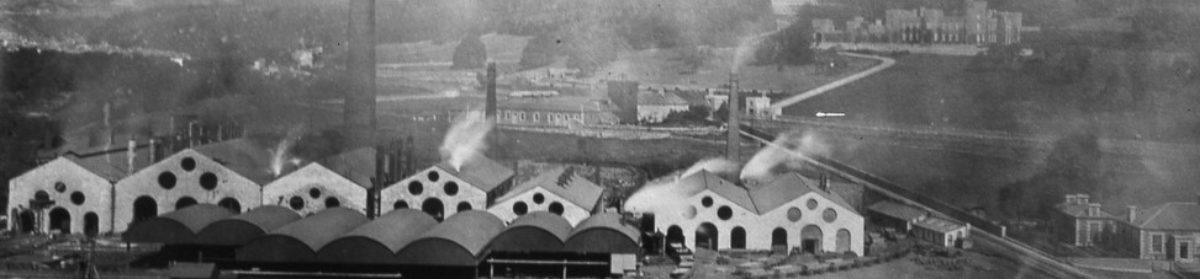
The remains of the Plymouth Ironworks. Photo courtesy of http://www.alangeorge.co.uk/index.htm

Many thanks to the Dictionary of Welsh Biography for allowing me to reproduce this article. To view the original, please follow this link –  https://biography.wales/article/s-HILL-PLY-1786