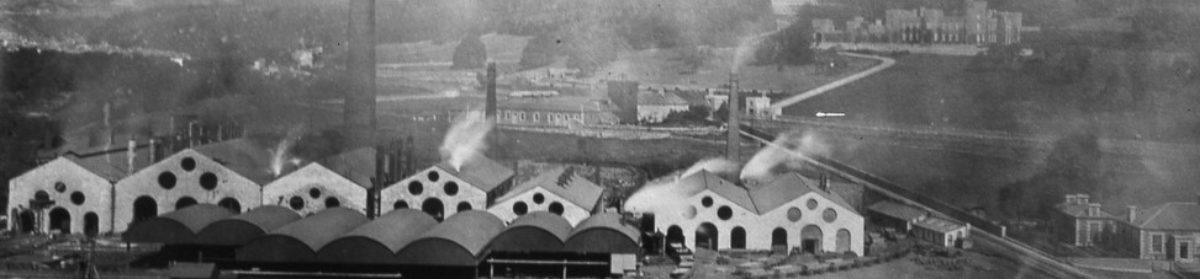
The Dowlais Boiler Explosion of November 1836

by Victoria Owens

185 years ago today, a terrible explosion occurred at the Dowlais Ironworks. To mark the anniversary, eminent historian, and biographer of Lady Charlotte Guest, Victoria Owens, has written the following article.

Although nineteenth century industry relied heavily upon steam power, people were slow to recognise the dangers that it presented. In 1836, an accident occurred at Dowlais which showed just what elemental peril high pressure steam could present. Dowlais House, home of ironmaster Josiah John Guest and his family, stood on the very margin of the Dowlais Ironworks and in her journal Guest’s wife Lady Charlotte wrote a graphic account of the boiler explosion that took place one November morning.

An excerpt of the 1851 Public Health Map showing the proximity of Dowlais House to the Ironworks

Guest had risen early. His nephew Edward Hutchins hoped shortly to purchase a share in Thomas and Richard Brown’s Blaina Iron Company and the two men planned to visit the Browns’ Works on the Ebwy fach riverin the course of the day. Charlotte got up while her husband was breakfasting, and as she dressed, she distinctly felt the house tremble. At first, it reminded her of what she had read about earthquakes – not a phenomenon of which she had any direct experience – and she reasoned that ‘something – not perhaps very awful – must have happened at the works.’ Hearing a window rattle she assumed, undaunted, that her fourteen-month old son Ivor was amusing himself by shaking it.

A vast explosion, the crash of a falling stack and the sound of bricks cascading onto the roof of the house disabused her of her error, and hearing the sound of escaping steam, she guessed that a boiler had burst. It was, she realised, ‘the centre one of the New Forge Engine, and consequently very near the House, towards which all the fury of the explosion was directed.’ While it was not unusual for eighteenth and early nineteenth century industrialists to live close to their works, 1836 plans of the Dowlais Works show the New Forge with its engine actually bordering the gardens of Dowlais House which was left ‘strewn with bricks, cinders and broken glass.’ Amazed and appalled, Charlotte later found a brick in her bed and discovered a heavy piece of iron ‘weighing several pounds’ embedded in an internal wall. Apparently it had passed straight between two servants as they chatted in the first-floor corridor. Meanwhile, a couple of workmen on the charging platform by the furnaces had an equally lucky escape. According to Charlotte, a ‘steam pipe fell between them and the furnace they were charging upon the bar they were using, which it knocked out of their hand.’ If the sentence-structure is somewhat awkward, it may reflect her shock at recalling how she saw the projectile strike the bar used to thrust coke, ore and flux into the furnace mouth clean out of the men’s hands. George Childs’ 1840 depiction of Dowlais labourers gives an idea of the impact that the sight must have made on her. ‘Most thankful I was,’ she wrote later, ‘that we were all in the house together. Had Merthyr [her private name for her husband] been in the works (which he would have been a quarter of an hour later) my alarm would have been infinitely greater.’ Caught in the blast, the boiler stack seemed to rise from its base to pause, ‘as if poised,’ in the air before crashing down from its 120 foot height across the Guests’ lawn, breaking all their windows’ and killing a man and a boy as it fell..

Outside her bedroom, Charlotte found Susan the nursemaid with young Ivor in the passage. As they ran downstairs in search of John, they felt the whole building shake. John was, in fact, already hastening upstairs to look for them and husband and wife simultaneously realised, appalled, that neither of them knew what had happened to their two-year old daughter Maria. Charlotte thought she had been eating an early breakfast with her father while John, in the stress of the moment, could not remember what he had done with her or whether she had even been with him. After a few moments of numb alarm, they found the little girl safe with the housekeeper, neither hurt nor unduly frightened. Seeing a crowd surge across his garden John went out to comfort them as best he could, before seeking to assess the extent of the damage to the works’ buildings.

The following week’s edition of the Cardiff and Merthyr Guardian carried not only a report of the explosion but also a comprehensive description of the boiler. A new installation, it was apparently 42 feet long and 6 feet in diameter. Despite weighing 18 tons and being embedded in solid masonry, it had burst with enough force to thrust it clean off its foundation and carry it over some ten yards’ distance before coming to rest at right-angles to its original position. A large piece of flying masonry had hit a house nearby, home to seven people. The man who had been sleeping in the room into which it actually landed somehow avoided injury, but not all the inhabitants were so lucky. John Howe, a fireman, and the boys David Thomas and John Jones both lost their lives, while ‘the wife of Daniel James, founder’ was badly injured. Meanwhile the New Forge where the boiler had been located, was blown to smithereens – ‘damage’ which the newspaper estimated at not less than £1000, ‘without taking into account the loss occasioned by the suspension of the works.’

At the inquest following the explosion, the jury returned a verdict of accidental death upon the deceased. Significantly, the coroner explicitly ruled out any question of culpability on the part of the Dowlais Company’s chief engineer John Watt. Local opinion – and presumably Watt himself – linked the cause of the explosion to the rupture of a boiler-plate immediately over the fire. The Dowlais Company’s decision in 1838 to name a new plateway locomotive ‘John Watt’ may well reflect the esteem in which John Guest held his colleague.

Dowlais Ironworks in the 1840s by George Childs. Photo courtesy of the Alan George Archive

For general information about boiler explosions, see http://www.historywebsite.co.uk/articles/boiler/explosions.htm

Last Honour for Nazi Victim

by Terry Jones

Whilst doing some research, Terry came across a fascinating article in the Merthyr Express dated 23 June 1956. Here he has written his version of the story, and what better time to post it than day after we remember the fallen of both World Wars.

In 1937, due to the escalation of atrocities against Jewish people by the Nazi party in Germany, Stanley Baldwin, the Prime Minister, made a wireless appeal on behalf of Jewish children in Germany for British families to help them.

One of these children was 13 year old Edgar Adolf Fleischer, son of Herr Max Fleischer of Berlin. Young Edgar left his parents and embarked on one of the Kindertransport, eventually arriving in Britain in April 1938. Here he was adopted by Mr F Wallace-Hadrill, a house-master at Bromsgrove School.

A keen musician, amongst the meagre possessions that he was allowed to bring from Berlin, Edgar carried with him a small violin case, holding his most precious possession – a violin. He had actually taken a few lessons at the Berlin Conservatoire until the Nazi racial laws forbade Jews to receive such lessons. Upon arriving in Britain however, he once again pursued his musical ambitions.

With the outbreak of the Second World War, and as soon as he was old enough, Edgar wanted nothing more than to join the British armed forces and fight the hated Nazis. In 1944, having taking the necessary oaths of loyalty to Britain, and officially changing his name from Fleischer to Fletcher, he joined the Royal Army Service Corps, and soon rose to the rank of Sergeant, and was selected as a cadet for further training for a commission.

Before he could complete his training course, in the aftermath of the D-Day landings, he was posted to Normandy to reinforce the British Army’s campaign to liberate Europe.

In 1945, he returned to Britain to complete his training, the last stage of which took place at Rhayader in November 1945. With just two days until his commission was due, Edgar took part in the final exercise – an assault exercise on a steep hillside. As he reached the summit, he slipped on the shale and fell forward on to his Bren gun and was killed instantly when it discharged. The only positive from this was that he never lived to find out that both his parents had been murdered by the Nazis in one of the death camps.

Edgar Fletcher was buried with military honours at Cefn-Coed Jewish Cemetery on 24 November 1945. His headstone bears two inscriptions – one in Hebrew and one in English:

Hebrew: ‘O let his soul be bound up in the bond of life’,

English: ‘Who falling among friends shares their promised land’.

Merthyr’s Heritage Plaques: Johnny Owen

by Keith Lewis-Jones

Johnny Owen
Statue & plaque sited at St Tydfil’s Shopping Centre, CF47 8EL  

Johnny Owen, 1956-1980, began boxing at the age of eight.

By the time he was 24, he was the British, Commonwealth and European Bantamweight Champion.

He was shy, kind and unassuming outside of the ring which was the only place where he was ‘comfortable’. He became known as ‘The Matchstick Man’ owing to his skeletal frame .

In 1980 he was knocked unconscious in a World Title fight in Los Angeles. He went into a coma and died six weeks later.

Important announcement

If anyone has sent a message to this site via the gmail account – merthyr.history@gmail.com, for some reason ALL of the messages on there have disappeared into the ether.

If you have sent a message recently – please could you re-send it.

Sorry for the inconvenience…..don’t you just love technology?

Memories of Old Merthyr

We continue our serialisation of the memories of Merthyr in the 1830’s by an un-named correspondent to the Merthyr Express, courtesy of Michael Donovan.

Assuming ourselves at the junction of the Mardy and High Street, we will try to go (as many did during the turnpike gate days) around to Dowlais. The Star is on the right hand, a small house and shop on the left, the Mardy House being close, in fact the front garden touched the wall of Shop House, and Mardy House itself faced out to the High Street. This was the new front; a portion of the older part adjoined and had a thatched roof. It was occupied by a Mrs David Meyrick, I believe (Mr David Meyrick Having died there). Adjoining the Mardy was the residence of Mr Edmund Harman.

An extract from the 1851 Ordnance Survey Map showing the area in question

Gillar Street comes in, and on the opposite corner was a shop where (if not mistaken) Mr William Harris first opened on his own account; then the residence of Mr William Rowland, the parish clerk. At the making of the Vale of Neath Railway it was necessary to take part of his garden, and the navvies were annoyed at his troubling so much about some fruit trees. Naturally they would move them in the early hours of the day to avoid interference, but on one occasion he went out while they were doing so, and heard one of the navvies say to the other “Look out Jim; here’s the b_____ old Amen coming”. His wrath was not modified by the hearing of this, but that he did hear it is well known.

An opening into the Cae Gwyn followed, and the Fountain public house was upon the corner of the Tramroad. Upon the right side behind the Star were some five or six cottages, and after an opening was passed that came from Pendwranfach, the Court premises and Garden followed. The house itself has been improved since then, but it was always the parent house of the town. The Glove and Shears adjoined, and abutting on its gable was the Tramroad. Just here will be spoken of again in reference to the Tramroad. Now however, we will cross it and ascend the hill – Twynyrodyn.

Some not over good cottages lined a part of the way; there was a better residence on the right before coming to Zion, the Welsh Baptist Chapel, and opposite the chapel was the residence of the Rev Enoch Williams. Facing down the road just above was the White Horse public house, with a row of cottages with gardens in front. There were but few cottages beyond Zion Chapel on that side.

The White Horse Inn. Photo courtesy of the Alan George Archive

At the end of the White Horse, and behind the row of cottages, is the original ground used for burial of those who died from the cholera epidemic in the very early thirties (those who died at the subsequent visitation being buried in Thomastown, near the Union Workhouse).

The road had few if any cottages. In a dell, which may be called the end of Cwm Rhyd-y-bedd, there was one, and some a little further on to the left. The ‘Mountain Hare’ was the name of the public house built there adjoining the railroad leading from the Winch Fawr to the Penydarren Works.

To be continued at a later date…..

Merthyr’s Chapels: Horeb Chapel, Penydarren

Horeb Welsh Independent Chapel, Penydarren

The cause at Horeb was begun in 1837 by Rev Joshua Thomas, the minister of Adulam Chapel in Merthyr. Rev Thomas started a school in a room adjoining the Lucania Billiard Room in Penydarren, and several members of Adulam, who were living in Dowlais, met Rev Thomas in the school and started holding prayer meetings there. The congregation grew to an extent that it was decided to build a new chapel, just a few yards away from Joshua Thomas’ school. The foundation stone was laid on 1 August 1839, and the chapel, the first place of worship in Penydarren, was completed the following year at a cost of £700. The original chapel was built in an elevated position overlooking the High Street.

The original Horeb Chapel. Photo courtesy of Carl Llewellyn.

For the first few years, Horeb was in a joint ministry with Adulam with the Rev Joshua Thomas ministering to both chapels. However when Rev Thomas left Merthyr in 1843, the elders of the chapel decided to call their own minister, and Rev Evan Morgan was ordained on March 26-27 1844. Sadly Rev Morgan was a victim of the cholera epidemic and died in June 1849, and he, his wife and one of his children were buried on the same day.

As a result of the cholera epidemic, there was a religious revival in Wales with many people joining chapels and churches. The congregation at Horeb continued to grow and in 1853, a new chapel was built at a cost of £1100. The new chapel was built with the main entrance now facing Horeb Street. Within three years a new schoolroom was also built next to the chapel at a cost of £400.

The second Horeb Chapel. Photo courtesy of Carl Llewellyn.

In 1891, the fabric of the building was in need of some attention, so the chapel underwent minor renovations and a new pulpit and ‘Big Seat’ were erected at a cost of £330.

By 1908, it had become obvious that the chapel was becoming quite dilapidated and really not adequate for the congregation, so a new chapel was built in 1908/09 at a cost of £3,900, including £400 for a grand pipe organ.

The magnificent third Horeb Chapel.

The interior of the chapel was finished to a very high standard with magnificent plasterwork, and the gallery and pulpit made from a mixture of oak, pitch pine, mahogany and ebony. The new chapel was considered to be one of the finest chapels in South Wales.

On the night of 28 April 1973, an arsonist started a fire in the chapel, and the building was gutted. Only the vestry adjoining the chapel was saved, and also the iron name plate which was cast in the Dowlais Ironworks.

Horeb Chapel in ruins after the arson attack in 1973.

Following the fire the chapel had to be demolished and the decision was made to build a new chapel. A new modern chapel was built at a cost of £60,000. Horeb is now the only place of worship in Penydarren.

Don’t believe all you read about Quakers’ Yard

by Christine Trevett

Do you know the Yard – the small, walled burial space at the heart of Quakers’ Yard village where Quaker burials happened until 1891? It’s a graveyard – gravestones now removed, all but one that is, which is flat to the ground and very understated, in Quaker fashion. If you’ve read about the burial ground on local websites or in older accounts of Merthyr history it’s as well to know that not everything you might read about it is accurate.

Among those things which are clearly odd is the claim that it was ‘opened’ in 1665 by someone called William Howe from Bristol. Odd, too, are some of the dates given for Quakers having supposedly worshipped clandestinely with other dissenters at Berthlwyd Farm, above Quakers’ Yard village.

Quakers’ Yard Burial Ground. Photo courtesy of the Alan George archive.

Firstly the ‘opening’ of that burial ground … a date of 1665 makes no sense. The piece of “walled about” land (as it’s described in the legal documents) was not given to the oversight of some named local Quakers until 1667. Yes, it was for Quakers to have burials in and then the gift of it “for a thousand years” to “the people of God called Quakers’’ was ratified in the freeholder’s will of 1670. Both of the documents were linked with the Quaker and widow Mary Chapman. She owned the Pantanas (or Pantannas) estate of which that burial ground  land was a part. The documents are in the National Library of Wales in Aberystwyth and at the time Mary Chapman lived in St. Mellons. But “opened” by a man from Bristol in 1665? I don’t think so.

The story makes no sense on other grounds too. In 1665 when the burial ground was allegedly opened Quakers were a newly-created sect. It had been under a decade and a half since their public emergence in England and in the 1660s they were much opposed by the authorities under Charles II. There had even been a Quaker Act in 1662, “for preventing mischiefs and dangers that may arise by certain persons called Quakers and others refusing to take lawful oaths”. The fact was that Quakers were widely suspected by “right thinking” people and this hardly tallies with some notion of them organising a formal “opening” of a very small  burial area, given that the land  was being set aside because of Quakers’ rift from the established church and the church’s refusal of ‘consecrated ground’ to such people. Presumably they wouldn’t have been inviting the local vicar to the ceremony!

In any case, the idea of such formality would have held no appeal for Quakers of those times and had there been no gifted land they would otherwise just have buried a loved one in whatever spot was available. Usually that was on their own land, while also refusing to acknowledge that any bit of earth was more ‘consecrated’ than the next one.

This was a troubled, messy time in the history of these islands and in Merthyr parish some Quakers had already been imprisoned for their nonconformity. In the 1660s, according to  the Diocese of Llandaff’s account of ‘conventicles’ (i.e. illegal gatherings apart from the established church) the houses of some named men in Merthyr parish were being described as venues for “the mixt rabble” of dissenting preachers and those who agreed with them. Those named men, Quakers, had been among the ones incarcerated previously and/or they were recipients of the ground from Mary Chapman. These seemed more like outlaws in the eyes of the authorities than people wanting freedom of conscience and freedom of worship. All things considered, I can’t see these times as ones in which local Quakers would be  getting a man in from Bristol for a nice opening of a burial ground.

And then there was Berthlwyd Farm … which was one of several places which have figured in Merthyr region’s history where religious dissent was concerned. Berthlwyd was sufficiently remote in those days to deflect prying interest and so it fitted the pattern of such places. The problem is, though, that it is claimed quite often that Quakers, with Baptists and other dissenters, were gathered together in Berthlwyd Farm “by 1650”. Yet that is impossible. There wasn’t a Quaker in Wales “by 1650”. The first Welsh person living in Wales to identify as Quaker did so in 1653, and he’d travelled to seek them out in the north of England. In South Wales it was later still for converts to Quakerism. Some of those worshippers up at Berthlwyd Farm who were religiously dissatisfied may have morphed in due course into the Quakers of the mid 1650s and 60s in Merthyr parish. In the 1640s, though, we should not number Quakers among Merthyr’s dissenters, as sometimes happens.

Some of the kind of imperfect information which gets repeated seems to come from local writers in the 19th century. They were also well confused about the Fell family. Lydia Fell was probably buried at Quakers’ Yard in 1699 and hers seems to have been the Quaker name best remembered in local folklore. She is said to have had some role in the early history of the burial ground too but misinformation and confusion about that, and about her, has also got around.

Christine Trevett was born in Susannah Place, where Treharris runs down to Quakers’ Yard.   That gave her a nagging interest in Quaker history as a hobby even though the day job required that she researched other things. She’s published quite a lot on Quaker history, including Women and Quakerism in the 17th Century and Quaker women prophets in England and Wales 1650-1700. Her look at Dowlais Educational Settlement and the Quaker John Dennithorne will be published by Merthyr Tydfil Historical Society in 2022.