From the Evening Express 120 years ago today….

The Melting Pot – Merthyr Tydfil's History and Culture
In Association with the Merthyr Tydfil & District Historical Society
From the Evening Express 120 years ago today….
by Phil Sweet

History is full of individuals who accomplish notable deeds and then fade from memory. One such gentleman is Walter William Meredith. This short article will hopefully both bring his story to life and recognise his achievements.
Walter Meredith was born on New Year’s Day 1863 and was the second child of William and Harriet Meredith who resided at 125 High Street in Merthyr. Walter’s father was a successful jeweller and had the financial means to invest in his son’s education.
Meredith initially attended Lloyd’s School in Merthyr. It was at this school that he first participated in the code of football which existed at the time. When he was eleven Meredith attended Taunton School and, during the five years he spent there, represented the school at both rugby and cricket.
He then spent the next three years at Shrewsbury School and whilst a pupil at the school he became acquainted with Association Football. Meredith proved to be a quick learner and went on to represent the school at football, cricket and running. During this time his rugby skills weren’t forgotten as he occasionally turned out for Merthyr RFC whilst home on vacation.
Meredith’s talents were not just confined to the sports field and on leaving Shrewsbury School in 1882 he was articled to a firm of solicitors in the City of London. While he was in the Capital Walter’s sporting career continued to flourish. He joined the London Athletic Club and on Wednesdays played rugby for a team called the Anomolites which was a combination of members of the London Athletic Club and doctors from the various London hospitals.
He was also a member of the Hermits & Phoenix Football Clubs which later merged into the well-known Clapton club. Indeed whilst he was with Clapton Meredith played at right back in the Clapton team which won the London Association Junior Cup. A true sporting all-rounder Meredith also competed in cross-country competitions for the Clapton Beagles team and during the summer months was a regular and successful participant in athletic sports held within easy travelling distance of London.
In 1887 Walter passed his final law examination and qualified as a solicitor This event saw him curtail his athletics career. However, his interest in sport was not extinguished completely as he served for a season as Secretary of London Welsh RFC.
In June 1891 Meredith returned to Merthyr to open his own solicitors practice in Market Square and resided with his parents and older sister Kate at 125 High Street. Back in his home town Walter wasted little time in throwing himself into the civic life of the area. As well as being President of Merthyr RFC and Secretary of Merthyr Athletic Club, in 1904 he was appointed High Constable of Caerphilly Higher.
Shortly after being appointed to the latter office Meredith made his lasting contribution to the sporting life of the town when he concluded the negotiations, on behalf of Merthyr Athletic Club, with the Bolgoed Estate for a 99 year lease on Penydarren Park which at the time was in great danger of being built on. This agreement secured for the people of Merthyr a central and well appointed venue for sporting activity which had previously been so lacking in the town.
Having secured the use of Penydarren Park for sport the twelve-strong syndicate of prominent townsmen who comprised Merthyr Athletic Club wasted little time in levelling the arena to create a playing field as well as athletics and cycling tracks. The ground was officially opened on Saturday 9th September 1905 when Swansea RFC took on Merthyr RFC and immediately became the home to Merthyr RFC, Merthyr Thursdays RFC and Merthyr Ladies Hockey Club.
These organisations were the first of many such clubs to take up residence at the ground. Although Penydarren Park has become synonymous with football in the town, having hosted both Football League and European Cup Winners Cup matches, the arena has also played host to touring international rugby teams and greyhound racing. Equally as significant is the fact that it has allowed countless thousands of children and adults in the Borough to engage in a variety of sporting pursuits.
Whilst securing the lease on Penydarren Park was undoubtedly Walter Meredith’s lasting civic legacy to Merthyr Tydfil his interests were not just confined to the sporting arena. As well as being an enthusiastic archaeologist and a recognised authority on the history of Merthyr Tydfil Meredith was the long-standing Secretary of both the Merthyr & Aberdare Incorporated Law Society and Merthyr Chamber of Trade & Commerce.
Politically he was a strong supporter of the Conservative Party acting as party agent in the town for the first decade of the twentieth century. Ten years earlier he had been one of the founder members of the Merthyr Constitutional Club eventually becoming the club’s president after holding the post of vice-president for eighteen years.
Walter Meredith was a bachelor who, following the death of his parents, moved with his spinster sister to 2, Courtland Terrace. He died on August 2nd 1932 whilst on holiday at Aberdw in Mid Wales where he was indulging in another of his life-long passions – angling. His funeral took place Friday August 12th at St David’s Church where he was life-long member. He is buried in Cefn Cemetery.
SOURCES OF INFORMATION
Evening Express
Merthyr Express
1871 Census
1881 Census
1891 Census
1901 Census
1911 Census
From the Evening Express 120 years ago today….


The article below is transcribed from the Evening Express 120 years ago today….
DEATH OF MR FOTHERGILL
Deceased a Former M.P. for Merthyr.
Mr. Richard Fothergill, formerly M.P. for Merthyr Tydfil, died at Sion House, Tenby, early this morning after an illness extending over a month.
BIOGRAPHICAL SKETCH
The redoubtable family of the Fothergills were early identified with  Westmoreland and the “North Countrie.” They were products of the North—the bleak nursery of strong men. The philosopher of the buckle and lamp has endeavoured to trace analogies between the magnetic and the mental. That we pass over; but certainly from the North came many of the pioneers of we iron and coal world, though not, be it added, without a blending of native genius.
The Fothergills first appeared in this country at Lydbrook, in the Forest of Dean, at Tredegar, and next in the Aberdare district, where the family was represented by Rowland Fothergill, who followed in the track of the Scales, and is creditably supposed to have thriven in the same ratio as that family declines. One of the Scales, who had a tendency to be pungent with his pen in after years, described Rowland Fothergill as the squire of Hensol, who “looked as though he never could stoop with his scythe to mow.”
Mr. Rowland Fothergill was a personage of note in Aberdare in 1819. He was the uncle of Richard Fothergill, and when that worthy was in his erratic youth he came and grew up by the side of the stalwart old man, trained into the mysteries of iron-making, and, when in all the strength of his manhood he careered about the valley, well mounted, scorning high- ways and dashing about the mountains, few finer types of humanity could be a cavalier amongst the Puritans, one upon whom men looked with pleasure for his man hood and frankness, and upon whom the eyes of women fell with pleasing interest.
As time past changes crept in. Mr. Rowland Fothergill drifted away from forges and furnaces to the arcadian attractions of Hensol, and when he died in the fulness of years Richard, the nephew, reigned in his stead. He was now the owner of Abernant and Llwydcoed. Ironworks, collieries, and landed estates were his. Not only had he thousands of men at his command, but a splendid array of able men as managers, agents, etc., whose descendants we see to-day—all that is left of them—in honourable positions at the Docks or elsewhere; men who since won rank in the industrial world, and held it by unswerving integrity.
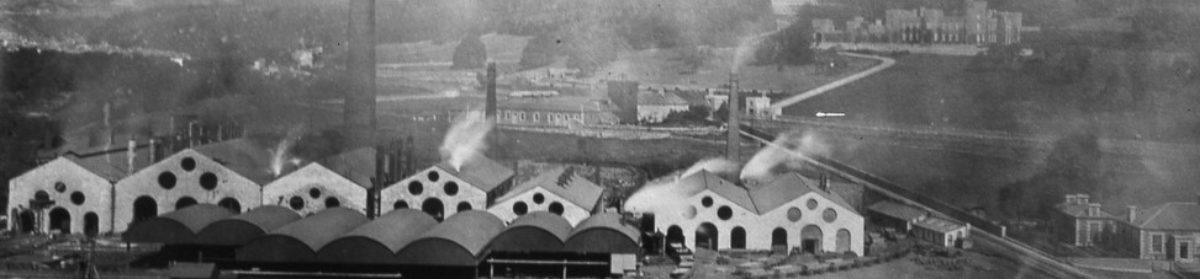
When Mr. Richard Fothergill had gained a position greater than that held by his uncle, there yet opened out a longer vista of distinction We find him aspiring to annex the ironworks of Mr. Anthony Hill, the last of the famous Plymouth Iron Company, who died in 1862. His death cleared the way to the ambitious ironmaster, suggesting greater and more successful rivalry to the Crawshays and Guests by his becoming as potent in the Merthyr Valley as in that of Aberdare. In connection with others, notably Mr. Hankey, a London banker, the Plymouth Ironworks and Collieries passed into his hands, and with remarkable industry he overlooked the workings of each ironworks and colliery.
In the zenith of his career as ironmaster he met with a sad family bereavement, and for a time he was overwhelmed, trying to find in religious consolation the anodyne. In time he rallied, and it was not very long before a vacancy in the representation of Merthyr Tydfil aroused in him the ambition to become to the iron and coal district what Sir John Guest had been. Keen student of man, it was not long before he gained his end, and, amid the cheers of hurraying men, the acclamations of “Fothergill age,” and the blaze of the magenta light won from the coal, he made his way to St. Stephen’s.
Friends and enemies gave him the credit of having been an active member of Parliament. He did not sit down, resting upon his laurels, but fought for all he was worth in advocacy of the virtues of the coal of Wales. Of course, many said that in doing so he also benefited himself. Be that as it may, he unquestionably did a good deal in the interest of steam coal, and was the means first of getting good Admiralty orders and, secondly, of making the beat steam coal of Wales more widely known.
While all intent upon coal, iron, Parliament, the commercial crash came which involved him in disaster, and the star which had arisen so brightly fell. It was a terrible calamnity to him and to the district. Many a man wished that Mr. G. Clark’s intention of carrying on Plymouth Works after the death of Mr. Anthony Hill had been accomplished, and deplored the acquisition by Mr. Fothergill. Fortunately, time and the merits of the famous Welsh coal brought about eventually some modification, though to this day old furnaces long disused at Plymouth and the wreck of Abernant and Llwydcoed are evidences of the greatest disaster to the iron industry Wales ever sustained. From that time and Mr. Fothergill’s retirement from Parliament his connection with his old district has been slight. Perhaps one of the best reminders of Mr. Richard Fothergill will be his successes at Abernant House. Here, with remarkable taste, he made the unsightly tips attractive, clothing eyesores with leaflage and foliage.
– Evening Express – 24 June 1903

From the Evening Express 120 years ago today….

From the Evening Express 120 years ago today…..

From the Evening Express 120 years ago today…

