Merthyr Memories: The Closure of Abermorlais School

Following on from the last post about the opening of Abermorlais School, Clive Thomas, former teacher at the school, has kindly shared his memories of the closure of the school.

The Closure of Abermorlais Junior School
by Clive Thomas

In September 1968 a new headteacher took charge of Abermorlais Junior School. Mr. O.P. Bevan (Ossie), recently a teaching head at Heolgerrig Primary came to a school with a century of history and a reputation for high standards. After all hadn’t it assisted in the education of three peers of the realm? As well as providing for the general education for many thousands of children, probably the most celebrated of the school’s pupils were the  Berry boys, namely Henry Seymour Berry, Lord Buckland, William Ewert Berry, Viscount Camrose and  Gomer Berry, Viscount Kemsley.

Funded by the British and Foreign Schools Society, Lady Charlotte Schreiber (previously Guest) had laid its foundation stone in 1867. It was built on what was later to be known as the British Tip, an accumulation of iron and coal waste from  over a century of operations at the Penydarren Ironworks.  In its elevated position, the school overlooked the town to the south, Ynysfach to the west and to the north Georgetown and the Brecon Road. It was from the streets, terraces and courtyards of these areas that children had come to Abermorlais for over a century, but with the redevelopment of many of these districts and family movement to the new Gurnos Estate, pupil numbers had declined massively and left a very large school building only twenty-five per cent occupied.

Abermorlais School in 1969

By the mid ‘Sixties’, the building had suffered from many years of neglect and the school was in almost terminal decline. Initially built to accommodate over six hundred pupils, by this time fewer than two hundred were taught in only six of the downstairs classrooms. Foot worn sandstone stairs with iron railings led to the upstairs classrooms, all of which   had been vacated a number of years previously. Here were rooms where chairs, desks and other unwanted furniture and equipment were stored. A variety of old textbooks and teaching materials, some of great age had also been discarded here and in the imagination of many of the remaining pupils, these classrooms had to be haunted.  Shelves and ledges were coated by inches of black dust from the open fires which heated the still occupied classrooms and hall.

A classroom at Abermorlais School

This particular school year was a significant one in that it would be the last in which children from Abermorlais would sit the Eleven Plus Examination. Comprehensive education had already arrived in the lower part of the County Borough with the opening of Afon Taf High School the previous year.  Mrs Wendy Williams was the teacher who shouldered the onerous responsibility of ensuring that every child in what was still called Standard Four gave of their best.

Mr. John Lloyd was the school musician. A talented pianist, he played for the Pendyrus Male Voice Choir, then under the baton of the famous Mr. Glyn Jones from Dowlais. Mrs. Eleanor Davies, wife of the former head was fulfilling her final year as deputy-headteacher, while Mrs. Morgan and Sylvia Lloyd assisted with the teaching of the younger juniors. Like Mr. Bevan, Clive Thomas was new to the school and in the first year of his teaching career.

The staff at Abermorlais School in the summer of 1969. Back row – Mrs M Williams, Mr Clive Thomas, Mr John Lloyd, Mrs Morgan. Front Row – Mrs Eleanor Davies, Mrs Annie-Mary Protheroe, Mr Ossie Bevan (headmaster), Mrs Sylvia Lloyd, Mrs Wendy Williams.

At Heolgerrig, Mr. Bevan had been involved with the Welsh School Council work on Environmental Studies. He was anxious to continue this approach and actively involve children in work which would help them gain a better understanding of how the school and town had evolved. To say that Abermorlais was poorly resourced to achieve these aims would be an understatement but his ingenuity, perseverance and jovial nature enabled significant progress to be made.

A new school had been planned to replace Abermorlais, but was to be built in a corner of Cyfarthfa Park and on the edge of what was the old school’s catchment area. This, it was rumoured was to be a semi-open plan school (whatever that meant) and represent the aspirations   of a new age in education. Many of the staff, needless to say approached the move with a degree of trepidation.

Towards the end of the Autumn term in 1970 the staff were ready for the move and packed all that we wished to take with us. The Abermorlais foundation stone, which Ossie had planned to take to the new school proved to be something of a sham unfortunately. The inscription had not been cut skilfully by a late nineteenth century mason into solid stone but into a mortar coating. When the machine went to pick up the stone it fell into pieces and was lost in the rest of the debris. The historic building was left to the salvage and demolition crews.

Abermorlais School during demolition

Many thanks to Clive Thomas for this fascinating article, and for providing all of the photographs.

The Meaning of Grawen

by Carl Llewellyn

Although there is a farm in Cwmtaf called “Grawen”, most residents living in Merthyr Tydfil would recognise the name being associated with the area around the Quar, Brecon Road, known as the “The Grawen”.

The Welsh word for “rough” is “garw”, and in the old Welsh language meadow is “gwaen” or “waen”. If these two words are combined we have Garw-waun, drop one “w” and the “a” in waen we have “Grawen”. In the old Welsh the “r” frequently changes its position  and so “Garwen” would become “Grawen”.

This is conjectural – the word “garw” (rough) combined with “nant” (a valley or a brook), gives us “turbulent brook” with the word “rough” associated with water – hence Nantgarw, Pontypridd, and an area near Cwmtaf is known as “Garwnant”. In Dewi Cynon’s history of Farm names the word “garw” or “rough” refers to the bed of the brook being “coarse” hence “rough brook”.

The ‘Round House’ in the Grawen, Brecon Road


A Letter from Germany

The following article appeared in The Merthyr Pioneer 103 years ago today, on 26 September 1914 – just after the outbreak of the First World War….

As reported in our issue of August 29, Miss Margaret Gilleland, daughter of Mr and Mrs Gilleland of Brecon Road, is one of the British subjects who were unable to leave Germany before the outbreak of the war. As was explained in that issue of the Pioneer, Miss Gilleland took up the post of governess with a German family residing at Posen in April last, from which place, however, the family have since gone to Borkun, probably in view of the advance of the Russian Army towards Posen.

Mr and Mrs Gilleland have naturally been somewhat concerned about the safety of their daughter, from whom they had received no communication since August 1 until the following letter arrived from a lady residing at The Hague, Holland, in which was enclosed the few lines written to her parents by Miss Gilleland in German (all letters posted in Germany at present must be in the German language), and translated by the lady who kindly forwarded the note to the family in Merthyr. By the courtesy of the family we are able to publish the letters as received, and Miss Gilleland’s friends in the district will be delighted to know that she is in good health and ‘very happy.’ The letter is as follows:

“The Hague
15th Sept 1914

Dear Sir and Madam, – You will probably be surprised to receive a letter from a total stranger. Fraulein Tietz, from Zulchan (Germany), asked me if I could write to you for your daughter, as you would be longing to know how she is getting on. On the overleaf you will find a translation of her German letter to you, for, of course, she cannot but write in German. So if you would kindly write your daughter in English, and then sent the letter to me, I will translate it, and forward it to her.

I have tried to translate it as well as I could, but please to forgive me if the language is not quite correct. Hoping you will soon send me a reply for your daughter. – I am, with kind regards, Yours sincerely,

                   L Huijgen de Raat”

Miss Gilleland’s note to her parents (as translated) is as follows:

“My Dear Parents, – I will write to you just a short letter to tell you that I am quite well and very happy. I also want to state that when in newspapers it is put that we foreigners are badly treated, this is absolutely untrue.

Please let me know how you are, and where George is. Much love, from yours lovingly,                                

Margaret Gilleland”

Below is a photograph of Margaret Gilleland that appeared in the Merthyr Guardian on 5 September 1914.

Merthyr Pioneer – 5 September 1914

Merthyr’s Trams

78 years ago today saw the last tram journey run in Merthyr. To mark the occasion, local historian Keith Lewis-Jones has provided the following fascinating article.

Trams at Pontmorlais Circus

The first thoughts of a tram system in the Merthyr area were in 1878, when a scheme was proposed by Messrs. Taylor, Forester and Sutherland, to construct a horse or steam tramway between Merthyr and Dowlais. In 1879, a public meeting was held at the Bush Hotel in Dowlais for the three promoters to explain their plans and to canvass support for the proposed system. The tramway failed to materialise for a variety of reasons, both financial and fear that the toll on the horses hauling trams up gradients, as steep as one in eleven, would make the tramway unprofitable to work.

By 1890, the population of Merthyr was 60,000, and the service of horse cars and brakes was wholly inadequate for the transport needs of such a large population. By this time a large section of the working population was employed at the Dowlais Works, with many living along the Brecon Road corridor and in Cefn Coed

It was therefore proposed to lease out, to a private company, the right to construct Light Railways between Cefn Coed and Dowlais, with a branch running to the centre of Merthyr at Graham Street. As is always the case with such progressive ideas, a great deal of vigorous and influential opposition was forthcoming from vested interests. It was decided to set up a commission to hear evidence and propose a way forward.

In May 1898 the Merthyr Tydfil Electric Traction and Lighting Co. Ltd., a wholly owned subsidiary of British Electric Traction (BET), made an application for a Light Railway Order under the Light Railways Act of 1896, and the order was granted on 16 May 1899.

The Light Railway Order authorised the construction of three railways.

Railway no. 1 was to be 3 miles 1 furlong 2.8 chains long and was to run from opposite the Morning Sun public house in Cefn High Street via Cefn Bridge, Brecon Road, Pontmorlais Road West, Penydarren Road, High Street Penydarren, New Road & High Street Dowlais to a terminus opposite the Bush Inn.

The section from the Morning Sun to the Merthyr side of Cefn Bridge was not to be constructed until Cefn Bridge had been re-constructed or replaced.

Railway no. 2, 3 furlongs 3.5 chains in length, was to run from the north side of the Owain Glyndwr on Pontmorlais Road West to Graham Street via High Street, terminating at the west end of Graham Street.

Railway no. 3 was 1.7 chains in length and formed the third side of the triangle at Pontmorlais, joining railway no. 1 with railway no. 2 on the east side of the Owain Glyndwr.

Trams at the terminus in Graham Street

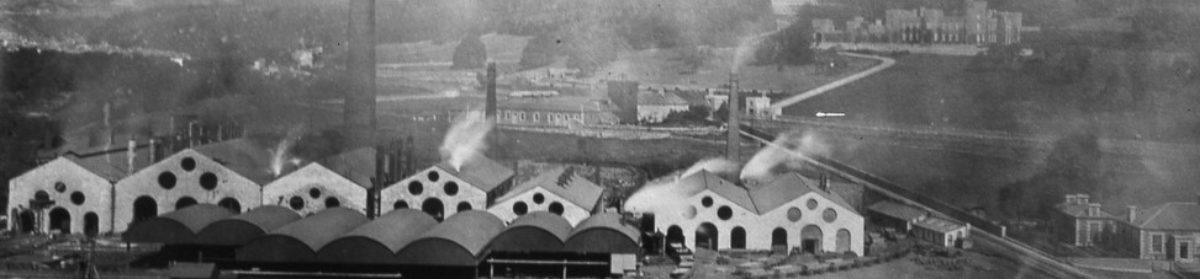
The Tram Depot, known as the Traction Yard, was constructed on the site of Penydarren Ironworks and was reached by way of a branch line which left the Dowlais route at the Trevethick (sic.) Street Junction. As well as providing facilities for tram maintenance, the site also housed the generating station for 550 volts direct current. As can be seen in the Company’s name, not only was it set up to operate trams but also to provide lighting within the area.

Traction Yard

For the opening of the system, thirteen single deck and three double deck trams were obtained. The single-deckers, nos. 1-13, were built by the Midland Railway Carriage & Wagon Co. Ltd., of Shrewsbury. They seated twenty-six passengers.

The open top, double deck trams came from the Electric Railway & Tramway Carriage Works Ltd. (ERTCW), of Preston – part of Dick, Kerr & Co. Ltd. They were numbered 14-16 and seated forty-eight passengers.

The first passengers were carried 6 April, 1901 with Dowlais route trams displaying a triangle and Cefn route vehicles a square on the front. The trams ran between 5.15 a.m. and 10.15 p.m. Passengers fares were one penny per mile or part thereof. Some examples being – Merthyr to Dowlais 2d and Cyfarthfa to Merthyr 1d. The fare for a journey from the Morning Sun in Cefn to the Bush Hotel in Dowlais would be 4d.

A tram outside the Bush Hotel in Dowlais

1903 saw the only serious accident to affect the tramway. On 22 January car number 10 left the rails while descending New Road, Dowlais causing no serious injuries, but the tram was badly damaged.

Passenger numbers had declined to 2,086,684 by 1936. The 1930’s had seen a decline in the number of passengers carried, partially due to the high rate of unemployment in the Borough – 41.7% in 1936.

The Corporation had been prevented from competing with the trams under the provisions of the Merthyr Tydfil Corporation Act of 1920 and so the tramway was eventually purchased by the Corporation for £13,500 in 1939, and abandoned on 23 August, leaving the Company to continue electricity generation until 1948.

Merthyr’s Last Tram

During its life, the tramway carried an estimated 85 million passengers and the tramcars covered a distance of around 8 million miles. Apart from the system in Cardiff, Merthyr’s tramway was the longest lasting in South Wales.

A fuller account of Merthyr’s Tram system by Keith Lewis-Jones can be found in Merthyr Historian volume 20.

All photos courtesy of http://www.alangeorge.co.uk/index.htm

A Fowl Crime at Merthyr

The curious article transcribed below appeared in The Merthyr Telegraph dated 21 September 1867. Although amusing, it is also fascinating in that such a trivial piece on the surface tells us so much about various aspects of life in Merthyr at that time.

THEFT OF A DUCK

Sarah Davies, a prostitute, was charged with stealing a duck, the property of Ann Harris, of Brecon Road, brothel keeper. Ann Harris deposed that she bought a duck Saturday night. On Sunday morning the prisoner took the duck away, and witness asked her to pay for it. She said she would give a shilling some time or other, Witness said she should not have it for less than eighteen-pence. The prisoner would not return it, so witness slipped out of the house and fetched the police. The duck was not cooked when she took it.

P.C. Lynne deposed that when he arrested the prisoner, she said she had bought the duck from a woman who stood in the market, but she did not know who it was. His Worship adjourned the case until next Monday in order that both women might produce as witnesses the parties from whom they purchased the duck.