Whilst doing some research, Terry came across a fascinating article in the Merthyr Express dated 23 June 1956. Here he has written his version of the story, and what better time to post it than day after we remember the fallen of both World Wars.
In 1937, due to the escalation of atrocities against Jewish people by the Nazi party in Germany, Stanley Baldwin, the Prime Minister, made a wireless appeal on behalf of Jewish children in Germany for British families to help them.
One of these children was 13 year old Edgar Adolf Fleischer, son of Herr Max Fleischer of Berlin. Young Edgar left his parents and embarked on one of the Kindertransport, eventually arriving in Britain in April 1938. Here he was adopted by Mr F Wallace-Hadrill, a house-master at Bromsgrove School.
A keen musician, amongst the meagre possessions that he was allowed to bring from Berlin, Edgar carried with him a small violin case, holding his most precious possession – a violin. He had actually taken a few lessons at the Berlin Conservatoire until the Nazi racial laws forbade Jews to receive such lessons. Upon arriving in Britain however, he once again pursued his musical ambitions.
With the outbreak of the Second World War, and as soon as he was old enough, Edgar wanted nothing more than to join the British armed forces and fight the hated Nazis. In 1944, having taking the necessary oaths of loyalty to Britain, and officially changing his name from Fleischer to Fletcher, he joined the Royal Army Service Corps, and soon rose to the rank of Sergeant, and was selected as a cadet for further training for a commission.
Before he could complete his training course, in the aftermath of the D-Day landings, he was posted to Normandy to reinforce the British Army’s campaign to liberate Europe.
In 1945, he returned to Britain to complete his training, the last stage of which took place at Rhayader in November 1945. With just two days until his commission was due, Edgar took part in the final exercise – an assault exercise on a steep hillside. As he reached the summit, he slipped on the shale and fell forward on to his Bren gun and was killed instantly when it discharged. The only positive from this was that he never lived to find out that both his parents had been murdered by the Nazis in one of the death camps.
Edgar Fletcher was buried with military honours at Cefn-Coed Jewish Cemetery on 24 November 1945. His headstone bears two inscriptions – one in Hebrew and one in English:
Hebrew: ‘O let his soul be bound up in the bond of life’,
English: ‘Who falling among friends shares their promised land’.
Earlier this year, on 16 June, Merthyr lost one of its great characters, and a huge champion of the town’s heritage, when Dewi Bowen passed away at the age of 93. Here his friend and former colleague, Mansell Richards pays tribute to the great man.
Dewi Bowen was a legend in his home village of Cefn-Coed, a legend at Cyfarthfa Castle School and a legend across the town of Merthyr Tydfil.
A naturally amusing man, he enjoyed making people laugh, whether passers-by in the street, his school pupils and their teachers – not forgetting headmasters – canteen ladies and caretakers, councillors and mayors. But he will be remembered mainly as a gifted artist and teacher. His imaginative artistic output was prodigious: his illustrations of scenes redolent of Merthyr and district’s rich and colourful history can be counted in their hundreds. It is no exaggeration to say that no individual over the decades contributed more to the heritage of this famous Welsh town.
St Tydfil’s Church by Dewi Bowen
Dewi was born on 7 August 1927 at number 87, High Street, Cefn-Coed-y-Cymmer (he loved to give his village its full title). From an early age he showed artistic talent which was nurtured at his beloved Vaynor and Penderyn Grammar School. In 1944 on leaving school at seventeen, he was directed to work as a coal miner for 2 years as part of the national war effort against Hitler’s Germany. This meant he had to postpone entry to art college. Dewi took pride in his years as a ‘Bevin boy’ at Elliot Colliery, New Tredegar and the Rock Colliery, Glynneath.
Indeed his memories of being a young miner never left him. Many of his detailed illustrations were based on his observations of those hard- working men who risked their lives daily in often dangerous conditions.
Similarly, he identified strongly with the soldier in both World Wars, but especially during the First World War. He never tired of telling of his father’s experience at Gallipoli and Mesopotamia, while his mother served as a nurse in both those wars. This strong affinity with the soldier never left him. Thus in later years, he joined a British Legion excursion to Flanders in order to be present at the unveiling of a sculptured red dragon monument at the site of the Battle of Mametz Wood, where thousands of Welshmen had been killed in 1916.
Dewi never refused work for charities. His cleverly designed, eye-catching posters, advertising fund-raising events appeared at local shops, pubs and libraries. Indeed, he and his scholarly brother Dr Elwyn Bowen MBE, to whom he was devoted, made a massive contribution toward necessary funding, estimated at tens of thousands of pounds, when the Urdd National Eisteddfod visited Merthyr in 1987.
The programme from Cyfarthfa High School’s 1982 production of Christmas Carol designed by Dewi Bowen
Dewi rejoiced also in designing the scenery for the Cefn-Coed Operatic Society which flourished during the 1950s and, contributed greatly in this respect to the annual stage musicals and concerts performed by pupils and staff of Cyfarthfa High School, a school he served loyally for 30 years.
Continuing along the cultural path, his work was regularly exhibited at the National Eisteddfod of Wales, while he contributed to many heritage projects across Merthyr and other districts of South Wales.
He took a particular interest in the preservation of the Joseph Parry Birthplace Project which won the Prince of Wales award. He played a pivotal role in this success for his school. The visitor to 4, Chapel Row, Georgetown will see a beautifully inscribed stone plaque alongside its front door. Not only did Dewi purchase the block of dressed-stone out of his own pocket, but he lovingly carved the inscription, including the evocative words, ‘Joseph Parry, y bachgen bach o Ferthyr, erioed, erioed- Joseph Parry, a little boy from Merthyr , forever, forever’. This carved tablet will remain a monument to the creative talent of Dewi Bowen.
His final contribution to the Merthyr cultural scene was to provide the superb illustrations for a book on Merthyr place-names, compiled by Malcolm Llewelyn. Dewi was delighted to be invited as a guest to the book’s launch last year.
But let us return to his never-to-be-forgotten humour, which appealed to people of all ages. At Cyfarthfa School, some pupils with only limited talent were known to have opted for art, mostly for the pleasure of being taught by him. Several brought him regular small gifts of sweets, while one girl, aware of his liking for wimberry tart, presented him with one every autumn. He was, undoubtedly, one of Cyfarthfa School’s most popular teachers.
One story he liked to tell concerned a friendship he had at Cardiff College of Art with the beautiful future actress Anna Kashfi, who was later to marry the Hollywood star, Marlon Brando. When teased about this, Dewi replied ‘I never understood how she preferred Brando to Bowen!’
Dewi never owned a car, preferring to walk almost everywhere. He particularly loved walking holidays during his earlier years. He visited the Holy Land and parts of Russia. When asked why he loved walking so much, he replied. ‘If you’ve spent 3 days in an ancient bus crossing the Negev Desert in the company of 2 Arabs and 50 sheep, you too, would enjoy walking’.
On another occasion he accompanied a friend to see a Wales/England rugby match at Twickenham. With Wales snatching victory towards the end, Dewi insisted on joining the triumphant Welsh supporters on the famous pitch. He astonished his friend by asking for help in order to ascend one of the very high rugby posts. After climbing unsteadily onto his friend’s shoulders, they were both confronted by a London policeman, who turned to the friend with the instruction ‘put the gentleman down please sir’. Some yards away a group of Cyfarthfa sixth-formers were holding their sides with laughter.
Cyfarthfa Castle by Dewi Bowen
Dewi loved music, especially light opera. He was a regular visitor to Cardiff theatres to enjoy Gilbert and Sullivan productions. He loved singing some of the songs in his distinctive sweet tenor voice, often when talking to friends on the telephone. Dewi would entertain at the drop of a hat.
But his greatest love was his family. He nursed his mother who lived to be a hundred during her final years, while his admiration for his brother Elwyn was profound. He received considerable love and support from his exceptionally loyal nieces, Ann and Elizabeth and sister-in-law Gwynfa, while he gained much joy from his young great nephews, Ewan and Llyr.
There can be no better epitaph to Dewi than in Shakespeare’s words:-
Born in Llandeilo, Carmarthenshire, it is not surprising that his memorial stone is inscribed in Welsh. On the stone is a verse in keeping with many Welsh headstones and is a Welsh type known as englyn. The verse describes John as a fond husband, a loving father, both willing and generous and that there has never been a man on earth with his healthy vigour, nor more genial.
At the time of taking on the licence, John Lewis may already have ‘retired’ from puddling, the Cyfarthfa Works was closed from 1874 until 1879 and this interval may have marked his ‘retirement’. More so because after such a long layoff the exacting work that puddling entailed would prevent a return to work for a man of his age. Charles Russell James recalled:
“puddlers in front of the huge furnaces plying their long puddling bars before fires that would roast an ox. To protect their bodies they wore long leathern aprons. The work was most exhausting. They did not live to be old men. They got shrivelled up at a comparatively early age, and often took to drinking beer heavily. No wonder poor fellows, for their thirst must have been a consuming one. They got heavy wages, but no wage can compensate for that class of killing work”.
Puddling was dangerous work, for example, Gabriel, one of John’s sons was forced to seek temporary parish relief for himself, his wife and four children in 1897 because of burns suffered at work.
Through his work, John would have been well acquainted with the beer trade, and the reopening of the Cyfarthfa Works in 1879 would have been a welcome boost to those inns near the works. John’s entrance into the beer trade and, the expansion of the inn, may have been prompted by the Work’s reopening. The iron masters appreciated from an early stage that their workers could not stand the hot, dusty and fume filled atmosphere of the works without regular intake of water. Beer offered the safest alternative to water and the works purchased beer from the nearby pubs on a contract basis for special exertions. When ‘encouragement’ was needed for special exertions beer notes were written by departmental managers, so that the beer could be brought into the works for the men or could be collected by them when they went home. In addition, public houses formed a useful gathering point for workers at the end of their shifts and especially those inns where gang masters paid their gangs their weekly wages.
John had a relatively short-lived career as a publican, no more than a decade. It would seem that the driving force at the Castle Inn was his son Samuel. Joan, John’s widow, moved out of the inn and Samuel became the full time landlord. During this early period Samuel’s sister Catherine and her husband Alfred Parry assisted him. Alfred was no stranger to the licensing trade; his late father Lewis Benjamin Parry was formally landlord of the Black Lion, Picton Street.
Samuel married Diana Smith in 1902 and continued to manage the inn for the next twenty years.
Samuel gave up the licensing trade in March 1915, with the transfer of the Inn’s licence to George Rees. Samuel had then moved to number 20 Gate Street. At the time of his death in March 1933, he was living at number 12 Dixon Street and working at the Dowlais Works. Samuel had inherited his father’s geniality; during his time as a landlord he had established himself within the community and must have been an active and well-liked personality, as testified by his obituary in the Merthyr Express:
“It is with deep regret we have to record the death of Mr. S. Lewis late of the Castle Inn, Caepantywyll, at the age of 57. Working at Dowlais Works, he collapsed at his work last Thursday leaving his home at 12 Dixon Street in his usual good spirits. It came as a great shock to his sons, daughters, relatives and friends. A great sportsman in past years and well known throughout Merthyr, the deceased was a widower of the late Mrs. Diana Lewis”.
It seems fitting that Samuel had returned to the industry that had helped prosper his father and his older brothers for so many decades and to what was then the last iron and steel works in Merthyr Tydfil.
It’s uncertain when the ‘old’ inn was demolished and the larger ‘new’ inn built in its place. The rebuild may have taken place just after Samuel’s retirement in 1915. George Rees was the licencee throughout and after the First World War, and by the onset of the Second World War the licencee was Arthur Charles Sussex.
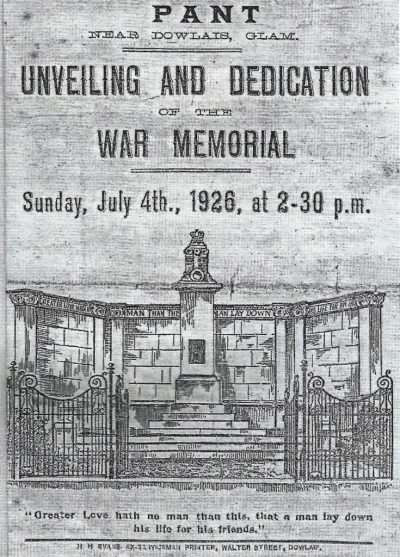
Ninety-five years ago today, on 4 July 1926, General Marden unveiled the Pant War Memorial, with about 1,300 people in attendance and with loud speakers and microphones were in place for the event. Pant was the second village in the area to erect a memorial to the men killed in the First World War.
The Memorial Committee was inaugurated in 1920; house-to-house collections were organised and many promises of weekly contributions were made, but due to the coal strike of 1921, and the trade depression that followed, the final cost of £800 was not quite met. The local inhabitants had paid the bulk of the money, and the school-children contributed largely through the many concerts organised by the staff. Also mentioned for their donations were: Merthyr Football Club, the directors of the Victoria Cinema and the Oddfellows Hall (where the concerts were held).
Mr F. J. Bateson released the ground he had rented from Messrs Guest, Keen and Nettlefold, enabling them to give the ground, previously owned by Daniel Thomas, stonemason, for the memorial. Before the memorial could be erected, the urinal built in 1906 had to be moved to the other side of Caeracca Bridge.
The Memorial is built mainly of Portland stone, with the side wing walls and steps leading to the cenotaph of local limestone. The bronze plate centrepiece reveals the names of local men who were killed during the conflict.
Designed by Mr C. H. C. Holder, a curator at Cyfarthfa Museum, the sculpture is a monument to the skill of Councillor F. J. Bateson from Pant and his assistants. The Mayor, Alderman D. Davies J. P., another Pant resident, accepted the deed as a gift from Mr S. J. Lloyd, Secretary of the Memorial Committee. The mayor had actually lost his son in the War, and his name is commemorated on the plaque.
General Marden, in his response, thanked the Dowlais Male Voice Party for “the most wonderful singing he had ever heard”. The march to Pant was led by the Municipal Band and the G.K.N. Dowlais Silver Band.
A second plaque was added to the memorial to honour the men of the village who died during the Second World War.
Photo courtesy of the Alan George Archive
To the left hand side of the main memorial is another plaque honouring the men who had been employed at the I.C.I. Factory at Dowlais who died in the Second World War. These were:
Today marks the 110th anniversary of the birth of Professor Herbert Nicholas – yet another Merthyr boy who worked hard to make it to the top of his profession.
Herbert George Nicholas was born on 8 June 1911 in Treharris. He was the youngest of seven children born to Rev William D Nicholas, minister of Bethel Chapel, and his wife Mary (née Warren), daughter of Samuel Warren, one of the foremost businessmen in Treharris, who opened Warren’s Drapery in Perrott Street.
At an early age, Herbert contracted rheumatic fever, which prevented him from attending school until he was 11. During this time he was educated at home by his eldest sister Evelyn, who had become a teacher. When he became well enough to attend school, Evelyn arranged for him to attend a small school in Cardiff run by a remarkable deaf lady, Miss Maud Humphries. Having travelled back and forth to Cardiff daily for three years, Herbert won a scholarship to the prestigious Mill Hill School in London. Mill Hill School was set up in 1807 by merchants and ministers from non-conformist backgrounds in order to provide a place of learning for the boys from their communities, as the “ancient” public schools at this time required all their pupils to belong to the Church of England.
Following his, not altogether happy, days at Mill Hill, Herbert won a place at New College, Oxford to read Greats. For the whole of his time at Oxford, his sisters supported him financially. The sums spent on him were carefully noted by Herbert however, and his sisters were duly repaid later. He graduated in 1934 with first-class degree.
The following year, Herbert acquired a Commonwealth Scholarship to travel to America to study history at Yale University. Originally concentrating on 17th Century history, he became more and more fascinated by contemporary American history, and he developed a huge admiration for the policies of President Franklin D Roosevelt. Upon his return to Britain in 1937, having managed to live off earnings for occasional articles he wrote as a freelance journalist for several months, he accepted a job lecturing in 19th Century History at Exeter College in Oxford.
Having spent two very happy years at Exeter College, the idyll was cut short by the outbreak of the Second World War. Classified as unfit for military service due to his bout of rheumatic fever as a child, Herbert joined the American Division of the Ministry of Information, where he had, as he later wrote: ‘…an indecently enjoyable war. I vastly enjoyed the work which was a natural extension of my academic interests, I had the company of singularly agreeable colleagues….’
In 1944, Herbert was elected as a fellow of Exeter College, and in 1946, following the cessation of hostilities, he returned to his post at the college. In 1948 he published his first book ‘The American Union. A short history of the USA’. In 1951 he published his only book about a British topic ‘The British General Election of 1950’.
That same year, he was invited back to New College to take over the position of tutorial fellow in politics. Although holding fellowships in other colleges (Exeter and Nuffield), New College would remain his base. In 1959 he published ‘The United Nations as a Political Institution’, which would eventually be published in five separate editions. In 1969 he was elected Rhodes Professor of American History and Institutions at Oxford, and in the same year he was elected to the British Academy, becoming vice-president in 1975-6.
Soon after his election as Rhodes Professor, he moved to Headington to look after his elderly sisters Evelyn and Doris, devoting nearly all of his time to their welfare. During these years he did find the time however, to write two more books – ‘The Nature of American Politics’ (1980) and ‘Washington Despatches, 1941-45 (1981). The first of these books is still used prominently in University courses on both side of the Atlantic.
When Evelyn died in 1987 (Doris having died previously), Herbert returned to college life, delighting friends, colleagues and ex-pupils with his sharp wit, punning one-liners and gifts as a raconteur. His favourite story being of how, in 1950, he, slight and bespectacled, together with his middle-aged schoolmistress sister, went with his pupil, Stansfield Turner, later a US admiral and head of the CIA, to hear a speech by the general secretary of the Communist Party, Harry Pollitt, who was fighting for a seat in South Wales. For their parts they found themselves denounced in the Daily Worker as ‘a bunch of American rowdies with their gangster’s moll trying to wreck the meeting.’ Most importantly, though, he never forgot his roots in Treharris, and spoke fondly of his youth there.
Herbert’s activities were curtailed when he suffered a stroke in 1991, but he recovered sufficiently to still be a major part of New College until his death on 3 July 1998 at the age of 87.
Laura Ashley was the first female entrepreneur, and I wrote this to honour and celebrate a Dowlais born girl from my home town of Merthyr Tydfil.
Laura Mountney was born in Dowlais on the 7 September 1925. Although her Welsh parents lived in London, they returned to ensure their child would be born in Wales. She was born in her Grandmother’s house in 31 Station Terrace, and it was from these humble beginnings in a colliery workers cottage she would go on to become the owner of a multi-million pound fashion and furnishing empire, with 500 shops worldwide carrying her name.
As a child she attended Hebron Chapel in Dowlais, and went to school at Marshall’s School, of which I can find no trace on maps or documents. This was until 1932 when she moved to England and attended Elmwood School.
At the beginning of World War II, Laura was evacuated back to Wales. However the Merthyr schools were full, so she attended Secretarial school in Aberdare until 1942, when, aged 16, she left school and joined the Royal Navy Service. Here she met the English engineer Bernard Ashley at a Youth Club.
Laura became Mrs Ashley in 1949 when she married Bernard. She and Bernard started a small business in 1953, in a basement flat in London’s Pimlico, Laura and her husband laid the foundations for what was to become one of Britain’s greatest fashion success stories.
She was inspired by an exhibition of Patchwork and Quilts on display at the Victoria and Albert Museum. Laura used library books to teach herself how to transfer colour onto fabric, working on a silk screen built by Bernard in their kitchen. This allowed her to make fabric for furniture, curtains etc. in the 1950s, expanding the business into clothing design and manufacture in the 1960s. The company grew over the next 20 years to become an international retail chain.
While working as a secretary and raising two children, Laura undertook some work for the Women’s Institute on quilting, revisiting the craft she learnt from her Grandmother and books. But this was no overnight success story. The couple struggled to raise working capital and every bit of the profit was invested straight back into the business. Her first order was 20 scarves to John Lewis stores. This grew to printed tea towels, gardening aprons etc. Bernard eventually left his city job to join in the family business. The couple went on to have another two children who all worked in the family business.
Laura became known as a British designer who achieved renown for her genteel Victorian inspired fashions in women’s clothes and for her English country style of furnishing for homes. For more than half a century her name was synonymous with quintessential English style, but Laura was Welsh through and through. Wales played a huge part in her success. Her first shop was in Machynlleth in 1961, with a factory two years later in Powys. Bernard was the company chairman and Laura kept her eye on the fabrics.
1970s printed cotton dresses by Laura Ashley exhibited at the fashion museum in Bath 2013
From humble beginnings the couple went on to success in the company allowing them to afford a yacht, private plane, Chateau in France, town house in Brussels and a villa in the Bahamas.
In 1985, just days after her 60th birthday Laura fell down the stairs at their daughters home in the West Midlands. She was taken to hospital, but sadly died days later of a brain haemorrhage. She is buried back home in Wales, in Carno.
The company continued without her. Sales totalled over £276 million in 2000. However in March 2020, due to the pressure put on retailers because of the outbreak of the Coronavirus pandemic, the fashion chain collapsed and went into administration.
Today marks the 80th anniversary of the Battle of the Denmark Strait, one of the most infamous naval battles of the Second World War.
On 18 May, the new German battleship Bismarck, at the time the most powerful battleship in the world, embarked on her maiden voyage, accompanied by the heavy-cruiser Prinz Eugen. Their mission was to attack the convoys bringing much-needed supplies to Britain from America.
In response, the Admiralty deployed as much of the British Fleet as possible to intercept the Bismarck. On the evening of 23 May, the British heavy-cruisers HMS Norfolk and HMS Suffolk spotted the German ships passing through the Denmark Strait – the passage between Iceland and Greenland. The two cruisers, being totally out-gunned by the German ships did not engage then enemy, but reported their position to the Admiralty to enable them to send in bigger ships, able to engage the enemy with heavier fire-power. The cruisers continued to track the ships using radar throughout the night.
The nearest British ships capable of tackling the Germans were the brand-new battleship HMS Prince of Wales, and the Home Fleet flagship, and pride of the British Fleet – HMS Hood. Despite its immense size and reputation, and armed with eight 15-inch guns (the same as the Bismarck), the Hood was an old ship, having been launched in 1918. Furthermore, the Hood had been designed as a battlecruiser – a ship with the fire-power of a battleship, but with the speed of a cruiser. The extra speed was attained by sacrificing the strong armour of a traditional battleship, especially on the deck. This left the Hood very vulnerable to plunging fire.
HMS Hood
At approximately 05.35 on the morning of 24 May, a lookout aboard the Prince of Wales spotted the German ships. The British ships turned towards the enemy to engage in battle, and at 05.50, Admiral Lancelot Holland, commander of the British taskforce, aboard HMS Hood, ordered the British ships to open fire when in range, and two minutes later, HMS Hood fired the first salvoes of the battle.
Within 8 minutes however, the unthinkable happened. A shell from the Bismarck struck the weak deck of the Hood and plunged through the ship, exploding in the armament magazine. The whole ship erupted in a fireball, broke in two, and sank immediately. From a crew of 1,418, there were three survivors.
The loss of the Hood, would send shockwaves around the world.
In the meantime, the Prince of Wales was being pounded by enemy fire, and unable to continue the battle alone, retreated. The admiralty, devastated by the loss of the Hood, made the immediate decision that the main priority was now to destroy the Bismarck at all costs.
After a thrilling chase across the Atlantic (the details of which are too complex to go into on this blog), on the morning of 27 May, the Bismarck, which had by this time been crippled by a torpedo from a Swordfish plane from the aircraft carrier HMS Ark Royal, was finally cornered by ships of the British fleet. The battleships HMS Rodney and HMS King George V devastated the Bismarck with gunfire, and the heavy-cruiser HMS Dorsetshire finished off the stricken ship with torpedoes. Of Bismarck’s 2,131 crew, there were 115 survivors.
Now we get to the Merthyr connection. Below are two cuttings taken from the Merthyr Express dated 21 June 1941 highlighting the two sides of the battle.
Merthyr Express – 21 June 1941Merthyr Express – 21 June 1941


 Dewi Bowen was a legend in his home village of Cefn-Coed, a legend at Cyfarthfa Castle School and a legend across the town of Merthyr Tydfil.




 Herbert George Nicholas was born on 8 June 1911 in Treharris. He was the youngest of seven children born to Rev William D Nicholas, minister of Bethel Chapel, and his wife Mary (née Warren), daughter of Samuel Warren, one of the foremost businessmen in Treharris, who opened Warren’s Drapery in Perrott Street.

 Soon after his election as Rhodes Professor, he moved to Headington to look after his elderly sisters Evelyn and Doris, devoting nearly all of his time to their welfare. During these years he did find the time however, to write two more books – ‘The Nature of American Politics’ (1980) and ‘Washington Despatches, 1941-45 (1981). The first of these books is still used prominently in University courses on both side of the Atlantic.


