The Growth of Football in Merthyr Tydfil – part 4

Transcribed by Phil Sweet

These articles which appeared in three consecutive editions of the Merthyr Express in March 1921 are Harvey Boots’ own reminiscences of the development of three football codes in the town up to that date.  

ARTICLE 2 MERTHYR EXPRESS 12TH MARCH 1921 (continued)

THE GROWTH OF FOOTBALL IN MERTHYR

(By Harvey Boots)

Meanwhile we of the Rugby Club were left in a quandary. The membership of the team that had been doing so well for us the previous season, and had raised the status of the club to a position it had never attained before, went over to the new game. A few remained true to the amateur cause, but we were left with little more than a skeleton of a team. Worse still all our supporters left us; our gates dwindled down to zero; while the other code grew in proportion. However, we kept pegging away, but things were going from bad to worse, our exchequer was dry, and we were owing the bank a bit. We continued for two or three seasons and the struggle was a long and costly one. To give an idea of how wealthy (?) we were becoming, on one occasion we played Cross Keys (a club now at the prominent head of all Welsh Clubs) to a gate of 17s 6d. On this princely sum we had to pay the return visit to Cross Keys. We were not forgotten entirely by the tradespeople of Merthyr at this period.

Several came to our aid, and one, in particular, rendered us very valuable financial assistance. I refer to Mr. J. T. Harrap. We had only to state our case and he was ever-ready to come to our help, but this sort of thing couldn’t go on indefinitely. We were in arrears with our rent, and when making application for Penydarren Park for what was eventually the last time, we found an offer had been made on behalf of the other club at a rental of £200, which was just double what we were charged. This, I am happy to say was turned down by the Athletic Club, although we, at this time, owed £100 for rent and no prospects of paying it.

We felt at this time that since we had been engaged for a number of years in fighting the battles of Welsh Rugby, it was time the parent body came to our assistance, and so began the beginning of the end. I went to Cardiff to interview them on innumerable occasions; as did W. T. Jones and E. Biddle, but all to no purpose. Although they had some thousands of pounds on deposit, they evidently thought it was a real pleasure for us, as private individuals, to keep on shelling out the money to keep the game alive. We wanted to book the Park again for the coming season, and although we owed the Athletic Club £100, they very kindly offered to forgo this, and write it off as a bad debt if the Welsh Union became guarantors for the rent in future. Down we go again to meet these gentlemen with this new proposal. “We don’t want financial assistance,” we told them. “We shall pull through if you will become guarantors for the rent.” Did they? No, bless you! With an ostrich-like wisdom they turned us down again, popped their heads back in the nice warm sand, and went to sleep. These valleys were then teeming with Rugby clubs. To-day there is only one between here and Cardiff – I refer to Pontypridd. All else is Soccer. I have always maintained – and always shall – that this particularly wise move on the part of the Welsh Union paved the way for what is now the popular game – Association.

Well, here were, we with a ground leased for a number of years (16), with nearly £4,000 spent on its improvement, and no tenant for it. The Athletic Club then held what was easily the most momentous meeting in its history and at this meeting we decided to form an Association Club. Believe me, Mr. Editor, had we known the troubles and pitfalls ahead I very much doubt if we would have decided as we did. However, with quick dispatch and unbounded enthusiasm, Dr Llewellyn Jones, Mr. H. C. Davies, with Mr. W. T. Jones as secretary, went up to London to interview the Management Committee of the Southern League. After viewing our ground and few other preliminaries, we were duly accepted as a member, and thus became the first Welsh Club in the Southern League. Our troubles had really only now commenced.

We had decided to introduce a new code into a district where previously, as I remarked before, an Association ball was rarely, if ever, seen. We were now in the Second Division of the Southern League, and as we were the only Welsh Club our fixtures in this section were all with English clubs. We advertised for players in the “Athletic News,” and, believe me, we got them. Our knowledge of the new game was not quite up to date, and I think some of the players who applied for places in the new combination must have been aware of the fact. Some of them came clean shaven, and with close-cropped heads, vowed they had played for Aston Villa and Newcastle, and had “scored the goal that had won the ‘Cup,’” which statement, if true, should have entitled them to whiskers of patriarchal dimensions and old age pensions.

All these things (and others) were sent to try us, but we were learning our lesson. The Northern Union Club were still going, but there were evident signs of a falling off here. Some of the South Wales clubs had already closed down for want of support, and the local club were beginning to feel the drain of those long trips to the North every other week. While they retained the popular fancy, a few spectators used to honour us with a visit just to see how the new-fangled game was going. Indeed, our gates were a thing of beauty, but not a joy for ever. They consisted of the players’ wives or sweethearts, the directors and a few friends, and a number of small boys who had managed to get in without paying. And there I think you have it. We didn’t want a bag of any sort to take the cash to the bank. I believe Mr. W. T. Jones used to put it in his waistcoat pocket to bank on Monday. It was only last week that Mr. John Evans (Royal Stores) mentioned that he remembered looking in on his way to the other game and was surprised to find as many players as spectators Many of my readers make take this cum grano salis, but I can assure them it was very near the mark.

To be continued…..
The Growth of Football in Merthyr Tydfil – part 3

Transcribed by Phil Sweet

These articles which appeared in three consecutive editions of the Merthyr Express in March 1921 are Harvey Boots’ own reminiscences of the development of three football codes in the town up to that date.  

ARTICLE 2 MERTHYR EXPRESS 12TH MARCH 1921

THE GROWTH OF FOOTBALL IN MERTHYR

(By Harvey Boots)

My feeble efforts to trace the history of the game of football in Merthyr has been the occasion of a good deal of friendly criticism from my intimate friends. I have endured a goodly portion of leg-pulling with hints on how to write for the Press, De facto how kindly strictures have proved very beneficial to this article, as several persons of renown in the history of the game locally ought to have come under greater review, and I am constrained to mention a few here and apologise for their omission the previous week. Through the courtesy of Mr. W. R. Lewis, decorator, etc., Pontmorlais, I am able to give the name of the very first team who played for Merthyr. As it was formed previous to the year of my nativity. I obviously can make no comment on their achievements, but a few of them I remember in later years. The Merthyr Football Team in 1877 consisted of T. Bryant (captain), J. Forrester (secretary), Bob James, Geo Gunson (brother of Mr. Robert Gunson), A. P. James, David and John Thomas (older brothers of Mr. Gomer Thomas), Lewis Brothers, three of whom were in the team and a fourth a member, Johnson, Jenkins, Ross Beynon (Abercanaid), Chris Bedlington, G. F. Matthews, W. Morgan (Dowlais), Ben Rogers, Tom Flooks (hairdresser, High Street), T. Williams, Tyrrell, Sam Thomas, Jack Richards, Tom Gameson Harris (Lloyds Bank), Albert Harris (solicitor) and Ireland (Cyfarthfa). Who in later days doesn’t remember Gus Jenkins (Dowlais), D. W. Evans (brother of J. B.), Harry Davies (an excellent half-back), Alf Hansard (he of the mighty punts to touch), D. J. Gould, (coal merchant, who played for both Cefn and Merthyr, and, who I believe, captained Merthyr for two or three seasons), Willie Harris (Aberdare), and W. L. Harris (Abercanaid), the latter of whom is now the agent for the Marquis of Bute). During the friendly discussion referred to above, the merits of various players  were discussed and after various pros and cons the consensus of opinion seems to point to John Ben and W. L. Harris (Abercanaid) as being the best pair of half-backs that have ever represented Merthyr.

I concluded my article last week at the point where the Merthyr Athletic Club had just come into being. At that time the Football Club was very healthy financially. As a matter of fact, we had a fairly substantial balance at the bank. We had fixtures at home with Newport, Swansea and Cardiff (each of whom appeared on Penydarren Park), Llanelly, Penarth – home and away. We had the satisfaction of defeating Llanelly at Llanelly by three points to nil – a difficult feat at any time, but especially at that period, when they were one of the strongest teams in Wales. I attribute a good deal of the success now attending the team to my brother George, who, at this time was Captain of the Newport XV, and at the height of his career as a Welsh forward. (He represented Wales on 19 occasions.) He very kindly came up from Newport one evening in each week of the football season and gave the members of the team some training in “packing” and other phases of the game. For this purpose, we hired the Drill Hall, and I have no doubt we received many valuable hints from this source.

In this case, as in so many others,  our success was really our undoing. The Northern Union game, which had been established in England for a number of years, was beginning to find adherents in South Wales. Mutterings and rumours of what it might accomplish in Merthyr were in the air, and then the blow fell, swiftly but none the less surely, for  it was proposed at our next annual meeting of members that we go over to the Northern Union game and so become a professional club. This, happily, after a very stormy meeting, was defeated on a vote, but so small was the majority that it made us, who had been fighting for the old Rugby Club, sit up and gasp. Had we been defeated on the poll it meant the assets of the club, the ground (which had now been improved to practically what it is to-day) and the balance at the bankers going over to the new formation. Thus, it came about that two camps were found in the town: one for the Northern Union, and the one to keep the old guard going.

Here, Mr. Editor, I am going to transgress for a moment and trust that if any of my friends, in reading this, should think I am indulging in recriminations, please banish the thought. In giving this short history, it is necessary to refer briefly to those times of strenuous combat between the rival factions and the bitter enmity it engendered. Happily, this feeling has quite passed away, and now is all harmony and peace.

With commendable energy, the Northern Union section, headed by Messrs. J. B. Evans, the late Bill Harris (schoolmaster), Sam Adams, J. R. Jones (baker) and others got to work to secure a ground, and succeeded in obtaining from the Bolgoed Estate through the Agent (Mr. J. T. Vaughan) the portion then known as the College Field (within a stone’s throw of Penydarren Park). It has ceased to have any attraction for winter sport, but in the summer is a veritable hive of “industry.” It is now the home of that very successful bowling club – the Merthyr West End.

Well, the playing pitch was improved; fixtures were arranged with the leading Northern Clubs, and those were names to conjure with in those days – Halifax, Oldham, Leeds, Huddersfield, Wigan etc., and the few South Wales clubs which went over at the same time. I don’t think they were many, and if my memory is not at fault, I can find them in Aberdare, Barry, Ebbw Vale and Mid Rhondda. These, I believe, comprised the whole. The game took on in Merthyr to a surprising degree, and was, no doubt, a very open and fast game which appealed to all spectators.

To be continued…..

The Pant War Memorial

by J Ann Lewis

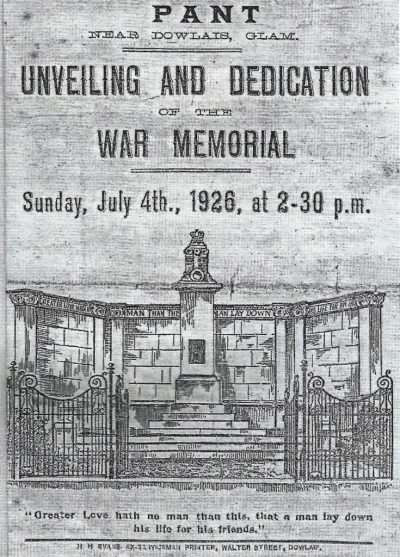
Ninety-five years ago today, on 4 July 1926, General Marden unveiled the Pant War Memorial, with about 1,300 people in attendance and with loud speakers and microphones were in place for the event. Pant was the second village in the area to erect a memorial to the men killed in the First World War.

The Memorial Committee was inaugurated in 1920; house-to-house collections were organised and many promises of weekly contributions were made, but due to the coal strike of 1921, and the trade depression that followed, the final cost of £800 was not quite met. The local inhabitants had paid the bulk of the money, and the school-children contributed largely through the many concerts organised by the staff. Also mentioned for their donations were: Merthyr Football Club, the directors of the Victoria Cinema and the Oddfellows Hall (where the concerts were held).

Mr F. J. Bateson released the ground he had rented from Messrs Guest, Keen and Nettlefold, enabling them to give the ground, previously owned by Daniel Thomas, stonemason, for the memorial. Before the memorial could be erected, the urinal built in 1906 had to be moved to the other side of Caeracca Bridge.

The Memorial is built mainly of Portland stone, with the side wing walls and steps leading to the cenotaph of local limestone. The bronze plate centrepiece reveals the names of local men who were killed during the conflict.

Designed by Mr C. H. C. Holder, a curator at Cyfarthfa Museum, the sculpture is a monument to the skill of Councillor F. J. Bateson from Pant and his assistants. The Mayor, Alderman D. Davies J. P., another Pant resident, accepted the deed as a gift from Mr S. J. Lloyd, Secretary of the Memorial Committee. The mayor had actually lost his son in the War, and his name is commemorated on the plaque.

General Marden, in his response, thanked the Dowlais Male Voice Party for “the most wonderful singing he had ever heard”. The march to Pant was led by the Municipal Band and the G.K.N. Dowlais Silver Band.

A second plaque was added to the memorial to honour the men of the village who died during the Second World War.

Photo courtesy of the Alan George Archive

To the left hand side of the main memorial is another plaque honouring the men who had been employed at the I.C.I. Factory at Dowlais who died in the Second World War. These were:

  • Simon Davies
  • William Evans
  • Thomas John Davies
  • Norman Ernest Freshwater
  • Cameron Meredith
  • Glyndwr Price
  • Frank Wills