Following on from the recent post about the Mount Pleasant Spitfire Crash, I have received the following newspaper cuttings from Elaine Archer:


In Association with the Merthyr Tydfil & District Historical Society
Following on from the recent post about the Mount Pleasant Spitfire Crash, I have received the following newspaper cuttings from Elaine Archer:
Many thanks to prominent local historian Joe England for the following article:-
The Puddler
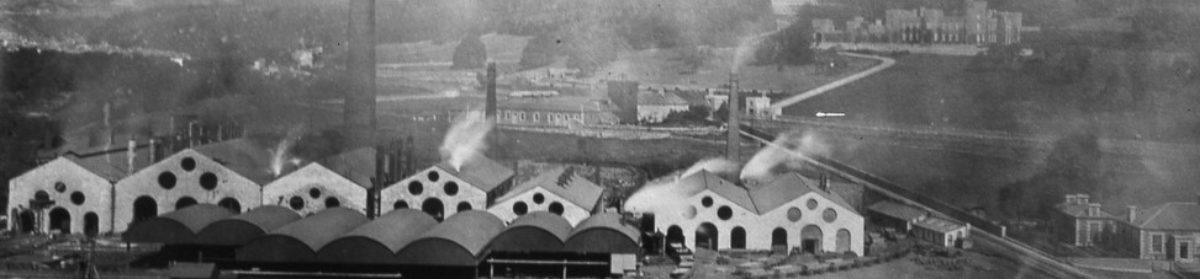
Who or what was the Puddler? He (always male) was a worker who in his day was central to the making of iron and a person of some importance in Merthyr and the other iron towns.
One writer reminisces: ‘One puddler I knew at Dowlais filled the chapel with his presence . . . a Cyfarthfa man stood in the Star parlour with his coat tails to the fire in the presence of Admiral Lord Nelson … another of the species used regularly every week to ride down to the seat of an influential county gentleman whose daughter he came very near marrying . . . it was by the merest accident in the world they found out, just in the nick of time, that the son-in-law elect was only a puddler.’
Puddling was a method of turning pig iron into much more malleable wrought iron. It was invented by Henry Cort but perfected by Richard Crawshay at Cyfarthfa in the 1790s. The puddler stirred the molten metal in a puddling furnace with an iron bar, working in conditions of tremendous heat and agitating the metal as it boiled and then gathering it at the end of a rod while the molten metal thickened.
This was arduous, strength-sapping work, but the puddler’s special skill was his judgement of when to bring out the congealing metal, a decision crucial to the quality of the finished product. He therefore held a key position in the manufacture of iron. They were usually young men in their twenties and thirties. By their forties they were physically burnt out.
In the early years of industrialisation their key position in the manufacture of iron made them workplace militants, although later they accepted the wage cuts imposed by the ironmasters. The reasons for that I have explained in my forthcoming book The Crucible of Modern Wales: Merthyr Tydfil 1760-1912. But the masters, nonetheless, were determined to find ways of getting rid of them. Puddlers were expensive and too powerful.
The opportunity came with the Bessemer process of making steel which would replace wrought iron in making rails. When the first steel rail was rolled at Dowlais in 1858 it broke while still hot ‘to the undisguised rejoicing of the assembled puddlers.’ But the writing was on the wall. Steel rails began to be successfully manufactured and by 1876 the iron rail was seen as a thing of the past. So was puddling. In 1885 the number of puddling forges at Dowlais was 19. There once had been 255.
Joe England
From the Merthyr Times 120 years ago today….


Many Merthyr people of a ‘certain age’ will remember one of Merthyr’s most striking buildings – The Angel Hotel.

In 1873, a successful local businessman Mr Enoch Williams decided to build a grand hotel in Merthyr to serve rail passengers arriving at the Taff Vale Railway Station. Mr Williams decided to build the hotel at the lower end of the High Street, and he bought the old Angel Inn and adjoining buildings to erect the hotel, retaining the licence of the Angel Inn to enable him to sell alcohol at the new hotel.
Despite having no experience in the building trade, Enoch Williams decided not to use a contractor and he controlled and supervised the project himself, even ordering and checking the supplies. This he continued to do until his death in 1876. Although dying before seeing his hotel finished, Mr Williams made ample provision in his will to complete the building, and the construction was completed under the supervision of a group of trustees. One of the consequences of Williams’ inexperience in architecture, was the fact that there was no provision whatsoever for gas in the building, and this was added before completion at considerable extra expense.
The hotel was finally completed in 1879, and it became an immediate landmark in the town. Described as “a uniquely strange Gothic castellated building”, the Angel Hotel towered above most of the other buildings in the town, and with its castellated roofline (formed by the regular pattern of chimneys around the top of the building), and its enormous glass roof, it was indeed a striking and unique building.

When completed, the hotel had 60 bedrooms, 84 fireplaces, 400 windows, a bar, a billiard room, a meeting room that was 76 foot by 26 foot in size, several sitting rooms and offices, and a promenade on the roof “from which, high above the smoke and amidst the pure air, a most agreeable walk can be enjoyed”. The famous roof was glazed with nine tons of glass. The bar, which ran the whole depth of the building was 100 foot long and 24 foot wide, and was divided in to four compartments. The upper floors of the building and the roof promenade were reached by a huge straight flight staircase at the centre of the building flanked by huge ornamented balustrades. The hotel also had the finest sprung dancefloor in Wales.
Unfortunately, from the outset, the Angel Hotel proved to be a ‘white elephant’. During the time it took to complete the hotel, the Taff Vale Railway Station was superceded by the Central Railway Station as Merthyr’s main station (the Taff Vale Station would eventually become a goods depot), thus the hotel was in the wrong part of town to attract the intended clientele.
Over the coming years, the Angel was used to hold religious meetings and political rallies and other such functions, and during the roller skating craze in 1909, a skating rink was installed at the hotel.

The hotel finally closed in 1933, and the building was put to several uses until it was demolished in 1957. A tragedy occurred during the demolition when a 21 year old worker, Cyril Jones died, and another, Dennis Murphy was seriously injured when they fell from a fourth floor window and covered in debris.
The curious article transcribed below appeared in The Merthyr Telegraph dated 21 September 1867. Although amusing, it is also fascinating in that such a trivial piece on the surface tells us so much about various aspects of life in Merthyr at that time.
THEFT OF A DUCK
Sarah Davies, a prostitute, was charged with stealing a duck, the property of Ann Harris, of Brecon Road, brothel keeper. Ann Harris deposed that she bought a duck Saturday night. On Sunday morning the prisoner took the duck away, and witness asked her to pay for it. She said she would give a shilling some time or other, Witness said she should not have it for less than eighteen-pence. The prisoner would not return it, so witness slipped out of the house and fetched the police. The duck was not cooked when she took it.
P.C. Lynne deposed that when he arrested the prisoner, she said she had bought the duck from a woman who stood in the market, but she did not know who it was. His Worship adjourned the case until next Monday in order that both women might produce as witnesses the parties from whom they purchased the duck.
Over the years, Merthyr has been home to over 120 chapels, and they became one of the mainstays of life in the town. Every month I would like to post a history of a different chapel. Let’s start with one of the most famous of Merthyr’s chapels – Bethesda Welsh Independent Chapel.

In 1807, the minister at Zoar Chapel, Rev Daniel Lewis, embarked on a visit to London and other large towns to solicit gifts of money from sympathetic benefactors to help clear the debts at Zoar Chapel.
Even though this was the custom at the time, some members of the congregation took exception to the trip and to the expenses incurred by the minister, and instigated an investigation into the affair by senior ministers from surrounding areas. When the investigation exonerated Rev Lewis, his accusers, unhappy with the outcome, left to start their own church.
The congregation originally met in an upstairs room of a smithy near the spot where Salem Chapel now stands in Newcastle Street, and called it Philadelphia. After two years larger premises were necessary and the congregation moved to another blacksmith’s forge between Zoar Chapel and the Morlais Brook and called it Beth-haran.
It was while they were at Beth-haran that the congregation extended an invitation to Rev Methusalem Jones to come and preach at their small meeting. He eventually became their minister and the congregation decided to build their own chapel. They obtained a piece of land on a lease from Mr W Morgan, Grawen, for £5 per annum rent. They built the chapel at the start of 1811, and Rev Jones licensed it at Llandaff court on 23 July 1811.
Under the guidance of Methusalem Jones the congregation had grown from 90 to almost 300, thus a larger chapel was needed, and a new chapel was built in 1829 at a cost of £1,002. Whilst under Rev Methusalem Jones’ ministry, Bethesda became mother church to many other chapels including:- Bethania, Dowlais; Saron, Troedyrhiw; Ebenezer, Cefn Coed; Salem, Heolgerrig. Rev Methusalem Jones continued to minister to the congregation at Bethesda until his death on 15 January 1839 at the age of 71.
Following Rev Jones death, Rev Daniel Jones was invited to become Bethesda’s minister in 1840. At the time that Daniel Jones became minister, there was an influx of people coming to Merthyr from Pembrokeshire and Cardiganshire seeking work in the various iron works; as Daniel Jones was known in those counties, a large number of the people coming to Merthyr started going to Bethesda Chapel thus greatly increasing the congregation.
Two years after becoming the minister however, Rev Jones had to have his right arm amputated, but because of the support and kindness he received from the congregation, he made a swift recovery and continued to preach at Bethesda until he left in 1855 to join the Anglican church.
It was at this time that the world famous composer Dr Joseph Parry was a member of Bethesda Chapel. He attended the chapel with his family until he emigrated to America in 1854. Indeed, Dr Parry’s mother, Elizabeth, had been working for Rev Methusalem Jones as a maid in her youth, and moved with him to Merthyr when he became the minister at Bethesda.
Following Daniel Jones departure, Bethesda was without a minister for three years, but the cause continued to flourish, and it was at this time that a number of members of Bethesda started a new cause at Gellideg Chapel.
By the late 1870’s it was decided to build a larger and more comfortable chapel, and on 24 June 1880 the foundation stone was laid by Mrs W T Crawshay, wife of William Crawshay the owner of Cyfarthfa Ironworks. The architect was Mr John Williams of Merthyr and the builder was Mr John Francis Davies of Dowlais. The chapel was completed in 1881 at a cost of £1,200.
Following its closure due to a diminishing congregation in 1976, Bethesda Chapel was used as an arts centre for several years. The building then began to fall into dereliction until it was finally decided to demolish the building in 1995.
The site of Bethesda Chapel has now been landscaped and a mosaic by Oliver Budd based on a painting by the renowned local artist and historian Mr Dewi Bowen has been erected as a memorial to the chapel.

65 years ago today…..

On 7 July 1941, five people were killed in Mount Pleasant in Merthyr Vale as a result of a terrible accident involving two Spitfire fighters.
At about 6.30pm on Monday 7 July 1941, two planes were seen flying over the hills behind Aberfan at an altitude of approximately 600 feet. The planes were Spitfires of the Royal Canadian Air Force on a training exercise from No 53 Operational Training Unit, based at RAF Heston. The planes were piloted by Sergeant Gerald Fenwick Manuel (R/69888) aged 25, from Halifax, Nova Scotia and Sergeant Lois “Curly” Goldberg (R/56185), aged 27, from Montreal.
From eye-witness accounts, the one plane overshot the other and their wing-tips touched, resulting in both pilots losing control of their aircraft. Sergeant Goldberg’s plane crashed into a field, killing him instantly, but the plane piloted by Sergeant Manuel crashed into a house at the end of South View in Mount Pleasant.
The house was the home of the Cox Family: James Cox, a shift worker at a munitions factory; his wife Alice aged 33, and their five children. At the time of the crash, James Cox was in bed, having just come home from a shift at the factory; his three sons Donald, Thomas and Len were out playing; and Alice and the two daughters, Phyllis aged 14 and three-year-old Doreen, had just returned from a shopping trip. Alice and the two girls were killed instantly, as was Sergeant Manuel, but James Cox had a remarkable escape as the impact of the plane threw him out of the rear window of the house, and he escaped with minor injuries.

William Brown who lived next door to the Cox family, and who’s house was also damaged, spoke of his own lucky escape: “I was coming out of my house with a bucket of water to go to my allotment when I saw the plane coming towards my house. Some instinct made me go back in, and when I was going along the passage something gave me a smack on the head. I managed to get into a room in the back and I saw the Cox’s house in flames……..There are usually ten to twelve children playing by the lamp-post directly outside the house, but today they were playing in the fields down by the river. My wife and grandchildren were in the back of the house, and they too were uninjured”.
Neighbours and local residents tried in vain to rescue Alice and the children, but the house had burst into flames immediately following the crash, and the heat was too great for attempts to rescue the family. The local police inspector paid tribute to the people, especially the women, saying: “The people of the district were marvellous. They all worked and spoilt their clothing, and never seemed to tire. The women-folk worked unceasingly, carrying water and sand while the men worked the stirrup pumps. They were magnificent and worked like Trojans”.
The bodies of Sgt Manuel and the deceased family members were buried two days later in the Ffrwd Cemetery, Cefn-Coed, while the body of Sgt Goldberg was interned in the Jewish cemetery at Cefn-Coed.
In 2007 a mural painted by local school children was unveiled in memory of the victims of the crash.
