A Short History of Merthyr General Hospital – part 1

by Ann Lewis

I suppose it’s difficult for us to imagine what life would be like without a hospital in an hour of need, but before 1888 Merthyr had only a small six-bedded Cottage Hospital for children at Bridge Street.

There was the workhouse for the sick paupers and Mrs Clark’s Hospital at Dowlais which had closed six years earlier. There was also a Fever Hospital at Pant, built in 1869, and another at Tydfil’s Well.  These were totally inadequate for the needs of a town the size of Merthyr, with the many accidents that occurred at the Ironworks and collieries. When accidents did occur the doctors would have to perform operations on a kitchen table or at the doctor’s surgery.

The Voluntary Hospital had for some time existed in London and other large cities. These were maintained by gifts and bequests from individuals and groups. The patients did not have to pay for treatment, for the doctors gave of their skills freely and in doing so gained a great deal of prestige and power in the management of the hospital.

By February 1886 the caring people associated with the Cottage Hospital formed a group with the sole aim of improving the facilities in Merthyr for the sick and injured. They included Drs. Biddle,  Cresswell, Webster, Ward and Dr Dyke who had founded the Children’s Hospital at his home called  ‘The Hollies’ in Bridge Street, Merthyr with  the Rev J Griffiths the then Rector of Merthyr and Sir  W T Lewis, who later became Lord Merthyr.

Unknown Dr, Dr Biddle, Dr Cresswell & Dr Ward

It was through Sir W. T. Lewis that the Marquis of Bute offered the sum of £1,000 towards the building of a voluntary hospital at Merthyr, and £1,000 towards the upkeep, provided the people of Merthyr raised the remainder of the money for the building. A meeting was held at the Temperance Hall and the people of Merthyr responded by raising £5,220 – a very large sum of money in those days.

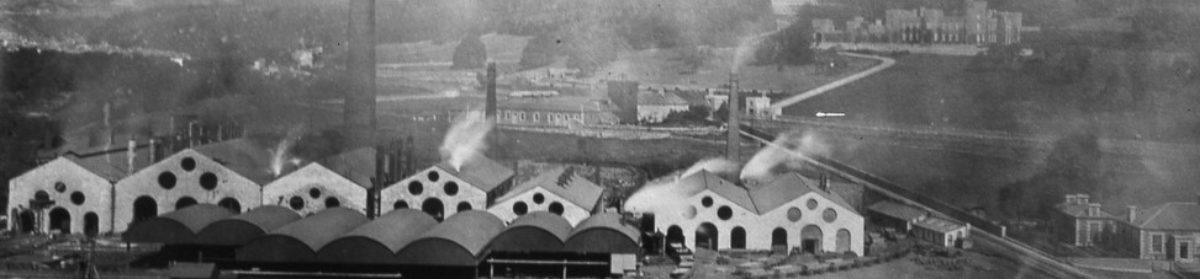
The Clock field was chosen as a suitable site between Dowlais and Merthyr because Dowlais was equally as important as Merthyr at that time. It was opposite the Old Penydarren Works and the freehold cost £300. The foundation stone was laid by Sir W T Lewis in June 1887. Lewis was greatly involved with the hospital and had donated ‘35,000 pennies’ which he had received from the members of the Provident Society, which he had helped found, on the occasion of his knighthood.

The General Hospital in 1888

The new hospital had two ten-bedded wards. The first, The Lady Ann Lewis Ward, was named after Sir W T Lewis’ wife, who was the grand-daughter of Robert and Lucy Thomas the first exporters of steam coal in South Wales. The second ward was St Luke’s Ward. There was also a small four bedded ward for children, which was the room used as the operating theatre opposite Ann Lewis Ward for many years. The original theatre had been opposite St Luke’s Ward, in what later became the General Office. Next to the original theatre were the splint and instrument rooms and the Dispensary.

Ann Lewis Ward
St Luke’s Ward

The Hospital had a Board of Governors and they were the policy making body.  Anyone could be a governor for the sum of £2 per year. Thousands of people helped to maintain the hospital voluntarily. The workers at the Ironworks and Collieries were asked to contribute a farthing a week or a penny per month or one shilling per year towards the cost. It seems a very small amount to us now, but not in 1888. Any donation above £100 was recorded for all to see on a large board at the entrance hall.

Many people endowed beds in memory of loved ones and would maintain the endowment over 12 months. When the hospital opened, it required £500 per year to cover expenses; by 1940 – £6,000 and by 1950 – £52,000, but wages were blamed for the last increase.

In 1895, as part of Queen Victoria’s Golden Jubilee Celebration, an Accident Receiving Ward was endowed by Sir W T Lewis. A stained glass window was commissioned by the High Constable of Merthyr, Mr Frank James, a solicitor and clerk to the Board of Guardians, to honour Lewis’ gesture. On 4 April 1900 a statue of Sir W T Lewis was erected outside the hospital in recognition of these services and the honour conferred upon him by Queen Victoria, in raising him to the Baronetcy.

The General Hospital after the opening of the Accident Receiving Ward – built adjoining the hospital at the left of the picture

To be continued….

The Royal Visit of 1912

105 years ago today, Merthyr was honoured with a visit from King George V and Queen Mary.

On 25 June 1912, the Royal Couple had embarked on a three day visit to Wales, the primary reason for which was to lay the foundation stone for the new National Museum of Wales in Cardiff. The King, however, had expressed a wish to see the social conditions of the area and Sir William Thomas Lewis (see previous posts) arranged a tour.

The Royal Train at Treherbert

On the 27 June they travelled on the Royal Train, first visiting the Lewis Merthyr Colliery at Trehafod, then on to the Mines Rescue Station at Dinas. The tour then continued by train through Pontypridd, Llancaiach, Bedlinog, Cwmbargoed, to Caeharris (Dowlais) Station where the King and Queen were scheduled to visit the Dowlais Works.

Dowlais Works decorated for the Royal Visit

To mark the occasion, craftsmen at the Dowlais Works had specially constructed two monumental archways for the Royal Couple to pass through – one made of coal and one made of steel.

The Coal Arch (left) and the Steel Arch (right)

They entered the works on foot, through the ‘Coal Arch’, and were greeted by a rousing rendition of ‘God Save the King’ by the Penywern Choir, who had been invited to entertain the Royal party. A message was later sent by the King and Queen to the conductor of the choir – Mr Evan Thomas, complimenting them on their singing, saying that the Penywern Choir “were the best choir of voices they had heard on their tour of South Wales”. The Royal Couple then entered Dowlais House where they met several invited distinguished guests and were served a sumptuous lunch. The Penywern Choir entertained the visitors during the lunch from a marquee that had been specially erected in front of the dining room.

Following lunch, the King and Queen were given a tour of the Works by Sir W T Lewis and Mr Arthur Keen, the owner of the works (he had purchased to Dowlais Iron Company from Ivor Bertie Guest in 1899, and the Works were now operating under the management of Guest, Keen & Nettlefolds). Having visited the Blast Furnaces, the Bessemer Plant, Goat Mill, Sleeper Mill, Sole Plate Mill, Fishplate Mill and the Siemens Plant, the Royal Couple exited the Works via the ‘Steel Arch’, and proceeded to Merthyr in their own Daimler car, to arrive at the Town Hall steps at 4.00pm where Sir W T Lewis presented them to the Mayor and Mayoress, Mr & Mrs J M Berry.

The King and Queen at Dowlais Works
Crowds outside the Town Hall in a specially erected stand

The Dowlais Works have since closed, the Steel Arch was dismantled in the 1920’s and the Coal Arch was dismantled in 1960.

Photographs courtesy of http://www.alangeorge.co.uk/index.htm

Sir William Thomas Lewis

Following on from the mention of Sir William Thomas Lewis in the previous post, here is an article that was published in the Cardiff Times 116 years ago today about the unveiling of the statue of him that stood for many years outside Merthyr General Hospital.

Cardiff Times – 13 April 1901

The statue is now situated outside the surviving part of St Tydfil’s Hospital.

Statue of W T Lewis outside St Tydfil’s Hospital in 2015

The Fountain

We’ve all seen it but what do we know about the Fountain in Caedraw?

The Fountain in 2015

The fountain was commissioned in 1906 to mark the granting of the charter for Merthyr’s Incorporation as a County Borough. The fountain was a gift of Sir William Thomas Lewis, the Merthyr-born coal magnate and philanthropist, as a tribute to Robert and Lucy Thomas, his wife’s grandparents.

Lucy Thomas (1781-1847), was one of the most remarkable people in the South Wales coalfield. She is considered to be the ‘Mother of the Welsh steam coal trade’. It was the coal from the Waun Wyllt Colliery at Troedyrhiw opened by her husband Robert in 1824 that helped to establish the reputation of Welsh coal on the London market.

The fountain, designed by W Macfarlane & Co, and manufactured at the Saracen Foundry, Possilpark, Glasgow was an elaborate canopied drinking fountain, 18ft. by 4ft. The open filigree canopy was supported by eight columns with griffin terminals which were positioned over capitals with foliage frieze above square bases. The highly decorated cusped arches were trimmed with rope mouldings. Cartouches contained within each lunette offered shields for memorial: a miner wielding a pick axe; a working miner; the coat of arms of St. Tydfil; and a dedication shield. Doves and flowers offered decorative relief on the circular, ribbed dome. The internal capitals contained flowers, and lion mascarons were placed on internal lunettes. The cast iron structure was surmounted by a heroic classical figure of Samson inscribed Strength.

Under the canopy stood the font. A circular shaft, ornamented with water lilies, rested on a wide base with canted corners. Four lion jambs supported four highly decorated quatrefoil basins. Rising from the centre was a pyramid shaped stanchion decorated with swan and bird decoration. A kylix-shaped lamp terminal with four consoles originally offered drinking cups suspended by chains.

The inscription on the dedication shield read:

Erected by Sir William T. Lewis and William Thomas Rees of Aberdare and presented to their native town in commemoration of Robert and Lucy Thomas of Waunwyltt in this parish, the pioneers in 1828 of the South Wales steam coal trade

The fountain was originally sited on a raised plinth near the site of the present-day Caedraw roundabout. It remained there until 1966 when it was moved due to the widening of the road, and the canopy was re-sited in front of St Tydfil’s Church, on the site of the current car-park. By this time the original drinking troughs had been removed and the canopy needed restoration, but the whereabouts of the original drinking fountain and five of the eight shields is unknown.

The Fountain at its original site. Photo courtesy of http://www.alangeorge.co.uk/index.htm

In 1988 it was designated a Grade II listed monument, and in 1993 as a result of a refurbishment programme, the fountain was moved to its present position immediately south of St. Tydfil’s Church. In 1995 Merthyr Council awarded the project to restore the fountain to Acorn Restorations Ltd and the re-sited and refurbished fountain was officially opened in July 1996.