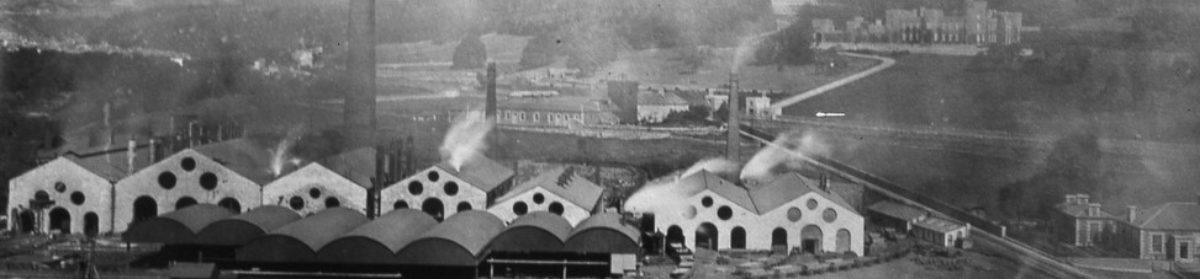
Memories of Old Merthyr

We continue our serialisation of the memories of Merthyr in the 1830’s by an un-named correspondent to the Merthyr Express, courtesy of Michael Donovan.

To return to the coach journey, the Bridgewater Arms was then kept by Mr George Roach, who afterwards move to the Castle at Merthyr,and after the change of horses they came to Quakers’ Yard. Here a slight halt was made, it might have been put down to kindness towards the animals, but the hostelry also supplied refreshments for the inner man. Whatever may be the reason, a long and steep hill had then to be ascended. After passing Pantannas the ascent modified, and on arriving at Nantddu turnpike, the pace could be again increased.

The Nantddu Turnpike (or Tollbooth) in Edwardsville. Courtesy of the Alan George Archive

A run of about two miles after this brought us to a pleasant cottage on  the right hand side, owned and occupied by a Mr Stephens, and the Mount Pleasant Public House, kept by John Griffiths, who afterwards moved to the Star opposite the Old Church in High Street, was close by on the other side of the road.

The drive through the woods up to Troedyrhiw was a pleasant one. The road just before entering Troedyrhiw has been altered a little for the making of the Taff Vale Railway, and after passing Troedyrhiw for about 1½ miles the road was subsequently diverted by Mr Anthony Hill. After crossing the line of the railroad forming the connection at present between the Taff Vale Railway and the South Duffryn Coal Pits, it kept to the east of the present road, passing close in front of Duffryn Cottage, the east end of Taibach and Pentrebach Rows, through what was part of the Forge Yard, then past Pentrebach House (where I believe Mr Probert now resides), and came out at a little above Plymouth Lodge.

A drawing of the Plymouth Lodge in the 1820’s. Photo courtesy of the Alan George Archive

From here there has not been any deviation of route, but until the Britannia Public House on the right-hand side, there was not a single cottage on either side. There was a bridge over the road for the conveying of mine rubbish between the Dowlais Branch Bridge and the Britannia similar to one passed under at Pencaebach. About a hundred yards on towards the High Street, and on the other side of the road stood the Bell, and adjoining the Bell was the Plymouth Tollgate. On the opposite side of the road, but just before coming to the Bell there was an open space to the town road that was used as place where coal was delivered; which with some others will be alluded to to exemplify the arrangements at the time.

After coming through the Plymouth gate there were cottages on both sides until the Plymouth watercourse came so close to the road as to prevent their being built on the left hand. Where the Taff Station was at the opening of the railway and for years afterwards, there was nothing but rubbish tips, but they were not high, and the road with a ford through the river went from Plymouth Street across by Rhydycar. Perhaps this was the very Rhyd (a ford), but the place called Rhydycar was on the side of the canal bank, a house and mine pit with a winding engine. It was doubtless a parish road for Mr Bruce, the grandfather of the present Lord Aberdare, when Stipendiary of Merthyr, passed that way home to his residence in Mountain Ash.

A section of the remarkable 1836 map of Merthyr by John Wood showing the Plymouth Street area as mentioned in this article.


To be continued at a later date….

The Taff Vale Railway

In 1835, the major industrialists in Merthyr began considering building a railway line from Merthyr to the Bute Docks in Cardiff. To this end, Anthony Hill, owner of the Plymouth Ironworks, contacted Isambard Kingdom Brunel, to estimate the cost of building such a railway – Brunel replied quoting an estimate of £190,649. The industrialists subsequently held a meeting, chaired by Josiah John Guest, at the Castle Inn in Merthyr, to discuss the issue, and decided to request Parliamentary permission to form a company to build the railway. Permission was granted an the company was incorporated the following year.

On 21 June 1836 Royal Assent was given to The Taff Vale Railway Company’s Act, allowing for the creation of the Taff Vale Railway Company. The founding capital of the Company was fixed at £300,000, in £100 share units. The directors were Josiah John Guest, Walter Coffin, Edward Lee, Thomas Guest, Thomas Guppy, Thomas Powell, Christopher James, Thomas Carlisle, Henry Rudhall, William Wait, William Watson, and Peter Maze. Company profits were capped at 7% originally, with a clause allowing for an increase to 9% subject to a reduction in the rates and tolls charged for use of the line.

The Act also capped the speed of the trains on the line to 12 mph (19 km/h), with stiff penalties for any speeding.

Construction of the railway was started in 1836, and the stretch from Cardiff to Navigation House (later named Abercynon) was opened in a formal ceremony on 9 October 1840, with public services starting the next day. The stretch from Abercynon to Merthyr was opened on 12 April 1841. The railway was single-line for its entire length, with passing only possible at or near the stations. It was not until 1857 that it became a double line. Brunel, the chief engineer, had chosen a narrower gauge (4 feet 8.5 inches or 1.435 m) than the 7 foot (2.134 m) gauge he would later choose for his Great Western Railway in order to fit the railway into the narrow space allowed to him by the River Taff valley.

Construction of the main line was relatively straightforward. The line mostly followed the course of the valley, and therefore needed few bridges and no tunnels. Brunel designed an impressive skew stone arch viaduct at Pontypridd, which spanned 110 feet (34 m) over the River Rhondda; the viaduct is still in use today, although it has been supplanted by a second, parallel viaduct. A similar viaduct was built at Quakers Yard.

The TVR’s original station in Merthyr was at Plymouth Street and was opened on 12 April 1841.

The Taff Vale Railway Station at Plymouth Street. Photo courtesy of http://www.alangeorge.co.uk/index.htm

This was joined in 1853 by the High Street station of the Vale of Neath Railway. A short joint line (TVR and GWR) was built to connect the TVR line to the new station in 1877. A year later, in August 1878, the Taff Vale transferred all of its passenger services to the High Street station, and used Plymouth Street as a goods depot instead. High Street station thus became the only passenger station in Merthyr, and was used by a total of six separate companies prior to the 1923 grouping. The TVR also opened stations at Merthyr Vale in 1883 and Pentrebach in 1886.

Merthyr Vale Station. Photo courtesy of http://www.alangeorge.co.uk/index.htm

The main line of the TVR was 24 miles (39 km) long. However, no fewer than 23 branch lines took the full length of track to 124 miles and 42 chains (200.40 km). Many of those branch lines were smaller lines taken over by the TVR – in 1841 a branch line was opened in the Rhondda going as far as Dinas, and a second was opened to Llancaiach Colliery. The Rhondda line would subsequently be extended, and by 1856 it had been extended into two lines – one to Maerdy and the other to Treherbert.

The TVR proved its worth immediately. At its peak, two trains a minute passed through the busiest station, Pontypridd. By 1850, the TVR was carrying 600,000 tons (600,000 metric tons) of coal per annum, and was paying a 6% dividend.

The line was conceived as a goods line, carrying iron and coal. However, it also ran passenger services from the beginning. There were two passenger trains each way daily, including Sundays. This was extended to three weekday services in 1844. Single fares from Cardiff to Merthyr were 5 shillings for first class, 4s. for second class, and 3s. for third, and were each reduced by a shilling in 1845.

The Taff Vale Railway continued to operate as a company in its own right until it was incorporated into the Great Western Railway in 1923.

The current railway line between Cardiff and Merthyr now follows the route of the original Taff Vale Railway.

A Map of the Taff Vale Railway System in 1913

Christmas 1883

The article transcribed below appeared in the Merthyr Express 135 years ago today (29 December 1883), and gives details of how Christmas was celebrated in Merthyr all those years ago. It’s remarkable how so much has changed, yet the drunken revelling has not!!!!

CHRISTMASTIDE AT MERTHYR

There was nothing novel in the manner of spending Christmas at Merthyr. For years it has been the practice of a number of young men and women to usher in Christmas by perambulating the streets the livelong night, shouting and screaming and indulging in various kinds of horseplay to their own amusement and the disgust of steady-going citizens trying to get their measure of rest after a hard day’s work. This year was no exception to the disagreeable instinct which seems to have forced the custom upon us. One or two singing parties were out and did their best to relieve the monotony of the other voices by singing some appropriate pieces, but it was a rollicking time for the youngsters who verily did not go home till morning when daylight was about to appear.

The morning was foggy, but it cleared rapidly after sunrise, and such a beautiful, bright, mild spring day has not been experienced on the 25th December for many years. It was most unseasonably fine, and people went abroad in thousands. The Taff Vale Company ran their ordinary service, and the Great Western ran special trains between Merthyr and Hirwain (sic) and vice versa. These trains were crowded with passengers. The interchange of outward and inward traffic was enormous and appeared to be pretty evenly balanced. At a very early hour the High-street was in a state of congestion. The puddle of the roads had no perceptible influence upon the incessant motion of the living stream, and as Christmas day does not rank as a Sunday in the Closing Bill, it was an ordinary day for public houses, which had a tremendous run of business. There was a good deal of drunkenness apparent in the evening, but no rowdyism. The charges at the police station for drunken and disorderly conduct were not numerous.

The usual Christmas dinner to the poor was distributed at St. David’s schoolrooms to over two thousand persons, the expenses of which were defrayed by the subscriptions of the townspeople. The Rector, the High Constable, and a numerous staff of volunteer carvers and distributors were engaged upon this duty for over two hours, well earning their own Christmas dinners, and, as heretofore, they had Mr. T. B. Meredith as their right hand man. Mr. J. Howfield, confectioner, undertook the cooking, which was all that could be desired.

The deaf and dumb people of the Merthyr branch of the Glamorganshire Mission to the Deaf and Dumb were entertained by Mr. and Mrs. Rhys Davies at their residence at Courtland Terrace. A large number of mutes came from Merthyr, Dowlais, Aberdare, Tredegar, Rhymney, Cardiff, and Swansea. After dinner, the mutes went up the hill to see one of their number suffering from an injured foot at his house, and one of them took a hat and made a collection for the poor man. After that an adjournment was made to Mr. Davies’s house to tea, which finished, their pastor, the Rev. E. Rowlands, addressed them on the “Love of God”, and after a cordial vote of thanks to Mr. and Mrs. Davies for their hospitality, the mutes left, having spent a most enjoyable Christmas.

At the Workhouse and Aberdare School too, the usual sumptuous fare of roast beef and plum pudding was served to the inmates and greatly enjoyed, whilst the additional luxuries of tobacco to the old men and snuff to the old women, as well as tea and coffee, were highly acceptable and appreciated.

Four performances of “The Haymakers” were given by the Bethesda Choir at the Temperance Hall on Christmas and Boxing Days. The powerful attraction of Uncle Tom’s Cabin influenced the attendance here prejudicially, nevertheless, the receipts for the whole series of performances amounted to a considerable sum, and the choir will more than clear all expenses. The performances were highly creditable, and received well-merited applause, the stage scenery being particularly effective. A competitive meeting was held at Bethel Chapel on Christmas Day, and at Hope Chapel on the evening following, while entertainments, dancing parties, and other forms of amusements took place all over the neighbourhood. The Volunteer Band paraded the town on Christmas Day, while the Town Band played several selections on the Market Square on Boxing Day. Altogether, the Christmastide just past has been as busy as any like period for many years.

The Edwardsville Tornado – part 2

The storm reached Edwardsville where the destruction was devastating.

The signal box on the Taff Vale Railway was severely damaged, and all the trees in the path of the storm, which was now 150 yards wide, were torn from the ground and flattened, blocking the old tramroad with timber, whilst at Goitre Coed Farm, a horse and cart were hurled against the wall of the barn.

At Edwardsville the storm first hit Prospect Place, all but demolishing the cottages there, before reaching Beechgrove Cemetery where the wind flattened most of the tombstones, demolished the cemetery chapel and caused severe damage to the sexton’s house.

Beechgrove Cemetery Chapel

The storm moved on to Windsor Road, Nantddu Terrace and The Avenue where tremendous damage was done to most of the houses, and the post office was almost totally destroyed. The postmaster’s son, 13 year old Gomer Israel was seriously injured and was rushed to Merthyr General Hospital with a fractured skull. He would eventually succumb to his injuries a few days later.

Edwardsville Post Office (centre of photo behind the cart)

Professor T D Edwards who lived at Rock Cottages had the roof blown off his house. Such was the force of the gale that he later found a ladder embedded in the wall of his house. As neither he nor any of his neighbours owned a ladder, one can only speculate how far this ladder had been blown for it to be so firmly embedded. On a lighter note, one of his neighbours had gone to bed early and was woken by the noise of the storm…..only to find himself, in waking up, in a different bedroom to the one in which he had gone to sleep!!!

A few doors away, the roof was ripped off the Edwardsville School, and the English Congregational Chapel was severely damaged. The chapel’s caretaker, Mrs Wheeler, was cleaning the chapel with her two daughters at the time the storm hit. They were buried by debris and had to be rescued. One of the daughters, Gertrude, aged 9, sustained serious injuries and was taken to King Edward VII Hospital in Cardiff.

Edwardsville School and Congregational Chapel

On 27 October, Ton Pentre Football Club had been playing at Treharris. The team were returning to the Railway Station when the storm hit. Frank Owen (Corby) Woolford, right-back and captain of Ton Pentre FC, Walter Breeze, trainer at Ton Pentre FC and Fred Tregrage another player and were walking ahead of the rest of the team. As they entered The Avenue, the full force of the storm hit and all three were picked up off their feet and hurled over 50 yards. Breeze and Tregrage were injured, but Woolford was hit by a falling slate which sliced through his head. A local policeman, P.C. Fisher rendered first aid at the site and the injured men were taken to a nearby shop where Dr Evans, Maesybryn treated Woolford. A car was immediately made available by Mr Thomas, a local chemist, and Frank Woolford was rushed to Merthyr General Hospital for emergency treatment. Woolford’s injuries proved too great and he died at 2am the following morning. He was 22 years of age.

Elsewhere in Treharris, everyone did what they could to help with the injured and homeless. Rev J R Morgan, the minister at Trinity Forward Movement Chapel in Treharris, who lived in Edwardsville gave shelter to many people at his home. His neighbour Rev Thomas, minister at Saron Welsh Wesleyan Chapel in Treharris, immediately offered assistance, despite his own house being badly damaged.

Having caused devastation at Edwardsville, the storm left the valley and began to lose some of its force, and it travelled in a straight line via Cefn Forest before hitting Bedlinog. Houses were damaged in Hylton Terrace and Bedw Road, but the force was going out of the storm. Leaving Bedlinog, the storm continued over the Rhymney Mountain and on to Tredegar where the torrential rain overwhelmed the drains and caused severe flooding.

The storm continued to move northwards throughout the night, but having left the confines of the Taff Valley, the storm’s ferocity had by now dissipated, and the storm front was now about 7 miles in width. However, the storm continued to leave a trail of destruction in its path with severe damage to buildings reported in Shropshire and Cheshire, until it eventually abated during the night.

An investigation was instigated by the Meteorological Office (now known simply as the Met Office) in the aftermath of the storm, and concluded that the tornado contained winds blowing in an anti-clockwise direction. Reports of the tornado’s duration varied from two seconds to five minutes. The Met Office investigators concluded that “…the storm was circular in shape; …it advanced at thirty-six miles an hour; …the width in South Wales was three hundred yards; ….the maximum duration of the storm at any one place must have been about seventeen seconds.

It is inconceivable that so much destruction could be caused in just seventeen seconds. Four people were killed in the tornado – the worst confirmed death-toll for a UK tornado, scores injured and damage to property was estimated at £40,000 in terms of repairs required – a considerable sum equivalent to around £2.5 million today.

If you would like to read more, a fuller account of the tornado has been published in the Merthyr Historian – Volume 25. Please contact me at the e-mail address shown if you would like to purchase a copy, and I will forward your request.

Merthyr’s Bridges: Quakers Yard Viaduct

Twelve years ago today, two plaques in Welsh and English were unveiled on Quakers Yard Viaduct to commemorate the 200th anniversary of Isambard Kingdom Brunel’s birth.

The Quakers Yard Viaduct was constructed as part of Brunel’s single-track Taff Vale Railway that connected Merthyr Tydfil to the docks at Cardiff. It carried the railway over the River Taff just south of Treharris.

The Taff Vale Railway was the first in Wales to be powered only by locomotives and the railway company that constructed it appointed Isambard Kingdom Brunel as engineer for the line and its structures. Its original track was standard gauge (4ft 8.5in or 1.435m). The northern section, from Abercynon to Merthyr Tydfil, opened on 12 April 1841, and the first rail traffic crossed Quakers Yard Viaduct on 21 April 1841.

Quakers Yard Viaduct during construction

The viaduct is slightly curved in plan and set at a skew angle to the river. Overall, it is 32.3m high, with six arches of 15.2m span each. The masonry is pennant sandstone, which has tooled detailing on all visible faces.

Brunel was concerned about the potential for damage the foundations of the river piers. To minimise this, the piers are octagonal in plan, aligned with their sides parallel to the river’s axis. This was an innovative idea, removing sharp corners that could obstruct river flow and possibly lead to cavitation. Substantial pediments cap the piers and the rounded arches have deep chamfers, echoing the angled pier faces.

The railway’s gradient between the Quakers Yard Viaduct and nearby Abercynon was too steep (up to 1 in 19) for the locomotives of the 1840s, so trains were cable-hauled by a stationary steam winding engine, which was located at the southern end of the viaduct.

In 1861-62, the structure was widened as part of the project to make the Taff Vale Railway double track throughout. Engineer John Hawkshaw (1811-91) designed the new work, which is of plainer masonry, with unchamfered arches and rectangular piers, and located immediately adjacent to the original against its outer curve, on the downstream (north) side.

In 1864, the cable-worked incline south of the viaduct was reconstructed at a shallower gradient (1 in 40). In addition, trains of the 1860s had more pulling power and did not require the winding engine.

In April 1988, the structure was Grade II* listed.

Quakers Yard Viaduct

John Mathias Berry

Today marks the centenary of the death of one of Merthyr’s most prominent citizens – John Mathias Berry.

John Mathias Berry and Mrs Mary Ann Berry

Born on 2 May 1847 in Camrose in Pembrokeshire, John Mathias Berry was brought up in Haverfordwest in a strict non-conformist household, and as a young man he began working for the Great Western Railway as a clerk. On 24 May 1870 he married Mary Ann Rowe of Pembroke Dock, and in 1872 became a father to a daughter, Lucy Beatrice. In 1874, Berry secured a better position as a station-master with the Taff Vale Railway and the family moved to Merthyr Tydfil.

On 17 September 1877, Berry became a father for the second time when Mary gave birth to a son – Henry Seymour. As a sideline to his job at Merthyr Station and also to earn extra money, John Mathias Berry began selling tea in the town, and this led on to him becoming a commercial traveller. During this time his family grew and he became a father to two more sons – William Ewart in 1879, and James Gomer in 1883.

In 1894, at the age of 46, John Mathias decided on a career change and opened a new business as an auctioneer and estate agent in Victoria Street. Due to a combination of his remarkable personality, his energetic business acumen and the economic growth at the time, the business became a huge success, and Berry became a very prosperous and important person in Merthyr.

As a result of his success, John Mathias became very active in public life in Merthyr. In 1902 he was made a J.P. for the County of Glamorgan, and he also became a councillor for the Town Ward on the District Council and from 1905 Borough Council. In November 1908 he became an alderman and was elected as Mayor in November 1911, and as such was responsible for welcoming King George V and Queen Mary on the occasion of their visit to Merthyr and Dowlais on 27 June 1912.

John Mathias Berry reading the proclamation of the visit of King George V and Queen Mary on the steps of the Town Hall

Despite his business and public activities, John Mathias remained a staunch non-conformist, and became a member of Market Square Chapel soon after his arrival in Merthyr, and within time he was elected as a deacon of the chapel. It was in this capacity that he was instrumental in the founding of the Caedraw Mission Sunday School and also the Ragged School. When Market Square Chapel celebrated its centenary in 1938, William Ewert and James Gomer, the two surviving sons of James Mathias, paid for a magnificent pipe organ to be installed in the chapel in memory of their father.

The pipe organ installed in memory of John Mathias Berry in the old Market Square Chapel

Indeed, John Mathias Berry was known as much for his charitable work in the town as his business and public life. As early as 1875, during the great ‘Lock Out’, John Mathias was at the forefront of the movement to open soup kitchens for the relief of the poor, and throughout his life he gave unstintingly of his time and money to help the under-privileged of the town.

John Mathias Berry died on 9 January 1917 after a short illness.

Despite everything he did in his life, John Mathias Berry’s lasting legacy will be as a father to three sons who became hugely successful millionaires and peers of the realm:-

Henry Seymour Berry (1877-1928), 1st Baron Buckland

William Ewert Berry (1879-1954), 1st Viscount Camrose

James Gomer Berry (1883-1968), 1st Viscount Kemsley

There will be more about the remarkable Berry brothers in the future. In the meantime if you wish to read more about them, take a look at the link below.

http://yba.llgc.org.uk/en/s2-BERR-BUC-1847.html