The Castle Inn (Tavern Twll), Caepantywyll – part 2

by Barrie Jones

Born in Llandeilo, Carmarthenshire, it is not surprising that his memorial stone is inscribed in Welsh. On the stone is a verse in keeping with many Welsh headstones and is a Welsh type known as englyn. The verse describes John as a fond husband, a loving father, both willing and generous and that there has never been a man on earth with his healthy vigour, nor more genial.

At the time of taking on the licence, John Lewis may already have ‘retired’ from puddling, the Cyfarthfa Works was closed from 1874 until 1879 and this interval may have marked his ‘retirement’. More so because after such a long layoff the exacting work that puddling entailed would prevent a return to work for a man of his age.  Charles Russell James recalled:

puddlers in front of the huge furnaces plying their long puddling bars before fires that would roast an ox. To protect their bodies they wore long leathern aprons. The work was most exhausting. They did not live to be old men. They got shrivelled up at a comparatively early age, and often took to drinking beer heavily. No wonder poor fellows, for their thirst must have been a consuming one. They got heavy wages, but no wage can compensate for that class of killing work”.

Puddling was dangerous work, for example, Gabriel, one of John’s sons was forced to seek temporary parish relief for himself, his wife and four children in 1897 because of burns suffered at work.

Through his work, John would have been well acquainted with the beer trade, and the reopening of the Cyfarthfa Works in 1879 would have been a welcome boost to those inns near the works. John’s entrance into the beer trade and, the expansion of the inn, may have been prompted by the Work’s reopening. The iron masters appreciated from an early stage that their workers could not stand the hot, dusty and fume filled atmosphere of the works without regular intake of water. Beer offered the safest alternative to water and the works purchased beer from the nearby pubs on a contract basis for special exertions. When ‘encouragement’ was needed for special exertions beer notes were written by departmental managers, so that the beer could be brought into the works for the men or could be collected by them when they went home. In addition, public houses formed a useful gathering point for workers at the end of their shifts and especially those inns where gang masters paid their gangs their weekly wages.

John had a relatively short-lived career as a publican, no more than a decade. It would seem that the driving force at the Castle Inn was his son Samuel. Joan, John’s widow, moved out of the inn and Samuel became the full time landlord. During this early period Samuel’s sister Catherine and her husband Alfred Parry assisted him. Alfred was no stranger to the licensing trade; his late father Lewis Benjamin Parry was formally landlord of the Black Lion, Picton Street.

Samuel married Diana Smith in 1902 and continued to manage the inn for the next twenty years.

Samuel gave up the licensing trade in March 1915, with the transfer of the Inn’s licence to George Rees.  Samuel had then moved to number 20 Gate Street. At the time of his death in March 1933, he was living at number 12 Dixon Street and working at the Dowlais Works.  Samuel had inherited his father’s geniality; during his time as a landlord he had established himself within the community and must have been an active and well-liked personality, as testified by his obituary in the Merthyr Express:

“It is with deep regret we have to record the death of Mr. S. Lewis late of the Castle Inn, Caepantywyll, at the age of 57. Working at Dowlais Works, he collapsed at his work last Thursday leaving his home at 12 Dixon Street in his usual good spirits.  It came as a great shock to his sons, daughters, relatives and friends. A great sportsman in past years and well known throughout Merthyr, the deceased was a widower of the late Mrs. Diana Lewis”.

It seems fitting that Samuel had returned to the industry that had helped prosper his father and his older brothers for so many decades and to what was then the last iron and steel works in Merthyr Tydfil.

It’s uncertain when the ‘old’ inn was demolished and the larger ‘new’ inn built in its place. The rebuild may have taken place just after Samuel’s retirement in 1915.  George Rees was the licencee throughout and after the First World War, and by the onset of the Second World War the licencee was Arthur Charles Sussex.

The Castle Inn in 2020

Notes on the Merthyr Tydfil Tramroads – part 2

by Gwilym and John Griffiths

Cwm Cannaid Tramroad: We do not know when this tramroad was constructed. We would guess it was sometime around 1800-1814. Despite its name, the tramroad was built before the shaft of Cwm Cannaid Colliery was sunk. The track was shown clearly on the 1814 Ordnance Survey Map and on Robert Dawson’s 1832 Boundary Commission Map whereas the shafts of Cwm Cannaid Colliery were apparently sunk about 1845. The purpose of the tramroad was to relieve the inefficient old tub canal, or coal canal, sometimes called the Cyfarthfa Coal Canal, of the 1770s. The latter transported coal (and perhaps ironstone?) in two-ton tubs from levels (some suggested via dangerous leats) in Cwm Cannaid to Cyfarthfa Works: some say horse-drawn, others say hauled or pushed by men and women. The Cyfarthfa Coal Canal was closed around 1835, which gives an explanation of Cwm Cannaid Tramroad on Robert Dawson’s 1832 Boundary Commission Map.

The tramroad followed roughly the route of the old coal canal: the latter a twisting route, the former almost a straight line. It skirted Glyn Dyrys Ironstone Mine, a coal shaft below Lower Colliers Row, in front of Lower Colliers Row itself, Tir Wern Uchaf (where it crossed the canal twice), a link to Cwm y Glo Colliery and Ironstone Mine, Upper Colliers Row, Tir Heol Gerrig and hence to the coke ovens and yards above (to the west) of Cyfarthfa Works.

Lower Colliers Row. Photo courtesy of the Alan George Archive

When Cwm Cannaid Pit was sunk in 1845, that became the terminus of the system. The 1901 Ordnance Survey Map named it ‘Cwm Pit Railway’, and the line linking it to ‘Gethin Railway’ was labelled ‘railway in course of construction’. We saw the remnants of these mines, canal and tramroad in the 1940s and 1950s, and often walked the old canal embankment, by then well wooded.

A section of the 1901 Ordnance Survey Map showing the tramroad marked as ‘Cwm Pit Railway’. Lower Colliers Row and the old Cyfarthfa Canal are also shown.

Again, industrial despoliation was reverting to nature: delicious wild strawberries on the old waste tipping, a nightingale singing by the disused and reed-covered canal reservoir, woodcock and common snipe, pied flycatchers and wood warblers, and numerous other birds; with wild orchids amongst the damp marshy vegetation with dragon-flies, damsel-flies, glow-worms and water-boatmen. We doubt if this still exists in the coniferous plantations which replaced them all in more recent years.

Dowlais Tramroad: This was constructed about 1792-93 to connect Dowlais Works with Pont y Storehouse near the Glamorgan Canal terminus, roughly near present-day Jackson’s Bridge. It gave Dowlais Works access to the then ‘recently’ constructed Glamorgan Canal. The route may well have followed initially the Morlais Quarry Tramroad from Dowlais via Gelli Faelog, keeping to the Gelli Faelog side of Nant Morlais. The 1793 extension from this tramroad is today represented by the main road and high pavement from Trevithick Street down to Pont Morlais and thence via the tunnel, formerly a bridge, into Bethesda Street to Jackson’s Bridge. Did the Glamorgan Canal Company pay the £1,100 for the construction of the tramroad (and Jackson’s Bridge) in lieu of the proposed linking canal from Merthyr Tudful to Dowlais?

Bethesda Street in the 1950s. The car is parked on what was the where tramway exited the tunnel mentioned above and continued to the Glamorganshire Canal at Pontstorehouse. Photo courtesy of the Alan George Archive

Gethin Tramroad: This tramroad or railway linked Gethin Colliery (sunk between 1845 and 1849 and opened 1849) initially, and Castle Colliery later (1860s?), with Cyfarthfa Works, taking a route in between those of Cwm Cannaid Tramroad and Ynys Fach Tramroad. No tramroad was shown on the 1850 Tithe Map and Schedule. By 1886 the track left Castle Colliery, skirted the hillside west of the Glamorgan Canal between Furnace Row and Tir Pen Rhiw’r Onnen, through Gethin Colliery (with a link to pit-shaft No2), past Graig Cottage and a bridge over Nant Cannaid. At (the 1853) Cyfarthfa Crossing it curved northwestwards past Tir Wern Isaf and Tir Llwyn Celyn, looping under the 1868 Brecon and Merthyr Railway near Heol Gerrig, and thence to the coke yards.

Gethin Colliery. Photo courtesy of the Alan George Archive.

By 1886 the route was upgraded to the GWR and Rhymney Railway as far as the Cyfarthfa Crossing. The 1876 six-inch Ordnance Survey Map showed the terminus for the ‘cwbs’ at the rear of Cyfarthfa Works. The 1901 Ordnance Survey Map called it ‘Gethin Railway’. Our grandfather used the railway to get to work at Castle Colliery, and we regularly used this route (then upgraded to a full railway) in the 1940s and 1950s on our daily journeys to and from school at Quakers Yard. One of us was on the last train to use this line before the viaduct between Quakers yard and Pont y Gwaith was found to be unsafe.

Gyrnos Quarry Tramroad: This was used to bring limestone from Gyrnos Quarry (Graig y Gyrnos) alongside Tâf Fechan, past the limekilns and coal yards, over Afon Tâf by Pont Cafnau to Cyfarthfa Works. We have no details of dates, but walked the route many times in the 1950s in search of dippers, kingfishers, grey wagtails and the rest. It was the first tramroad recorded in the 1805 list of John Jones and William Llywelyn: 1 mile 106 yards to Cyfarthfa Furnaces and just over 1¾ miles to the new Ynys Fach Furnaces. In view of the size of the quarry, it must have transported many tons of material.

Pont-y-Cafnau in March 2017

Notes on the Merthyr Tydfil Tramroads – part 1

by Gwilym and John Griffiths

 TRAMROAD: According to the Oxford Concise English Dictionary, ‘tramroad’ is now an historical word: a road with wooden, stone or metal wheel-tracks; a ‘tramway’. Strictly speaking, ‘tramroad’ should be written ‘tram-road’ with a hyphen, but the spelling variation ‘tramroad’ has been used commonly in this district.  There were many tramroads constructed in this valley in so-called ‘historical’ times, though we can still recall many of them very well indeed and had much fun in our youth having rides on the trams.

Blaen Cannaid Tramroad: This tramroad linked several of the ironstone and coal levels, as well as later mines and collieries, in the hamlet of Gelli Deg to Cyfarthfa Works. The tramroad started at some ironstone levels about 900-1,000 feet above sea-level near Blaen Cannaid, not far from the site of the sixteenth century iron bloomery or small furnace. The route of the tramroad went between Pen y Cae and Pen y Coedcae, crossing the (unnamed?) stream which fed the small reservoir near Lower Colliers Row; and thence over Nant Cwm y Glo to Cwm y Glo Colliery and Ironstone Mine.

Cwm y Glo Colliery. Photo courtesy of the Alan George Archive

Thereafter it continued northwards to Coedcae Ironstone Mine, over Nant Cwm Pant Bach, across the road Heol Gerrig, linking with Cwm Cannaid Tramroad at the coke yards behind the furnaces at Cyfarthfa Works. We often walked the area in the 1940s and 1950s but recall nothing of note: merely grassed-over waste tipping, etc. What a pity?

Clyn Mil Tramroad: This tramroad went from Plymouth Works up the steep Clyn Mil Incline to the east, past Prospect House (where some distant cousins of ours, the Coles, lived in the 1940s) and Tir Clyn Mil Uchaf and its lime kiln (where our great-great grandparents, David and Mary Morgan, lived and died), and then turning south towards Clyn Mil Colliery and Ironstone Mine.

Prospect House. Photo courtesy of the Alan George Archive

One link from the tramroad deviated further up the mountainside via Coedcae and the Clyn Mil Inclined Plane to several ‘unnamed’ ironstone levels and southwards to waste tipping on Gwern Las land. Another link went to ‘Waun’ Coal Level on Gwern Las property. Another link went to a clay pit on the south side of Clyn Mil Pond and another tramroad linked northwards to ‘New’ Pit (one shaft for coal and another for ironstone) close to Tir Cwm ‘Blacks’ and then on to the brickworks at Tre Beddau.

A very extensive network of lesser roads, some only temporary, covered the higher part of Tir Clyn Mil and Tir Wern Las and these were used either for transporting ironstone or waste tipping. We have no idea as to dates or any other details, but walked all of these routes on numerous occasions, long after the tramroad lines had been removed, in the 1940s and 1950s. It was a barren area then, with industry all gone, but the despoliation was gradually returning to nature again. Here were the homes of redstarts, wood warblers, even wood larks, with skylarks, meadow pipits and cuckoos towards the higher moorland portions. There is surprisingly little information in print about the Plymouth Works as far as we can trace.

To be continued….

Bare Knuckles, White Ladies and Martyred Rebels: The Mythic Townscape of Merthyr Tydfil

by Gareth E Rees

The article below is copied, courtesy of Gareth E Rees from his website Unofficial Britain. To view the original article, please follow this link: http://www.unofficialbritain.com/bare-knuckles-white-ladies-and-martyred-rebels-the-mythic-townscape-of-merthyr-tydfil/

In the year leading up the (Not So) Great Pandemic, I was fortunate enough to take a trip around Wales, researching my book, Unofficial Britain on a sunny weekend in spring.

It was just me, my car and a smartphone. Plus some underpants. Clean ones, at that. No expense spared. Those were the days when you could buy pants on a whim, simply by walking into a clothes shop.

One of my aims of my trip was to explore the Brymbo steelworks near Wrexham, where my grandfather worked until his death in 1976, and where my uncle worked until the factory closed in 1990.

As I was to discover, the ruins of the Brymbo works are haunted by a bottom-pinching phantom steelworker and two black dogs, which I saw with my very own eyes, but that is a story you can read in the book when it comes out.

While I was in North Wales, I was accompanied to the secret mustard gas factory nestled in the Rhydymwyn Valley by Bobby Seal, who wrote about it for Unofficial Britain in 2015: The Valley Works: Mendelssohn, Mustard Gas and Memory.

On the second day of my mini-tour I drove to South Wales, stopping at Port Talbot to look at its still-functioning steelworks, where a monk is said to haunt the grounds of Tata Steel (more of that in my forthcoming book, too).

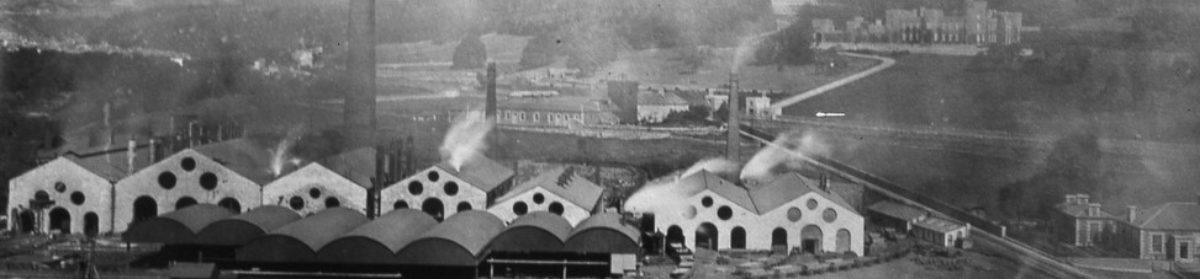
As I approached Cardiff, I decided on a detour to Merthyr Tydfil, once the great industrial centre of the British Empire, dominated by four ironworks: Plymouth, Penydarren, Dowlais and Cyfarthfa. By the 1830s, the latter two had become the largest in the world.

As iron made way for steel in the latter half of the 19th century, the Ynysfach Ironwork closed. Its Coke ovens became a hub for the homeless, destitute and society’s outsiders. At the time is was considered a den of boozing, thievery and prostitution, but it may well have great place to hang out and – from the perspective of today – at least they could all be closer than 2 metres apart.

It was here where local bare knuckle fighter Redmond Coleman became locked in an epic battle with his rival, Tommy Lyons. The fight is said to have lasted over three hours, leaving both men flat out on the ground at the end, panting with exhaustion. It would have made the infamously long fist-fight scene in John Carpenter’s They Live seem like a minor playground scuffle. Redmond Coleman was so attached to the place that he later claimed his spirit would never leave Merthyr and instead would remain to haunt the Coke Ovens.

This form of afterlife was to be the fate of Mary Ann Rees. Alas, she had no choice in her decision to haunt Merthyr Tydfil. In 1908 she was murdered by her boyfriend, William Foy, whom she had followed into Merthyr on her final evening alive, suspecting him of sleeping with someone else. Her broken body was found in a disused furnace. Rees is considered to be the White Lady who today haunts the old engine house: a sad lady in a long, flowing dress.

The decline of the coal, iron and steel industries devastated Merthyr but it remained a hub for manufacturing. In the 20th century the Hoover factory employed over 4,000 people, with its own sports teams, social clubs, fire brigade and library.

In 1985, Sir Clive Sinclair’s infamous C5 battery operated vehicle went into production at the factory. A local urban myth was that the motors for the CV were, in fact, repurposed Hoover washing motors. They created only 17,000 units before operation was shut down six months later.

The factory closed in 2009 and remains a quiet hulk by the Taff at the edge of the town. Across the road is a derelict car park, its tarmac crumbling, with moss and grass creeping across the last faded parking bay lines.

A majestic pylon inside the perimeter of the abandoned car park slings electricity over the factory to the other side of the valley, where its brethren have amassed on the hills in great numbers. Whatever has happened in the past century, power still pulses through the town, coursing through the veins of Wales.

The fall of the Hoover factory was another blow to the economically stricken town, which might have lost its role in the world, but keeps its story alive in public artworks that I saw on my journey.

The past is never far away when you walk through Merthyr, a townscape saturated in industrial lore.

… Near St. Tydfil’s Church is an ornate drinking fountain on a raised plinth. It commemorates the pioneers of the South Wales steam coal trade. Its canopy is adorned with steel motifs of coal wheels, steamboats and a miner with a pickaxe.

…On a modern brick wall in the town centre, beneath a ‘To Let’ sign, is an abstract frieze of the industrial landscape.

….A pub that has opened in the restored water board building is named The Iron Dragon, with two resplendent golden dragons sculptures jutting from either side of the stone columns that frame the door.

…The Caedraw Roundabout outside the Aldi contains a sculpture by Charles Sansbury, which transforms an earth-bound pit winding gear into a 12 metre tall spire, surrounded by a crescent of standing stones, positing some link in the imagination between the Neolithic and the industrial revolution.

…Pink granite benches are engraved with poems about the industrial past. “the stalks of chimneys bloomed continuous smoke and flame”, says one by Mike Jenkins. Another quotes the scientist Michael Faraday:

“The fires from the hills shone very bright into my room and the blast of the furnace kept up a continual roar.”

On another bench I read lines from ‘Merthyr’ a poem by local lad, Glyn Jones:

“…I find what rustles/ Oftenest and scentiest / through the torpid trees / Of my brain-pan, is some Merthyr-mothered breeze”.

In that same poem, Jones describes the post-industrial town’s decayed slum areas mid-century as “battered wreckage in some ghastly myth”.

On this bench pictured below, was a reference to Dic Penderyn and the 1831 Merthyr uprising.

At that time, the town was home to some of the most skilled ironworkers in the world. But unrest was growing….

Locals were increasingly angry about their inadequate wages, while they were lauded over by the industrialists of the town. It was time for change, but they were hopelessly disenfranchised with only 4% of men having the right to vote.

In May 1831, workers marched through the streets, demanding Parliamentary reform, growing rowdier as their ranks swelled. They raided the local debtors’ court, reclaiming confiscated property and destroying the debtors’ records. Growing nervous about the rebellion, which was beginning to spread to other villages and towns, the industrial bosses and landowners called in the army.

On June 3rd, soldiers confronted protestors outside the Castle Inn and violence broke out. After the scuffle, Private Donald Black lay wounded, stabbed in the back with a bayonet by an unseen assailant.

Despite there being no evidence that young Richard Lewis committed the act, he was accused of the crime and sentenced to death by hanging, disregarding the petition of the sceptical townsfolk, and even doubting articles in the local newspaper. The government wanted the death of a rebel as an example to others, and poor Dic Penderyn was to be it, regardless of trifling matters like proof.

He is now an important cult figure in the working class struggle, buried in his hometown of Port Talbot, but remaining here in spirit, one small burning flame of Merthyr’s fiery legacy.

To buy a copy of Gareth’s book, please follow the link on his site.

Merthyr’s Ironmasters: William Crawshay II

William Crawshay II. Photo courtesy of Cyfarthfa Museum and Art Gallery

William Crawshay II was the third generation of the Crawshay dynasty of Cyfarthfa Ironworks. Born on 27 March 1788, he was the second son of William Crawshay I, only son of Richard Crawshay, who took over ownership of the works from Anthony Bacon.

When Richard Crawshay died in 1810, owing to arguments between him and his son, William (senior), the latter only acquired a three-eighths share of the Cyfarthfa Ironworks, despite being the only son and heir. Over the next decade, William Crawshay senior set about acquiring the remaining shares in the Works to make himself undisputed master of Cyfarthfa. He, preferred however to live away from Merthyr, overseeing the Crawshays’ London base at the wharves in George’s Yard, Upper Thames Street, so he appointed his son William (II) to manage the operation at Cyfarthfa.

When William Crawshay II assumed business responsibilities, Welsh iron was in its heyday and Cyfarthfa prospered under his charge: in 1810 the four blast furnaces producing approximately 11,000 tons of pig iron annually.

These early years were marked by a perennial battle with his father over the extent of his authority at the works. The elder Crawshay was determined to keep Cyfarthfa subordinate to the family’s merchant house at George Yard. This his son could not endure; he was intent on selling Cyfarthfa iron as he saw fit, without reference to his father and brothers in London. Yet despite the repeated tendering (and hasty withdrawals) of his resignation young William was unable to overcome his father. ‘My Dear Will, don’t play the fool,’ his father told him after one threatened resignation in 1820, ‘You are now Vice-Roy of Cyfarthfa and will be Sovereign early enough if you will be content to allow his present Majesty some shadow of Royalty’.

By 1823 the Cyfarthfa Ironworks was the largest in Britain, producing 24,200 tons of pig iron from eight blast furnaces, and William, who was at this time living at Gwaelodygarth House, decided that it was time to erect a new home befitting his status as Merthyr’s ‘Iron King’. He employed architect and engineer Robert Lugar, the same engineer who built many bridges and viaducts for the local railways, to design a huge neo-gothic ‘mock’ castle, complete with towers and turrets, standing in 158 acres of landscaped parkland, overlooking the Ironworks. Cyfarthfa Castle was completed in 1824, at a cost of £30,000.

William Crawshay I died in 1834, and William II became sole proprietor of the Cyfarthfa Works, and also inheriting a share in the London property. By the time Crawshay entered into his inheritance, however, the pre-eminence of Cyfarthfa was slipping. He could not prevent his works being overhauled by neighbouring Dowlais, where the Guests were more sensitively attuned to the crucial market for rails in the 1830s and 1840s. Indeed, the aloofness of the Crawshay dynasty was fast becoming an impediment to continued success: little notice was taken, for example, of the new steelmaking technology of the 1850s. In William Crawshay’s last years it was clear that the great days had passed.

As a young man Crawshay inclined to radicalism in politics. He was also a firm supporter of anti-truck legislation, sensing an opportunity to embarrass the Guests, who operated a truck system (the system of paying wages in goods instead of money) at Dowlais. During the Reform crisis he actively promoted the cause of parliamentary reform – while simultaneously introducing a programme of sudden wage cuts at depression-hit Cyfarthfa. This was a volatile course of action, and one to which contemporaries attributed the insurrectionary riots which swept Merthyr in June 1831, obliging Crawshay to write a hasty defence of his role in local affairs, “The Late Riots at Merthyr Tydfil” (1831).

During the later 1830s he swung abruptly into the Tory camp, although this was a plainly opportunistic manoeuvre to unseat Sir Josiah John Guest, who had been returned for the newly enfranchised borough of Merthyr in 1832 on a radical ticket.

William was married three times, each time to a bride with connections in the iron trade. He married first, in 1808, Elizabeth, the daughter of Francis Homfray (1725–1798) of Stourbridge, a member of the midland iron-making dynasty, and later proprietor of the Penydarren Ironworks. They had three sons, and Elizabeth died in 1813 giving birth to a daughter. Crawshay married second, in 1815, Isabel, the daughter of James Thompson of Grayrigg, Westmorland. Her uncle William Thompson (1793–1854), MP, lord mayor of London in 1828, was a partner in the Penydarren Ironworks, and her uncle Robert Thompson was the proprietor of the Tintern Abbey Ironworks in Monmouthshire. Isabel died in 1827, having given birth to two sons and seven daughters. Crawshay married third, in 1828, Isabella (d. 1885), the sister of Thomas Johnson, a partner in the Bute Ironworks in the Rhymney Valley, and they had a daughter.

William began spending an increasing amount of time at his estate at Caversham in Oxfordshire, which he bought in 1848, having previously leased it for many years, and it was at Caversham that he died on 4 August 1867. In his will, the Cyfarthfa Ironworks were passed on to his elder son from his second marriage – Robert Thompson Crawshay.

Caversham Park

Memories of Old Merthyr

We continue our serialisation of the memories of Merthyr in the 1830’s by an un-named correspondent to the Merthyr Express, courtesy of Michael Donovan.

A map by John Wood of Georgetown in 1836 showing the area (George Street) covered in this article.

In a cottage in the row, say 6 or 8 doors up, there was an old blind man, Thomas Evans, who had been a hammerman at Cyfarthfa. He was of the scientific society at the ‘Dynevor’, and was pleased if anyone would sit and read to him (this said advisedly and from experience).

Two dwellings followed owned by Mr David Williams (known as Williams of Pontyrhun). He was a widower, and had a family of two sons and two daughters. One of the later kept a school, but became Mrs John Jones (druggist etc.) of Aberdare. One of the sons, John, was the editor of the Silurian paper, which started at Brecon in the Whig interest, to whom the late Mr Peter Williams, of the Merthyr Telegraph, was apprenticed. The other son emigrated to Australia.

At the top, not many doors from the gate house, Mr Thomas Shepherd, then the cashier at Cyfarthfa Works lived. He removed to Navigation House after the death of Mr George Forrest, and then became superintendent of the Glamorganshire Canal.

Restarting from the bridge and crossing the tramroad, some short distance up on the left, a Mr Walter Morgan resided. He had been brought up as a solicitor, but was then in the brewery business. The brewery was situated behind the house, and had entrance from a road at the back.

An extract from the 1851 Public Health Map showing a more detailed view of the area in question. Mr Morgan’s Brewery (by 1851 called the Ship Brewery) is marked.

Mr Morgan had two daughters and one son. The eldest married, but her painfully sudden death seemed to show that she was not happy. The youngest became Mrs Macnamara, wife of a barrister, who became judge of one of the East Indian courts. Her brother, who also was a barrister, became the same, but whether both were in Calcutta or elsewhere cannot be recalled.

The ascent was steep shortly after passing Mr Morgan’s residence. A Captain Oakey lived in residence on the left and overlooked the flat portion of Georgetown etc. He had been at sea for many years and then lived retired.

Upon Mr Crawshay – the grandfather of the present generation – buying a lot of old stores from Woolwich, they were sent to Cyfarthfa to be manufactured into bar iron, and there were some pieces of ordnance as well as round balls amongst the lot. Mr Robert Thompson Crawshay had one at least of the cannons taken to the tip above Nantygwenith and fired them (for I think there was more than one). The good old captain, who was enjoying his siesta upon the first firing and stretched upon his sofa, from association of his past life rolled himself off the sofa and on to the floor. So strange is habit.

Hill House – the home of Captain Oakey. Hill House was later the home of several generations of the Williams Family for many years. Photo courtesy of the Alan George Archive

Above Captain Oakey’s was the house occupied by Mr Jeffries, the blast furnace manager at Cyfarthfa. There were then no other houses except an isolated cottage or two until Penyrheolgerrig was come to.

To be continued at a later date……

Cefn Cemetery

by Carolyn Jacob

Cefn-Ffrwd is the largest Cemetery in the Borough covering approximately 40 acres.

Cefn Cemetery in the early 1900s. Photo courtesy of http://www.alangeorge.co.uk/index.htm

In the nineteenth century burial was a huge problem here. In a hundred years Merthyr Tydfil grew from a Parish of just over 500 persons to the only large town in Wales with a population of over 50,000 in 1850. During the 1849 cholera outbreak there were over 1,000 deaths in one month alone. Infant mortality was high and other diseases such as smallpox and TB were rife. Not all the chapels and churches had their own burial ground and the responsibility for burial lay with the Parish Authorities.

In 1850 there were three Merthyr Tydfil Parish Burial Grounds, the Graveyard around St. Tydfil’s Church, the Cemetery in Twynyrodyn and the new so called ‘cholera’ Cemetery in Thomastown. Dowlais had two Parish cemeteries, St John’s Church and a small cholera cemetery near the Works. This was a time when cremation was unheard of, and these soon became inadequate.

The Board of Health, founded in 1850, took advantage of a new Act of 1852, which empowered them to set up Cemeteries and leased land in Breconshire to set up a new Cemetery. The Cemetery was managed by the Burial Board. The first burial took place on 16 April 1859. The Ffrwd portion of the Cemetery was added in 1905, the first burial being on 20 November 1905.

The bridge connecting the old cemetery with the new Ffrwd section during construction in 1905. Photo courtesy of http://www.alangeorge.co.uk/index.htm

Average burials in the nineteenth century were around 400 annually. In 1878 the son of one of the gravediggers set fire to the ‘dead-house’ of the Cefn Cemetery and a report of 21 of December 1878 described the ‘unseemly behaviour’ of children frequently climbing about the monuments of the Cemetery.  In 1902 when the road to Cardiff was widened a large section of the St Tydfil Graveyard was removed and the ‘remains’ were moved to Cefn Coed Cemetery. Those reburied included Charles Wood, who erected the first furnaces at Cyfarthfa.

Easter was a traditional time for ‘flowering the graves’ and a report in the Merthyr Express of 26 March 1916 records that:-  ‘at Cefn Cemetery on Friday and Saturday, relatives of the dead attended from long distances to clean stones and plant flowers’. 

Cefn Coed became a Municipal Cemetery for Merthyr Tydfil in 1905. Welsh Baptists were buried in unconsecrated ground and Roman Catholics in consecrated ground. There is a separate large Jewish Cemetery at Cefn Coed and there is an index to all the Jewish burials in Merthyr Tydfil Library.

There are many famous people buried in Cefn Coed Cemetery including:-

  • Enoch Morrell, first Mayor of Merthyr Tydfil and the Welsh Miners Leader who had to negotiate the return to work after the General Strike.
  • Redmond Coleman, the boxing champion of Wales at the beginning of the twentieth century.
  • Adrian Stephens, inventor of the steam whistle.
The old cemetery buildings at Cefn. Photo courtesy of http://www.alangeorge.co.uk/index.htm