
Merthyr’s Chapels: Hermon Chapel, Dowlais
We continue our feature on the chapels of Merthyr with a look at one of the oldest and largest chapels in Dowlais – Hermon Welsh Calvinistic Methodist Chapel.
 In 1791, an elderly lady named Mary Taylor moved to Dowlais from Dinas Powis, but upon arrival in Dowlais she found that she was the only Methodist in the area. She was soon joined however by a Mr Thomas Davies, and they started worshipping together. Gradually, others joined them, and they began worshipping at Pontmorlais Chapel in Merthyr before they were given permission to meet in Dowlais on the premises of Mr Thomas Williams, a local shoemaker.
As the congregation grew, they decided, in 1806, to open a Sunday School, and in 1810 they formed themselves into an established cause. The worshippers continued to meet in private houses until they took out a lease on the small Bethel Chapel; the Baptist Cause that had started there having failed.
The congregation continued to grow and in 1827 they decided to build their own chapel on a plot of land acquired at the bottom end of Gwernllwyn Isaf Farm. This was the first chapel of any importance to be built in Dowlais.
In 1837, the freehold of the land on which the chapel was built was purchased from Mrs Mary Overton, and it soon became apparent that chapel was too small to accommodate the ever growing accommodation. A new chapel was designed by Rev Evan Harris, minister at Pontmorlais Chapel, and the very large new chapel was completed at a cost of £2,000 and opened in 1841.

It is interesting to note that Josiah John Guest, owner of the Dowlais Ironworks, and a staunch Anglican, contributed £50 to the rebuilding of the chapel. The reason he gave was that he was pleased to hear that none of the congregation had participated in the Chartist Riots.
Hermon Chapel was subsequently regarded as one of the most important Calvinistic Methodist Chapels in Wales and became the mother church of Libanus Chapel, Calfaria Chapel, Elizabeth Street Chapel and Radcliffe Hall, Penydarren, as well as being prominent in the founding of Nazareth, Fochriw; Ysgwydd Gwyn, Deri and Gosen, Bedlinog.

In 1901 a new school room was built adjoining the chapel at a cost of £1,000, and in 1904 major renovations were undertaken costing £3,000, including £600 for a magnificent pipe organ built by Messrs Nicholson and Lord of Walsall.
With the redevelopment of Dowlais, the chapel was forced to close and in 1962, became the first of Dowlais’ chapels to be demolished.
Terrible Accident in Dowlais
As reported in the Western Mail 120 years ago today (14 February 1899):
TERRIBLE ACCIDENT AT DOWLAIS
FALL OF A ROOF AT THE IRON COMPANY’S WORKS
ONE MAN KILLED AND SEVERAL INJURED
THOUSANDS OF POUNDS DAMAGES
(From our Dowlais correspondent – Dowlais, Wednesday Night)
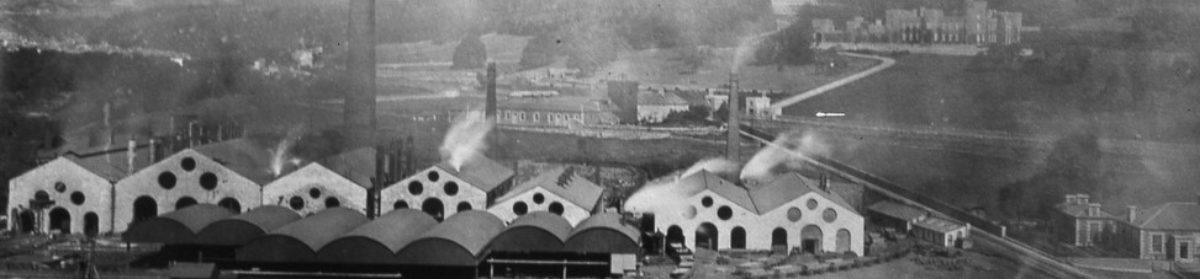
Great excitement prevailed at Dowlais this evening consequent upon a terrible accident which occurred in the Lower Works. First reports stated that the machinery in the Bessemer department, bad been blown to pieces by an explosion and that about a dozen persons had been killed. For more than two hours the town was in a terrible state of agitation, and crowds of people flocked to the gates of the Lower Works. Such a state of excitement has never before been witnessed in the district. On inquiries being made, however, it was found that the accident was not quite so serious as was originally reported, but it was, nevertheless, one of the most terrible that has ever happened in any of the works on the hills.
For a few years past the Dowlais Iron Company have been engaged in the construction of it new Bessemer department in the Lower Works, and it was hoped that it would be completed in another three or four months. A part of the new works has already been started. Meanwhile the old machinery has been used, and the ‘old Bessemer’ has remained in its usual condition. Massive stone walls enclose the works, the roof was constructed of slate supported by massive iron girders. About, twenty minutes to six o’clock this evening the roof gave way, with terrible results. One of the men who were at the cranes says that at the time he was working, when he heard a creaking in the roof. Looking up he saw that the roof was gradually giving way, and he at once took shelter under one of the pieces of machinery.
About 70 or 80 men were working in the place at the time. Fortunately for them, the roof did not give way at once, otherwise they would all have been killed. As it was, the ledge of the roof, after falling from its supports, rested for a few a seconds on the top of the cranes and hydraulic machinery, and thus enabled the men to escape. They dashed out of the building, but although the majority escaped uninjured several were struck by falling slates and were injured more or less severely. One young man, named John Morgan, who was ‘teeming’ at the time, saw the roof giving way, and thinking to escape more rapidly than his companions, he rushed towards the cogging mill. He had not gone more than a few yards when the roof fell in with a terrible crash. Nothing more was seen of him until nearly two hours later.
As soon as it was deemed safe to do so, men were sent to explore the debris with the view of ascertaining whether any serious loss of life bad taken place. Several tons of debris lay about in all directions, and for a long time it was impossible to make any headway. At last one of the men struck his spade against something, and on removing the debris it was found that the body of a man lay beneath one of the massive iron girders which supported the roof. By the aid of screw-jacks the girder was removed, and Morgan was brought out quite dead. It was ascertained that one of the pieces of iron which had fallen with the slates had penetrated the poor fellow’s side, and he had also sustained other frightful injuries. Morgan leaves a young widow and a child aged only nine weeks. It is believed that Morgan’s is the only life that has been lost, but several other workmen received injuries of a more or less serious character, and have had to be surgically treated.
The loss sustained by the Dowlais Iron Company must be estimated at several thousand pounds. Nearly all the hydraulic machinery and the cranes have either been destroyed or considerably damaged. At the time of the accident the vessels were full of molten iron, and in the confusion and excitement which followed the catastrophe the contents could not be emptied. The iron has therefore cooled, and cannot again be extracted from the vessels, which are rendered useless and will have to be blown up by dynamite. Nor can the effect of the accident upon the workmen be as yet correctly stated. All the branches of the steelworks must necessarily remain idle until the Bessemer department is again put into proper working order. Several hundreds of men have been thrown out of employment and some weeks will certainly elapse before things can be put to rights again.
The cause of the accident is very simple. The iron girders naturally contract and wear away under the influence of such terrific heat as continually prevails in the Bessemer department. The recent severe weather has, moreover, been most disastrous to buildings of this kind.
Keir Hardie: Leader of the Labour Party – part 4
by Carolyn Jacob
‘The life of one Welsh miner is of greater commercial and moral value to the British nation than the whole Royal crowd put together.’
Keir Hardie June 1894
 ‘One day in June, 1894, in the Commons, an address of congratulations was moved on the birth of a son to the Duchess of York. Hardie moved an amendment to this address, crying out that over two hundred and fifty men and boys had been killed on the same day in a mining disaster, and claiming that this great tragedy needed the attention of the House of Commons far more than the birth of any baby. He had been a miner himself; he knew. The House rose at him like a pack of wild dogs. His voice was drowned in a din of insults and the drumming of feet on the floor. But he stood there, white-faced, blazing-eyed, his lips moving, though the words were swept away and he was dismissed for spoiling the joy of a Royal occasion’.
R. Clynes, Memoirs, 1937
Attacking the Royal Family was hugely unpopular but Hardie was grief-stricken for colliers’ families and bitter that others did not seem to even care. He later criticised the visit by the Russian Czar because Russia had recently treated trade unionists savagely, shooting demonstrators. In reply Keir Hardie and two others were removed from the list of Members invited to Court functions. In the Merthyr Express Keir Hardie seemed amused not to be invited to the Royal Garden Party, an invitation he would not have accepted, as he could not return the compliment by inviting the Court to tea in his small terraced house in Lanarkshire.
‘I thought the days of my pioneering were over but of late I have felt, with increasing intensity, the injustice inflicted on women by our present laws’.
Keir Hardie, speech at the Labour Party Conference, 1907
‘That there is difference of opinion concerning the tactics of the militant Suffragettes goes without saying, but surely there call be no two opinions concerning the horrible brutality of these proceedings? Women, worn and weak by hunger, are seized upon, held down by brute force, gagged, a tube inserted down their throats and food poured or pumped into the stomach’.
Keir Hardie, letter to Votes for Women, 1 October, 1909
The Pankhursts converted Hardie to the cause of women’s suffrage, although not all of his fellow socialists shared this commitment. In 1907 when Miss Arscott of Merthyr Tydfil, daughter of the Brecon Road grocer, was imprisoned in London for taking part in a demonstration outside the Houses of Parliament Keir Hardie visited her in prison to offer his support and encouragement. He had many female supporters in Merthyr Tydfil, including the daughter of the Liberal MP, D.A. Thomas.
‘Keir Hardie has been the greatest human being of our time. Asked to write a motto, he would choose Votes for Women and Socialism for All.’
The Women’s Dreadnought, 2 October, 1915

‘His extraordinary sympathy with the women’s movement, his complete understanding of what it stands for, were what first made me understand the finest side of his character. In the days when Labour men neglected and slighted the women’s cause or ridiculed it, Hardie never once failed us, never once faltered in his work for us. We women can never forget what we owe him’.
Isabella Ford, a member of the NUWSS
‘Politics is but a kind of football game between the rich Tories and the rich Liberals, and you working men are the ball which they kick vigorously and with grim delight between their goalposts’.
Keir Hardie, The Labour Leader
Keir Hardie devoted his life to the working class and, contrary to the lies of the Conservative Party, he accepted no money for himself. Hard work wore him out, in some photographs he looked like Old Father Time but he was only 59 when he died.
‘The moving impulse of Keir Hardie’s work was a profound belief in the common people. His socialism was a great human conception of the equal right of all men and women to the wealth of the world and to the enjoyment of the fullness of life. He had a touching sympathy for the helpless. I have seen his eyes fill with tears at the news of the death of a devoted dog. He carried to his end an old silver watch he had worn in the mine, which bore the marks of the teeth of a favourite pit pony, made by the futile attempt on its part to eat it’.
Philip Snowden

Keir Hardie could not understand how working-class men could fight each other for a ‘Capitalist Cause’. He was a firm opponent of all wars.
‘I knew that Keir Hardie had been failing in health since the early days of the war. The great slaughter, the rending of the bonds of international fraternity, on which he had built his hopes, had broken him’.
Sylvia Pankhurst
‘The long-threatened European war is now upon us. You have never been consulted about this war. The workers of all countries must strain every nerve to prevent their Governments from committing them to war. Hold vast demonstrations against war, in London and in every industrial centre. Down with the rule of brute force! Down with war! Up with the peaceful rule of the people’.
Keir Hardie at the Merthyr Olympia Skating Rink, 30 October 1914
Keir Hardie disagreed with the Labour Party over the outbreak of the First World War in 1914, as a pacifist, he tried to organize a national strike against Britain’s participation in the war and was saddened that the recruiting in Merthyr showed patriotic zeal. He was concerned about the threat to civil liberties and to the living standards of the working class. Although seriously ill, Hardie took part in several anti-war demonstrations and some of his former supporters denounced him as a traitor.

In December, 1914, Hardie had a stroke and he returned to the House of Commons in 1915 before he had made a full-recovery. Numerous meetings in various parts of the country and staying in people’s homes took their toll. His London home, was an attic in Nevill Court and he does not appear to have taken much care of himself. Politics concerned him more than personal comfort. Once when his doctor told him to rest, he went to Belgium to meet other social democratic leaders but was arrested as he was mistaken for an anarchist!
‘Hardie died of a broken heart. He had always been a pacifist; when British Labour refused to inaugurate a great strike on behalf of peace, Hardie became a broken man’.
R. Clynes, Memoirs
‘What could Hardie do but die?’
George Bernard Shaw

Keir Hardie: Leader of the Labour Party – part 3
by Carolyn Jacob
In January 1971 John Williams remembered James Keir Hardie in a Merthyr Express article called ‘The cloth-capped charismat’. There were only a few local people left who had seen James Keir Hardie in person. John recalled him as being of medium stature with white hair and beard. What made him stand out was that he walked firmly and always held his head. He looked dignified and serene. He was usually dressed in a tweed suit and soft collar. When he was but a small boy, John Williams remembered seeing him walking down Wind Street, Dowlais.
Famous people came to Merthyr Tydfil to support Keir Hardie’s election campaigns in 1906 and 1910. George Bernard Shaw was the principal speaker at Keir Hardie’s meeting in the Drill Hall. He was reported to have said: ‘If he met a working man who was not going to vote for Keir Hardie he would not talk to him, but he would put him in a museum as a curiosity.’
Merthyr Express, 8 January, 1910.

In 1912 the Independent Labour Party had their annual conference in Merthyr Tydfil, and the Suffragettes also had their important meeting here.
‘It is greed, cruelty, selfishness and the exploitation of man by man which a world-wide Socialist movement must unite to end’.
Keir Hardie in the Merthyr Miners’ Hall, 1908, following a recent trip to India.
He was committed to international socialism and toured the world arguing for equality. Speeches he made in favour of self-rule in India and equal rights for non-whites in South Africa resulted in riots and he was attacked in newspapers as a troublemaker. After his visit to India he spoke about the exploitation of women and child labour and the huge profits which are made on the back of their labour. He pleaded for the workers to rally against injustice and oppression the world over.
He later found injustice closer at home, the Dowlais Works strike of 1911, and he used it to emphasise the need for class unity in face of the industrial unrest sweeping Britain. Dowlais was notorious for its anti-unionism and shocking work conditions. Keir Hardie saw to it that Dowlais got no government contracts until the strikers were reinstated but the moulders were not taken back. He seized the opportunity provided by the Royal Visit to Dowlais in 1912 to write an Open Letter to the King and ensure that the moulders were reinstated in their employment. Nothing could be allowed to upset a Royal Visit.
‘The barber’s shop in which I worked was down by the Fountain, where Keir Hardie made some of his best speeches …… When I was thirteen or fourteen I joined the Independent Labour Party and Hardie became the first Socialist candidate, and I remember that he used to share the constituency of Aberdare and Merthyr with D.A. Thomas, who later became Lord Rhondda’.
Arthur L. Horner, Merthyr as I Knew it
21 years ago:- ‘It was tenaciously upheld by the public authorities, here and elsewhere, that it was an offence against laws of nature and ruinous to the State for public authorities to provide food for starving children, or independent aid for the aged poor. Even safety regulations in mines and factories were taboo. They interfered with the ‘freedom of the individual’. As for such proposals as an eight-hour day, a minimum wage, the right to work, and municipal houses, any serious mention of such classed a man as a fool’.
Keir Hardie’s , ‘Sunshine of Socialism Speech’ , 11 April 1914
He campaigned for such extreme and radical issues as home rule for Wales, old age pensions, votes for women, the nationalism of basic industries and the abolition of the House of Lords. The Merthyr Express of August 1907 reported that Keir Hardie had gone to America for his health. During a lecture he delivered on Socialism in Winnipeg, not only did someone run off with his hat but his vest and tobacco pouch also disappeared!
Although he shone on the public platform, it has been said that he was no politician as compromise was not in his nature. He preached that poverty was not inevitable but sprang from man-made conditions. Hardie declared that what was bad in the social system was not to be endured but abolished. However, he did enjoy some entertaining moments in Merthyr Tydfil. His 1910 election success was celebrated by a dance and reception at Cyfarthfa Castle at which he sang.
‘The man and his gospel were indivisible”. His simple heroism made our party and our world’.
Bruce Glasier

To be continued….
Keir Hardie: Leader of the Labour Party – part 2
by Carolyn Jacob
‘The condition of the miners is desperate. Over 100,000 are starving, or on the verge of it; a whole province lies waste, so far as productive labour and the means of life are concerned.’
Keir Hardie came to South Wales early in his career and attended a meeting of Aberdare miners in 1887. In the winter of 1896 he first visited the town of Merthyr Tydfil. Later he remembered that the evening was bitterly cold. Although the meeting was not large or enthusiastic, he knew that these were very early days. In 1898 Keir Hardie responded to the request to help the Welsh miners during the Great Welsh Coal Strike and he walked around the Valleys giving public talks and speaking to the men. He referred to this time as his ‘best ever holiday’. During the Cambrian Collieries dispute, Keir Hardie used parliament to denounce army and police thuggery. He embarrassed the Home Secretary, Churchill, by giving all the details about government-sponsored violence against miners and their families.
 After soldiers shot strikers at Llanelli during the Railway Strike in 1911, he wrote a pamphlet, Killing No Murder, to expose the government even more. Keir Hardie was equally prepared to align himself with any worker in struggle.
He campaigned passionately against poverty and was proud to be called the ‘member for the unemployed’, campaigning for the minimum wage and an end to child poverty. He pioneered social welfare, advocating a national health service financed from taxation.
‘His love of justice is quite genuine and you will find that he is respected by men who are attached to that attribute’.
Hiliare Belloc, letter to Wilfred Blunt, 18th April, 1911
‘I have said, both in writing and from the platform many times, that the impetus which drove me first into the Labour movement, and the inspiration which has carried me on in it, has been derived more from the teachings of Jesus of Nazareth than from all other sources combined .
James Keir Hardie explaining the influence of Christianity on his beliefs, 1910.
In his address in Cyfarthfa Park in July 1909, he spoke on the text ‘Give us this day our daily bread’ and concluded that, ‘Christ was not only thinking of bread, but of all the requirements of a healthy, human life. There were thousands of homes within the Merthyr constituency, which he had the honour to represent, where the bread-winner toiled from morning till night, and yet poverty was always hunting the home. He believed that there would never be true Christianity until they had Socialism. Was it Christianity for the rich to oppress the poor; for the Government to spend millions in building up war machines for the destruction of human life and grudge hundreds for the relief of poverty? Was it Christian for the Liberal Prime Minister to refuse to see a deputation of women asking for the vote, and then to have a hundred sent to prison because of that refusal? The present system was anti- Christian and, in many respects, anti-human as well’.
Keir Hardie enthusiastically congratulated the new Merthyr Tydfil County Borough Council for purchasing Cyfarthfa Castle and Park. It was wonderful that working people now owned the home of a wealthy ironmaster, ‘This is all yours now’ .
‘When he was the only member of the Labour Party in the House of Commons, he did not mind that. To him it had never mattered whether he stood alone or as one of ten thousand, so long as he knew his principles to be right. Whether it be in public or in private life, that which distinguished a man in the truest sense of the word was that he should have a mind of his own, and not simply be one driven thither and thither by every wind, and swayed by every gust that blew’.
Speech by Keir Hardie in Cyfarthfa Park, July 1909

To be continued…..
Keir Hardie: Leader of the Labour Party – part 1
by Carolyn Jacob
A rhyming note sent by Keir Hardie to Tom Mackley in reply to some birthday congratulations, 15 August 1912:
 Dear Comrade, if you flatter so,
You’ll make an old man vaunty:
I’m six and fifty years, ‘tis true
And much have had to daunt me.
But what of that? My life’s been blest,
With health and faith abiding;
I’ve never sought the rich man’s smile,
I’ve never shirked a hiding.
I’ve tried to do my duty to
My conscience and my neighbour,
Regardless of the gain or loss
Involved in the endeavour.
A happy home, a loving wife,
An I.L.P. fu’ healthy;
I wadna’ swap my lot in life
Wi’ any o’ the wealthy
At this time when we are still remembering the centenary of the end of a dreadful and pointless war we should note that the MP for Merthyr Tydfil, Keir Hardie was totally opposed to this conflict. He died in 1915 broken hearted because World War I had destroyed his great dream of brotherhood. His life is proof that faith, courage and belief can ‘move mountains’. Keir Hardie did not select Merthyr Tydfil, he said that ‘A Welsh speaking Welshman’ should fight Merthyr for the ILP. He believed all Celts were socialists by instinct. Merthyr Tydfil chose Keir Hardie. While Hardie fought an unsuccessful campaign to be elected in Preston, local supporters battled for him in Aberdare and Merthyr. It was possible then to stand in more than one constituency. The election results came out on different days, the newspapers announced that Keir Hardie had been defeated yet again and the next day his victory and election in Merthyr Tydfil was reported. He quickly adapted to Wales, learnt to sing the National Anthem in Welsh and campaigned for Welsh Disestablishment.
James Keir Hardie summarised Merthyr’s contribution to political life: ‘In the golden days to come, when poverty has been destroyed and freedom instituted, the Merthyr Boroughs will hold a warm place in the affections of the happy people as having been the pioneer constituency in heading the Revolution which led to setting up a new social order’.In the words of the Aberdare Leader, 30 October 1915, following the death of Keir Hardie.
‘Earth’s truest heroes are the men who stand Alone, undaunted in a righteous cause, Seeking no honours high or station grand, Heedless alike of blaming or applause; Careless of acclamation or reward’.
We should be proud that our MP, virtually alone in the Commons, spoke against World War 1. He stuck to his beliefs although he met a violent reaction. He would never have criticised those who gave their lives for their country but only those you sent them to their deaths. In the words of George Bernard Shaw after his death, his indomitable truth goes marching on
When he first became an M.P. they had no salary and he supported himself through lectures and writings. He believed it his duty to attend every sitting of the Commons and, if he was prevented by illness, he would send an apology to be put in the Merthyr Express for the electors.
‘It is reputed that a roofer shouted at Keir Hardie assuming he had come to work on the roof of the Commons. His reply was that he had only come to work on the Floor’.
James Keir Hardie was the first advocate of Socialism in the House of Commons and the first leader of an independent Labour group in that assembly. He wanted to eradicate poverty from the lives of the people and to make it possible for all men, women and children to have lives of worth and dignity. He campaigned for all to have good houses, good education and a better economic status. He was a lover of peace. and was elected for Merthyr Tydfil at the time of the Boer War, in the “Khaki” Election of 1900. He was as resolute in denouncing the war as he was in advocating Socialism. He was accused of being a Boer spy and of rejoicing at British defeats and other equally stupid things were said against him, but unpopularity did not silence him, nor modify the tone of his writing in the Labour Leader.
‘Keir Hardie is Labour’s greatest pioneer and its greatest hero. He became the first Labour MP, the founder of the ILP, first leader of the Labour party, pioneer editor of the Labour Leader, and a giant in the socialist movement worldwide. Miraculously, he created a new party, as ‘an uprising of the working class’.
Kenneth O Morgan, Keir Hardie, 2008
To be continued……..
Merthyr Tydfil Historical Society – 2019 Lecture Programme
The committee of the Merthyr Tydfil Historical Society are pleased to announce the programme for 2019’s lectures.
The Merthyr Tydfil Historical Society meet at Canolfan Soar at 7.00 on the first Monday of the month – please come along….all are welcome.
| 4 February | |
| Robert Jones | An Historical Walk around Abercynon |
| 4 March | |
| Anne Watts | The Last Tsar of Russia |
| 1 April | |
| David Maddox | Voices: Valley Women’s Lives 1900-1918 |
| 13 May | |
| Victoria Owens | Lady Charlotte Guest |
| 3 June | |
| Klavdija Erzen | History of Jews in South Wales |
| 1 July | |
| Society AGM | |
| 2 September | |
| Barrie Jones | The Rev Maber and Merthyr’s Glebelands |
| 7 October | |
| Mary Owen | To be announced |
| 4 November | |
| Clive Thomas | Some Aspects of Early Nineteenth Century Housing in Merthyr Tydfil |
| 2 December | |
| David Pike | Evan Roberts the Evangelist |
Did you know?
Welcome to another new regular feature – Did you know? In this feature I hope to highlight some of the important facts about Merthyr that you may or may not have known.
Did you know that the man who built the very first Dalek for Doctor Who was from Merthyr?
Bill Roberts was born in 1918 in Gwladys Street in Pant. He attended Cyfarthfa Grammar School, but moved to Uxbridge in 1936. He enjoyed a career as an aircraft engineer, working for Miles Aircraft, before setting up his own company – Shawcraft Models.
In 1963, when the Daleks were originally conceived by Terry Nation for the first series of Doctor Who, the BBC commissioned designer Raymond Cusick to design them, but the job of actually building them was given to Bill Roberts who worked from Cusick’s blueprints.

If anyone has any interesting items for the new ‘Did you know?’ feature, please get in touch.
The Cinderella Club of Merthyr Tydfil
I have received the following request via e-mail:-
I am researching information on the Cinderella Club of Merthyr Tydfil, which existed sometime from the 1880’s.
In the 19th Century (the great) Robert Blatchford, a Manchester Journalist and social reformer, campaigned for the formation of groups who would provide food and clothing for children condemned to live in appalling conditions in slums. They came to be known as Cinderella Clubs.
They sprang up all over the Country but gradually died out following the introduction of the Welfare State. Just one remains; Bradford. I have searched through old newspapers, and journals available on-line at the National Library, and found references to these clubs in Cardiff, Chester, Carmarthen, Newport and Wrexham, but not Merthyr. Indeed, I cannot find a single reference on-line.
My interest was piqued, following a FaceBook post from Tacy Chris Black, of Kansas, USA.
The post concerned a very fine mantle clock (pictures enclosed), with the inscription ‘presented to J Morgan Rees, Merthyr Cinderella Committee, 1895.


Mr. J Morgan Rees must have performed a great service for poor children, to warrant such a generous gift.
I wonder if you have any further information on the Merthyr Cinderella Club and J. Morgan Rees.
Best Regards
Roger Evans
If anyone has any information about this, please contact me at merthyr.history @gmail.com and I will pass it on.