Memories of Old Merthyr

We continue our serialisation of the memories of Merthyr in the 1830’s by an un-named correspondent to the Merthyr Express, courtesy of Michael Donovan.

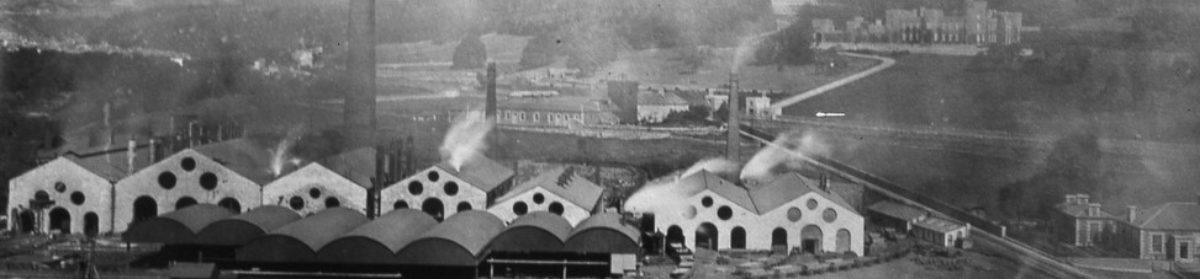
There are two trivialities that must be stated about Penydarren before alluding to that which will perpetuate its memory for all time. (1) The end of the forge was a pure example of Doric architecture, (2) and the small stack of the roll lathe boiler was an exact model one-fifth the size of the monument on Fish Street Hill, London.

Penydarren Ironworks in the early 1800s. Photo courtesy of the Alan George Archive

The Petherick family had positions in the early days of Penydarren, and Evan Hopkins, the author of “Magnetic Distribution of Metalliferous Veins” went thence to South America about the deposits there. It is, however, as the parent of the locomotive that Penydarren will ever be remembered. As there seem to be doubts about some things I will endeavour to put it clear, although not strictly within my own personal recollections.

Notwithstanding the great genius of James Watt, and the wonderful sagacity of Mathew Boulton, the idea of using steam in a cylinder to give motion to a piston, and allowing it then to escape into the atmosphere, was thought to be too dangerous, and the condensation of the steam was adhered to them.

Richard Trevithick (left), however, more daring, did not allow himself to be influenced by such fears, but towards the close of the 18th century began to put his thoughts into use. He made a road locomotive, and in 1802, injunction with Andrew Vivian, obtained the patent.

It is only my idea that the Pethericks were the means of introducing Trevithick to Penydarren, for one (a Mr John Petherick), wrote in 1858 that, “I perfectly remember when a boy, about the year 1802, seeing Trevithick’s first locomotive, worked by himself, come through the principal street of Cambourne”. But be that as it may, this, or another of Trevithick’s make, travelled to London, and often ran upon some ground near Bethlehem Hospital, and also where Euston Station now stands. It must be borne in mind that it was thought quite impossible to get sufficient grip between the wheels and a road to cause them to move the carriage forward.

It is clear Trevithick was in the neighbourhood about 1800, for stationary engines were made by him or from his designs both at Penydarren and Tredegar Works. These have been seen at work by me. His first locomotive was used about the works, and very probably hauled some of the cinders which for the tip alongside of the Morlais Brook and River Taff. The fact of an engine having cast iron wheels, running on an iron road being able not only to propel itself forward but draw a load after it was there demonstrated, and must have been a subject of controversy because a bet of £1,000 was made between Mr Homfray and Mr Crawshay as to the possibility of its taking ten tons of iron down to the basin and bringing the empty trams back.

The ten tons of iron was take to its destination, but for some cause the engine and the empties did not return to the works as satisfactorily as hoped for. The weight of the engine is stated to have been about five tons, and the gross weight altogether of 25 tons.

It seems as if Mr Homfray was an exceedingly hot tempered man, and it is clear that Trevithick had the same infirmity. This I have from one who was able to recall both personally. It would scarcely be proper to trace here how engines were designed by Trevithick, and did work elsewhere soon afterward, and how Trevithick himself having more enticing engagements allowed others to carry on the work he had begun.

To be continued at a later date…..

Merthyr’s Bridges: Pontyrhun, Troedyrhiw

by David Collier

Pontyrhun in 1912. Photo courtesy of the Alan George Archive

Legend has it that the bridge over the river Taff in Troedyrhiw is located at the place where Tydfil’s brother Rhun was killed, in around the year 480, by Saxon or British pagans or a band of marauding Picts. It is commonly accepted that, thereafter, bridges constructed on this spot have been known by names which mean ‘Rhun’s Bridge’. These include Pontyrhun, Pontrhun and Pont-y-Rhun.

There is, however, a less colourful explanation  for the name of this bridge. In his book ‘Bridges of Merthyr Tydfil’ W. L. Davies states that this ancient site is “the most natural and only location for a bridge crossing below the meeting of the two Taffs at Cefn Coed-y-cymmer”. It is, therefore, possible that the name of this bridge is derived from it being the FIRST bridge in the lower valley as suggested by ‘Pont yr Un’ (roughly translatable as ‘bridge one’) as printed on at least one early map.

The first known record of a bridge at this spot dates from the 1540’s when it would have been made of wood. Later replacements were of a stone arch construction but, by 1857, a wrought iron structure was in place. Disaster struck on 15 December 1878 when the foundations on the west bank were washed away.

Pontyrhun following the collapse. Photo courtesy of the Alan George Archive

This bridge was reconstructed in 1880 and remained in place with regular repairs and strengthening until 1945 when plans were prepared for a new bridge which was then completed. By the 1960’s it was apparent that this bridge was inadequate for the amount of traffic that it then carried and so on 3 October 1965 it was closed for 13 weeks whilst a new bridge, that remains in use to this day, was erected.

This article has been transcribed from the Friends of Saron web-page, and is used here with the kind permission of David Collier. To see the original article please see: https://friendsofsaron.wordpress.com/2020/08/24/pontyrhun-bridge-troedyrhiw/

Merthyr Tydfil Historical Society

The Merthyr Tydfil Historical Society is pleased to announce its lecture programme for the first half of 2022 – the Society’s 50th year!!!

Annual membership is £12, but you are welcome to come to any lecture – whether you are a member or not – guests pay £2 per lecture, the lectures a free to members. Everyone is welcome!!!!

In Memoriam: Meta Scott

Following on from the last article, here is a very moving tribute to Meta Scott that appeared in the Cardiff Times on 30 January 1892.

How hard it is to realise the dreadful truth that poor Miss Meta Scott has passed from our midst to the Great Beyond; and that never again shall we see her on the concert platform or in front of a competitive choir!

True, we had missed her from her favourite post for considerably more than a year, but we knew that she lived, and Hope bade us look forward to the time when we should see her again. But Hope, alas was deceptive. That slight, fragile figure for whose reappearance we so often looked, and sighed when we found we had looked in vain, now lies cold and immovable in the Cefn Cemetery. She who was wont to thrill vast audiences with her marvellous performances on the pianoforte and the violin will never again waken the melodies of earth. She has gone to waken sweeter music among the angels. Yet poor human nature refuses to be comforted with this knowledge, “for frightful to all men is death, from of old called King of Terrors”, and we mourn with heavy hearts the loss of one who in public was a brilliant musician, and in private a true and sincere friend.

It is not necessary to enter into details of the career of the deceased lady; those details have already been given by the daily papers. Her career was, as everyone knows, brilliant from first to last. Hers was a life of assiduous labour from her very childhood; she was in very truth a slave to her art. The amount of hard work the poor slight figure got through was really remarkable, and there can be but little doubt that her end was brought about in the same way as that of Kirke White was. There is something unspeakably sad in the thought of one who had toiled so hard, and who was in very truth a child of genius, passing to the tomb just at the moment when the gates of fame were open to her.

Poor Miss Scott was a favourite with all classes wherever she went. She never appeared at a concert without calling forth unbounded enthusiasm from her audience, and as an eisteddvod accompanist she was eagerly sought after. On many occasions have I heard her praised by the adjudicators for her excellent playing with the choirs.

Her last days were full of incidents of an intensely pathetic nature. She was taken ill shortly after the Brecon Eisteddvod, but she continued her work until imperatively commanded to desist by her medical adviser – fighting the fell consumption, that was gnawing her young life away all too soon, with a courage that none who knew her imagined she possessed. But as months of gloomy illness succeeded one another, and that poor fragile form grew weaker and weaker, the sufferer lost hope, and realised that she had been all too surely “nipt by the winds’ unkindly blast”. She saw that all the high hopes which her friends centered on her, and that the career which had opened out so brilliantly and which promised such a glorious future were all to be buried in the merciless tomb.

On the first day of the present year she dictated a little poem which she bad composed on the death of the old year. It was the wail of farewell which the stricken child of genius poured out upon the world she was so soon to leave. A friend came to visit her, and the sufferer on being given her violin attuned its strings and played “Lead, kindly Light”. “There”, said she at the close, “you have heard me play for the last time on earth”.

A few hours ere her poor body lay tenantless she heard the singing of a funeral party that was passing along the road. She requested those near her that at her own funeral the grand old hymn, “Bydd myrdd o ryveddedau” should be sung. Reader, canst thou think of that pathetic request without shedding a tear? And her request was granted. When I heard that old hymn sung with such wonderful impressiveness at Swansea Eisteddvod last August I little thought that ere six months would pass it would be sung by a host of sorrow-stricken men and women over the unclosed grave of poor Meta Scott. But so it was. She whose career had been so meteoric in its brilliancy and whose end was so inexpressibly sad, was laid to her rest amid the strains of the hymn she had asked them to sing at her funeral.

It is not Merthyr alone, but the whole country that is poorer by her loss.

Meta Scott

Today marks the 130th anniversary of the death of another of Merthyr’s great musical talents – Meta Scott.

Meta Scott was born Sarah Margaret Scott in 1860, the daughter of William Scott, a grocer at Brecon Road.

William Scott, an able musician, played the flute in a small band which met in the family home, so the young Meta was surrounded by instrumental music from an early age. It was inevitable therefore that she soon showed her own musical talents, and began taking music lessons at the age of seven, soon excelling in both the piano and violin. It is said that she would practice for up to fifteen hours a day.

The hard work paid off and she was accepted at the Royal Academy of Music to further her studies, winning medals for playing both the violin and piano, and out of 500 students, Meta was chosen as the official accompanist for the Academy at a prestigious concert at St James Hall.

Following her graduation, she moved to Cardiff, and began her career as a performer. She was in demand throughout Wales as both an accompanist and a soloist, and also began teaching. Also, almost uniquely at the time for a woman, she formed and conducted several small orchestras throughout Wales, taking them to various Eisteddfodau and competing with very best of local musicians.

South Wales Daily News – 1 October 1889

The pinnacle of this achievement came at the National Eisteddfod in Brecon in 1889, held in the grounds of the Castle. At the Eisteddfod, she led an orchestra from Merthyr in one of the principal competitions, reaching the final, but narrowly losing out to the Cardiff Orchestral Society under the leadership of Dr Joseph Parry.

It was soon after the Brecon Eisteddfod that Meta Scott became ill. At first it was thought that Meta was suffering from the effects of over-work, but it was soon realised that she was in fact suffering from tuberculosis. She cancelled all of her engagements and returned Merthyr where she fought a losing battle against the disease for the next two years. She died at her family home on 15 January 1892 at the age of 31.

Her funeral was attended by all of the prominent musicians and citizens of Merthyr, and as the funeral cortège made its way from Brecon Road to Cefn Cemetery, hundreds of people lined the route to pay their respects to the beloved musician. The cortège was headed by the Cyfarthfa Band, and followed by the massed choirs of Merthyr who had joined together to pay tribute to Meta. The service was conducted by Rev J G James, the minister of Market Square Chapel, and members Meta’s own orchestra, who had narrowly missed out on first prize at the Brecon Eisteddfod, carried her coffin to her final resting place.

The Memories of a Child Evacuee from Folkestone to Merthyr Tydfil, 1940 – part 3

by Peter Campbell

When we arrived we were given lemonade and cakes to eat while the teachers and staff decided what would happen next. We were all very tired and wanted to sleep. After a while they came to us, that is me and my brother and sisters, and told us we would not all be able to stay together, that me being the youngest would stay with my eldest sister Pat which was good but my other sister Ivy would be on her own, as would Gordon and Terry. Soon a couple came to us to take us to their home a Mr and Mrs Evans. Our teachers said we would all meet back at the hall in the morning, I never saw where my sister and brothers went.  We left and went with Mr and Mrs Evans to go to their home.

The first night was very strange I did not sleep very well, I just wanted to be back home with my Mum and Dad, my sister Pat said it would be alright the war would not last very long we would soon be home again.

Next day we went back to the church hall to find out about our new school, we also saw my sister and brothers again; they were staying in a different part of the town. The school we were going to was called St Illtyd′s not far from where we were staying. It was a big school and everybody there thought we were funny because we did not talk like them but they were nice to us.

Pat and Peter Campbell, Merthyr Tydfil 1940

After a couple of weeks things were not right where we were staying. They were cruel to us, we were told not to come home till late, sometimes we had to go to school without any breakfast. I cried quite a lot and told my teacher I wanted to go home and we were not happy with Mr and Mrs Evans my sister told her teacher they were cruel to us.

The next day we were moved from there to another house, to a Mr and Mrs Mahoney they were very nice and made us welcome right away. We had good food warm and comfortable beds. They wrote to our parents to tell them we were OK.

There was no bathroom so having a bath was quite an ordeal. In the back yard hanging on the wall was a big long tin bath, on bath nights twice a week the bath was brought into the living room and put in front of the coal fire. The bath would then be filled with part cold water then boiling water from kettles until it was warm enough. I was lucky I got the first bath then my sister Pat had the same water and when my brother Terry came to stay that was three in the same water, we had to be quick because the water did not stay hot for very long. My brother Terry said it was great because where he had been staying before he had to have his bath outside!

Then one day about two years after we had moved to Wales, we were told some great news; we as a family were going to be all together once again. My Dad who worked for the Air Ministry was to be posted to Carlisle – which was considered to be a safe part of the country.

Everybody was happy that we were going home although they would miss us and we would miss them, our teachers, friends, Mr and Mrs Mahoney.

We felt sorry for all the other children we were leaving behind, they would have to stay there until the war finished.

So the day came for us to say goodbye to everybody Mr and Mrs Mahoney were very sad, they had been very good to us. We promised to keep in touch with them.

On the train to our new home in Carlisle (we really could not say it properly) we were told it was in Scotland and everybody wears a kilt! We were very excited and happy and could not wait to see our Mum and Dad and baby brothers again after two years. The further we travelled north the more mountains we saw it was fantastic we had never seen mountains as big before.

We were met at the station by our Mum and Dad I thought they looked a lot different since we last saw them two years ago. We jumped off the train and gave them lots of hugs and kisses. Mum said we all looked very grown up. It was a strange place Carlisle very big and noisy not a bit like Merthyr, but the difference was we were all together one happy family! We got on to a bus to take us to our new home which was in Dalston Road, It was a very big house with lots of rooms. We were met by our Granddad and the rest of the family and had a great big party which went on for ages.

Life changed again; new town, new school, new friends.

We were very happy to be able to say we were no longer evacuees, but we couldn′t help thinking about our other Mum and Dad who looked after us so well and all our school friends we had left behind in Merthyr Tydfil, South Wales.

Like all good stories this has a fairytale ending….. and we all lived happy ever after!

Many thanks to Les Haigh for giving me permission to reproduce this article. To see the original please visit:-

http://www.leshaigh.co.uk/folkestone/evacuee.html