The latest chapel in our ongoing series is Smyrna Baptist Chapel in Aberfan.
After Rev James Lewis became minister of Carmel Chapel, Troedyrhiw, in the 1860s, he started a Sunday School in Aberfan. This was held firstly at a private house and then in the long room of the old Red Cow public house.
As the congregation grew Rev Lewis and two of his deacons – William Jones and William Philip Price decided to build their own place of worship, and in 1879 a plot of land was leased from Mrs Rowland Griffiths of Aberfan House for £2.10s.0d., and a small chapel was built by William Lloyd, a member of Carmel Chapel, for the sum of £750.
By the turn of the 20th Century, the congregation had grown sufficiently for a new chapel to be built. It was decided to build the chapel on a larger plot of land adjoining the original chapel. The new chapel was built by the Spratt Brothers of Merthyr and was completed in 1902 at a cost of £1,874. The original chapel was joined on to the new chapel to be used as a vestry.
During the Aberfan Disaster, Smyrna Chapel was the first building to be opened to aid the rescuers, with the vestry used as a refreshment centre and the chapel as a casualty centre for the rescuers. In the aftermath of this, due to the inevitable mess caused, the chapel had to close for restoration. When this was completed a special service was held to re-open and re-dedicate the chapel.
Members of Smyrna Chapel at the re-opening ceremony in 1967
The new chapel was demolished in 2002, but the original chapel remains and has been refurbished for use by the community.
The original chapel, later the vestry, now refurbished as a community centre
Following on (obliquely) from the last post, and although it is a morbid subject, it is also fascinating to see what were the main causes of death in years gone by. Here is an extract from the Annual Report for the Sanitary Condition of Merthyr Tydfil from 1868 – 150 years ago.
You have probably never heard of Pearson Robert Cresswell, but had you lived in Dowlais in the late 19th Century, if you were lucky, he may have saved your life.
Dr Pearson Robert Cresswell
Pearson Cresswell was born on 24 July 1834, the second son of Charles and Ann Cresswell, a solicitor and his wife, then living in Henwick, near Worcester. It was in Worcester that Pearson grew up, although while he was still in school, the family emigrated to Australia. Indeed, it is in Melbourne, that his parents and siblings lived and died.
This was not to be Pearson’s destiny, however, as in the 1850s he returned to the UK to study medicine, training in Middlesex Hospital and the Medical Centre in London, qualifying in 1859 as a Member of the Royal College of Surgeons (he became a Fellow in 1873). But our interest in him dates from May 1860, when he secured the post of Chief Surgeon to the Dowlais Iron Company, an appointment he retained for the next 40 years, until his retirement and death on 22 Nov 1905 aged 71.
Pearson was a noted medic in Dowlais, running a private practice as well as working for the Dowlais Iron Company and running both the Dowlais Workman’s Hospital and the Merthyr and Dowlais General Hospital.
However, it was for his work on antiseptics, particularly for the treatment of gunshot wounds and fractures or other serious injury, that he was a pioneer. He published several papers on it, and influenced thinking and practice on surgical techniques, such as the use of gloves in operations. He also promoted vaccination, becoming both Public Vaccinator and Medical Officer of the First District of the Merthyr Tydfil Union and of the Pant Fever Hospital. He was a staunch advocate of First Aid, delivering lectures on the subject and encouraging ordinary people to understand the principles. As such, he became the president of the Merthyr Centre of the St John’s Ambulance Association from 1881, when it was founded in Merthyr, and indeed it is from this that he was awarded a special mark of distinction in 1897 as a honorary associate of the Order of the Hospital of St John of Jerusalem in England.
You would have thought that all these activities would have kept Pearson Cresswell busy, but no. He was a Justice of the Peace for Glamorgan, held a special commission as a Justice in Lunacy, was Chairman of the Income Tax Commission and High Constable of Caerphilly Higher. In addition, he was a Church Warden of St John’s Parish Church in Dowlais, president of the South Wales Branch of the English Church Union and Chairman of the Dowlais Constitutional Club.
Perhaps it is his connection with the Volunteer Force that is the most difficult for us to understand today. Just after his arrival in Dowlais, Pearson was gazetted as an associate surgeon in the Administrative Battalion 2ndGlamorgan Rifle Volunteer Corps, founded the year before. By 1891 he had become the Lieutenant Colonel Commander of the Administrative Battalion for all the companies in the Taff Valleys, which by this point had been consolidated. He “professionalised” the Corps, turning it into first a territorial and then the Volunteer Battalion Welsh Regiment, standardising the uniform, creating a cycling corps and establishing an officers’ and non-commissioned officers’ mess, equipped the regiment with machine guns and cleared the debts. Thus it was that he was able to raise and send three companies from the Regiment to the South African War.
Glamorgan Rifle Volunteer Corps. Dr Cresswell is seated at the right
Pearson died after a short illness in November 1905, in Dowlais, leaving a wife, two sons and two daughters, both sons having followed him into the medical profession. He was buried in Malvern, next to his first wife and daughter.
A man of his time, he was part of a time of change in Dowlais, and it is recognition of the importance of Merthyr during the nineteenth century that a man such as Pearson Cresswell lived and influenced thinking and practise there and in the wider world, for 40 years.
The railway has played an important part in Merthyr’s history, but also in my own personal history.
My earliest memory of the railway stems from the beginning of the Second World War when the evacuees arrived in Merthyr. Quite a number of them came to live in Abercanaid, and I remember them arriving at the old Abercanaid Station. I don’t remember any details however, as I was only a small child myself at the time.
I have many more memories of Abercanaid Station – it is where we would start out on our annual holiday to stay with my father’s auntie at Castlemorton near Malvern. This wasn’t a straightforward journey – we started out in Abercanaid, changed at Quakers Yard, and again at Pontypool before catching the train to Malvern, and then a bus journey to Castlemorton. The great excitement of the journey was going over Crumlin Viaduct – it was so high and so rickety-looking there was always a sense of trepidation mixed in with the excitement.
My other childhood memory of Abercanaid Station was having to catch the train from there to Quakers Yard to go to school at Quakers Yard Technical School. After a while I came to realise that from where I lived in Pond Row, I could watch the train passing Rhydycar Junction, and if I ran like the clappers I could make it to Abercanaid Station in time to catch my train. Little did I realise in those days that I would end up working on the railway.
I started my career working on the railway in November 1952, and ended up working there for almost 50 years. I first started working at Merthyr Railway Station as a carriage oiler and greaser.
The old Merthyr Station bears no resemblance to the small station we have today. Originally designed by Isambard Kingdom Brunel, by the 1950’s, Merthyr Station had five platforms and was covered by a huge glass roof. There were two waiting rooms (ladies and general), and also a refreshment room. There were many staff there, including the stationmaster and his clerk, four booking office clerks, two inspectors, seven or eight porters, Mrs Watley who announced the trains, and many others. I particularly remember Mrs Pritchard who was a cleaner – she lived to the grand old age of 106.
A plan of the old Merthyr Station
I left Merthyr Station to do my National Service, and having completed it, I went to work at Dowlais Caeharris Station. I trained as an examiner (or a wheel-tapper as it was called), and my job was to examine passenger rolling stock at Caeharris and Dowlais Central Stations, as well as freight rolling stock at the Ivor Works and the ICI Factory. Although much smaller than Merthyr, Caeharris was a very busy station, and in the time I worked there, there were four people in my department (Carriage & Wagon) as well as a stationmaster, booking clerk, two porters and four carriage cleaners.
Whilst I was at Caeharris Station, Dr Richard Beeching, chairman of the British Railways Board, produced his report to streamline Britain’s railway system. This resulted in the closure of dozens of railway lines and hundreds of stations. Caeharris Station was one of the casualties, and Merthyr’s railway network was decimated. I returned to work at Merthyr Station, and one of my lasting memories of that time was catching the last goods train from Brecon to Merthyr – a very poignant occasion. Merthyr Station eventually closed to be replaced by a smaller building, and my job moved at that time from Merthyr to Pontypridd.
Looking back on the way the railways played such a pivotal role in Merthyr’s history, and thinking of the different lines and stations there were in the borough, it is sad to see what we have lost – all in the name of progress.
Further to the post on 25 April this year, there seems to be more problems with the graves at St Tydfil’s Church, five years after the previous report…..
While perusing the old Merthyr Expresses I came across an article written on 16 July 1970 entitled:-
Down Comes Link With Railways Pioneers
On 6 July, 1970, Cefn Railway Bridge, which spanned the Cefn Coed High Street was demolished after 104 years due to its unsafe condition. Demolition began at 08:00 a.m. and was completed with about four hours.
Cefn Railway being demolished
The bridge was a continuation of the Cefn Pontycapel Viaduct which completed in 1866 at a cost of £25,000 (equivalent to £2.1 million). The routing of the railway it served, may have been affected by the strong pressure from the powerful Crawshay iron masters.
Cefn Coed High Street showing the Railway Bridge in the early 20th Century
The viaduct was built by Thomas Savin and John Ward, his brother-in-law, to designs prepared by Alexander Sutherland. It had been described as a graceful and majestic structure, one of the finest viaducts in South Wales, being built on a graceful curve which added much to its beauty. With fifteen arches 40 feet each, it has a total length of 725 feet and a height of 115 feet.
Saviour
The Viaduct came into being after many trials and tribulations. At the beginning of 1866 a crisis occurred – Thomas Savin who with John had been managing the railway, and had been paying the shareholders their guaranteed five percent, was overwhelmed by his commitments and failed disastrously, nearly bringing down the finances of the Brecon and Merthyr Junction Railway with him. Other legal frays remained a prominent feature of their lives for the following four years. But despite all this the railway was completed.
The saviour of the venture was Alexander Sutherland who produced an alternative route into Merthyr, which avoided Cyfarthfa Castle by going down the West side of the valley and so won the support instead of the emnity of the Crawshay Family. This was achieved at great engineering expense.
It has been said that a bribe was accepted to divert the railway line around the Crawshay property instead of through it.
The six and three-quarter miles between Pontsticill and Merthyr involved a descent at 1 in 45-50 feet and between Morlais Junction and Merthyr and two complete reversals of direction.
At one stage in the construction of the Pontycapel Viaduct, the stone masons went on strike which meant that the bricklayers had to be called in. This is why one sees bricks lining the underneath of the arches while the remainder of the structure is stone.
The last brick was ceremonially laid by Mrs Sutherland in 1866, but there were further interruptions due to contracting difficulties and it was not until 1 August 1867 that the line was opened from Pontsticill to Cefn, which then replaced Pant as the terminus for the Merthyr horse bus.
The word Pontycapel means bridge to the chapel – it did in fact lead over to a chapel although it is believed that there was a Roman Catholic church at Tai-mawr.
Mr Elwyn Bowen, headmaster of Ysgol-y-Graig Junior School and local historian, said he was told by his Uncle, who would have reached the age of some 90 years, that when the footings were being dug for the viaduct a number skeletons were unearthed.
Tying in with the previous couple of posts, local historian Ann Lewis, has provided the following.
In the 1970’s, Vince Harris, the founder and first Chairman of the Merthyr Tydfil Historical Society gave me an old coin and a slip of paper with the details. Below is a photograph of the coin, and a transcription of the explanation.
This old 1806 George III half-penny was found in the ruins of the old Penydarren Ironworks’ blast furnaces in 1969.
This find is of particular interest to the history of the invention of the first steam locomotive to run on rails carrying passengers and goods.
The locomotive, invented by Richard Trevithick, ran very successfully from Penydarren to Abercynon Basin on 21 February 1804 – 21 years before the ‘Locomotion’ built by George Stephenson which ran in 1825 – and that even had to run on rails rolled at either Penydarren or Dowlais. Also, Trevithick’s Engine didn’t run over the Minister to the Board of Trade, or anyone else for that matter, on its trial run…..unlike Stephenson’s!!!
The 1806 half-penny is reputed to be among the first coins minted by Boulton & Watt on the first presses worked by steam, and is in excellent condition. One of the half-pennies that was struck in the 1970’s at the Royal Mint in Llantrisant is shown in comparison with the old one.
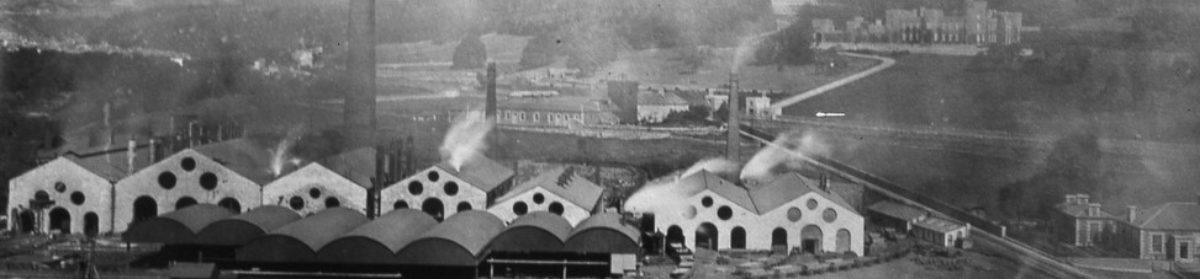


 This old 1806 George III half-penny was found in the ruins of the old Penydarren Ironworks’ blast furnaces in 1969.