Anthony Bacon MP (1717-1786)

Following on from the last article, I am pleased to announce the publication of another new book.

Local historians Wilf and Mary Owen have written an excellent account of the life of Anthony Bacon, founder of the Cyfarthfa Ironworks which has now been published.

The book is priced at £6.00. If anyone would like a copy, it will be available at Merthyr Central Library and at Cyfarthfa Museum and Art Gallery, or please get in touch via the e-mail – merthyr.history@gmail.com and I will pass on any orders.

Rosser Beynon 

Here is an article about a very important, but largely forgotten man in Merthyr’s musical history – Rosser Beynon.

Rosser Beynon was born in Glyn Neath in 1811, the oldest child of John and Elizabeth Beynon. In 1815 the Beynon family moved to Merthyr Tydfil where John Beynon secured a job at the Cyfarthfa Ironworks. Upon moving to Merthyr the family became members of Zoar Chapel.

Rosser Beynon began working at the Ironworks at the age of eight, but he also began attending a school conducted by a Mr MacFarlane. As well as this he also began teaching himself music and it was in this field he immersed himself and it is said that he would lose many hours of sleep trying to master some musical problem.

At the age of 18, Beynon was given the responsibility of training the choir at Zoar Chapel, and he remained in this position until he was given sole responsibility for conducting the choir in 1835. In about 1840, he began giving music lessons in his house in Bethesda Street, and his reputation was such that he was asked to travel all over South Wales to give lessons. In addition, he was invited all over Wales to adjudicate competitions for compositions of hymns and anthems, and became the musical editor of ‘Y Diwygiwr’, the monthly periodical produced by the Independent Union of South Wales. Between 1845 and 1848 he published ‘Telyn Seion’ a collection of hymns and anthems by many prominent composers.

In 1850, Rosser Beynon was among the 58 people who left Zoar to move to Ynysgau Chapel to bolster the congregation at the latter chapel following the crisis associated with the decline of Rev T B Evans. Upon arrival at Ynysgau, he immediately took over the leadership of the choir and remained in charge of the choir until 1872.

Throughout his adult life, Rosser Beynon continued to work as a miner in the Dowlais Pits and In December 1875, while supervising repairs in the mine, he contracted a cold which subsequently developed into bronchitis and pleurisy. Rosser Beynon died on 3 January 1876 at the age of 65. He was buried in Cefn Coed Cemetery and the inscription on his tomb reads:

Er Coffadwriaeth am
Rosser Beynon (Asaph Glan Taf), Merthyr Tydfil
A fu farw Ionawr 3ydd, 1876,
Yn 65 mlwydd oed.
Yma yn isel mae un o weision
Miswig a’i mawredd y’mysg y meirwon;
Canad dirwest, ac athraw cantorion;
Hunodd un Ngwalia dan nawdd angelion,
Ac yn Iesu cysga’i noson – a’i ffydd
Roes aur-obenydd i Rosser Beynon

Merthyr Tydfil Historical Society

The Merthyr Tydfil Historical Society is pleased to announce details of forthcoming lectures.

Monday 2 September 2019
The Rev Maber and Merthyr’s Glebelands
Barrie Jones

Monday 7 October 2019
Anthony Bacon (1717-1786) ‘A Man of Foresight’
Founder of Cyfarthfa Ironworks
Mary Owen

Monday 4 November 2019
Some Aspects of Early Nineteenth Century Housing in Merthyr Tydfil
Clive Thomas

Monday 2 December 2019
Evan Roberts the Evangelist
David Pike

Meetings are held at Canolfan Soar at 7.00pm
Membership – £10 per annum
Non members – £2 per lecture

ALL ARE WELCOME

Merthyr Regatta

The short article transcribed below appeared in The Cardiff Times 150 years ago today (3 July 1869). It is yet another example of the vibrant and varied events that marked the social calendar of Merthyr in years gone by.

The Merthyr Tydfil Boating Club regatta came off at Dolygaer Lake on Thursday, last week. The weather was very auspicious, it being bright, sunny, and warm, and convenient arrangements having been made for the running of trains on the Brecon and Merthyr Railway, there was a vast concourse of people at the lake early in the day. Trains were also run from Brecon, Cardiff, and Newport, and altogether it was calculated that there were about 8000 present.

The boat racing commenced about two o’clock, and while it lasted it created considerable excitement. The programme, however, which had been prepared for the occasion, was little more than half carried out. Even after the first race, which was easily won by the Hirwain crew, the zest of the competitors seemed to have been completely extinguished. The only spirited race afterwards was that in which a crew of Cyfarthfa mechanics and the Manship Bros., of Newport, had such and excitingly tight pull, that the former won by an almost imperceptible difference only. The regatta was not, for some reasons, attended with the success which has marked it occasion on former years.

Photo courtesy of http://www.alangeorge.co.uk/index.htm

Merthyr’s Ironmasters: Richard Crawshay

Courtesy of Cyfarthfa Castle Museum & Art Gallery

Richard Crawshay was born in 1739 in Normanton in the West Riding of Yorkshire, the first child of William Crawshay (1713–1766), a farmer, and his wife, Elizabeth (1714–1774), née Nicholson. He had three sisters. According to family tradition a bitter quarrel with his father led to the sixteen-year-old Crawshay setting out for London.

Initially starting work aged 16, he was apprenticed to a Mr Bickleworth of York Yard, Thames Street, selling flat irons in an iron warehouse, he eventually became, on Bickleworth’s retirement in 1763, sole proprietor of the business, and by the 1770s he had established himself as one of London’s leading iron merchants.

He married Mary Bourne in 1763 and they had a son William and three daughters, Anne, Elizabeth and Charlotte. Charlotte married Benjamin Hall, and became the mother of Benjamin Hall, 1st Baron Llanover.

By 1775, he was acting as the agent for Anthony Bacon, owner of Cyfarthfa Ironworks, for supplying iron cannon to the Board of Ordnance, and in 1777 he became a partner in the business. In 1786, following the death of Anthony Bacon, he took over the whole Cyfarthfa Ironworks, in partnership with William Stevens (a London merchant) and James Cockshutt. In May 1787 he took out a licence from Henry Cort for his puddling process, but the rolling mill needed was not completed until 1789. He solved the problems of the puddling process by using an iron plate for the furnace ceiling and sea-washed sand for the floor. In 1791 he terminated the partnership, which had made little profit. He continued the business alone, and had two blast furnaces, eight puddling furnaces, three melting fineries, three balling furnaces, and a rolling mill in 1794. A blast furnace was built by 1796, and a fourth in 1796. There were six by 1810. He thus developed Cyfarthfa into one of the most important ironworks in South Wales.

The Cyfarthfa Ironworks in the late 1700’s by William Pamplin – Richard Crawshay’s gardener. Courtesy of Cyfarthfa Castle Museum & Art Gallery

Crawshay was very ambitious and imperious in manner, being called ‘The Tyrant’ by some, but was without social pretension. He was active in protecting the interests of the iron trade and was a major promoter of the Glamorganshire Canal which immensely improved transport of iron to Cardiff docks.

In 1804 Samuel Homfray the proprietor of the Penydarren Ironworks made a wager with Richard Crawshay of 500 guineas that Richard Trevithick’s steam locomotive could haul 10 tons of iron along the Merthyr Tramroad from Penydarren to Abercynon. Crawshay lost the bet when Trevithick’s became the first to haul wagons along a “smooth” iron road using adhesive weight alone.

At his death in 1810, Crawshay’s estate was worth £1.5 million. In his will he left three-eighths of the Ironworks to his son William Crawshay, three-eighths to his son-in-law Benjamin Hall and two-eighths to his nephew Joseph Bailey.

St Tydfil’s Church Memorial Windows

The article transcribed below appeared in the Cardiff Times 120 years ago today (13 May 1899).

MERTHYR PARISH CHURCH

Memorial Windows

On Sunday afternoon the dedication of five stained glass memorial windows which have been placed in the restored parish church of Merthyr took place at a service conducted by the rector (Rev. Di. Lewis).

The west window in the tower was given by Sir W. T. Lewis, Bart., in memory of the local “captains of industry”; the south aisle window was presented by Mr and Mrs Frank James, in memory of the late Miss Florence James, their daughter, and the three chancel windows were the gifts of Miss Williams, Maesgruddiad, and Mrs Brewer, Danygraig, Mon.

In the chancel, which is of an apsidal form, and the roof of which is groined, the lancets are about nine feet high, in the three central lancets are, placed three stained glass memorial windows by the well-known artist, Mr Kempe, London. The subjects are the Crucifixion. The central window is divided into three panels above is a canopy of peals of bells ringing, whilst the central panel depicts Our Lord on the Cross, the lower of the panels showing a pelican which is represented according to the old myth as feeding its young with its own blood by picking its breast, this being meant as emblematical of the Blessed Sacrament of the altar. The right hand window has a canopy with bells ringing, the second panel is that of the Blessed Virgin at the Cross, and the third or lowest panel has an angel holding a shield on which are painted some of the instruments of the Passion.

The left hand window has also a similar canopy of bells, the central panel depicting St. John at the foot of the Cross. In the third panel there is an angel holding a shield, on which again are painted the other instruments of the Passion. In these three panels there are scrolls with suitable texts in Latin from Holy Scripture. The windows present a very pleasing appearance, and are regarded as a very becoming decoration of the sanctuary. They were given by Miss Williams and Mrs Brewer, in memory of some of the members of the Maesgruddiad family.

In the south aisle is a handsome window divided into three panels. In the central panel is depicted St. Cecilia playing on an instrument of music. This window has beautiful Romanesque decorations. It was presented by Mr and Mrs Frank James. The next window in the tower was given by Sir W. T. Lewis, Bart., and is considered to be a very interesting work of art. It was designed by Mr Newbury, London. It incorporates subjects characteristic of the industries of the district, and is in that respect a bold departure from the conventional treatment of subjects in memorial glass. It is mainly the conception of the rector, but it appears there are ancient examples of such treatment.

The stained glass window is divided into three panels formed by a light framing of Norman detail. The upper panel, which comprises the main portion of the window, illustrates Luke ii. 1-4, where Jesus teaches the disciples to pray, and has two angels above holding a scroll on which is written the first portion of the Lord’s Prayer, and on the panel below the picture continues, Give us this day our daily bread.”

The smaller panels, which form a base to the window, are filled with subjects relating to the industries of the district. The left panel indicates a pit’s mouth with machinery, on which is inscribed “The thing that is hid bringeth He forth to light”, and on the right blast furnaces are illustrated – “As for the earth, out of it cometh bread” – and underneath the wharfing and loading of coal and iron are depicted. These two panels are decoratively treated, and it has been the artist’s endeavour to combine the many interesting details as the space permits. At the sill of the window are the arms of the donor, Sir Wm. T. Lewis, Bart. Underneath is a handsome brass plate three feet square, on which are engraved the names of 37 of the “captains of industry”.


The inscription reads as follows:-

“Efe a gyffwrdd a’r mynyddoedd a hwy a fygant”

Psalm 104, v. 32.

The above Window is erected to the Glory of God and to perpetuate the memory of the following

“CAPTAINS OF INDUSTRY”

with whom Sir William Thomas Lewis, Bart., has been associated in the development of the Minerals of the District, i.e.:-

William Adams, Ebbw Vale Works.
George Brown, Nixon’s Collieries.
Crawshay Bailey, Nantyglo and Aberaman.
William Southern Clark, Aberdare.
The Crawshays of Cyfarthfa and Hirwain Works.
Tom Cumow, Plymouth Works.
The Davises of Blaengwar.
William Davies, Lewis Merthyr Collieries.
Sir George Elliot, Bart., Aberaman.
The Evanses of Dowlais.
The Formans of Penydarren Works.
Anthony Hill, Plymouth Works.
Thomas Howells, Lletty Shenkin Collieries.
Christopher James, Llwyncelyn, Rhondda.
William Jenkins, Consett (formerly Dowlais).
R Johnson, Rhymney.
William Jones, Cyfarthfa Works.
The Josephs, Plymouth Works.
The Kirkhouses, Cyfarthfa Works.
Lewis Lewis, The Graig and Lletty Shenkin Colllieries.
Lewis Thomas Lewis, Plymouth Collieries.
Lewis Thomas Lewis, Cadoxton Lodge, Neath.
The Llewelyns of Hirwain and Pontypool.
The Martins of Dowlais and Penydarren Works.
William Menelaus, Dowlais.
John McConnochie, Cardiff.
Captain Ralph Pomeroy, Cardiff.
Robert T. Rees, the Graig and Lletty Shenkin Collieries.
Daniel Rees, the Graig and Lletty Shenkin Collieries.
The Thomases of Waunwyllt.
The Waynes, Gadlys Works.
David Williams, Ynyscynon.
Edward Williams, Middlesbrough (formerly Dowlais).
John Williams, Lletty Shenkin Collieries.
William Williams, Cyfarthfa Works.
W.H. Williams, Lewis Merthyr Collieries.
George Wilkinson, Cwmpennar Collieries.

Reddwch i’w Llwch.

Diolchus Anrheg Syr William Thomas Lewis.

Barwnig, Mardy, Aberdar, 1896.

At the service an address was delivered by the Rector, who described the windows and adverted briefly to the subject of memorials in churches historically regarded. He referred also to the list of persons whose names were in the list of “Captains of industry” as pioneers of the trade of the district. Many of them risked all they had in their enterprises, and some of them lost all they had. He mentioned various improvements yet to be made before the parish church would be comfortably equipped, and announced that the offertory would be in aid of a fund for providing seats.
Merthyr’s Bridges: The Iron Bridge

In our series looking at the bridges of Merthyr, we come to Merthyr’s most iconic bridge, and indeed one of Merthyr’s most iconic lost structures – the Old Iron Bridge.

Photo courtesy of the Alan George Archive

The Old Iron Bridge, or the Merthyr Bridge as it was originally called was commissioned by William Crawshay to replace a stone bridge that had been washed away by a flood. This act was not entirely altruistic on the part of Crawshay, as the only other bridge across the River Taff in town was Jackson’s Bridge, which had been built in 1793 by the Dowlais Iron Company.

Watkin George, the principal engineer at the Cyfarthfa Works was tasked with designing the new bridge, and he conceived a structure fabricated with cast iron sections. To span the River Taff, George had to design a bridge that would span between 65 to 70 feet from bank to bank, so single cast iron beams would be impractical, as they were limited to 20-25 feet in length due to the possibility of the iron failing due to the continuous traffic that would use the bridge.

He decided, therefore to build a structure comprising three separate sections between 22 and 24 feet long, the thickness of the iron being one and a quarter inches, and he constructed the bridge as a cantilever, with the two end sections mounted on buttresses built on the banks of the river with a convex central section fixed between them.

Work started on the bridge in the middle of 1799, and was completed by April the following year. The new bridge had an overall length of 64 feet, and was five feet wide.

The bridge was in constant use as the only bridge in the centre of Merthyr until a new bridge – the Ynysgau Bridge, also called the New Iron Bridge, was built next to it in 1880.

Ynysgau Bridge with the Old Iron Bridge behind it. Photo courtesy of http://www.alangeorge.co.uk/index.htm

The amount of traffic using the bridge can be illustrated in the table below (originally from Merthyr Historian Vol 2, used with the kind permission of The Merthyr Historical Society). Following construction of the new bridge, The Old Iron Bridge was used primarily as a footbridge.

Courtesy of the Merthyr Tydfil Historical Society

In 1963, the bridge was dismantled as part of the refurbishment and ‘improvement’ of Merthyr. The remains of the bridge – indeed the vast majority of it, now lie gathering dust in a warehouse in Merthyr, and all attempts by local historical groups to have the bridge re-erected somewhere in the town (it can’t be re-erected in its former position as the river has been widened), have failed.

One of the most iconic views of old Merthyr – the Old Iron Bridge with Ynysgau Chapel. Photo courtesy of http://www.alangeorge.co.uk/index.htm

To read a fuller account of the history of the Old Iron Bridge, try to get hold of a copy of Volume 2 of the Merthyr Historian where you will find a marvellous article about the bridge by Leo Davies.

Merthyr’s Ironmasters: The Hill Family

Richard Hill I (died 1806), who had had experience in Anthony Bacon’s iron-works (at Cyfarthfa and Hirwaun), became Bacon’s trusted manager of the Plymouth Ironworks. He was elected a burgess or freeman of Cardiff in 1784. He married Mary, the sister of Mrs. Bacon, and named his youngest son (born in 1784) Anthony, after Anthony Bacon. On the death of Anthony Bacon, as all the natural children were minors, the estate was placed in Chancery, and the receiver, William Bacon, granted a lease of the Plymouth furnace for fifteen and a half years from Christmas Day 1786, to Richard Hill I, during the minority of Thomas Bacon; this was approved by the Court of Chancery. Hill entered into an arrangement with Richard Crawshay of Cyfarthfa, to supply the latter with pig-iron, and seeing the possibility of increasing his output and of enlarging his works, he secured several leases in order to extend the mineral property attached to the works. About 1794, Richard Hill I had very serious trouble with the Glamorganshire Canal Navigation, then recently opened, for improperly taking the water from the Taff river which he required for his Plymouth works. Richard Hill II (died 1844), his son, then aged twenty, closed the sluices between the canal and the mill-race, and had a desperate encounter with the canal lock-keeper, as a result of which the lock-keeper was awarded substantial damages at the Glamorgan Great Sessions. At the next Great Sessions, Richard Hill I obtained a verdict in his favour and was awarded £300 damages for injury to his works by the Glamorganshire Canal.

In 1799, Thomas Bacon, who had been granted the Plymouth works under his father’s will, became of age, and agreed to surrender to Richard Hill I all his interest in the Plymouth works, and this he confirmed in 1803 when he was 24 years of age. Being now in full possession of the Plymouth works, he with his sons, Richard II and John Hill, entered into an agreement with the Dowlais and Penydarren iron companies for the construction of a tram road for their joint use, from their works to join the Glamorganshire canal at Navigation (now Abercynon). In the same year, 1803, Richard Hill I, who was a practical engineer, agreed to construct a tram road for the joint use of the same three companies to convey limestone from the Morlais Castle quarries. It will thus be seen that Richard Hill was on very good terms with the neighbouring ironmasters, which was far from being the case between the Penydarren and Dowlais companies.

Richard Hill and son were anxious to improve their business by adding a forge and mills, but were very short of capital for such extension. Partners were sought, and A. Struttle advanced £15,000 and John Nathaniel Miers (son-in-law of Richard Hill I), £5,000 to form the Plymouth Forge Company with a capital of £20,000. Work now proceeded briskly at the Plymouth iron-works where Richard Hill I was ably assisted by his sons, Richard II and Anthony Hill (1784 – 1862). But on 20 April 1806, Richard Hill I passed away leaving all his estate to his widow, Mary, his three sons, Richard II, John Hill (of London), and Anthony Hill, and his two daughters, Elizabeth, and Mary, the wife of J. N. Miers (of Cadoxton Lodge). By 1813, Messrs. Struttle and Miers seceded, and the three brothers became partners. On account of the withdrawal of capital, the brothers had to obtain a loan on mortgage of £54,000 from Messrs. Wilkins of the Brecon Old Bank. Richard Hill II for a time lived at Llandaff and looked after the sales side of the business, while Anthony ably managed the productive side, but the burden of the huge loan was a great impediment for many years to the successful working of the concern.

In 1806, the three furnaces at Plymouth produced 3,952 tons of pig-iron, while in 1815 the same three turned out 7,800 tons. A fourth furnace was erected at Plymouth and in 1819 the first furnace was erected at Dyffryn and c. 1824 two others were erected; like all the others these were worked by water-power in which Anthony had great faith — he was very slow in adopting steam-power as the other iron-masters were doing. With Anthony Hill as managing-partner the works were carried on with great vigour and ability, and their brand of bar-iron had a special value and was known for its excellence throughout the world. The produce of the blast furnaces continued to increase year by year. In 1820, it was 7,941 tons, in 1830, over 12,000 tons, by 1846, it was over 35,000 tons.

In 1826 John Hill sold out his interest to his brothers, Richard II and Anthony. Later, No. 8 furnace was built, which was said by Mushet, the great authority on iron manufacture, to be the largest in the world. Richard and Anthony continued as sole managers until the death of Richard in 1844, after which Anthony continued as sole managing director until his own death at the age of seventy-eight on 2 August 1862. Anthony Hill was regarded as the most scientific iron-master of his district. He carried out many experiments for the improvement of iron-making, and was the patentee of many new methods. Gradually he succeeded in paying off the loan burden and attained great wealth. His death was keenly felt in the district, as he had been ‘associated with good deeds, with broad and enlightened measures for his people’s comfort, for their religious welfare, and their education.’ He established a new church at Pentre-bach, and endowed it with £200 per annum; he also founded the Pentre-bach National School and left a sum of money for the ‘Anthony Hill scholarship’ for secondary schools which is still in existence. After his death the works were sold to Messrs. Fothergill, Hankey and Bateman for £250,000; they came to an end c. 1880.

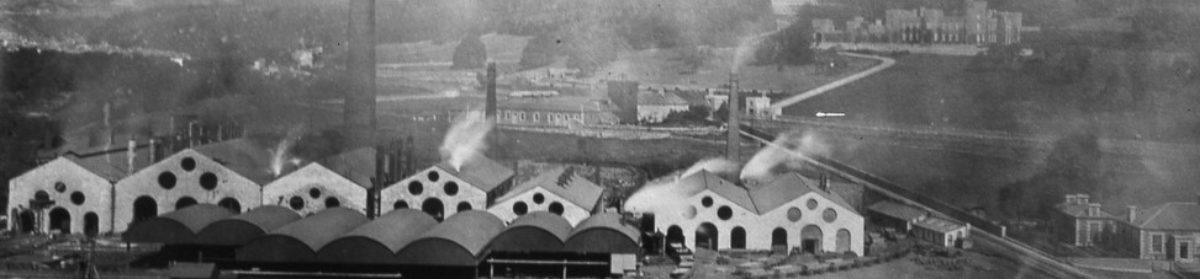
The remains of the Plymouth Ironworks. Photo courtesy of http://www.alangeorge.co.uk/index.htm

Many thanks to the Dictionary of Welsh Biography for allowing me to reproduce this article. To view the original, please follow this link –  https://biography.wales/article/s-HILL-PLY-1786

Merthyr: Then and Now

In the latest post in our ongoing series we have a couple of photographs of the area just outside the gates of St Tydfil’s Church.

In the first photograph, taken in the early 1900’s we can clearly see the famous Star Inn, where Admiral Lord Nelson and Lady Hamilton stayed when they visited Cyfarthfa Works in 1800.

Photo courtesy of http://www.alangeorge.co.uk/index.htm

The second photograph, taken in 2012, shows the area completely changed.

That’s progress for you – an important part of Merthyr’s history replaced by an advertising hoarding.

The Decline of Merthyr

In 1859, the Penydarren Ironworks closed. 160 years ago today (26 February 1859), the remarkable article transcribed below, written in anticipation of the closure appeared in the Merthyr Telegraph. It makes fascinating reading as the language used is so striking and almost poetic…a far cry from today’s brand of journalism.

Over the thresholds of a thousand houses stream the long and darkening shadows which forerun events of a stern and saddening character. In a few months that fierce light which so long has glared around Penydarren will be invisible, and the incessant clang of iron and harsh vibrations of monster machinery will no longer be heard. Penydarren works will belong to the past.

For several weeks the inhabitants of this town and neighbourhood heard of the rumoured sale of Penydarren works with incredulity. They could not believe that so great an establishment would be broken up, the works fall into decay, and the men scattered to the four winds of heaven. Yet, at last, the dread truth has forced itself upon our convictions, and we now doubt not that the end of Penydarren is at hand.

The Dowlais Iron Co., holding large works on the extreme edge of the mineral basin, have been for some time progressing with less than its usual vigour in consequence of a deficient supply of mine and coal. It is true new pits have been sunk at Cwmbargoed, but it will be two or three years before they will begin to yield, the enormous depth forbidding any earlier success, though the men are incessantly employed. Thus it became a serious consideration with the Trustees, where, and by what means, the requisite supply should be obtained from to meet the demand. The adjoining mine and coal field of the Penydarren Co. and the known desire of Mr. W. Forman to part with it, offered a solution of the difficulty, and hence, after a consultation and discussion by the principals of each place, one has been merged into the other, and Dowlais has become worthier even than before of being styled the largest iron-works in the world.

We may anticipate that on the opening of the new mill – a mill unequalled in the locality, a large number of additional workmen will be employed; the miners and colliers also may be expected to continue working as usual; but, we apprehend, there will still be many unemployed, and the change will tend to deteriorate the value of house property considerably in Penydarren, and the upper part of Merthyr, from Pontmorlais to Tydfil’s Well. There can be no doubt but that there will be much suffering in one way or another. Young men, full of vigour, may try their fortunes elsewhere broad shoulders and muscular arms will never fail to obtain their owners bread and cheese, but the old men, the semi-pensioners, the half used up veterans, cannot be expected to seek a subsistence in other districts, cannot be expected but to crawl, feeble worn-out beings, into the last resort of humble life – the Workhouse.

In addition to this, the first step towards a decline, we see evidences around us of a gloomy character. The lease of the Dowlais works is said to last only during the minority of the Marquis of Bute. When he comes of age a new lease, under new and perhaps impossible conditions, may be required.

It is also rumoured, on what authority we know not, that the Plymouth iron-works are for sale, and no one, acquainted with Mr. Hill, will hear this without fearing that the change of ownership, by whomsoever made, cannot be for the benefit of the workmen. No matter how good the next employer may be, new brooms have a tendency to sweep clean, and brush away old and good usages, pensions, perquisites and benefits to an alarming extent.

Again, at the Cyfarthfa works things wear an alarming aspect. The lease is yet unsettled. Mr. Crawshay has stated the sum he will give, and we all know that he will abide by his word, and blow out the whole of the furnaces rather than yield. And let us add that were Mr. Crawshay, unfortunately for us all, to be succeeded by another, we might find the system of iron-making on the hills introduced into Cyfarthfa, with its attendant Truck shops, which, God forbid for the sake of poor humanity! To this Truck the Crawshays have ever been firm opponents, much to their honour and the welfare of the town.

All these shadows warn us to be prepared for coming evils – to be on the alert towards lessening the trials of disastrous times – to prepare our several homes against the menacing storm.

Merthyr is a town called into existence by the discovery of the minerals underneath. With their exhaustion it fades as rapidly as it rose.

In these facts we trace the presages of decline. The tree which resists the skill of the gardener may exist for a time, unimproving, unprogressive, but when the storm comes the resistance is but weak, and beneath the tempest it falls!